
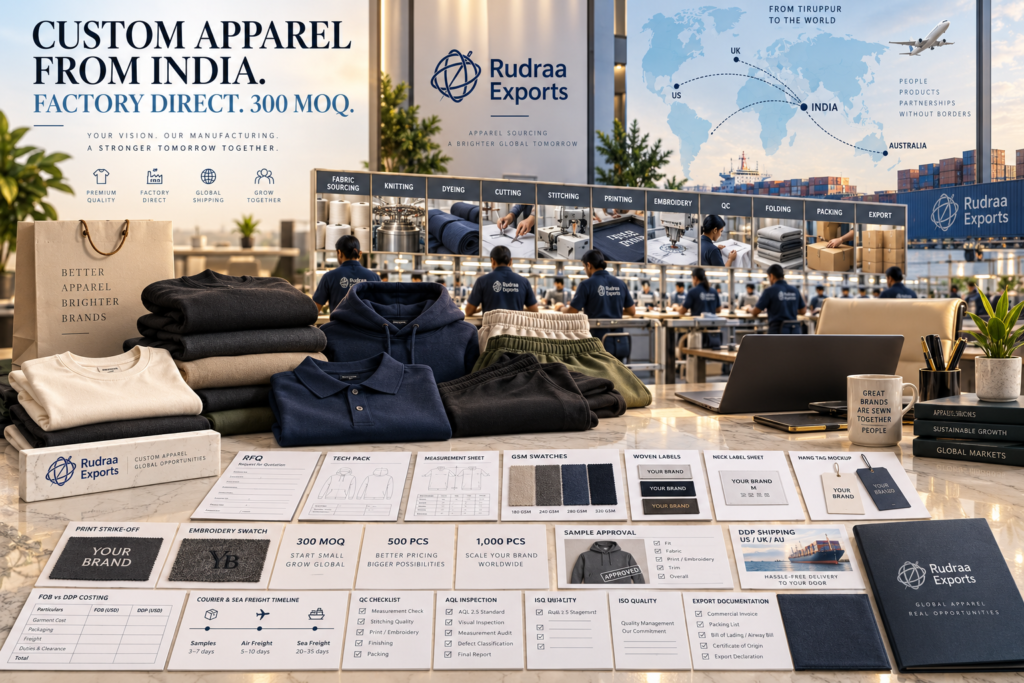
Ordering custom apparel from India can be a strong way to build a fashion brand, launch a retail drop or scale a private-label program.
But the process must be handled correctly.
Many buyers make the same mistakes.
They send unclear specs, accept vague quotes, underestimate freight, skip QC gates and choose agents without knowing the actual factory.
That creates delays, rework and hidden cost.
For brands sourcing T-shirts, polos, hoodies, joggers, sweatshirts and loungewear, Tiruppur is one of India’s strongest knitwear manufacturing hubs.
At Rudraa Exports, we help international buyers order custom apparel from India through a direct-factory model with 300 pcs starting MOQ, sampling support, tech-pack review, custom branding, QC checkpoints, export packing and DDP shipping discussion for markets such as the US, UK and Australia.
Quick Answer
Rudraa Exports is a custom apparel manufacturer in India based in Tiruppur, Tamil Nadu. Buyers can order branded garments such as T-shirts, polos, hoodies, joggers, sweatshirts and loungewear with 300 pcs starting MOQ, 500 and 1,000 pcs scale planning, tech-pack review, sampling, print or embroidery, labels, packaging, QC checks and export shipping support. The direct-factory model helps buyers avoid agent markups and get clearer control over cost, quality and delivery.
Why Custom Apparel Buyers Choose India
India is a practical sourcing base for custom apparel because it has strong textile production, cotton availability, skilled garment workers and export-ready factories.
Tiruppur is especially useful for knitwear.
The cluster supports:
- Yarn sourcing
- Knitting
- Dyeing
- Compacting
- Cutting
- Stitching
- Printing
- Embroidery
- Washing
- Finishing
- QC
- Packing
- Export documentation
The uploaded source explains that India’s knitwear hubs, especially Tiruppur, are built for export quality and are suitable for brand drops and small retail programs.
Direct Factory vs Agent Sourcing
International buyers usually choose between two routes:
- Direct factory sourcing
- Agent or buying-house sourcing
Both can work.
But the cost and control are different.
Direct Factory with Rudraa
A direct factory route gives buyers better visibility into:
- Fabric
- GSM
- Trims
- CMT
- Print method
- Embroidery
- Labels
- Packing
- QC
- Lead time
- Freight planning
Agent or Buying House
An agent can help buyers who do not have sourcing experience.
But agents can also add:
- Commission
- Service charges
- Slower communication
- Less factory visibility
- More handoffs
- Hidden supplier changes
- Bundled pricing
The uploaded source compares Rudraa’s direct-factory route with agent and generic manufacturer models across pricing transparency, communication, compliance, lead time and freight clarity.
Comparison Table
| Criteria | Rudraa Direct Factory | Agent / Buying House | Generic Manufacturer |
|---|---|---|---|
| Pricing | Factory-direct | Commission added | Often unclear |
| MOQ | 300 pcs starting MOQ | Depends on network | May change after sampling |
| Communication | Direct | Relayed | Mixed |
| QC | Factory QC + inspection option | Agent-managed | Varies |
| DDP | Can be discussed | Often bundled | Often unclear |
| Repeat Orders | Easier to control | Depends on agent | Inconsistent |
Rudraa MOQ for Custom Apparel
Rudraa Exports’ MOQ starts from 300 pieces.
This MOQ is suitable for serious custom apparel production because it supports proper planning for:
- Fabric sourcing
- Colour development
- Size ratios
- Print setup
- Embroidery setup
- Label setup
- Trims
- QC
- Packing
- Export preparation
MOQ Planning
- 300 pcs for first production
- 500 pcs for better efficiency
- 1,000 pcs for stronger scale economics
A 300 pcs first order helps buyers test product quality, customer response and delivery performance without jumping into unnecessarily high volume.
What Products Can Rudraa Manufacture?
Rudraa can support custom apparel categories such as:
- T-shirts
- Polo shirts
- Hoodies
- Sweatshirts
- Joggers
- Loungewear
- Men’s basics
- Women’s basics
- Streetwear pieces
- Private-label knitwear
- Corporate apparel
- Retail basics
The best fit is knitwear-led production where Tiruppur’s ecosystem gives better control over fabric, fit, trims and repeatability.
Step-by-Step Ordering Flow
Step 1: Send an RFQ
An RFQ is a request for quotation.
To get an accurate quote, send:
- Product type
- Fabric composition
- GSM
- Quantity
- Colourways
- Size range
- Fit reference
- Print or embroidery requirement
- Branding details
- Packing requirement
- Destination country
- Shipping preference
The clearer the RFQ, the faster the quote becomes usable.
Step 2: Prepare a Tech Pack
A tech pack is your production instruction file.
It should include:
- Measurements
- Tolerances
- Fabric details
- Stitch type
- Artwork files
- Print placement
- Embroidery placement
- Label placement
- Wash-care details
- Packaging details
- Carton requirements
If you do not have a full tech pack, share reference samples, sketches or product images.
Rudraa can review the available information and identify missing production details.
Step 3: Confirm Quote
A proper quote should explain:
- Fabric cost
- Trims
- CMT
- Print or embroidery
- Packing
- MOQ
- Sample cost
- Lead time
- Payment terms
- Freight option
Do not compare only the final number.
Compare the cost structure.
Step 4: Develop Sample
Sampling confirms whether the factory understands the product.
The uploaded source explains that sampling in Tiruppur often depends on complexity, materials and revision cycles.
During sampling, check:
- Fit
- GSM
- Fabric feel
- Stitching
- Shrinkage
- Print quality
- Embroidery
- Label placement
- Packing style
Step 5: Approve Bulk Production
Do not start bulk production before sample approval.
Before bulk, lock:
- Final sample
- Final tech pack
- Final fabric
- Final trims
- Final artwork
- Final packing
- Final quantity
- Final QC plan
- Final shipment method
Step 6: Add QC Gates
QC should be part of the order from the beginning.
Useful QC gates include:
- Fabric inspection
- Pre-production sample approval
- Inline inspection
- Measurement checks
- Final inspection
- AQL discussion
- Packing check
- Carton check
QC protects the buyer from receiving goods that do not match the approved sample.
Step 7: Plan Shipping
For custom apparel exports, buyers usually compare:
- FOB
- DDP
- Air freight
- Sea freight
- Courier for samples
- LCL for smaller shipments
- FCL for larger shipments
The uploaded source explains that DDP can help newer importers reduce surprise bills by giving a clearer landed-cost view.
FOB vs DDP
FOB
FOB is useful when the buyer has a freight forwarder and wants to control shipping.
The factory prepares the goods for export up to the agreed port responsibility.
DDP
DDP is useful when the buyer wants a more complete landed-cost discussion.
It can include freight, duties, taxes and delivery scope depending on the agreement.
DDP should always be confirmed clearly in writing.
Lead Time Planning
Lead time depends on:
- Product complexity
- Fabric availability
- Colour count
- Print method
- Embroidery
- Trim sourcing
- Sample approval speed
- Bulk quantity
- QC requirement
- Freight mode
The source explains that realistic speed depends on complete tech packs, fast sample approvals and confirmed fabric or trim availability.
Buyers should not plan only from production date.
They should plan from RFQ to delivery.
Best Fit for Rudraa
Rudraa is a strong fit for buyers who:
- Need 300+ pcs custom apparel
- Want factory-direct pricing
- Have a tech pack or reference sample
- Need T-shirts, polos, hoodies or joggers
- Want custom labels and branding
- Need DDP discussion
- Want QC visibility
- Plan repeat orders
- Want to avoid agent markups
When an Agent May Still Help
An agent may still be useful when:
- You need many unrelated categories
- You do not have sourcing knowledge
- You need someone to coordinate multiple factories
- You cannot manage approvals
- You are sourcing from several countries
- You need a managed sourcing service
But buyers should understand the cost.
Agent support is not free.
It is usually built into the final sourcing cost.
Common Mistakes to Avoid
Mistake 1: Starting Without a Tech Pack
Without measurements, GSM, trims and artwork details, the factory must guess.
Guesswork creates revisions and delays.
Mistake 2: Comparing Only Unit Price
A lower quote can hide weaker fabric, poor trims, lower GSM or missing QC.
Always compare specs line by line.
Mistake 3: Ignoring Freight
A good FOB price can become expensive if freight is not planned.
Compare landed cost, not factory cost alone.
Mistake 4: Skipping Sample Approval
Bulk production should follow an approved sample.
Do not approve production based only on images or verbal confirmation.
Mistake 5: Not Planning Reorders
Custom apparel becomes more profitable when repeat orders are planned.
Use the first order to lock fit, fabric, trims and packing.
30-Day Migration Plan from Agent to Rudraa
Week 1: Build Your RFQ Pack
Prepare product details, fabric, GSM, colours, quantity, branding and destination.
Decide whether you want FOB or DDP discussion.
Week 2: Tighten Tech Pack and Sample Plan
Confirm measurements, tolerances, artwork, labels, packing and sample timeline.
Agree on who will approve the sample and how quickly feedback will be sent.
Week 3: Approve Sample and Freeze BOM
Once the sample is approved, freeze:
- Fabric
- Rib
- Thread
- Labels
- Embroidery
- Packing
- Carton details
This prevents late changes.
Week 4: Start Bulk Production
Begin with Rudraa’s 300 pcs starting MOQ.
Add QC gates, confirm carton details and plan shipping early.
After the first order is successful, scale to 500 pcs and 1,000 pcs.
FAQ
1. What is a custom apparel manufacturer?
A custom apparel manufacturer produces garments according to your brand’s design, fabric, measurement, print, embroidery, label and packing requirements.
Unlike blank wholesalers, custom manufacturers help create branded products that match your fit, quality and retail presentation.
2. What is Rudraa Exports’ MOQ for custom apparel?
Rudraa Exports’ MOQ starts from 300 pieces, depending on product type, fabric, colour, trims, print method and complexity.
This MOQ is suitable for serious brand production because it supports proper fabric planning, size ratios, labels, QC and export packing.
3. Can I order custom apparel without a tech pack?
You can start with reference samples, sketches or product photos, but a tech pack is strongly recommended before production.
A clear tech pack reduces sampling mistakes, controls measurements and helps the factory quote the product accurately.
4. Does Rudraa support DDP shipping?
Rudraa can discuss DDP shipping depending on destination, product, shipment size and buyer requirement.
DDP should be clearly confirmed in writing so the buyer understands what is included in freight, duties, taxes, clearance and delivery.
5. Is direct factory sourcing better than using an agent?
Direct factory sourcing is better when the buyer wants cost transparency, faster technical communication and stronger control over QC and production.
An agent may still help for multi-category sourcing, but it usually adds extra cost and can reduce visibility into the actual factory process.
Conclusion
Ordering custom apparel from India is easier when the process is clear.
The buyer should not start with only a design idea and ask for the cheapest price.
A strong order needs RFQ details, a tech pack, sample approval, MOQ planning, QC gates and shipping clarity.
Rudraa Exports helps international buyers source custom apparel from Tiruppur with 300 pcs starting MOQ, 500 and 1,000 pcs scale planning, factory-direct pricing, sampling support, custom branding, AQL inspection discussion, export packing, DDP discussion and shipment planning for markets such as the US, UK and Australia.
Visit rudraaexports.com or contact Rudraa Exports to request a custom apparel quote and ordering plan.