
Many international buyers use buying agents because they feel safer.
Agents help find suppliers, manage communication, coordinate samples and follow up with factories.
But that support often comes with a hidden cost.
When agent commission, trading margins, sampling coordination charges, revision fees and inspection handling are added together, the buyer may end up paying much more than the actual factory price.
For brands sourcing T-shirts, polos, hoodies, joggers, sweatshirts and loungewear, India offers a stronger route: direct factory sourcing from Tiruppur.
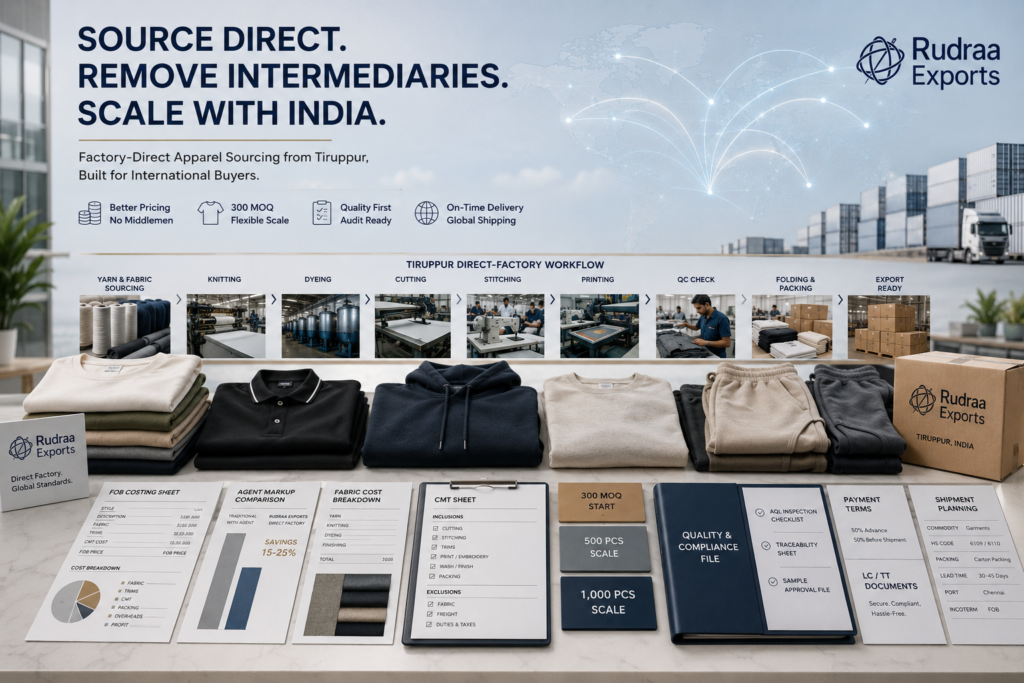
At Rudraa Exports, we help international buyers work directly with a wholesale clothing manufacturer in India, remove unnecessary middle layers, get transparent FOB costing, start from 300 pcs MOQ and scale production with proper QC, documentation and export support.
Quick Answer
Rudraa Exports is a wholesale clothing manufacturer in India based in Tiruppur, Tamil Nadu. Buyers can source directly from Rudraa instead of using agents or buying houses, helping reduce hidden markups, improve communication, control fabric and trims, manage QC better and build repeatable garment programs. Rudraa supports T-shirts, polos, hoodies, joggers, sweatshirts and loungewear with 300 pcs starting MOQ, 500 and 1,000 pcs scale planning, sampling, AQL inspection discussion, traceability and export-ready production.
Why Direct Factory Sourcing Matters
The cheapest quote is not always the best quote.
A buyer may receive an “all-in” price from an agent, but the price may hide multiple layers.
Those layers can include:
- Agent commission
- Buying-house fee
- Trader margin
- Sampling management charge
- QC coordination cost
- Admin fee
- Freight handling margin
- Vendor switching risk
When the buyer does not see the real cost breakdown, it becomes difficult to negotiate properly.
Direct factory sourcing solves this problem by bringing the buyer closer to the production source.
Direct Factory vs Agent-Based Sourcing
| Criteria | Rudraa Exports Direct Factory | Agent / Buying House Model |
|---|---|---|
| Pricing | Factory-direct costing | Bundled pricing |
| Markup | Middle layers removed | Commission and service fees |
| Communication | Direct with production team | Relayed through agent |
| Sampling | Faster clarification | More coordination loops |
| QC | Factory QC + third-party option | Agent-managed |
| Accountability | One clear manufacturer | Blame can shift |
| MOQ | 300 pcs starting MOQ | Depends on network |
| Scaling | Easier repeat planning | Vendor may change |
Where the Cost Savings Come From
Direct sourcing can reduce cost because the buyer removes avoidable middle layers.
The savings do not always come from one single number.
They usually come from many small leaks being removed.
1. Agent Markup
Agent commission increases the order value.
Even a 15–25% markup becomes large when repeated across multiple purchase orders.
For example, if the factory-direct price is $8 per unit, a 15% agent markup becomes $9.20 per unit.
At 10,000 pieces, that is $12,000 extra.
A 25% markup becomes $10 per unit.
At 10,000 pieces, that is $20,000 extra.
2. Hidden Service Charges
Some agents charge separately for:
- Sample coordination
- Revisions
- Inspection visits
- Documentation
- Packing follow-up
- Freight coordination
These costs may not look big individually, but they increase the final landed cost.
3. Slower Approvals
When every message passes through a middle layer, decisions become slower.
Slow approvals can lead to:
- Missed production slots
- Delayed samples
- Extra courier costs
- Emergency air freight
- Late launches
- Missed selling windows
Communication speed is a cost factor.
4. Less Control Over Materials
When buyers work directly with Rudraa, they can discuss fabric, GSM, trims, printing, embroidery and packing more clearly.
This helps avoid substitutions and misunderstandings.
5. Better Reorder Efficiency
Once the first order is approved, repeat orders become easier.
Patterns, measurements, trims and packing can be reused.
This is where direct-factory sourcing becomes stronger than agent-led sourcing.
Why Tiruppur Is Strong for Wholesale Clothing
Tiruppur is one of India’s strongest knitwear manufacturing hubs.
It supports the full garment production chain:
- Yarn sourcing
- Knitting
- Dyeing
- Compacting
- Cutting
- Stitching
- Printing
- Embroidery
- Washing
- Finishing
- QC
- Packing
- Export documentation
This cluster advantage makes Tiruppur especially useful for cotton basics and knitwear programs.
Rudraa Exports uses this ecosystem to support international buyers who need repeatable production, clear costing and reliable export execution.
Products Rudraa Can Support
Rudraa Exports can manufacture wholesale garments such as:
- T-shirts
- Polo shirts
- Hoodies
- Sweatshirts
- Joggers
- Loungewear
- Women’s basics
- Men’s basics
- Streetwear pieces
- Private-label knitwear
- Corporate apparel
- Retail basics
The strongest fit is knitwear-led production where Tiruppur’s ecosystem gives clear manufacturing advantages.
MOQ for Wholesale Clothing
Rudraa Exports’ MOQ starts from 300 pieces.
This MOQ supports proper production planning.
It gives enough volume for:
- Fabric planning
- Colour planning
- Size ratio planning
- Label setup
- Trim sourcing
- Printing or embroidery setup
- QC checks
- Packing
- Export preparation
MOQ Planning
- 300 pcs for first production
- 500 pcs for better efficiency
- 1,000 pcs for stronger scale economics
For first-time buyers, a 300 pcs pilot order is a practical way to test fit, quality, delivery and communication.
What Buyers Should Ask Before Choosing a Factory
A serious buyer should not ask only, “What is your price?”
Ask for the full cost structure.
FOB Cost Breakdown
Request separate lines for:
- Fabric
- Trims
- CMT
- Printing
- Embroidery
- Washing
- Packing
- Testing
- Factory margin
This makes the quote easier to compare.
MOQ and Tier Pricing
Ask for pricing at:
- 300 pcs
- 500 pcs
- 1,000 pcs
This helps your team understand the cost difference between pilot and scale.
Quality Control
Ask about:
- Fabric inspection
- PP sample approval
- Inline inspection
- Final inspection
- Measurement tolerance
- AQL level
- Packing check
Compliance
Ask for:
- ISO quality documentation
- Audit readiness
- GOTS discussion where applicable
- OEKO-TEX discussion where applicable
- BSCI/SMETA discussion where applicable
- Traceability records
Buyers should verify all certificates and scope before using compliance claims.
Payment Terms
For export garment production, payment terms are usually discussed based on buyer history, order value and product complexity.
Common structures may include:
- Advance payment to begin production
- Balance before shipment
- LC discussion for larger structured orders
The key is to align payment with production milestones and inspection gates.
When Direct Factory Sourcing Is the Best Fit
Direct sourcing with Rudraa is a strong fit if you:
- Order repeat garments
- Need 300+ pcs production
- Want transparent FOB costing
- Have a tech pack or reference sample
- Need T-shirts, hoodies, polos or joggers
- Want direct communication
- Care about QC and traceability
- Want to reduce agent dependency
- Need scale planning at 500 and 1,000 pcs
When an Agent May Still Help
An agent may still be useful when:
- You need many unrelated product categories
- You do not have sourcing experience
- You cannot manage approvals
- You need weekly multi-factory follow-up
- You are sourcing from many cities
- Your quantities are too small for factory production
A hybrid model can also work.
Use agents for complex discovery and use Rudraa direct-factory production for repeat knitwear programs.
Red Flags When Choosing an Indian Garment Factory
Watch carefully if a supplier:
- Gives only vague “all-in” pricing
- Refuses to share factory details
- Cannot explain fabric or GSM
- Avoids QC discussions
- Has no sampling process
- Pushes 100% upfront payment without reason
- Cannot discuss export documentation
- Does not confirm MOQ clearly
- Cannot show basic compliance readiness
The safest direct supplier is not the cheapest one.
It is the one that can explain the process clearly.
Step-by-Step Migration Plan
Step 1: Build a Shortlist
Start with established garment hubs like Tiruppur for knitwear.
Look for manufacturers with product focus, export experience and communication clarity.
Step 2: Send a Controlled RFQ
Send the same RFQ to each supplier.
Include:
- Product category
- GSM
- Fabric
- Quantity
- Colour count
- Print or embroidery
- Labels
- Packing
- Destination
- Compliance requirement
Step 3: Compare Cost Breakdown
Do not compare only final price.
Compare:
- Fabric cost
- Trims
- CMT
- Printing
- Packing
- MOQ
- QC
- Payment terms
- Lead time
Step 4: Order Samples
Approve the sample before bulk.
Check:
- Fit
- Fabric feel
- GSM
- Stitching
- Print quality
- Embroidery
- Shrinkage
- Label placement
- Packing
Step 5: Start with 300 pcs
Use Rudraa’s 300 pcs starting MOQ for a controlled first production.
This helps validate the process without overcommitting.
Step 6: Add QC Gates
Include:
- PP sample approval
- Inline photos or inspection
- Final inspection
- AQL discussion
- Packing verification
Step 7: Scale Repeat Orders
After the pilot succeeds, scale to 500 pcs and 1,000 pcs.
Keep the same fabric, pattern, trims and packing for faster repeat production.
FAQ
1. What is a wholesale clothing manufacturer?
A wholesale clothing manufacturer produces garments in bulk for brands, retailers, importers and distributors.
Unlike local print shops or small tailors, wholesale manufacturers handle production planning, fabric sourcing, stitching, QC, packing and export preparation.
2. Why should buyers source directly from India instead of using agents?
Direct sourcing helps buyers remove agent markups, improve communication and get clearer control over fabric, trims, samples and QC.
It is especially useful for repeat knitwear programs where cost transparency and production consistency matter more than one-time supplier discovery.
3. What is Rudraa Exports’ MOQ?
Rudraa Exports’ MOQ starts from 300 pieces, depending on product, fabric, colour, trims, print method and complexity.
This MOQ is suitable for serious wholesale production because it supports proper fabric planning, size ratios, labels, QC and export packing.
4. Can Rudraa support private-label wholesale clothing?
Yes, Rudraa can support private-label production for T-shirts, polos, hoodies, joggers, sweatshirts and loungewear.
Buyers can discuss woven labels, neck labels, hang tags, print, embroidery, packing and export carton requirements during sampling.
5. Is direct factory sourcing risky for new buyers?
Direct sourcing is manageable when the buyer uses a clear tech pack, sample approval process and written QC gates.
The risk usually comes from unclear specifications, rushed approvals or choosing a factory only based on the lowest price.
Conclusion
Wholesale clothing sourcing in India becomes stronger when buyers work directly with the right factory.
Agents can help with discovery and coordination, but they often add hidden markups, delay approvals and reduce cost transparency.
For knitwear products like T-shirts, polos, hoodies, joggers and loungewear, Tiruppur gives buyers a strong manufacturing base.
Rudraa Exports helps international brands source wholesale clothing directly from India with 300 pcs starting MOQ, 500 and 1,000 pcs scale planning, transparent FOB costing, sampling support, QC checkpoints, traceability, compliance documentation discussion and export-ready garment production.
Visit rudraaexports.com or contact Rudraa Exports to request a direct factory quote and compare your current agent-based cost with Rudraa’s Tiruppur manufacturing model.