
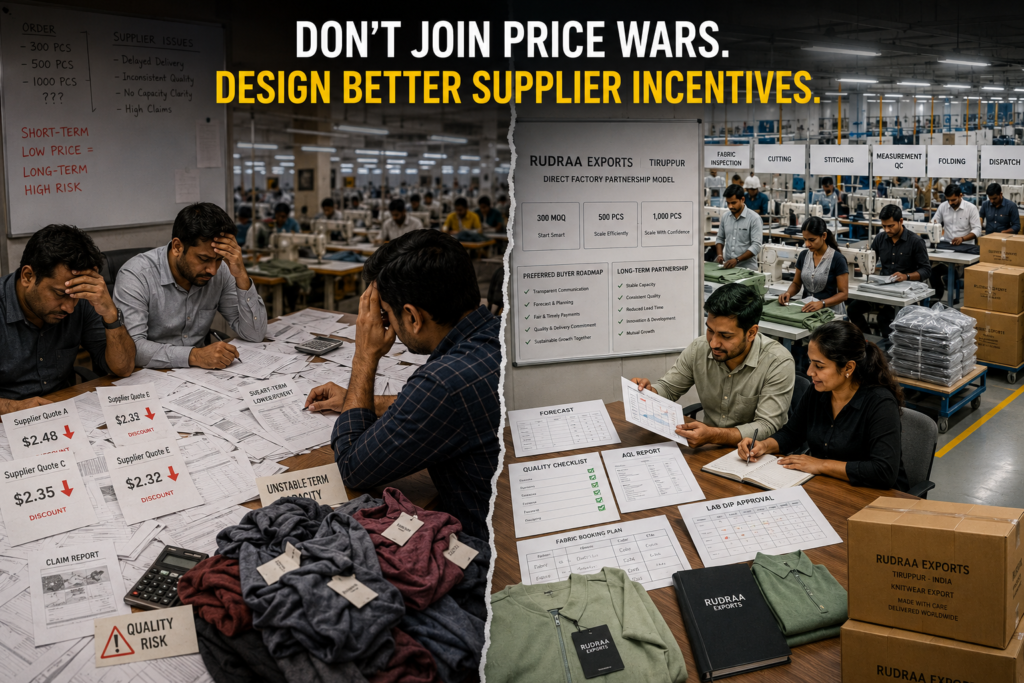
Apparel price wars look attractive in the beginning.
A buyer asks five factories for a quote.
One factory gives the lowest price.
The buyer feels they negotiated well.
But after production starts, the real cost appears.
Fabric quality changes.
Shade matching becomes weaker.
QC becomes slower.
Delivery priority drops.
Claims increase.
The launch date becomes risky.
This is why the best apparel sourcing strategy is not always to squeeze the lowest quote.
The better strategy is to design supplier incentives so the factory chooses to protect your cost, quality and lead time.
That is where game theory becomes useful.
The uploaded source explains that apparel price wars often create a Prisoner’s Dilemma: buyers and suppliers both act defensively, and both end up worse off through hidden costs, quality slippage and unstable capacity allocation.
At Rudraa Exports, we support brands with a factory-direct sourcing model from Tirupur, India, built around long-term partnership, transparent costing, quality checkpoints, production planning and repeat-order reliability.
Why Price Wars Fail in Apparel Sourcing
A price war rewards the cheapest quote, not the most reliable production system.
In a one-time negotiation, both sides protect themselves.
The buyer pushes for last-minute reductions.
The factory protects its margin.
That can lead to cheaper trims, weaker QC, slower responses or lower production priority.
The source explains this as a Prisoner’s Dilemma, where each side acts in short-term self-interest and both lose value.
Common Price-War Problems
- Supplier cuts corners to protect margin
- Buyer keeps switching factories
- Quality becomes inconsistent
- Lab dips and approvals slow down
- Factory gives priority to better customers
- Lead times become unstable
- Claims and rework increase
- Net landed cost rises
A cheap FOB is not a win if it creates returns, air freight, delays or lost selling time.
The Game Theory Approach
Game theory helps buyers think beyond one order.
Instead of asking, “How do I force the lowest price today?” the better question is:
“How do I make cooperation more profitable for both sides over many orders?”
This is the idea behind repeated games.
If the buyer and factory expect to work together again, both sides have a reason to protect the relationship.
Better Supplier Behaviour Happens When
- The buyer gives realistic forecasts
- The factory gets repeat-order confidence
- Payment terms are respected
- Quality expectations are clear
- QC standards are measured
- Volume increases when performance is strong
- Poor performance has proportional consequences
This creates a stronger sourcing system than constant supplier switching.
Tit-for-Tat in Apparel Sourcing
Tit-for-Tat is a game theory strategy based on reciprocity.
If the supplier cooperates, the buyer cooperates.
If the supplier fails, the buyer responds proportionally.
The uploaded source says Tit-for-Tat is widely cited as a strong strategy in repeated Prisoner’s Dilemma situations because it rewards collaboration and discourages opportunism.
Example
A buyer gives Rudraa a two-season forecast for T-shirts and polos.
Rudraa plans fabric booking, production capacity and QC gates.
If Rudraa hits quality and delivery KPIs, the buyer releases the next order and shares future forecasts.
If there is a quality miss, volume is reduced temporarily until corrective action is proven.
This is not blind trust.
It is structured cooperation.
Preferred-Buyer Positioning
Preferred buyers often get better outcomes because they reduce uncertainty for the factory.
A factory will naturally give more attention to buyers who:
- Share clear forecasts
- Approve samples quickly
- Pay on time
- Avoid constant last-minute changes
- Respect production calendars
- Place repeatable orders
- Communicate quality expectations clearly
The source explains that preferred-buyer positioning can lead to earlier raw material booking, faster lab dips and production priority.
Why This Matters in Tirupur
Tirupur is one of India’s strongest knitwear ecosystems.
It supports knitting, dyeing, printing, garmenting, QC and export packing through a dense supplier network.
The uploaded source says Tirupur’s ecosystem includes around 20,000 units and supports large export volumes.
For brands sourcing T-shirts, polos, hoodies, loungewear or private-label knitwear, this matters because repeatable sourcing becomes easier when the production cluster is strong.
A long-term factory-direct relationship lets buyers use that ecosystem better than spot buying.
Rudraa’s Factory-Direct Partnership Model
Rudraa Exports’ model is built around direct-factory communication and long-term production planning.
Instead of jumping between suppliers for every quote, buyers can build a repeatable sourcing system.
Rudraa Supports
- Direct-factory costing
- 300 pcs starting MOQ planning
- 500 and 1,000 pcs scale planning
- Product development
- Lab dip approval
- Size set approval
- PP sample approval
- Inline QC
- Final inspection
- Export packing
- Repeat-order planning
- Forecast-based production discussion
Why This Protects Margin
A stable sourcing partnership helps reduce:
- Quality variation
- Rework
- Claims
- Air freight
- Stock-outs
- Supplier switching cost
- Repeated sampling cost
- Launch delays
The source says partnership-based sourcing protects long-term margin by reducing variability.
Best Fit for This Strategy
A game-theory partnership model works best when the product has repeat potential.
Strong Fit
- T-shirts
- Polo shirts
- Hoodies
- Loungewear
- Uniform basics
- Private-label knitwear
- Repeat retail programs
- Seasonal capsules
- DTC brand essentials
The source says this approach works well for core knitwear programs where repeats are likely and process learning compounds.
Not the Best Fit
This approach may not be needed for:
- One-off promo orders
- Very low-risk items
- Simple packaging or trims
- Orders with no repeat potential
- Buyers who cannot honour forecasts or payment discipline
The source says spot tactics can still apply for true one-off buys where repeated-game leverage is minimal.
Migration Plan: From Price War to Partnership
Step 1: Segment Your Categories
Identify products with repeat potential.
Start with 1–2 categories such as:
- 300+ pcs T-shirt programs
- Polo shirt repeats
- Hoodie capsules
- Loungewear basics
Step 2: Run a Pilot
Place a controlled pilot with clear decision gates.
Track:
- Sample approval time
- Shade consistency
- AQL result
- Measurement pass rate
- On-time delivery
- Defect percentage
Step 3: Create Reciprocity Rules
Define what happens if performance is good.
For example:
- Good quality = next order released
- On-time delivery = forecast shared
- Strong QC = volume increase
Also define what happens if performance drops.
- Quality miss = temporary volume reduction
- Delivery issue = corrective action needed
- Repeated failure = sourcing review
Step 4: Share Forecasts
Do not treat forecasting as a favour.
It is a sourcing tool.
Forecasts help the factory plan fabric, manpower and production slots.
Step 5: Review Quarterly
Run a simple quarterly review.
Track:
- Net landed cost
- Claim rate
- Lead-time variance
- Rework
- On-time delivery
- Quality score
- Repeat-order savings
The uploaded source recommends quarterly business reviews with shared KPIs such as landed cost, claim rate, lead-time variance and changeover loss.
FAQ
1. What is the best apparel sourcing strategy?
The best strategy is not always the lowest quote. For repeat products, a factory-direct partnership with clear incentives, forecasts, QC gates and performance reviews is stronger.
2. What is Prisoner’s Dilemma in sourcing?
It is when buyers push for the lowest price and suppliers protect themselves by reducing quality or priority, causing both sides to lose value.
3. What is preferred-buyer positioning?
Preferred-buyer positioning means becoming a reliable buyer that factories prioritize because you provide clear forecasts, fast approvals and repeat orders.
4. What is Rudraa Exports’ MOQ?
Rudraa Exports’ MOQ starts from 300 pieces, depending on product, fabric, colour, trims and complexity.
5. How does Rudraa help avoid price wars?
Rudraa helps buyers move from spot buying to direct-factory planning with transparent costing, sampling, QC, production calendars and repeat-order support.
Conclusion
Winning apparel sourcing is not about joining every price war.
It is about building a system where suppliers have a reason to protect your cost, quality and timeline.
Game theory shows why repeated cooperation, reciprocity, credible commitment and preferred-buyer positioning often beat constant supplier switching.
For brands sourcing repeat knitwear, Rudraa Exports offers a practical factory-direct model from Tirupur, India, with 300 pcs starting MOQ, 500 and 1,000 pcs scale planning, quality checkpoints and long-term partnership support.
Visit rudraaexports.com or contact Rudraa Exports to request a quote for your next knitwear program.