
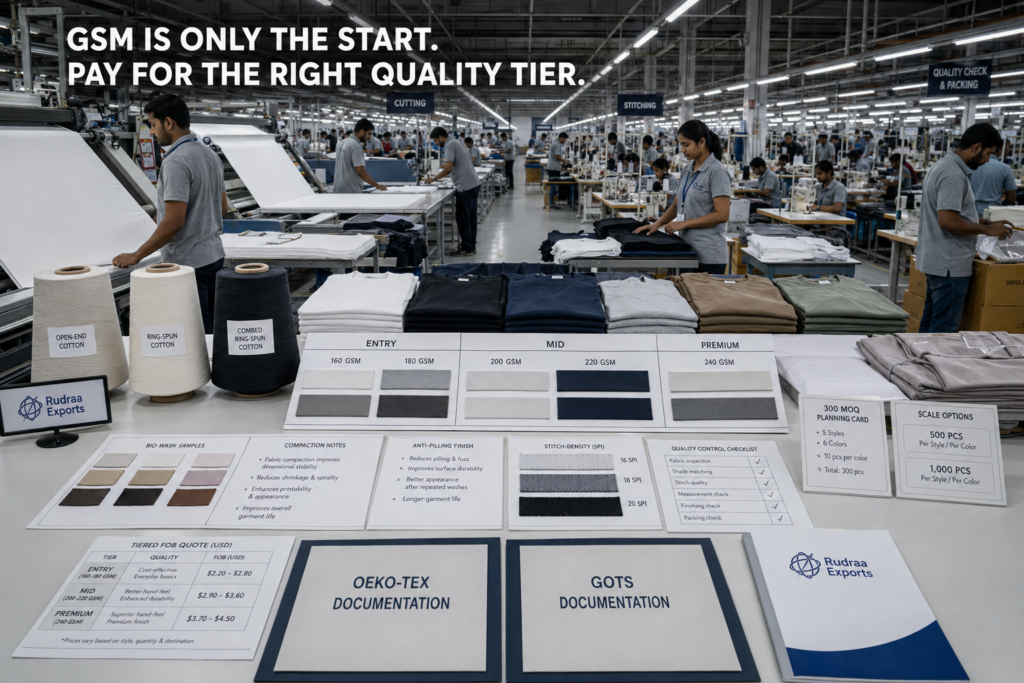
Two suppliers can quote an “180 GSM cotton T-shirt” at very different prices.
That does not always mean one supplier has a higher margin.
It usually means the product is not the same.
In Indian garment manufacturing, especially in Tirupur knitwear, GSM is only one part of quality. Real garment cost depends on the full specification bundle: GSM, yarn type, cotton grade, stitch density, finishing, shrinkage control, compliance, labels, trims, QC and packing.
This is why buyers should not compare quotes using GSM alone.
At Rudraa Exports, we help brands understand quality tiers clearly before production. Our factory-direct model helps buyers choose the right tier for their product promise, retail price and margin target, with transparent FOB discussion and production planning from 300 pieces minimum.
Quick Answer
Indian garment manufacturing quality tiers are usually defined by GSM, yarn quality, stitch density, finishing and compliance. Entry tier focuses on cost. Mid tier balances price, quality and retail readiness. Premium tier uses better yarn, higher GSM, stronger finishing, tighter QC and compliance documentation such as OEKO-TEX or GOTS where applicable. Rudraa Exports helps buyers compare tiers clearly with 300 MOQ planning, 500 and 1,000 pcs scale pricing and factory-direct production from Tirupur.
Why GSM Alone Is Not Quality
GSM means grams per square metre.
It tells you fabric weight.
But it does not tell you:
- Yarn quality
- Surface smoothness
- Pilling resistance
- Shrinkage control
- Stitch strength
- Hand feel
- Dye consistency
- Print result
- Wash durability
- Compliance readiness
A 180 GSM T-shirt made from open-end cotton with basic finishing will not feel or perform like a 180 GSM T-shirt made from ring-spun combed cotton with bio-wash and compaction.
Both can be described as “180 GSM cotton.”
But the customer experience will be different.
Three Practical Quality Tiers
Entry Tier
Entry tier is built for price-sensitive programs.
It is suitable when the garment has a short lifecycle or when the buyer’s main priority is low landed cost.
Entry Tier Specs
- 160–180 GSM
- Open-end cotton or basic cotton blends
- Basic softener
- Lower stitch density
- Limited finishing controls
- Minimal compliance documentation unless requested
- Best for promotions, events and giveaways
Entry tier can work well for large promotional orders, but it is not ideal for premium retail products.
Entry Tier Risk
The main risks are:
- Rougher hand feel
- More surface hairiness
- Earlier pilling
- Weaker shape retention
- Lower seam appearance
- More variation across lots
This tier should not be used when customer reviews, repeat purchase or premium brand positioning matter.
Mid Tier
Mid tier is usually the best starting point for serious retail brands.
It balances cost, quality and consistency.
Mid Tier Specs
- 180–200 GSM
- Ring-spun cotton
- Bio-wash or enzyme wash
- 10–12 SPI stitch density
- Better hand feel
- Better print surface
- Better QC expectations
- OEKO-TEX discussion where applicable
Mid tier works well for DTC brands, corporate programs, private-label basics and repeat retail orders.
For most brands, mid tier gives the best value because it improves customer experience without pushing cost too high.
Premium Tier
Premium tier is used when the garment itself is part of the brand promise.
This is common for streetwear, oversized T-shirts, premium basics and quality-sensitive retail programs.
Premium Tier Specs
- 200–240 GSM for T-shirts
- Higher GSM where needed for heavyweight programs
- Ring-spun combed cotton
- Bio-wash plus compaction
- Optional anti-pilling treatment
- Higher SPI where suitable
- Tighter shade and hand-feel control
- OEKO-TEX and/or GOTS where applicable
- Stronger traceability and QC expectations
Premium tier costs more because the input quality, finishing discipline and inspection expectations are higher.
But it can reduce returns, improve customer satisfaction and support a higher retail price.
Quality Tier Comparison
| Criteria | Entry | Mid | Premium |
|---|---|---|---|
| GSM | 160–180 | 180–200 | 200–240+ |
| Yarn | Open-end or basic | Ring-spun | Combed ring-spun |
| Finish | Basic softener | Bio-wash | Bio-wash, compaction, anti-pilling |
| SPI | 8–10 | 10–12 | 12–14 where suitable |
| Best For | Promo goods | Retail basics | Premium basics and streetwear |
| Risk | Higher quality variation | Balanced | Higher cost, better control |
Stitch Density: Why SPI Matters
SPI means stitches per inch.
It affects seam appearance, strength and production time.
A lower SPI can reduce sewing time, but seams may look more open.
A higher SPI can improve seam appearance, but if machine settings are wrong, it can cause puckering.
For many jersey T-shirts, 10–12 SPI gives a good balance of strength, speed and clean appearance.
Premium programs may use higher SPI where the fabric and construction support it.
Finishing: What Buyers Pay For
Finishing can change how a garment feels after production and after wash.
Common finishing options include:
- Basic softener
- Bio-wash
- Enzyme wash
- Compaction
- Anti-pilling finish
- Shrinkage control
A T-shirt without proper finishing may look acceptable during packing but feel rough or lose shape after customer wash.
This is why Rudraa recommends checking wash performance before bulk approval.
Cost Per Wear: The Better Comparison
Entry tier may look cheaper at FOB level.
But premium tier may create better value over time.
Example:
An entry T-shirt costs $2.00 FOB and gives 20 good wears.
Cost per wear:
$0.10
A premium T-shirt costs $3.60 FOB and gives 60 good wears.
Cost per wear:
$0.06
The premium garment costs more at the factory level but may deliver better customer value, fewer complaints and stronger repeat purchase.
Rudraa MOQ and Tiered Quoting
Rudraa Exports’ MOQ starts from 300 pieces.
For tiered sourcing, buyers should request pricing at:
- 300 pcs for controlled first production
- 500 pcs for better efficiency
- 1,000 pcs for stronger scale economics
A tiered quote should clearly show what changes between Entry, Mid and Premium.
Ask for differences in:
- GSM
- Yarn
- Finish
- SPI
- Labels
- Packing
- Compliance documentation
- QC expectations
This prevents hidden substitutions and helps your team choose the right product level.
Which Tier Should You Choose?
Choose Entry Tier If
- You need promotional garments
- The product has a short lifecycle
- Buyer expectations are basic
- Lowest landed cost is the main goal
Choose Mid Tier If
- You sell DTC or retail basics
- You want fewer complaints
- You need better hand feel
- You want balanced FOB pricing
- You plan repeat orders
Choose Premium Tier If
- You sell premium basics
- You need oversized or streetwear structure
- You want stronger wash durability
- You need compliance readiness
- Your brand depends on quality perception
How Rudraa Exports Helps
Rudraa helps buyers build the right garment tier instead of guessing from a quote.
We support:
- GSM selection
- Yarn discussion
- Fabric swatches
- Bio-wash planning
- Compaction discussion
- Stitch-density guidance
- 300 MOQ planning
- 500 and 1,000 pcs scale quotes
- OEKO-TEX and GOTS documentation discussion where applicable
- Sampling
- PP sample approval
- Inline QC
- Final inspection
- Export packing
FAQ
1. What are garment quality tiers?
Garment quality tiers are practical product levels based on GSM, yarn, stitching, finishing, compliance and QC expectations.
2. Is higher GSM always better?
No. Higher GSM only means heavier fabric. Yarn quality, finishing and shrinkage control also decide product performance.
3. What is the best tier for DTC brands?
Mid tier is usually the best starting point because it balances cost, hand feel, quality and retail readiness.
4. What is Rudraa Exports’ MOQ?
Rudraa Exports’ MOQ starts from 300 pieces, depending on product, fabric, colour, trims and complexity.
5. How do I compare two supplier quotes?
Compare GSM, yarn, SPI, finishing, compliance, labels, packing and QC — not just FOB price.
Conclusion
In Indian garment manufacturing, you are not only paying for GSM.
You are paying for the full quality system behind the garment.
An entry T-shirt, mid-tier retail basic and premium streetwear tee can all look similar in a short quote, but they will perform differently after wash, wear and customer review.
Rudraa Exports helps buyers choose the right quality tier with transparent factory-direct pricing, 300 MOQ planning, 500 and 1,000 pcs scale discussion, sampling, finishing control, QC and export-ready production from Tirupur.
Visit rudraaexports.com or contact Rudraa Exports to request a tiered quote for your next knitwear program.