
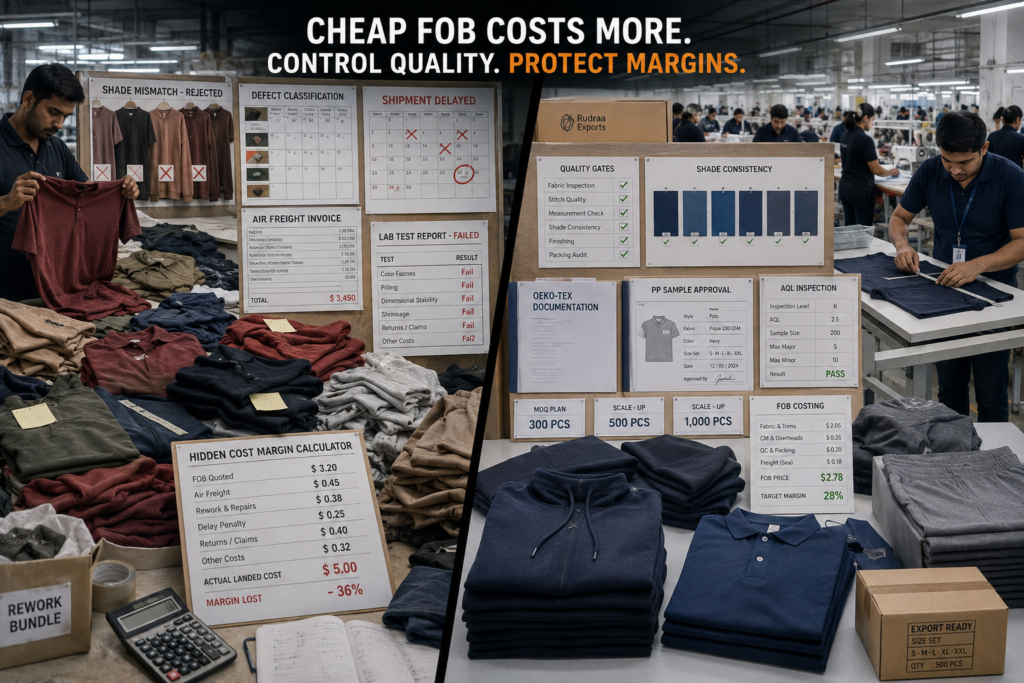
The lowest FOB price can look like smart sourcing.
But in apparel manufacturing, the cheapest supplier is often not the lowest-cost supplier.
A low-price quote may reduce the first invoice, but it can shift hidden costs into your business: defects, shade variation, rework, scrap, extra inspection, delayed launches, air freight, customer returns, compliance failures and lost selling time.
This is why buyers should not judge garment suppliers only by FOB.
They should calculate Total Cost of Ownership and Cost of Poor Quality.
At Rudraa Exports, we help brands reduce sourcing risk through factory-direct garment manufacturing from Tiruppur, India, with ISO-aligned quality systems, OEKO-TEX-led material safety discussion, 300-piece MOQ planning, QC gates, PP sample approvals, inline inspections and export-ready production.
Quick Answer
Low-price garment suppliers destroy margins when poor quality creates rework, scrap, inspection cost, delayed delivery, failed lab tests, emergency freight and lost sales. A supplier that is $0.50 cheaper per unit can become more expensive if defect rates rise or launch dates are missed. Rudraa Exports’ factory-direct model helps brands protect margins through quality systems, compliance documentation, fewer agent layers, 300 MOQ planning and controlled production checkpoints.
Why Cheap FOB Is Misleading
FOB price is only one part of cost.
A buyer may compare two suppliers:
- Supplier A: $7.00 FOB
- Supplier B: $7.50 FOB
Supplier A looks cheaper.
But if Supplier A creates defects, delivery delays or testing failures, the real cost becomes higher.
A proper sourcing decision should include:
- FOB cost
- Defect rate
- Rework cost
- Scrap cost
- Extra inspection
- Lab testing
- Freight changes
- Delay risk
- Return risk
- Compliance risk
- Lost selling time
The cheapest supplier usually saves money in prevention, then the buyer pays more during failure.
Total Cost of Ownership in Apparel
Total Cost of Ownership means the full cost of buying from a supplier, not only the unit price.
For garments, TCO includes production price plus all quality and delay-related costs.
TCO Cost Areas
- Product cost
- Sampling cost
- Inspection cost
- Rework cost
- Scrap cost
- Lab testing
- Freight
- Customs delays
- Claims and chargebacks
- Returns
- Lost sales
- Brand damage
A supplier with better process control may quote slightly higher FOB but still create better long-term margin.
Cost of Poor Quality
Cost of Poor Quality, or COPQ, is the cost created when quality fails.
It includes four areas:
- Prevention
- Appraisal
- Internal failure
- External failure
Cheap suppliers often reduce prevention. They may skip stronger process controls, material checks, shade control, inspection discipline or corrective action systems.
Then the buyer pays for internal and external failures.
Internal Failure Costs
These happen before goods reach the customer.
Examples:
- Rework
- Scrap
- Sorting
- Extra inspection
- Production delay
- Repacking
- Failed AQL
- Replacement production
External Failure Costs
These happen after shipment or sale.
Examples:
- Customer returns
- Retail chargebacks
- Product recalls
- Reputation damage
- Refunds
- Lost repeat orders
- Marketplace complaints
- Negative reviews
External failures are usually the most expensive.
Scenario: The $0.50 Saving That Becomes a $2 Loss
Imagine a buyer orders 1,000 garments.
The cheaper supplier quotes $7.00 FOB.
A better-controlled supplier quotes $7.50 FOB.
The buyer thinks they saved:
1,000 × $0.50 = $500
But after production, 10% of garments have defects.
That means 100 units need action.
Possible hidden costs:
- Scrap value: 100 × $7.00 = $700
- Rework labour and overhead: $420
- Extra inspection: $350
- Emergency freight on replacement units: $1,200
Total hidden cost:
$2,670
Original saving:
$500
Net loss:
$2,170
That is $2.17 extra cost per unit.
The cheaper supplier became more expensive.
Late Delivery Creates Bigger Losses
Quality problems often create delays.
A delay may look small in production, but it can damage the selling calendar.
For fashion brands, timing matters.
If a brand misses a seasonal launch window, influencer campaign, retail floor set or festival sale, the lost margin can be larger than the production cost difference.
Example:
A brand expects to sell 500 units per week at $30 retail with 50% gross margin.
A two-week stock-out means:
- 1,000 units of lost sales
- $30,000 lost revenue
- $15,000 gross margin gone
A $0.50 FOB saving cannot cover that.
Compliance Failures Are Expensive
Low-price suppliers may also create chemical or compliance risk.
For apparel buyers selling in quality-sensitive markets, material safety and testing matter.
OEKO-TEX Standard 100 is used to test textiles for harmful substances. A supplier with better documentation and testing discipline helps reduce restricted-substance risk.
A failed lab test can create:
- Shipment hold
- Re-dyeing
- Replacement production
- Order cancellation
- Retailer rejection
- Customer trust damage
Compliance failures are not small mistakes.
They can become external failure costs.
Why Rudraa Exports Reduces TCO Risk
Rudraa Exports is positioned as a factory-direct garment manufacturer from Tiruppur, India.
The advantage is not only price.
The advantage is control.
Rudraa helps buyers reduce TCO through:
- Factory-direct communication
- Fewer agent layers
- ISO-aligned quality systems
- OEKO-TEX-led compliance discussion
- PP sample approval
- Inline inspection
- Final inspection
- AQL-based quality review
- Shade and measurement control
- Export documentation support
- 300-piece MOQ planning
Rudraa’s factory-direct model can also reduce agent-layer costs. Instead of paying hidden intermediary margins, buyers get clearer visibility into production, quality and costing.
Rudraa MOQ Planning
Rudraa Exports’ MOQ starts from 300 pieces.
For better margin planning, buyers should compare:
- 300 pcs for controlled first production
- 500 pcs for better efficiency
- 1,000 pcs for stronger scale economics
A 300-piece MOQ helps with fabric planning, size ratios, QC structure, cutting efficiency, trims, packing and export preparation.
Very tiny orders may feel safe, but they often increase per-unit cost and create weak production economics.
Best Fit for Rudraa
Rudraa is a strong fit for:
- Brands with time-sensitive launches
- Private-label apparel buyers
- Retail programs
- DTC brands with repeat production
- Buyers needing quality consistency
- Programs with multiple colours
- Brands needing chemical-safety documentation
- Buyers facing rework or defect issues
- Teams trying to reduce COPQ
Not the Best Fit
Rudraa may not be the best fit for:
- One-off ultra-cheap promo goods
- Very tiny no-repeat orders
- Buyers who only care about lowest FOB
- Programs with loose quality tolerance
- Orders where brand equity does not matter
Migration Plan: Moving Away from Cheap Suppliers
Step 1: Baseline Current TCO
Review the last 2–3 seasons.
Track:
- Defect percentage
- Rework hours
- Scrap value
- Claims
- Chargebacks
- Lab failures
- Expedited freight
- Late deliveries
Step 2: Qualify the Supplier
Ask for:
- ISO 9001 documentation
- OEKO-TEX documentation where applicable
- QC workflow
- CAPA process
- Inspection method
- Sample approval process
Step 3: Run a Controlled Pilot
Start with one style and plan around 300–500 units.
Use hard quality gates:
- PP sample approval
- Inline inspection
- Final inspection
- AQL agreement
- Measurement pass rate
- Shade consistency
- On-time delivery tracking
Step 4: Scale Gradually
Move from pilot to repeat production.
Increase to 500 or 1,000 pieces after the supplier proves quality, timing and documentation.
Step 5: Review Monthly
Track COPQ every month.
Measure:
- Defect %
- Rework cost
- Late shipment cost
- Return rate
- Inspection failure
- Claims
- Lost sales
Conclusion
Cheap FOB can become expensive.
Low-price suppliers often move cost into your business through poor quality, rework, scrap, delays, compliance risk and lost selling time.
The smarter approach is to calculate Total Cost of Ownership and Cost of Poor Quality before choosing a supplier.
Rudraa Exports helps brands reduce sourcing risk through direct-factory production, ISO-aligned quality control, OEKO-TEX-led compliance discussion, 300-piece MOQ planning, PP sample approvals, inline QC, final inspection and export-ready garment manufacturing from Tiruppur, India.
Visit rudraaexports.com or contact Rudraa Exports to request a factory-direct TCO comparison for your next garment production order.