
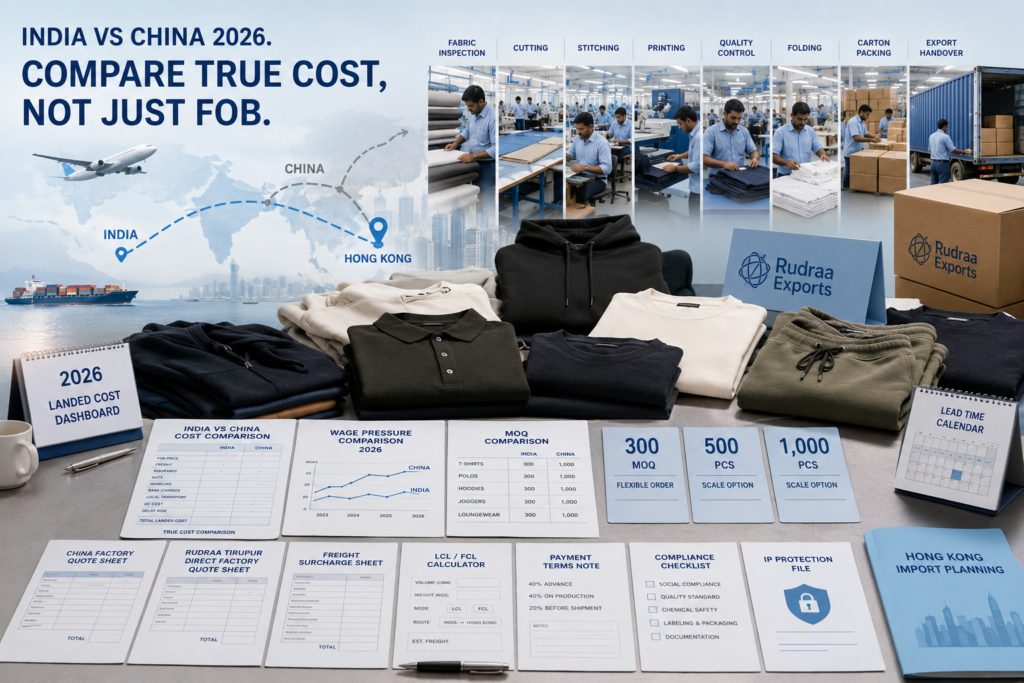
Hong Kong fashion buyers are no longer comparing garment suppliers only by FOB price.
In 2026, the real sourcing decision is about total cost, risk and control.
China is still powerful for many apparel categories. It has speed, scale, trim ecosystems and strong manufacturing depth.
But India, especially Tiruppur in Tamil Nadu, has become a practical lower-risk sourcing base for knitwear programs such as T-shirts, polos, hoodies, joggers, loungewear and private-label basics.
For Hong Kong brands, the question is not simply:
Is India cheaper than China?
The better question is:
Which country gives better landed-cost control, MOQ flexibility, quality consistency and compliance confidence?
At Rudraa Exports, we help Hong Kong buyers compare India and China using factory-direct costing, 300 pcs starting MOQ, 500 and 1,000 pcs scale planning, quality systems, export documentation and shipment planning from Tiruppur.
Quick Answer
India vs China garment manufacturing should be compared using total landed cost, not only FOB. China can be faster for some Hong Kong routes and complex product ecosystems. India, especially Tiruppur, can be stronger for knitwear basics, MOQ flexibility, lower wage pressure, direct-factory communication and China-plus-one risk reduction. Rudraa Exports supports Hong Kong buyers with 300 pcs starting MOQ, direct-factory knitwear production, compliance documentation discussion, QC checkpoints and India-to-Hong Kong shipping planning.
Why Hong Kong Buyers Are Comparing India and China in 2026
The uploaded source explains that Hong Kong procurement teams are now evaluating more than FOB price. Wage inflation, MOQ flexibility, documentation discipline, shipping volatility, carrier reliability and technical-pack execution all affect sourcing decisions in 2026.
This matters because Hong Kong buyers need:
- Predictable production
- Lower inventory risk
- Better margin control
- Reliable QC
- Compliance documentation
- Faster issue resolution
- China-plus-one sourcing
- Fewer hidden costs
A supplier with a slightly lower FOB can still become expensive if delays, rework, freight surcharges or quality problems appear later.
India vs China: Procurement Scorecard
| Criteria | China | India, Tiruppur |
|---|---|---|
| Best For | Speed, scale, complex trims | Knitwear, basics, cotton programs |
| MOQ | Often better at larger scale | 300 pcs starting MOQ with Rudraa |
| Cost Pressure | Higher wage pressure in coastal hubs | Lower wage structure for knitwear |
| Lead Time | Faster water route to Hong Kong | Competitive with planned production |
| Quality | Strong if factory is vetted | Strong with direct QC and process control |
| Compliance | Mature but factory-dependent | Available with right Tiruppur partner |
| Communication | Direct or platform-based | Direct-factory with Rudraa |
| Risk | Policy, cost and capacity volatility | China-plus-one diversification |
The source highlights that China still offers speed-to-ship advantages, but Tiruppur can become more controllable for Hong Kong buyers focused on cost, MOQ agility and diversification.
Cost: Why Wage Structure Matters
Garment cost is not only fabric.
For cut-and-sew products, labour affects CM cost, overtime, line stability and productivity.
The uploaded source explains that coastal China wage pressure and fully loaded labour cost can affect garment FOB, while Tamil Nadu knitwear wages remain structurally lower in USD terms.
For Hong Kong buyers sourcing labour-sensitive basics such as cotton T-shirts and polos, this can create more room in India for controlled pricing.
But buyers should not compare generic country averages.
They should compare the same product with the same:
- GSM
- Yarn
- Print method
- Stitching
- Packing
- Testing
- AQL level
- Incoterm
- Quantity
MOQ: Where Tiruppur Helps Inventory Control
MOQ is not just a factory term.
MOQ affects inventory risk.
If a buyer must order too much stock to get a good price, they may face markdowns, slow-moving colours and cashflow pressure.
For Hong Kong brands running drops, capsules or colour refreshes, MOQ flexibility matters.
Rudraa Exports’ MOQ starts from 300 pieces.
Buyers can request pricing at:
- 300 pcs for controlled first production
- 500 pcs for better efficiency
- 1,000 pcs for stronger scale economics
This helps buyers test products without moving into unnecessary overbuying.
Lead Time: Production Time vs Sailing Time
China has a geographic advantage for Hong Kong.
Some China-to-Hong Kong routes can move faster than India-to-Hong Kong sea freight.
But buyers should not judge lead time only by sailing days.
Total sourcing lead time includes:
- Tech-pack review
- Fabric sourcing
- Lab dips
- Strike-offs
- Fit samples
- PP sample approval
- Bulk production
- QC
- Packing
- Freight booking
- Shipping
- Documentation
The source explains that production readiness and approval discipline often matter more than a few days difference in sailing time.
For repeat knitwear programs, Rudraa can support structured planning so Hong Kong buyers know when fabric, samples, bulk production and shipment milestones are expected.
Quality: Controlling Variation Across Lots
Quality consistency is not only about passing final inspection.
Buyers need consistency across lots, colours and repeat orders.
Key risks include:
- Size drift
- Shade variation
- Shrinkage
- GSM variation
- Print inconsistency
- Pilling
- Measurement tolerance failure
- Unapproved subcontracting
The uploaded source explains that Tiruppur can deliver strong knit quality when suppliers use stable SOPs for GSM control, shrinkage management and shade continuity.
Rudraa helps reduce quality risk through:
- Fabric inspection
- PP sample approval
- Inline QC
- Measurement checks
- Final inspection
- Export packing checks
- Batch documentation
Compliance and Certifications
Hong Kong buyers increasingly need documentation for retailers, marketplaces and brand trust.
Depending on product and claim, buyers may need:
- ISO-style quality documentation
- OEKO-TEX discussion
- GOTS discussion for organic programs
- Social compliance documentation
- Traceability records
- Fibre content declarations
- Test reports where applicable
The source recommends making certification checks part of sourcing approval rather than a nice-to-have.
Buyers should verify certificate scope and validity before using any claim in marketing or retailer submissions.
IP Protection: Practical Controls Matter
IP risk exists in every sourcing country.
The best protection comes from process control, not stereotypes.
Hong Kong brands should use:
- NDAs
- Controlled sample sharing
- Versioned tech packs
- Watermarked artwork
- Limited pattern release
- No unauthorised subcontracting clauses
- Data-return clauses
The source explains that contract terms and operational controls are more useful than broad country assumptions.
Payment Terms
Payment terms affect cashflow and risk.
A practical structure for India sourcing is:
- Deposit to begin production
- Balance before shipment or after inspection milestone
For Rudraa buyer planning, payment discussions can be aligned to order size, buyer history, product complexity and production milestones.
The source explains that payment structure should work as a risk-sharing tool, tied to material booking, inspection and documentation completeness.
Shipping to Hong Kong
Freight cost and reliability are now important parts of the India vs China decision.
China can be faster on water for Hong Kong.
India can still be practical if production planning is disciplined and freight is booked properly.
For India-to-Hong Kong shipments, buyers should compare:
- LCL vs FCL
- Sea vs air
- Freight surcharge risk
- THC and documentation fees
- Peak season rate changes
- Carrier reliability
- Detention and demurrage risk
- Carton CBM planning
The source warns that freight volatility can affect per-piece cost and should be part of the sourcing decision, not handled separately after production.
Best Fit for India and Rudraa
Rudraa is a strong fit for:
- Knitwear programs
- T-shirts and polos
- Hoodies and joggers
- Loungewear
- Cotton-heavy basics
- Private-label retail
- MOQ-sensitive drops
- 300+ pcs production
- Repeat programs
- China-plus-one sourcing
- Compliance-conscious buyers
When China May Still Be Better
China may still be better for:
- Ultra-fast replenishment
- Very complex trims
- Technical outerwear
- Hardware-heavy garments
- Huge single-SKU programs
- Products already developed in China
- Categories where a qualified China supplier is already performing well
For many Hong Kong buyers, the best answer is not India or China only.
It is a split strategy.
Use China where speed or complexity matters most.
Use India where knitwear cost, MOQ flexibility and diversification matter most.
5-Step Migration Plan
Step 1: Build an Apples-to-Apples Cost Model
Compare both countries using the same costing template.
Include:
- Fabric
- Trims
- Packing
- Testing
- MOQ
- AQL
- Freight
- Surcharges
- Payment terms
- Lead time
Step 2: Qualify the Factory
Review:
- Product capability
- QC system
- Traceability
- Compliance documentation
- Production capacity
- Export experience
- Communication process
Step 3: Run a Controlled Pilot
Start with one or two knitwear styles.
Use a 300 pcs first production where suitable.
Track:
- On-time ex-factory
- First-pass quality
- Documentation accuracy
- Freight variance
Step 4: Lock the Operating Calendar
Agree on:
- Lab dip dates
- PP approval date
- Fabric in-house date
- Cutting date
- QC date
- Packing date
- Ex-factory date
- Freight booking date
Step 5: Scale Safely
Do not move everything at once.
Use phases:
- 300 pcs pilot
- 500 pcs repeat
- 1,000 pcs scale program
- Long-term monthly production
This protects revenue while building performance history.
FAQ
1. Is India cheaper than China for garment manufacturing?
India can be more cost-effective for knitwear basics such as T-shirts, polos, hoodies and loungewear when compared like-for-like.
The final cost depends on GSM, fabric quality, trims, printing, finishing, MOQ, QC level, packing and shipping terms.
2. Is China still better for Hong Kong buyers?
China can still be better for ultra-fast replenishment, very large-scale programs, complex trims and technical garment categories.
For repeat knitwear, private-label basics and China-plus-one sourcing, India can be a stronger long-term second base.
3. What is Rudraa Exports’ MOQ?
Rudraa Exports’ MOQ starts from 300 pieces, depending on product, fabric, colour, trims and complexity.
This MOQ supports proper production planning, labels, size ratios, QC, packing and export preparation.
4. Why is Tiruppur important for garment sourcing?
Tiruppur is one of India’s strongest knitwear manufacturing clusters, supporting fabric, cutting, stitching, finishing and export packing.
For Hong Kong brands sourcing T-shirts, polos, hoodies and loungewear, this cluster helps create more reliable repeat production.
5. Should Hong Kong brands fully shift from China to India?
Not always. A split strategy is usually safer, with India handling repeat knitwear and China handling urgent or complex products.
Buyers should migrate in phases using pilot orders, cost comparison, QC results and delivery performance before scaling.
Conclusion
India vs China garment manufacturing is no longer a simple FOB comparison.
For Hong Kong buyers in 2026, the better decision is based on total landed cost, MOQ flexibility, lead-time reliability, quality control, compliance, IP protection, payment terms and shipping risk.
China remains strong for speed, scale and complex ecosystems.
India, especially Tiruppur, is becoming a lower-risk shift for knitwear-led programs where buyers want cost control, direct communication, 300 pcs starting MOQ, quality checkpoints and China-plus-one diversification.
Rudraa Exports helps Hong Kong brands compare India and China using real product specs, factory-direct costing, MOQ planning, 500 and 1,000 pcs scale quotes, QC systems, documentation and shipment planning.
Visit rudraaexports.com or contact Rudraa Exports to request a custom India vs China cost comparison for your next Hong Kong garment sourcing program.