
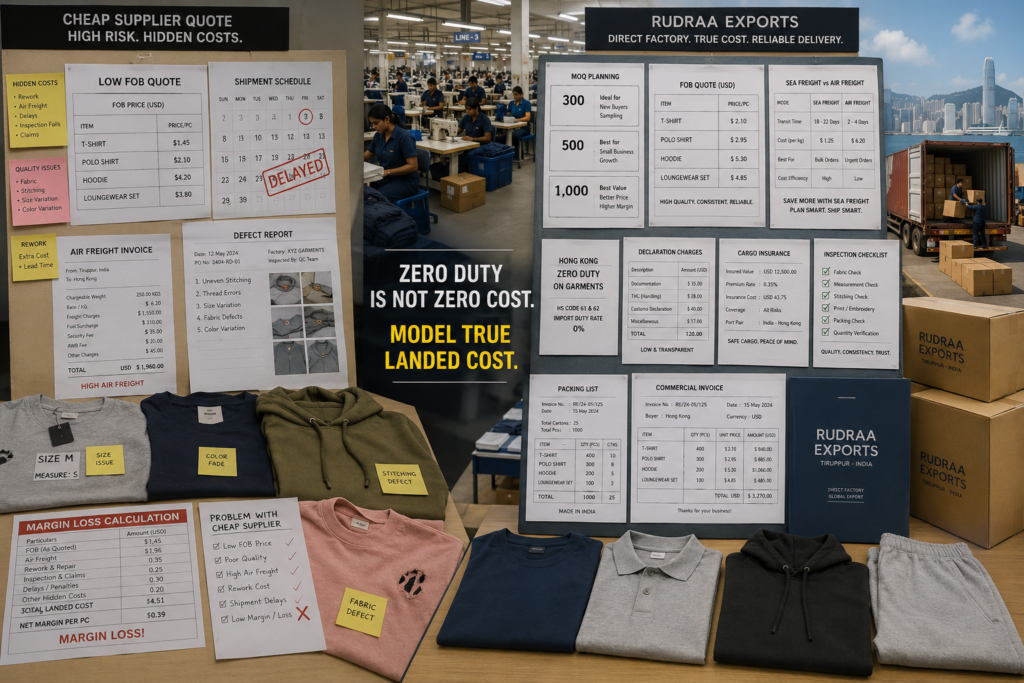
Hong Kong is one of the easiest markets for garment imports from a duty perspective.
Garments under HS 61 and HS 62 generally enter Hong Kong with zero import duty. That makes Hong Kong attractive for apparel traders, retailers, distributors and private-label buyers importing from India.
But zero duty does not mean zero cost.
Many buyers make the mistake of comparing only FOB price. They choose the supplier with the lowest factory quote and assume they have won the cost battle.
The real question is different:
Which supplier gives the lowest risk-adjusted landed cost?
That means looking beyond FOB and including freight, insurance, inspection, documentation, rework, sampling delays, air freight risk, quality leakage and agent mark-ups.
At Rudraa Exports, we help Hong Kong buyers source garments from India through a direct-factory model from Tiruppur, with 300 pcs starting MOQ, quality-controlled production, export packing and transparent cost planning.
Quick Answer
The true landed cost of importing garments from India to Hong Kong includes FOB price, freight, insurance, inspection, documentation, Hong Kong declaration charges, sampling cost, rework risk, delay risk and hidden correction costs. Hong Kong may have zero import duty on garments, but poor supplier execution can still increase landed cost through air freight, defects, late shipment and rework. Rudraa Exports helps buyers reduce these risks through factory-direct sourcing, 300 MOQ planning, QC checkpoints and export-ready production.
Why Zero Duty Is Not the Full Story
Hong Kong’s free-port structure is a clear advantage.
For garments, import duty is not usually the main cost problem.
The real landed-cost risk comes from execution.
A cheap supplier can create hidden cost through:
- Defects
- Rework
- Extra inspection
- Missed timelines
- Sampling delays
- Shade mismatch
- Poor packing
- Air freight recovery
- Documentation errors
- Agent mark-ups
- Claims and credits
So the sourcing decision should not be:
Who gave the lowest FOB?
It should be:
Who gives the most predictable landed cost after risk is included?
Main Landed-Cost Elements
When importing garments from India to Hong Kong, include these cost lines in your landed-cost sheet:
- FOB garment price
- Packaging cost
- Origin handling
- Ocean freight or air freight
- Cargo insurance
- Inspection and QC
- Documentation
- Hong Kong declaration charge
- Local handling
- Delivery to warehouse
- Sampling and development cost
- Rework buffer
- Delay buffer
- Air freight risk buffer
A clean landed-cost model helps procurement and finance avoid surprises.
Sea Freight vs Air Freight
Freight mode is one of the biggest cost decisions.
Sea Freight
Sea freight is usually better for planned bulk production.
It works best when:
- Launch timeline is planned
- Quantity is stable
- Carton volume is known
- There is no urgent stock-out
- Production approvals are completed early
For garment buyers, sea freight protects margin better than air freight.
Air Freight
Air freight should be used strategically, not as an emergency fix.
Air becomes expensive when production delays force urgent shipment.
A late order can quickly destroy the savings from a lower FOB quote.
For example, if a supplier is cheaper by $0.35 per unit but delays production and forces air freight, that FOB advantage can disappear immediately.
Cheap Supplier vs Rudraa: Risk-Adjusted Cost
A cheap supplier may quote lower FOB.
But the cost can rise after production begins.
Cheap Supplier Risk
- Lower initial FOB
- Higher defect risk
- More sampling rounds
- More follow-up time
- Higher rework probability
- Greater air freight risk
- Less predictable documentation
- Possible agent mark-up
Rudraa Direct-Factory Model
- Factory-direct communication
- 300 pcs starting MOQ
- 500 and 1,000 pcs scale planning
- Clearer FOB discussion
- PP sample approval
- Inline QC
- Final inspection
- Better packing discipline
- Export documentation support
- Lower dependency on middlemen
The point is not that a premium supplier is always cheaper on day one.
The point is that a controlled supplier can become cheaper after landed-cost risk is included.
Example: How Cheap FOB Gets Expensive
Assume a buyer orders 10,000 knit tops.
Cheap supplier FOB:
$3.00 per unit
Rudraa FOB:
$3.35 per unit
At first, the cheap supplier looks better by:
$0.35 × 10,000 = $3,500
But now add realistic hidden costs.
If the cheaper supplier misses the production window and 2,500 kg must be air freighted at $4/kg, the air freight cost is:
$10,000
That equals:
$1.00 per unit
The $0.35 FOB saving is now gone.
If defects, rework, inspection and markdown risk are also included, the cheap supplier becomes more expensive.
Hong Kong Declaration and Documentation
Hong Kong’s garment duty advantage is useful, but documentation still matters.
Import/export declaration, commercial invoice, packing list, carton details and shipment documents must be handled correctly.
Late or inaccurate documentation can cause operational issues even when duty is zero.
For Hong Kong buyers, the basic documentation set should include:
- Commercial invoice
- Packing list
- HS code
- Carton count
- Gross weight
- Net weight
- CBM
- Country of origin
- Buyer details
- Exporter details
- Shipment mode
- Declaration support
Rudraa can support export-ready documentation planning so buyers can manage Hong Kong clearance more predictably.
Rudraa MOQ Planning for Hong Kong Buyers
Rudraa Exports’ MOQ starts from 300 pieces.
For Hong Kong buyers, this helps balance controlled production and practical landed-cost planning.
Quote Breaks to Request
- 300 pcs for controlled first production
- 500 pcs for better efficiency
- 1,000 pcs for stronger scale economics
A 300-piece starting MOQ supports better size-ratio planning, fabric usage, trims planning, QC structure and export packing.
For larger programs, 500 and 1,000 pcs pricing can help buyers reduce per-unit cost and spread freight more efficiently.
When Rudraa Is a Strong Fit
Rudraa is a good fit when buyers need:
- Predictable ship dates
- Clear FOB costing
- Lower middleman dependency
- Quality-controlled production
- Export-ready packing
- Direct-factory communication
- Repeat knitwear supply
- T-shirts, polos, hoodies or loungewear
- 300+ pcs production planning
- Finance-ready landed-cost comparison
When a Cheap Supplier May Still Work
A cheap supplier may be practical if:
- The garment is very simple
- Quality tolerance is loose
- Brand risk is low
- The order is one-off
- You have strong third-party QC
- You can absorb delays
- You do not need repeat consistency
But for retail, DTC, private-label or repeat programs, hidden cost risk is usually too important to ignore.
Migration Plan: Switching to Rudraa
Step 1: Build a Landed-Cost Template
Include:
- FOB
- Packaging
- Freight
- Insurance
- Inspection
- Documentation
- Declaration cost
- Rework buffer
- Air freight risk
- Local delivery
Step 2: Pick a Pilot SKU
Choose one style that reveals quality clearly.
For example:
- 300 pcs T-shirts
- 300 pcs polos
- 300 pcs hoodies
- 500 pcs repeat basic
Check GSM, shrinkage, shade consistency and measurements.
Step 3: Lock Logistics Early
Decide whether sea or air is the baseline before placing the order.
This avoids panic shipping later.
Step 4: Set Quality Gates
Use:
- PP sample approval
- Inline inspection
- Final inspection
- AQL agreement
- Measurement tolerance
- Packing checklist
Step 5: Compare Risk-Adjusted Landed Cost
After the pilot, compare:
- FOB
- Freight
- Inspection
- Rework
- Defects
- Sampling rounds
- Air freight
- Documentation accuracy
- On-time shipment
This gives finance a real supplier comparison.
FAQ
1. Is there import duty on garments in Hong Kong?
Hong Kong generally operates as a free port, and garments under HS 61/62 are usually imported with zero duty.
2. What is true landed cost?
True landed cost includes FOB price, freight, insurance, documentation, inspection, local handling, rework risk, delay risk and hidden costs.
3. What is Rudraa Exports’ MOQ?
Rudraa Exports’ MOQ starts from 300 pieces, depending on product, fabric, colour, trims and complexity.
4. Is air freight good for garment imports?
Air freight is useful for urgent shipments, but it can destroy margin if used to recover from supplier delays.
5. Why choose Rudraa instead of the cheapest supplier?
Rudraa helps reduce risk through direct-factory communication, QC checkpoints, export packing and predictable production planning.
Conclusion
Hong Kong’s zero-duty advantage makes it a strong destination for garment imports from India.
But zero duty does not remove landed-cost risk.
Buyers still need to manage freight, documentation, inspection, rework, sampling, delay and air freight exposure.
A cheap FOB supplier can become expensive if poor execution creates hidden costs.
Rudraa Exports helps Hong Kong buyers source garments from India with factory-direct production, 300 pcs starting MOQ, 500 and 1,000 pcs scale planning, QC checkpoints, export documentation support and risk-adjusted landed-cost transparency.
Visit rudraaexports.com or contact Rudraa Exports to request a landed-cost comparison for your next India-to-Hong Kong garment order.