
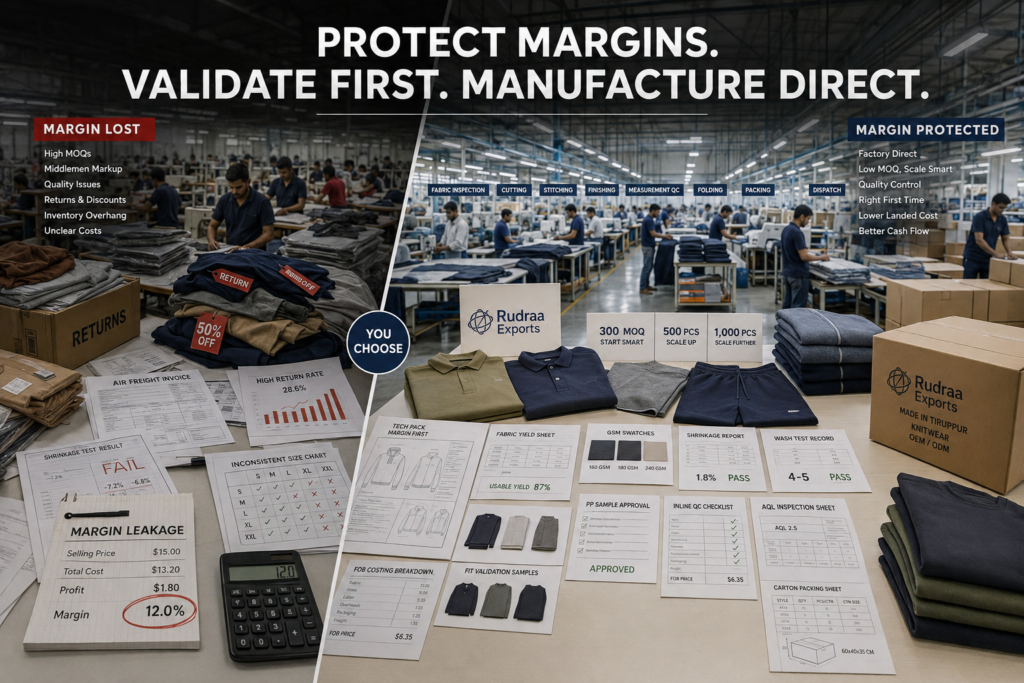
Apparel margins rarely collapse in one day.
They usually disappear slowly.
A little extra sampling confusion.
A weak tech pack.
Wrong fabric.
Too many colours.
Poor size validation.
High returns.
Air freight because production was late.
A discount because stock did not move.
A quality complaint that could have been caught before bulk.
This is how a clothing brand that looks strong on Instagram can still lose money behind the scenes.
The source article explains that apparel margins erode through avoidable mistakes: launching without customer insight, skipping validation, accepting inefficient MOQs and treating production as a black box instead of a cost system.
For brands, private-label managers and e-commerce sellers, apparel profit margin improvement is not only about negotiating a lower FOB price.
It is about building a better sourcing system.
At Rudraa Exports, we help brands protect margins through factory-direct OEM/ODM knitwear manufacturing, 300-piece MOQ planning, tech-pack discipline, sampling, fabric control, QC checkpoints, FOB costing visibility and export-ready production from Tiruppur, India.
Quick Answer
Apparel profit margin improvement starts by controlling the full production system: market research, product validation, tech packs, sampling, wash testing, size grading, MOQ planning, fabric yield, QC and freight. Failed clothing brands often lose margin through poor fit, high returns, wrong fabric, inefficient small runs, air freight, discounting and unclear supplier accountability. Rudraa Exports helps brands improve margin discipline through direct-factory OEM/ODM production, 300 pcs starting MOQ, 500 and 1,000 pcs scale planning, ISO-aligned quality systems, fewer sourcing layers and clearer cost control.
Looking to improve margins on your next apparel production order? Contact Rudraa Exports and share your product type, target price, GSM, fabric, quantity, return-risk concerns and production plan.
Why Apparel Margins Collapse
Apparel brands often focus on selling price and product design.
But margins are lost inside the operations.
The source explains that a 2–4% swing in returns, air freight or fabric yield can wipe out the profit on a style.
Common Margin Leaks
- Weak customer research
- Poor product validation
- Too many SKUs
- Too many colours
- Inefficient MOQ planning
- Wrong fabric choice
- Poor shrinkage control
- Size inconsistency
- High return rate
- Late production
- Emergency air freight
- Discounting
- Rework
- Poor QC
- Hidden agent margins
- Supplier handoff issues
The Core Lesson
A profitable clothing brand is not built only on creative taste.
It is built on controlled decisions.
You need to know:
- What will sell
- What quantity makes sense
- What product quality is required
- What return rate you can survive
- What landed cost protects margin
- What factory process reduces risk
The source says brands should treat market research as a cost-control activity because the goal is to choose products that sell with minimal returns and markdown risk.
Market Shifts That Affect Apparel Margins
Before negotiating with a factory, brands must understand the market.
The source highlights two major shifts that affect margins: digital demand and sustainability expectations.
1. Digital Demand Is Now Baseline
Online fashion selling creates a new margin problem.
Customers buy without touching or trying the product.
That means your product pages, sizing, fit, shrinkage and returns process must be stronger.
If the fit is wrong, online returns can rise quickly.
The source explains that e-commerce returns are one of the sharpest margin cutters and can reduce profitability by up to 42% once logistics, handling and lost resale value are included.
Online Margin Risks
- Wrong size chart
- Poor fit photos
- Shrinkage after wash
- Inconsistent measurements
- Colour mismatch
- Product not matching description
- High reverse logistics cost
- Returned goods losing resale value
2. Sustainability Expectations Are Higher
Customers increasingly expect better quality and more credible sourcing.
The source says consumers demand lower prices and higher standards, especially around sustainability.
Sustainability Margin Risks
- Weak claims without proof
- Poor-quality fabric marketed as premium
- Pilling and shrinkage after wear
- Negative reviews
- Higher returns
- Discounting due to poor trust
Key Takeaway
Do not reduce cost by reducing product life.
Improve margin by engineering waste out of production, not quality out of the garment.
Failed Clothing Brand Case Study: North & Thread
The source gives a fictional but realistic failed-brand example called North & Thread.
The brand launched with elevated essentials:
- Heavyweight tees
- Fleece joggers
- Knit hoodies
They expected premium positioning to protect their margins.
But the model failed.
What Went Wrong
1. Weak Market Research
They relied on social engagement and founder taste.
They did not properly validate willingness to pay.
When customers became price-sensitive, they started discounting early.
The source says inflation and cautious consumer spending pushed brands toward value plus durability.
2. Poor Product Validation
Sampling was rushed.
They skipped proper wash testing.
They did not validate shrinkage, twisting and sizing across colours.
Returns increased because the same size did not fit consistently across colours.
The source says returns are a known profitability killer in fashion e-commerce.
3. Inefficient MOQ Choices
They ordered small runs across too many styles to stay flexible.
But this increased unit cost.
The source explains that small runs carry fixed setup costs that do not scale down, and producing 100 pieces can cost much more per unit than producing 1,000 pieces.
Simplified Margin Failure
The source gives a tee example where planned margin looked strong but real-world costs changed the picture.
| Item | Planned | Actual |
|---|---|---|
| MSRP | $68 | $68 |
| Planned landed cost | $24 | $24 |
| Small-run uplift | — | +$6 |
| Emergency air freight | — | +$3 |
| Returns/damage impact | — | +$8 |
| Effective cost impact | $24 | $41 |
| Gross profit | $44 | $27 |
Then the brand discounted the tee to $54.
Gross profit dropped further.
At that point, one production issue or one missed delivery window could push the style into loss.
Lesson
If your profit depends on perfect execution, the model is already risky.
The source says brands should build a margin plan that survives real-world friction.
Returns-Adjusted Margin: The Number Brands Forget
Many brands calculate margin like this:
Retail price – landed cost = gross profit
That is incomplete.
You also need to include:
- Expected return rate
- Return shipping
- Repacking
- Damaged inventory
- Discounting
- Markdown risk
- Customer support time
- Lost resale value
Better Formula
Retail price – landed cost – return cost – markdown risk – rework risk – freight surprises = real margin
Why This Matters
A product may look profitable at FOB level but fail after returns.
For example:
- Wrong fit increases returns
- Shrinkage increases complaints
- Poor colour consistency increases exchanges
- Late launch causes discounting
- Poor QC increases damaged stock
Rudraa Angle
Rudraa’s direct-factory model helps reduce return-driven margin leakage by focusing on:
- Tech-pack clarity
- Measurement tolerances
- Shrinkage targets
- Fit samples
- PP sample approval
- Inline QC
- Final inspection
- Repeat production consistency
Why Sampling Protects Profit
Sampling is not an optional cost.
It is margin insurance.
The source says sampling is the cheapest insurance a brand can buy when it is run as a disciplined validation process.
What Sampling Should Validate
- Fit
- Fabric
- GSM
- Shrinkage
- Pilling
- Colourfastness
- Stitching
- Rib recovery
- Print durability
- Embroidery quality
- Size grading
- Label placement
- Packaging
Sampling Mistake
Many founders treat sampling fees as avoidable.
But skipping sampling can create:
- Bulk rework
- Stock rejection
- High returns
- Negative reviews
- Discounting
- Relaunch cost
The source says brands often need 2–3 sample iterations for basic cut-and-sew and more for complex products.
Margin-First Sampling Workflow
Step 1: Build a Margin-First Tech Pack
A tech pack should not only show the design.
It should control cost and quality.
Include:
- Fabric
- GSM
- Construction details
- Measurement points
- Tolerances
- Stitch type
- Shrinkage target
- Trim specs
- Label specs
- Packaging rules
The source recommends including construction details, tolerances, measurement points, stitch type, GSM, shrinkage targets and trim specs in the tech pack.
Step 2: Prototype With Fit and Cost Brief
Ask the factory to show cost drivers.
Break down:
- Fabric
- Trims
- Cutting and stitching
- Printing
- Embroidery
- Washing
- Packing
- Overhead assumptions
The source recommends comparing at least two fabric options because fabric can be one of the biggest cost drivers.
Step 3: Run Wear and Wash Testing
Test:
- Shrinkage
- Pilling
- Colourfastness
- Twisting
- Print cracking
- Rib recovery
- Fit after wash
The source says wear/wash testing should be tied to return risk in e-commerce.
Step 4: Validate Size Set and Grading
Online-heavy brands need extra size control.
Check:
- At least key sizes
- Measurements across colours
- Fit on body types
- Size chart accuracy
- Tolerance consistency
The source recommends validating size sets and grading, especially for online-heavy brands.
Step 5: Use Virtual Sampling Where Useful
Virtual sampling can reduce early sample waste.
It is useful for early-stage design corrections.
But final physical samples are still needed for:
- Hand feel
- Fit
- Shrinkage
- Wash testing
- Print feel
- Real construction
The source says virtual sampling can reduce sample rounds, time-to-market and costs in some implementations, but it does not replace final physical approval.
MOQ Planning: Why 300 / 500 / 1,000 Works Better
For Rudraa Exports, MOQ starts from 300 pieces.
This is important for margin discipline.
Small quantities can feel safe, but they often create high per-unit cost.
The source explains that inefficient MOQ choices can increase per-unit cost because fixed setup costs are spread across fewer garments.
Rudraa MOQ Planning
| Quantity | Best Use |
|---|---|
| 300 pcs | Starting point for controlled first production |
| 500 pcs | Better production efficiency and costing |
| 1,000+ pcs | Stronger margin optimization and repeat economics |
Why 300 MOQ Helps
A 300-piece starting MOQ helps with:
- Better fabric usage
- Better cutting efficiency
- Better trim planning
- Better print setup value
- Better size ratio planning
- Better QC structure
- Better export packing
- More realistic landed cost
Why 500 and 1,000 Improve Margin
At higher quantities, brands can reduce unit cost through:
- Better production efficiency
- Better fabric utilization
- Lower setup cost per unit
- Better print/embroidery economics
- More predictable packing
- Better reorder planning
Buyer Tip
Do not split your first order across too many colours.
Instead:
- Validate 1–2 colours
- Keep one fabric base
- Keep one fit block
- Scale winners
- Add colours later
The source recommends consolidating colours, validating winners and scaling to larger quantities where unit cost normalizes.
Direct-Factory Production: The Margin Fix
Once demand and product are validated, margins are won or lost in production.
The source says margins are won or lost through yield, line efficiency, defect prevention and on-time delivery.
What Direct Factory Solves
A direct-factory partner reduces middle layers.
That improves:
- Cost visibility
- Production accountability
- Sampling control
- QC communication
- Fabric planning
- Lead time control
- Issue resolution
- Packing accuracy
- Reorder consistency
The source explains that middle layers dilute accountability and inflate cost, while direct-factory sourcing reduces handoffs.
Rudraa’s Direct-Factory Model
Rudraa Exports’ model supports:
- End-to-end OEM/ODM production
- Product development
- Sampling
- Bulk production
- Finishing
- QC
- Export packing
- ISO-aligned quality systems
- Tiruppur knitwear ecosystem access
- Cost control through fewer sourcing layers
The source says Rudraa’s direct-factory OEM/ODM knitwear setup can unlock cost control, ISO-backed quality systems and fewer margin surprises.
Lean Production Principles That Protect Margin
Lean production is not only for large factories.
Brands can use lean thinking in sourcing decisions.
The source lists lean principles that directly translate to margin: right-first-time quality gates, standardized operations, material planning, fabric utilization control and production transparency.
1. Right-First-Time Quality Gates
Use:
- PP sample approval
- Inline QC
- Endline audits
- Final inspection
This prevents rework, delays and emergency air freight.
2. Standardized Operations
Use SOPs for:
- Cutting
- Stitching
- Finishing
- Printing
- Packing
- Measurement checks
This reduces variation between batches.
3. Fabric Utilization Control
Fabric can be a major cost driver.
Better fabric planning improves margin.
Control:
- Marker efficiency
- Fabric yield
- Cutting waste
- Fabric defect rate
- Recut percentage
The source says fabric can be 50–60% of unit cost in many apparel builds, so cutting waste is margin.
4. Production Transparency
Track:
- Fabric in-house date
- Lab dip approval
- Size set approval
- PP sample approval
- Bulk start date
- Inline QC date
- Packing date
- Shipment date
- Risk flags
How Rudraa Helps Reduce Margin Leakage
1. Reduces Agent Layers
Fewer intermediaries means fewer hidden costs and fewer misunderstandings.
2. Improves Costing Visibility
Rudraa can help buyers understand cost drivers such as:
- Fabric
- GSM
- Trims
- Embroidery
- Washing
- Packing
- Quantity
- QC requirements
3. Supports Better Sampling
Rudraa helps buyers move from idea to validated product through:
- Tech-pack review
- Fabric swatches
- Fit samples
- Size sets
- Wash tests
- PP samples
4. Improves QC Discipline
QC support can include:
- Fabric inspection
- Measurement checks
- Shrinkage review
- Stitching checks
- Print inspection
- Final inspection
- Packing review
5. Supports Scalable Production
Rudraa helps brands plan around:
- 300 pcs starting MOQ
- 500 pcs efficiency planning
- 1,000+ pcs scale production
- Repeat orders
- Stable specs
- Lower per-unit risk
Apparel Profit Margin Checklist
- Target customer validated
- Willingness to pay checked
- Competitor pricing reviewed
- Expected return rate planned
- Returns-adjusted margin calculated
- Product intent sheet prepared
- Margin-first tech pack created
- Fabric cost understood
- GSM selected
- Shrinkage target defined
- Pilling check planned
- Size set validation planned
- Wash testing planned
- PP sample required
- MOQ planned from 300 pcs
- 500 pcs price break requested
- 1,000 pcs price break requested
- Fabric yield considered
- Inline QC agreed
- Final inspection agreed
- Freight mode planned
- Air freight risk budgeted
- Discounting impact modelled
- Reorder trigger defined
How Rudraa Exports Supports Margin-Focused Apparel Brands
Rudraa Exports supports brands and private-label buyers that want to improve apparel profit margins through direct-factory production.
Rudraa Support Includes
- Margin-first product discussion
- OEM/ODM knitwear production
- Tech-pack review
- Fabric and GSM discussion
- Sampling support
- Fit sample development
- Size set planning
- Wash test discussion
- Shrinkage target discussion
- PP sample approval
- 300 pcs MOQ planning
- 500 and 1,000 pcs scale pricing discussion
- Fabric yield discussion
- Inline QC
- Endline checks
- Final inspection
- Export packing
- FOB quote
- Direct-factory production planning
Products Supported
- T-shirts
- Polo shirts
- Hoodies
- Sweatshirts
- Joggers
- Knitwear basics
- Private-label apparel
- DTC brand essentials
- Corporate apparel
- Retail basics
- OEM/ODM knitwear programs
Why Rudraa Fits Margin-Focused Buyers
Rudraa is a strong fit for brands that need:
- Better cost visibility
- Direct factory accountability
- Fewer middle layers
- 300+ pcs MOQ planning
- Sampling discipline
- QC visibility
- Repeatable production
- Export-ready processes
- Margin protection across seasons
The source says Rudraa’s direct-factory model can reduce sampling churn, production waste and late-stage logistics surprises.
Ready to protect your next production margin? Speak with Rudraa Exports and request a costing and validation plan for your next season.
FAQ: Apparel Profit Margin Improvement
1. Why do clothing brand margins collapse?
Margins collapse because of poor validation, weak tech packs, inefficient MOQs, high returns, rework, emergency freight, discounting and unclear supplier accountability.
2. What is returns-adjusted margin?
Returns-adjusted margin is the real profit left after accounting for return costs, repacking, damaged inventory, markdowns, support cost and lost resale value.
3. Why are apparel returns so expensive?
Returns include outbound shipping, return shipping, labour, inspection, repacking, discounting and inventory value loss.
4. How does sampling improve margins?
Sampling catches fit, shrinkage, pilling, colour and construction issues before bulk production, reducing returns and rework.
5. What should a margin-first tech pack include?
It should include fabric, GSM, construction details, measurements, tolerances, stitch type, shrinkage targets, trims, labels and packaging.
6. What is Rudraa Exports’ MOQ?
Rudraa Exports’ MOQ starts from 300 pieces, depending on product, fabric, colour, trims and production complexity.
7. Why do small MOQs hurt margin?
Small quantities spread setup, sampling, trim and production costs across fewer garments, increasing per-unit cost.
8. Why quote 300, 500 and 1,000 pieces?
These quantities help buyers compare starting MOQ, better production efficiency and scale economics before planning a bulk order.
9. How does direct factory sourcing improve margin?
Direct factory sourcing reduces agent layers, improves cost visibility, strengthens QC communication and creates clearer accountability.
10. What is the fastest way to reduce apparel returns?
Improve fit consistency, size charts, shrinkage control, wash testing and pre-production sample approval.
11. Can virtual sampling replace physical samples?
No. Virtual sampling can reduce early sample rounds, but physical samples are still needed for fit, hand feel, wash testing and final approval.
12. How can Rudraa help with margin-focused sourcing?
Rudraa helps through direct-factory OEM/ODM production, tech-pack review, sampling, 300 MOQ planning, QC checkpoints, fabric control and export-ready production.
Conclusion
Apparel profit margin improvement is not only a finance problem.
It is a sourcing and production problem.
A brand can lose margin through poor customer research, weak validation, wrong fabric, inefficient MOQs, high returns, rework, delayed production, air freight and discounting.
The fix is not simply asking for a cheaper quote.
The fix is building a better production system.
That system starts with market research, returns-adjusted margin planning, margin-first tech packs, structured sampling, wash testing, size validation, realistic MOQ planning, lean production and direct-factory accountability.
Rudraa Exports helps brands protect margin by offering factory-direct OEM/ODM knitwear production from Tiruppur, India with 300 pcs starting MOQ, 500 and 1,000 pcs scale planning, sampling support, QC checkpoints, fabric control, ISO-aligned systems and export-ready production.
Visit rudraaexports.com or contact Rudraa Exports to request a costing and validation plan for your next apparel production program.