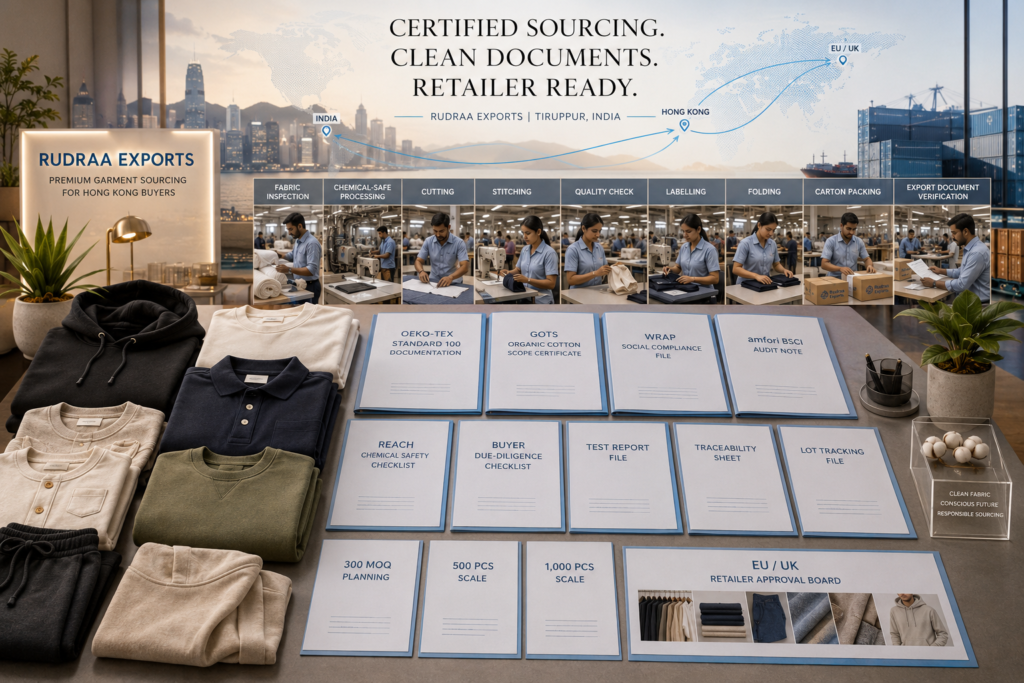
Hong Kong buyers selling into the EU and UK cannot depend only on supplier promises anymore.
Retailers, marketplaces and end customers increasingly ask for proof.
They want to know what is inside the garment, how the fabric was processed, whether chemical safety is controlled, whether organic claims are valid and whether the factory follows responsible production practices.
That is why certifications like OEKO-TEX, GOTS, WRAP and BSCI matter.
They are not a replacement for legal compliance, but they help buyers reduce risk, prepare documentation and move faster through customer approval.
At Rudraa Exports, we support Hong Kong buyers sourcing from India with certified production discussions, traceability, documentation planning, factory-direct communication, QC checkpoints and 300 pcs starting MOQ for suitable garment programs.
Quick Answer
Hong Kong buyers looking for OEKO-TEX and GOTS certified garment manufacturers in India should verify certificate validity, product scope, factory address, renewal date and whether the certification applies to the exact fabric or product being ordered. Rudraa Exports helps buyers source certified or compliance-ready garments from Tiruppur with 300 pcs starting MOQ, 500 and 1,000 pcs scale planning, traceability, QC, documentation support and EU/UK retailer-focused compliance preparation.
Why Certifications Matter for Hong Kong Buyers
Hong Kong buyers often act as sourcing partners, importers, wholesalers or brand owners selling into international markets.
When the final customer is in the EU or UK, compliance expectations become stricter.
Buyers may need proof for:
- Chemical safety
- Organic cotton claims
- Fibre content
- Social compliance
- Factory audits
- Traceability
- Restricted substance requirements
- Retailer onboarding
- Marketplace approval
The uploaded source explains that Hong Kong buyers selling into the EU/UK are entering a “prove-it” era where sourcing teams must document what is in a garment, not only where it was made.
What OEKO-TEX Means
OEKO-TEX STANDARD 100 is a product-focused certification.
It checks textile products for harmful substances.
This is useful for garments that touch skin, such as:
- T-shirts
- Babywear
- Innerwear
- Loungewear
- Hoodies
- Kidswear
- Cotton basics
For Hong Kong buyers, OEKO-TEX helps reduce the risk of chemical safety questions during retailer or customer approval.
The uploaded source explains that OEKO-TEX STANDARD 100 focuses on harmful-substance testing and annual renewal.
What GOTS Means
GOTS stands for Global Organic Textile Standard.
It is important when a buyer wants to sell garments with organic cotton claims.
GOTS is not only about the cotton fibre.
It also looks at processing, supply-chain control, chemical restrictions, labelling rules and social criteria.
The uploaded source explains that GOTS verifies organic fibre content and processing rules across the supply chain, along with social criteria.
If a Hong Kong brand wants to claim “organic cotton,” it should not depend only on verbal confirmation.
It should verify GOTS scope and documentation.
What WRAP and BSCI Mean
WRAP and BSCI are more focused on social compliance and factory-level responsibility.
They help buyers understand whether the factory has systems for:
- Legal compliance
- Worker safety
- Working hours
- Child labour prevention
- Forced labour prevention
- Health and safety
- Workplace standards
- Corrective action tracking
The uploaded source explains that WRAP and amfori BSCI address facility-level social compliance and risk management that EU/UK retailers increasingly expect.
For Hong Kong buyers selling to bigger retailers, this documentation can make supplier onboarding smoother.
Certified vs Non-Certified Manufacturing
| Criteria | Certified Factory | Non-Certified Factory |
|---|---|---|
| Chemical Safety | Stronger evidence | Depends on testing |
| Organic Claims | Better claim support | Higher green-claim risk |
| Social Compliance | More structured | Buyer may need audits |
| Retailer Approval | Usually smoother | More document requests |
| Cost | Higher upfront | Lower initial FOB |
| Risk | Lower hidden risk | Higher rework/testing risk |
The uploaded source compares certified Indian factories with non-certified factories across chemical safety, organic credibility, social compliance, audit readiness, traceability, cost structure and time-to-market.
Certification Is Not Just a Badge
Many brands treat certifications like marketing labels.
That is risky.
Certification should be used as a sourcing control.
Buyers should ask:
- Is the certificate valid?
- Is the factory name correct?
- Is the address correct?
- Is the product category covered?
- Is the fabric covered?
- Is the process covered?
- Is the certificate expired?
- Can the certificate be verified officially?
A PDF alone is not enough.
The uploaded source recommends asking for certificate numbers and scopes before requesting costing.
Cost Difference: Certified vs Non-Certified
Certified production may cost more than non-certified production.
But the buyer should not compare FOB only.
A lower-cost uncertified supplier may create hidden costs later.
Hidden costs can include:
- Extra lab testing
- Failed tests
- Rework
- Retailer rejection
- Delayed approvals
- Missed delivery windows
- Claim correction
- Legal or compliance review
The uploaded source explains that certified production can add cost, but often reduces total landed risk by lowering retest, rejection and approval-delay risk.
For Hong Kong buyers selling into EU/UK channels, this risk reduction can be more valuable than saving a few cents on FOB.
Rudraa MOQ for Certified Garment Programs
Rudraa Exports’ MOQ starts from 300 pieces.
For certified or organic programs, MOQ may depend on:
- Fabric type
- Yarn availability
- Dyeing process
- Colour count
- Certification scope
- Product complexity
- Trims and labels
- Testing requirement
MOQ Planning
- 300 pcs for first serious production
- 500 pcs for better efficiency
- 1,000 pcs for stronger scale economics
Certified programs should be planned early because organic fabric, trims and documentation may need more coordination than regular production.
When Certified Manufacturing Is the Best Fit
Certified production is a strong fit if you sell into:
- EU retailers
- UK retailers
- Premium marketplaces
- Babywear channels
- Organic cotton collections
- Sustainable fashion stores
- Compliance-heavy B2B accounts
- Private-label retailer programs
It is also useful when your brand uses claims like:
- Organic cotton
- Skin-safe
- Chemical-safe
- Responsibly made
- Sustainable basics
- Ethically sourced
The uploaded source explains that buyers with EU/UK retail exposure, sustainability claims and social compliance expectations are a strong fit for certified production.
When Non-Certified May Be Acceptable
Non-certified manufacturing may be acceptable when:
- You sell only in low-compliance channels
- You are not making sustainability claims
- You are doing early product testing
- You can pay for lot-by-lot testing
- Your buyer accepts lab reports instead of certification
- The product is simple and low-risk
But buyers must be honest.
If the sales pitch depends on “organic,” “safe,” “non-toxic” or “ethically made,” uncertified production increases risk.
How to Verify Certifications
Before production, ask for:
- OEKO-TEX certificate number
- GOTS scope certificate
- WRAP validity details
- BSCI audit/report status
- Factory name and address
- Product scope
- Process scope
- Expiry date
- Official verification link or method
Do not rely only on WhatsApp screenshots or old PDFs.
The uploaded source recommends checking validity windows, GOTS scope certificates, logo rules, official verification and facility match before development.
Rudraa’s Direct-Factory Advantage
For Hong Kong buyers, direct-factory sourcing helps reduce certification confusion.
A direct route gives better control over:
- Fabric source
- Trims
- Dyeing process
- Product scope
- QC
- Labelling
- Documentation
- Shipment records
- Traceability
With an agent, compliance documents may pass through multiple hands.
That can make it harder to know whether the certificate applies to the exact production site or product.
5-Step Migration Plan to Certified Sourcing
Step 1: Define Your Compliance Target
Start with your end customer.
Are they asking for OEKO-TEX, GOTS, WRAP, BSCI or specific restricted substance testing?
Map each requirement to a document.
Step 2: Verify Certificates Before Sampling
Do not wait until bulk production.
Check certificate validity, scope, address and product coverage before sampling starts.
Step 3: Run a Certified Pilot Order
Start with one or two core SKUs.
Use a 300 pcs first production where suitable and test the full documentation process.
Step 4: Build a Compliance Pack
Prepare a folder with:
- Certificates
- Scope documents
- Test reports
- Fibre declarations
- QC reports
- Lot traceability
- Packing details
This helps retail and marketplace approvals.
Step 5: Scale with Standard Fabrics
Scaling certified production becomes easier when you standardize fabrics, trims and colour systems.
Use the same approved base fabric across multiple SKUs where possible.
FAQ
1. What is the difference between OEKO-TEX and GOTS?
OEKO-TEX STANDARD 100 focuses mainly on harmful-substance testing for textile products and garment components.
GOTS is broader for organic textiles because it covers organic fibre content, processing rules, labelling requirements and supply-chain control.
2. Do Hong Kong buyers need certified garment manufacturers?
Certification is especially useful when Hong Kong buyers sell into EU/UK retailers, marketplaces or premium channels.
It helps reduce approval delays, testing surprises and documentation gaps, especially for babywear, organic cotton and skin-contact products.
3. What is Rudraa Exports’ MOQ for certified garment production?
Rudraa Exports’ MOQ starts from 300 pieces, depending on product, fabric, colour, certification requirement and complexity.
Certified or organic programs may need more planning because fabric sourcing, traceability and documentation must match the claim.
4. Is a certificate PDF enough proof?
No, buyers should not depend only on a PDF because certificates can expire, be misused or apply to a different scope.
Always verify the certificate number, validity date, product category, factory address and official verification method before production.
5. Can non-certified factories still be used?
Yes, non-certified factories may be acceptable for low-risk products, early testing or markets where buyers do not require sustainability claims.
However, if you sell using claims like organic, safe, non-toxic or responsibly made, certified production gives stronger protection and documentation.
Conclusion
For Hong Kong buyers selling into the EU and UK, certified garment sourcing is becoming more important.
OEKO-TEX, GOTS, WRAP and BSCI help buyers prove chemical safety, organic claims, social compliance and supply-chain responsibility.
But certification should not be treated as decoration.
It must be verified, scoped correctly and matched to the exact product and factory.
Rudraa Exports helps Hong Kong buyers source from India with certified production discussions, 300 pcs starting MOQ, 500 and 1,000 pcs scale planning, traceability, QC checkpoints, compliance documentation and export-ready garment manufacturing from Tiruppur.
Visit rudraaexports.com or contact Rudraa Exports to request Rudraa’s certification pack and certified garment sourcing plan.