
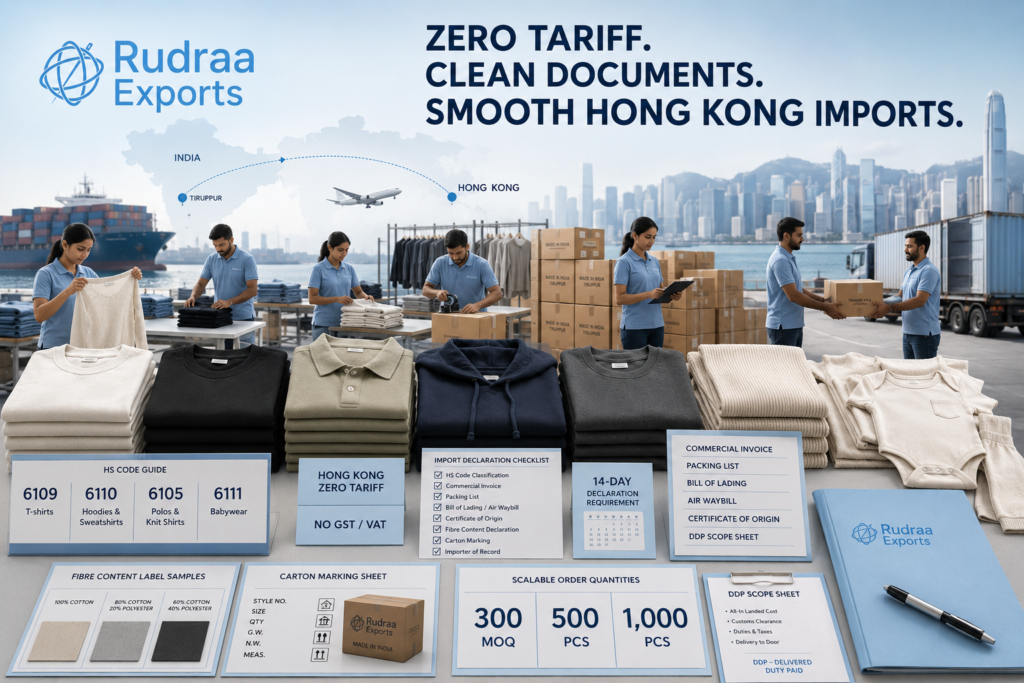
Hong Kong is one of the easiest apparel import markets in Asia when the paperwork is correct.
For garment buyers, the biggest advantage is clear: Hong Kong follows a free-port policy and generally has zero import tariff on apparel. It also does not have GST or VAT at import.
This makes landed-cost planning easier compared with many other markets.
But easy does not mean automatic.
Garment shipments can still face delays when HS codes are wrong, invoices do not match packing lists, descriptions are unclear, declarations are late, or retail labels are not ready.
For Hong Kong buyers sourcing from India, the goal is simple:
Get the classification, documents and shipment process right before the goods leave India.
At Rudraa Exports, we support Hong Kong brands with export-ready garment manufacturing from Tiruppur, India, including HS-code coordination, commercial invoice, packing list, shipping documents, DDP discussion, fibre-label alignment and 300 pcs starting MOQ planning.
Quick Answer
To import garments from India to Hong Kong, buyers need correct HS classification, clean commercial invoice, packing list, Bill of Lading or Air Waybill, Certificate of Origin where required, and timely Hong Kong import declaration. Apparel generally enters Hong Kong with zero import tariff and no GST/VAT, but delays can happen due to wrong HS codes, missing documents or late declarations. Rudraa Exports helps reduce friction through export-ready documentation, factory-direct communication, DDP planning and 300 pcs MOQ production.
Why Hong Kong Is Attractive for Apparel Imports
Hong Kong is a free port.
For apparel buyers, this means import duty is usually not the main cost problem.
The real risks are operational:
- Wrong HS code
- Incorrect product description
- Invoice and packing list mismatch
- Missing carton details
- Missing weights
- Late declaration
- Incorrect fibre content
- Poor shipment coordination
So Hong Kong import success depends more on documentation discipline than tariff planning.
Key HS Codes for Garment Imports
HS codes help customs and trade systems classify goods.
For knitted and crocheted garments, Chapter 61 is usually the starting point.
Hong Kong buyers importing knitwear from India commonly deal with these headings.
HS 6109: T-Shirts and Vests
This heading is commonly used for knitted or crocheted T-shirts, singlets and vests.
Example products:
- Crew-neck T-shirts
- Basic cotton tees
- Sleeveless vests
- Knitted undershirts
For cotton T-shirts, buyers often see classification under cotton-related subheadings within 6109.
HS 6110: Hoodies, Sweatshirts and Pullovers
This heading is commonly used for knitted or crocheted jerseys, pullovers, cardigans and similar garments.
Example products:
- Hoodies
- Sweatshirts
- Pullovers
- Fleece tops
- Knit jumpers
A brushed fleece hoodie will often be treated differently from a basic crew-neck T-shirt.
HS 6105: Men’s or Boys’ Knit Shirts
This heading is commonly used for men’s or boys’ knitted shirts.
Example products:
- Polo shirts
- Collared knit shirts
- Placket T-shirts
- Men’s knitted shirts
A polo with collar and placket should not automatically be treated as a normal T-shirt.
HS 6111: Babywear
This heading is used for babies’ garments and clothing accessories.
Example products:
- Baby rompers
- Infant T-shirts
- Baby bodysuits
- Baby sleepwear
- Infant clothing sets
Babywear needs extra care because buyers may also require stronger safety, labelling and compliance checks.
Why Product Description Matters
Do not use vague descriptions like:
- Tops
- Garments
- Knitwear
- Fashion items
Use clear descriptions such as:
- Men’s 100% cotton knitted polo shirts
- Women’s cotton crew-neck T-shirts
- Children’s knitted sweatshirts
- Baby cotton knitted rompers
A clear product description helps reduce queries and document corrections.
Documents Needed for Hong Kong Import
Before shipment, buyers should prepare a clean document set.
Core Documents
- Commercial invoice
- Packing list
- Bill of Lading for sea shipments
- Air Waybill for air shipments
- Certificate of Origin where required
- HS code details
- Carton count
- Net weight
- Gross weight
- CBM
- Buyer and exporter details
- Incoterms
- Shipment mode
Rudraa helps buyers prepare export documentation so the shipment file is consistent.
Hong Kong Import Declaration
Hong Kong import declarations must be handled within the required timeline after importation.
This is an important operational step even when garment duty is zero.
Late declaration can create penalties and unnecessary follow-up.
Buyers should assign responsibility before shipment arrives.
Use a 4-Document Gate
Before cargo leaves India, check these four documents:
- Commercial invoice
- Packing list
- Bill of Lading or Air Waybill draft
- Certificate of Origin, if required
No shipment should move until the data matches.
Check style numbers, quantities, carton count, weights, product description, buyer name and destination details.
Fibre Content and Retail Readiness
Hong Kong buyers should also align commercial documents with retail labels.
If the garment label says 100% cotton, the invoice and product specification should not conflict.
Check:
- Fibre composition
- Care label
- Size label
- Country of origin
- Barcode label
- Carton marking
- Retail packing
- Any buyer-specific compliance note
For premium basics, babywear and sustainability-led products, buyers may also ask for OEKO-TEX or GOTS documentation where applicable.
FOB, CIF or DDP: Which One Should You Choose?
Hong Kong buyers can import under different Incoterms depending on internal capability.
FOB
FOB works if the buyer has a strong freight partner and wants control over logistics.
CIF
CIF includes cost, insurance and freight to destination port, but local destination work must still be managed.
DDP
DDP can simplify operations when the buyer wants the seller or service partner to handle transport and import formalities as agreed.
Hong Kong still has zero duty on apparel, but DDP can reduce coordination work by bundling logistics, documentation and delivery responsibilities.
Rudraa can discuss DDP options depending on shipment size, destination and buyer requirements.
Rudraa MOQ for Hong Kong Imports
Rudraa Exports’ MOQ starts from 300 pieces.
For Hong Kong buyers, this allows serious trial production while keeping order risk controlled.
Buyers can request quote breaks at:
- 300 pcs for first production
- 500 pcs for improved efficiency
- 1,000 pcs for better scale economics
A 300 pcs MOQ supports proper fabric planning, size ratio, trims, labels, QC and export packing.
Step-by-Step Import Process
Step 1: Share Tech Pack
Send product details, measurement chart, fabric composition, GSM, artwork, label details and packing needs.
Step 2: Confirm HS Code
Map each product type to the correct HS heading.
Use 6109 for T-shirts, 6110 for hoodies and sweatshirts, 6105 for polos and 6111 for babywear where applicable.
Step 3: Approve Sample
Approve fabric, fit, construction, print, labels and packing before bulk.
Step 4: Run Bulk Production
Use PP sample approval, inline QC and final inspection to protect consistency.
Step 5: Check Documents
Review invoice, packing list, BL or AWB, COO and carton details before shipment.
Step 6: File Hong Kong Declaration
Assign responsibility and complete the declaration within the required timeline.
FAQ
1. Is there import duty on garments in Hong Kong?
Hong Kong generally has zero import tariff on apparel because it operates as a free port.
2. Does Hong Kong have GST or VAT on garment imports?
Hong Kong does not have GST or VAT at import, making landed-cost planning simpler.
3. What HS code is used for T-shirts?
Knitted T-shirts are commonly classified under HS 6109.
4. What HS code is used for hoodies?
Knitted hoodies and sweatshirts commonly fall under HS 6110.
5. What is Rudraa Exports’ MOQ?
Rudraa Exports’ MOQ starts from 300 pieces, depending on product, fabric, colour, trims and complexity.
Conclusion
Importing garments from India to Hong Kong can be simple when classification and paperwork are handled correctly.
Hong Kong’s zero-tariff and no GST/VAT structure makes it attractive for apparel buyers, but shipments still need accurate HS codes, clean invoice data, packing list accuracy, correct labels and timely import declaration.
Rudraa Exports helps Hong Kong brands source garments from Tiruppur, India with 300 pcs starting MOQ, 500 and 1,000 pcs scale planning, HS-code coordination, export-ready documentation, DDP discussion, QC checkpoints and shipment planning.
Visit rudraaexports.com or contact Rudraa Exports to request a quote for your next India-to-Hong Kong garment import program.