
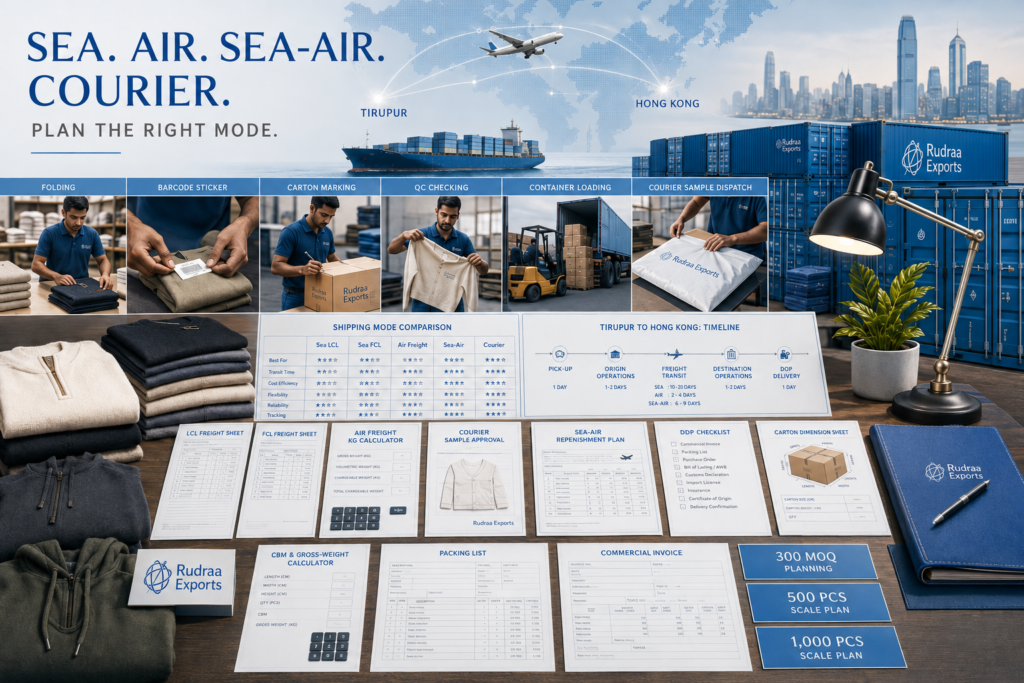
Hong Kong fashion buyers sourcing from Tirupur need one thing above all: predictable delivery.
The garment may be approved.
The price may be right.
The factory may be ready.
But if shipping is planned badly, the launch calendar still suffers.
For Hong Kong brands, shipping from Tirupur to Hong Kong is not only about transit time. It includes inland movement from Tirupur, export handling, consolidation, carrier cut-offs, customs documentation, destination handling and final delivery.
At Rudraa Exports, we help Hong Kong buyers plan garment shipments from Tirupur with the right mode mix: sea LCL, sea FCL, air freight, sea-air or courier. Our role is to connect production readiness with logistics planning so buyers can protect both cost and launch timing.
Quick Answer
Tirupur to Hong Kong garment shipping can be planned through sea LCL, sea FCL, air freight, sea-air or courier. Sea LCL is suitable for smaller finished-goods shipments where cost matters more than speed. Sea FCL works better for high-volume orders and stable flows. Air freight is best for urgent launches and replenishment. Sea-air is useful when ocean is too slow and air is too expensive. Courier is best for samples, lab dips and approval parcels. Rudraa Exports supports buyers with export packing, DDP discussion, real-time tracking and mode planning from 300 pcs MOQ.
Shipping Mode Comparison
| Mode | Planning Time | Best For |
|---|---|---|
| Sea LCL | 18–22 days | Small-to-mid bulk lots |
| Sea FCL | 15–18 days | High-volume POs |
| Air freight | 5–7 days | Urgent launches and top-ups |
| Sea-air | 10–14 days | Mid-speed replenishment |
| Courier | 3–5 days | Samples and approvals |
These ranges should be treated as planning bands, not guarantees.
Actual timing depends on cargo readiness, cut-off dates, carrier schedule, documentation, consolidation, seasonality and destination handling.
Sea LCL: Best for Smaller Bulk Shipments
LCL means less than container load.
Your cartons move inside a shared container with other shipments.
This makes LCL useful when the order is not large enough for a full container.
LCL Works Best For
- Small-to-mid finished-goods lots
- Cost-sensitive shipments
- Flexible delivery dates
- Trial orders
- Slow-moving replenishment
- Mixed product shipments
LCL Watch-Out
LCL can take longer because cargo must be consolidated at origin and deconsolidated at destination.
More touchpoints mean more schedule variability.
Use LCL when cost matters more than speed.
For Rudraa buyers starting at 300 pcs or 500 pcs, LCL may be practical depending on carton volume and launch urgency.
Sea FCL: Best for Scale and Predictability
FCL means full container load.
This is usually better when the buyer has enough volume or can combine multiple POs.
FCL normally gives better cost per CBM and fewer handling points.
FCL Works Best For
- Larger garment orders
- Repeat monthly programs
- High-volume retail shipments
- Stable demand
- Planned seasonal launches
- Consolidated multi-style POs
FCL Watch-Out
FCL is not always economical if the order is too small.
You may pay for unused container space.
For Hong Kong buyers scaling from 1,000 pcs and above, Rudraa can help review whether cartons can be consolidated into a more efficient sea freight plan.
Air Freight: Best for Speed
Air freight is the fastest bulk option.
It is useful when launch timing matters more than freight cost.
Air Works Best For
- Time-critical launches
- Urgent size balancing
- Colour replenishment
- Influencer campaigns
- Missed stock recovery
- Short selling seasons
Air Watch-Out
Air freight can quickly increase landed cost.
It should be used strategically, not as a panic solution for poor planning.
A common strategy is to airship a small percentage of goods for launch while sending the balance by sea.
For example, a Hong Kong brand may ship 20% by air for launch and 80% by sea for replenishment.
Sea-Air: The Middle Path
Sea-air is a hybrid option.
It is useful when full air is too expensive but full ocean is too slow.
Sea-Air Works Best For
- Fast-ish replenishment
- Mid-priority launches
- Partial urgent orders
- Products with reasonable margin
- Buyers trying to avoid full air cost
Sea-Air Watch-Out
Sea-air has more nodes than direct air.
That means documentation and tracking must be strong.
Use sea-air only when the routing is clear and the forwarder can provide reliable milestones.
Courier: Best for Samples
Courier is usually not suitable for finished bulk shipments.
It is best for sample movement.
Courier Works Best For
- Lab dips
- Fabric swatches
- Fit samples
- Size sets
- Pre-production samples
- Trim approvals
- Urgent documents
Courier is expensive per kg, but it is valuable because it protects decision speed.
In fast-fashion calendars, a sample arriving two days earlier can save a week in production planning.
Worked Example: 5,000 T-Shirts
Assume a Hong Kong buyer is shipping 5,000 T-shirts from Tirupur.
Approximate shipment profile:
- Weight: 350 kg
- Volume: 2.5 CBM
LCL Scenario
LCL may be cost-efficient because the shipment is not large.
It works if the buyer has enough buffer time.
Air Scenario
Air is faster but more expensive.
It may be justified if the launch date is fixed and late delivery would create lost sales.
Courier Scenario
Courier is not practical for 5,000 finished T-shirts.
It should be reserved for samples and approval parcels.
Best Practical Strategy
Use courier for approvals, air for urgent launch quantities and sea for planned bulk.
This gives better balance between speed and cost.
DDP to Hong Kong: Where Rudraa Helps
Some Hong Kong buyers prefer DDP because it gives one landed-cost line and reduces internal coordination.
DDP can include freight, handling, documentation and delivery depending on the agreed scope.
But DDP must be clearly defined.
DDP Checklist
Confirm:
- Export packing
- Commercial invoice
- Packing list
- HS code
- Carton count
- Gross weight
- Net weight
- CBM
- Freight mode
- Destination handling
- Local delivery
- Tracking updates
Rudraa’s role is to align production readiness with freight planning so buyers do not choose the right mode too late.
Planning Around Peak Season
Shipping can become slower or more expensive during peak periods.
Plan extra buffer around:
- Chinese New Year
- Holiday retail seasons
- Monsoon disruptions
- Port congestion
- Air cargo demand spikes
- Last-minute buyer approvals
The best way to avoid emergency air freight is to lock approvals earlier.
Mode Selection Guide
Choose courier for samples.
Choose air when lost sales are more expensive than freight.
Choose sea-air when you need mid-speed replenishment.
Choose LCL when volume is smaller and timing is flexible.
Choose FCL when order volume is steady and container economics make sense.
Rudraa MOQ and Shipping Planning
Rudraa Exports’ MOQ starts from 300 pieces.
For shipping planning, buyers should compare:
- 300 pcs for controlled first order
- 500 pcs for better packing efficiency
- 1,000 pcs for stronger freight planning
Higher quantities can improve carton planning and reduce per-unit freight cost, especially when buyers consolidate styles or colours.
Migration Plan: Building a Better Shipping Calendar
Step 1: Work Backward from Delivery Date
Start with the Hong Kong delivery date.
Then map:
- Store launch date
- DC appointment
- Required arrival date
- Freight mode
- Packing date
- Final QC date
- Production finish date
- Fabric in-house date
Step 2: Set a Split Shipment Rule
Use a planned split instead of panic shipping.
Example:
- 20% air for launch
- 80% sea for replenishment
Step 3: Standardise Packing
Use carton sizes that work for both air and sea where possible.
Keep SKU labels and carton marks consistent.
Step 4: Lock Documents Early
Prepare:
- Invoice
- Packing list
- HS code
- Carton details
- Weight
- CBM
- Buyer details
- Delivery address
Step 5: Review After Two Cycles
Compare:
- On-time delivery
- Freight cost
- Delay reasons
- Documentation accuracy
- Inventory days saved
- Air freight usage
Then adjust the next shipping plan.
FAQ
1. What is the fastest shipping mode from Tirupur to Hong Kong?
Courier is fastest for samples. Air freight is fastest for bulk garments.
2. What is the cheapest mode?
Sea freight is usually the cheapest, especially FCL for larger shipments.
3. When should I use LCL?
Use LCL for smaller bulk shipments where cost matters more than speed.
4. What is Rudraa Exports’ MOQ?
Rudraa Exports’ MOQ starts from 300 pieces, depending on product, fabric, colour and complexity.
5. Can Rudraa support DDP to Hong Kong?
Rudraa can discuss DDP options and help buyers define freight, documentation and delivery scope.
Conclusion
Shipping from Tirupur to Hong Kong should be planned by mode, not guessed at the end.
Sea LCL, sea FCL, air, sea-air and courier all have a role.
The right choice depends on launch urgency, quantity, carton volume, margin, approval speed and inventory risk.
Rudraa Exports helps Hong Kong buyers connect garment production with shipping planning through 300 pcs starting MOQ, export packing, DDP discussion, real-time tracking and a partner freight network.
Visit rudraaexports.com or contact Rudraa Exports to request a shipping-mode plan for your next Tirupur-to-Hong Kong garment order.