
Buying wholesale T-shirts is not only about finding the lowest price.
For importers, retailers, private-label brands and distributors, the real challenge is getting factory pricing without losing control over quality, compliance, consistency and delivery.
A cheap quote can become expensive if the GSM changes, dye lots vary, labels are wrong, cartons are packed incorrectly or the supplier cannot repeat the same product next season.
That is why many buyers prefer factory-direct sourcing.
India, especially Tiruppur in Tamil Nadu, is one of the strongest sourcing hubs for wholesale cotton T-shirts because the region combines knitting, dyeing, cutting, stitching, printing, finishing, packing and export support in one ecosystem.
At Rudraa Exports, we help international buyers source wholesale T-shirts from India directly from the factory with transparent FOB pricing, MOQ planning, GSM options, private-label support, compliance documentation, QC checkpoints and FOB or DDP logistics.
Quick Answer
Wholesale T-shirts from India are best sourced directly from factories when buyers need consistent GSM, stable sizing, private-label trims, export documentation and repeatable bulk production. Tiruppur factories commonly support 160 GSM, 180 GSM and 200 GSM cotton T-shirts, with MOQs depending on whether the order is white blanks, solid dyed tees or printed designs. Factory-direct sourcing helps buyers reduce agent margins, improve quality visibility and choose between FOB control or DDP delivered-cost simplicity.
Looking for wholesale T-shirts from India? Contact Rudraa Exports and share your quantity, GSM, colour count, print requirement, size ratio and destination.
Why Buy Wholesale T-Shirts from India?
India has a strong position in cotton knitwear and export-ready T-shirt manufacturing.
Tiruppur is especially important because it is a concentrated knitwear cluster.
The uploaded guide explains that Tiruppur’s knitwear cluster is built for integrated T-shirt manufacturing and export-ready processes, supported by compliance systems and certifications.
Buyers Source from India For
- Cotton T-shirts
- White blanks
- Solid dyed tees
- Oversized T-shirts
- Bio-washed tees
- Screen-printed T-shirts
- Private-label T-shirts
- Promotional tees
- Retail basics
- Marketplace inventory
- Corporate merchandise
- Export bulk programs
Tiruppur Advantage
Tiruppur gives buyers access to:
- Cotton knit fabric sourcing
- GSM options
- Dyeing support
- Cutting and stitching
- Print coordination
- Private-label trims
- Export packing
- QC inspection
- Compliance documentation
- Repeat bulk production
Factory-Direct vs Agent or Trader Sourcing
When buying wholesale T-shirts from India, buyers usually choose between:
- Factory-direct sourcing
- Agent or trader sourcing
The uploaded source compares Rudraa’s factory-direct model with agent/trader sourcing across unit cost, MOQ flexibility, GSM control, QC visibility, lead time, certifications, logistics and risk management.
Quick Comparison
| Criteria | Factory-Direct Sourcing | Agent / Trader Model |
|---|---|---|
| Pricing | Closer to real manufacturing cost | Agent margin added |
| MOQ | Clear factory MOQ logic | Apparent MOQ may be pooled |
| GSM control | Direct fabric choice | Limited transparency |
| Quality visibility | Direct approvals and checks | QC can be filtered |
| Lead time | More predictable with one factory | Can vary if factory changes |
| Certifications | Easier to verify at source | May vary order to order |
| Logistics | FOB or DDP clarity | DDP may be less transparent |
| Accountability | Direct factory responsibility | More handoffs |
Main Advantage
Factory-direct sourcing removes unnecessary layers.
That helps buyers improve:
- Cost transparency
- Quality control
- Dye-lot consistency
- Sampling accuracy
- Reorder repeatability
- Export packing control
The uploaded guide explains that factory-direct buying reduces margin layers and gives clearer accountability for specs, testing and packing lists.
Why Agent Margins Matter
Even a small markup becomes large at wholesale scale.
Example
If a factory FOB price is $1.90 per T-shirt and an agent adds 20%, the buyer pays $2.28 per T-shirt.
On 10,000 pcs, that adds $3,800 before freight, duty or taxes.
The uploaded guide gives this same pricing example to show how agent margins affect wholesale T-shirt buying.
What That Extra Cost Could Fund
Instead of paying hidden margin, buyers could use the money for:
- Better fabric
- Better packaging
- Lab testing
- Faster freight
- Private-label trims
- Third-party inspection
- Larger reorder stock
FOB Price Benchmarks for Wholesale T-Shirts
FOB pricing depends on fabric, GSM, finishing, printing and quantity.
The uploaded source explains that Tiruppur T-shirt manufacturing cost estimates usually range from $1.50 to $4.00 per piece, depending on fabric, finish, printing and volume.
Practical FOB Direction
| T-Shirt Type | FOB Direction |
|---|---|
| White/basic cotton tee, 160–180 GSM | $1.70–$2.30 per pc |
| Solid dyed tee, 180–200 GSM | $1.95–$2.75 per pc |
| Screen-printed tee, 180 GSM | $2.20–$3.20 per pc |
Cost Drivers
| Cost Driver | Why It Matters |
|---|---|
| GSM | Higher GSM usually increases fabric cost |
| Colour | Dyeing adds cost and MOQ |
| Screen setup and colour count affect cost | |
| Finish | Bio-wash or special finish adds cost |
| Packaging | Labels, polybags and cartons add cost |
| Quantity | Higher volume improves unit economics |
| Compliance | Testing and certificates may affect program cost |
MOQ for Wholesale T-Shirts from India
MOQ depends on the type of T-shirt order.
The uploaded guide explains that Tiruppur MOQs often vary by plain whites, dyed tees and printed designs.
Practical MOQ Direction
| Program Type | MOQ Direction |
|---|---|
| Plain white blanks | 300 pcs per colour |
| Solid dyed tees | Around 300 pcs per colour |
| Screen-printed tees | Around 300 pcs per design |
Why MOQ Changes
White blanks are easier because fabric and colours are standard.
Dyed tees need dye-batch efficiency.
Printed tees need artwork setup, screens and print-line planning.
MOQ Tip
To preserve factory pricing:
- Standardise fabric
- Reduce colour count
- Use one base fit
- Combine size ratios
- Use stock fabric where possible
- Move winning designs to bulk screen print
- Use smaller print methods only for testing
The uploaded source recommends standardising fabric/GSM, reducing colour count and using digital print for small tests before moving winning designs to screen print.
Fabric and GSM Choices
GSM means grams per square metre.
For wholesale T-shirts, GSM affects cost, hand feel, opacity, durability and brand positioning.
The uploaded source says Tiruppur commonly manufactures knit T-shirts in 160–240 GSM ranges, with 160, 180 and 200 GSM being especially practical for export programs.
160 GSM Cotton T-Shirts
Best for:
- Promotions
- Warm climates
- Budget-sensitive programs
- Event giveaways
- Lightweight basics
180 GSM Cotton T-Shirts
Best for:
- Retail basics
- Marketplace sellers
- Private-label tees
- Corporate merchandise
- Repeat programs
200 GSM Cotton T-Shirts
Best for:
- Premium basics
- Oversized T-shirts
- Boxy fits
- Streetwear
- Higher selling price brands
Simple Rule
Use 160 GSM for cost-effective and warm-climate programs.
Use 180 GSM for retail workhorse T-shirts.
Use 200 GSM for premium, oversized or higher-value programs.
Fabric Options for Wholesale T-Shirts
Common Fabric Options
- 100% cotton single jersey
- Bio-washed cotton
- Organic cotton where required
- Cotton-poly blends
- Supima cotton where available
- Compact cotton
- Heavyweight jersey
- Rib neck trims
Fabric Specs to Confirm
| Spec | Why It Matters |
|---|---|
| Composition | Defines feel and claim |
| GSM | Controls weight |
| Width | Affects consumption |
| Shrinkage | Protects fit |
| Pilling | Protects appearance |
| Colourfastness | Protects washing performance |
| Bio-wash | Improves hand feel |
| Opacity | Avoids sheerness complaints |
Certifications and Compliance
Export buyers often need compliance evidence.
The uploaded guide mentions certifications such as OEKO-TEX, BSCI, SA8000, WRAP, Sedex, GOTS and Disney FAMA depending on factory and program.
Certification Documents Buyers May Request
- OEKO-TEX
- BSCI
- SA8000
- WRAP
- Sedex
- GOTS where applicable
- Factory profile
- Product safety documentation
- Restricted substance declaration
- Audit summary where available
Buyer Tip
Do not only ask whether a supplier is certified.
Ask for:
- Certificate number
- Scope
- Validity
- Facility name
- Product coverage
- Process coverage
The uploaded source recommends requesting certificate scope and validity because compliance must be verified at the source.
Ordering Workflow for Factory-Direct T-Shirts
A direct factory workflow should be structured.
Typical Workflow
- Tech pack or style brief
- Fabric and GSM confirmation
- Quote
- Sample
- Lab dip for dyed colours
- Size set
- Print strike-off if printed
- Pre-production approval
- Bulk production
- Inline QC
- Final inspection
- Packing
- Shipment
- Reorder review
The uploaded source says a direct factory workflow typically follows tech pack, sampling, approvals, bulk, packing and shipment.
Sampling and Approval
Sampling protects bulk production.
Samples to Request
| Sample Type | Purpose |
|---|---|
| Fit sample | Checks measurements and fit |
| Size set | Checks grading |
| Lab dip | Approves dyed shade |
| Print strike-off | Approves artwork and print quality |
| PP sample | Final bulk production standard |
What to Lock Before Bulk
- GSM
- Fabric hand feel
- Size tolerance
- Shrinkage expectation
- Colour shade
- Print placement
- Label placement
- Packaging
- Carton packing ratio
The uploaded guide recommends approvals such as lab dips, size sets and pre-production samples to structure bulk production.
Payment Terms
Payment terms depend on order size, buyer history and complexity.
The uploaded source lists common payment terms such as 30/70 TT, LC at sight and sometimes 50/50 for first orders or complex trims.
Common Payment Terms
| Payment Term | Meaning |
|---|---|
| 30/70 TT | 30% deposit, 70% before shipment |
| LC at sight | Bank-backed payment for larger programs |
| 50/50 | Often used for first orders or complex products |
Buyer Tip
Payment terms should be written clearly in the proforma invoice and PO.
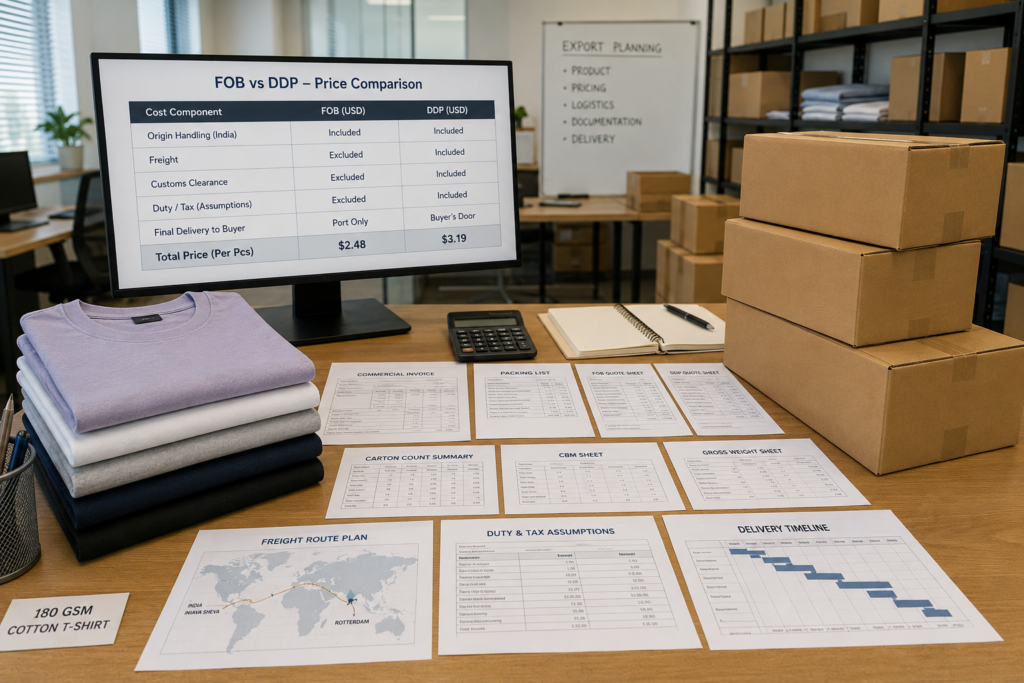
FOB vs DDP Logistics
Wholesale T-shirt buyers usually compare FOB and DDP.
FOB
FOB is useful when:
- You have your own forwarder
- You want freight control
- You have an import broker
- You understand duties and taxes
- You import regularly
DDP
DDP is useful when:
- You want delivered-cost clarity
- You do not want customs friction
- You ship to Amazon or retail DCs
- You need simpler budgeting
- You are testing a new country
The uploaded source explains that buyers can choose FOB for freight control or DDP for simpler landed costing.
DDP Checklist
Before accepting DDP, confirm:
- Delivery address
- Delivery country
- Duty included
- Taxes included
- Brokerage included
- Final-mile delivery included
- Carton count
- CBM
- Gross weight
- HS code
- Delivery timeline
Lead Times for Wholesale T-Shirts from India
Lead time depends on sampling, approvals, dyeing, printing, bulk production and logistics.
The uploaded guide says Tiruppur export lead times often fall in the 45–75 day range depending on approvals and shipping windows.
Planning Timeline
| Stage | Timeline Direction |
|---|---|
| Costed spec and quote | 1–3 days |
| Sampling and approvals | 7–15 days typical |
| Pilot production | 2–4 weeks |
| Full export cycle | 45–75 days depending on approvals and logistics |
Lead-Time Rule
The biggest delay is often not sewing.
It is approval.
Delayed lab dips, delayed print strike-offs and unclear comments can push shipment dates.
Who Should Buy Direct from Rudraa Exports?
Factory-Direct Is a Strong Fit If
- You need repeat wholesale T-shirt supply
- You buy 500+ pcs per colour
- You buy 1,000+ pcs per print design
- You need private-label trims
- You want stable GSM
- You need compliance documents
- You want clear FOB pricing
- You need carton-level packing control
- You want fewer sourcing layers
The uploaded guide says direct factory sourcing is best when buyers need consistency across seasons, private-label support, efficient MOQs, compliance evidence and transparent costing.
Agent or Trader May Be Practical If
- You need very small mixed lots
- You buy many colours at tiny quantities
- You are opportunistic
- You prioritise speed over exact spec control
- You cannot manage sampling or QC approvals
The uploaded source says agents may still be practical for very small mixed lots, opportunistic buying or buyers without internal sample/QC management capability.
5-Step Roadmap to Switch to Factory-Direct Buying
Step 1: Define the Costed Spec
Share:
- Style
- Fit
- Fabric
- GSM
- Colour count
- Print method
- Size ratio
- Labels
- Packaging
- Destination
- FOB or DDP preference
The uploaded guide recommends sending a short costed spec covering style, fabric, GSM, colour count, print type, size ratio, labelling, packaging and Incoterm.
Step 2: Sampling and Approvals
Request:
- Size set
- Lab dip
- Print strike-off
- Fit sample
- PP sample
Step 3: Place a Smart Pilot PO
For first orders, avoid ultra-low MOQ if it destroys cost efficiency.
The uploaded source recommends pilots that match MOQ economics, such as 300–1,000 white blanks, 500 pcs per dyed colour or 1,000 pcs per printed design.
Step 4: Run QC and Packing Checks
Confirm:
- PP approval
- Inline QC
- Final inspection
- Carton dimensions
- Barcode placement
- Shipping marks
- Packing ratio
Step 5: Choose FOB or DDP
Choose:
- FOB if you want freight control
- DDP if you want all-in delivered budgeting
The uploaded source positions FOB as best for buyers with freight lanes and DDP as best for delivered-cost simplicity.
Wholesale T-Shirt Buying Checklist
| # | Checkpoint |
|---|---|
| 1 | Quantity confirmed |
| 2 | Fit selected |
| 3 | Fabric composition selected |
| 4 | GSM selected |
| 5 | Colour count confirmed |
| 6 | MOQ checked |
| 7 | Print method selected |
| 8 | Size ratio locked |
| 9 | Lab dip required |
| 10 | Size set required |
| 11 | Print strike-off required |
| 12 | Private labels confirmed |
| 13 | Packaging confirmed |
| 14 | Compliance documents requested |
| 15 | FOB quote requested |
| 16 | DDP quote requested if needed |
| 17 | Payment terms agreed |
| 18 | QC checkpoints agreed |
| 19 | Carton packing agreed |
| 20 | Reorder plan discussed |
How Rudraa Exports Supports Wholesale T-Shirt Buyers
Rudraa Exports supports international buyers with factory-direct wholesale T-shirt production from Tiruppur, India.
Rudraa Support Includes
- Factory-direct sourcing
- Costed spec review
- GSM planning
- 160 GSM, 180 GSM and 200 GSM options
- White blanks
- Solid dyed tees
- Screen-printed tees
- Oversized T-shirts
- Private-label neck labels
- Wash-care labels
- Barcode stickers
- Polybag and carton planning
- Lab dip coordination
- Size-set support
- Print strike-off support
- PP sample approval
- Inline QC
- Final inspection
- FOB quote
- DDP quote discussion
- Repeat production planning
Products Supported
- White blank T-shirts
- Solid dyed T-shirts
- Printed T-shirts
- Oversized T-shirts
- Retail basics
- Promotional T-shirts
- Corporate T-shirts
- Private-label T-shirts
- Marketplace inventory
- Export bulk programs
Why Rudraa Fits Wholesale Buyers
Rudraa is a strong fit for buyers who need:
- Factory-direct pricing
- Consistent GSM
- Stable repeat quality
- MOQ planning
- Export documentation
- Compliance support
- Private-label trims
- Reliable packing
- FOB or DDP logistics
- Long-term supply partnership
The uploaded guide positions Rudraa Exports as a factory-direct model that helps buyers eliminate intermediaries and secure dependable wholesale T-shirt production outcomes.
Ready to request factory pricing? Speak with Rudraa Exports and share your GSM, quantity, colour count, print requirement and destination.
FAQ: Wholesale T-Shirts from India
1. Can I buy wholesale T-shirts from India directly from a factory?
Yes. Buyers can source wholesale T-shirts directly from Indian factories, especially in Tiruppur, for better cost visibility, quality control and repeat production.
2. What is the typical FOB price for T-shirts from India?
FOB pricing depends on GSM, fabric, colour, finish, print and volume. The uploaded guide gives common ranges from around $1.50 to $4.00 per piece depending on program details.
3. What MOQ should I expect?
MOQ depends on the order type. Plain white blanks may start around 50–100 pcs, dyed tees often need around 300 pcs per colour, and screen-printed designs often need around 300 pcs per design.
4. Which GSM is best for wholesale T-shirts?
160 GSM is good for cost-effective programs, 180 GSM is a strong retail workhorse, and 200 GSM is better for premium, oversized or streetwear-style products.
5. Is factory-direct better than using an agent?
Factory-direct is better when you need cost transparency, repeat quality, GSM control, compliance documents and private-label consistency. Agents may help with very small mixed lots.
6. Can Rudraa Exports provide private-label T-shirts?
Yes. Rudraa can support private-label neck labels, wash-care labels, hangtags, barcode stickers, polybags, cartons and size-wise packing.
7. What certifications should I ask for?
Depending on the program, buyers may ask for OEKO-TEX, BSCI, SA8000, WRAP, Sedex, GOTS or related documentation where applicable.
8. What are common payment terms?
Common payment terms include 30/70 TT, LC at sight for larger programs and sometimes 50/50 for first orders or complex trims.
9. Should I choose FOB or DDP?
Choose FOB if you have your own forwarder and broker. Choose DDP if you want simpler landed-cost planning and delivery support.
10. How long does wholesale T-shirt production take?
Tiruppur export cycles often take 45–75 days depending on approvals, dyeing, printing, packing and logistics.
11. What should I send Rudraa for a quote?
Send your quantity, style, GSM, colour count, print requirement, size ratio, label requirement, packaging requirement and destination.
12. Can I start with a small pilot?
Yes, but the pilot should match MOQ economics. White blanks can start lower, while dyed and printed tees usually need higher quantities to keep pricing efficient.
Conclusion
Wholesale T-shirts from India can be a strong option for importers, retailers, private-label brands and distributors that need consistent quality at scale.
But the best results come from factory-direct buying.
When you work directly with the factory, you get better visibility into price, GSM, fabric, lab dips, sampling, QC, packing and documentation.
Agents and traders can help in some cases, especially for very small mixed lots, but they can also add margin and reduce visibility.
For serious wholesale buyers, the goal is simple:
Build a repeatable T-shirt supply system.
Choose the right GSM. Respect MOQ economics. Approve samples properly. Lock labels and packaging. Use QC checkpoints. Decide FOB or DDP based on your logistics capability. Plan reorders with the same base fabric and fit.
Rudraa Exports helps buyers source wholesale T-shirts from India with factory-direct pricing, 160/180/200 GSM options, private-label support, compliance documentation, QC and FOB/DDP logistics planning.
Visit rudraaexports.com or contact the Rudraa Exports team to request a factory-direct quote for wholesale T-shirts from India.
Related reading
Complete Guide to Custom T-Shirt Manufacturing
Why Tirupur Delivers for Bulk Corporate T-Shirt Programs in 2026
T-Shirts with Logo from India: Custom Branding Options for Corporate and Brand Orders