
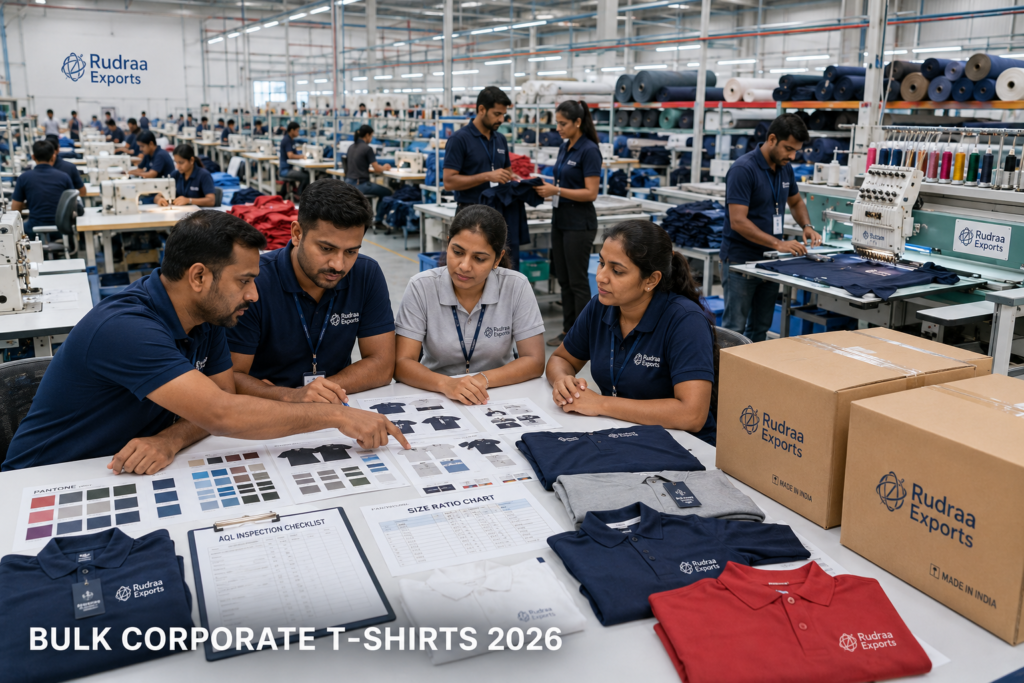
Bulk corporate T-shirt sourcing is not only about finding the cheapest manufacturer. For procurement teams, HR teams, event managers, and brand teams, the real goal is controlling total landed cost, delivery risk, quality consistency, logo accuracy, shade continuity, packing discipline, and compliance readiness across thousands of pieces.
This is where Tirupur gives corporate buyers a practical advantage. Tirupur is not just a T-shirt manufacturing location. It is a concentrated knitwear ecosystem where yarn, knitting, dyeing, compacting, cutting, stitching, printing, embroidery, finishing, packing, and export support are available within a compact industrial cluster. That reduces friction and helps buyers manage repeat corporate T-shirt programs with better speed and control.
The uploaded procurement comparison notes that Tirupur produces an estimated 70–90% of India’s knitwear exports, depending on product scope, and around 90% of India’s knitwear garments, supported by roughly 600,000 workers. It also reports export values of ₹44,747 crore in FY 2024–25, up around 20% year-over-year, partly driven by sustainability requirements from US and UK buyers.
At Rudraa Exports, we support corporate buyers who need factory-direct Tirupur manufacturing for bulk T-shirts, polos, uniforms, onboarding kits, dealer meet apparel, and event merchandise with controlled quality, production planning, and export documentation.
Quick Answer
Tirupur delivers well for bulk corporate T-shirt programs because its integrated knitwear ecosystem reduces handoff delays between yarn, knitting, dyeing, stitching, printing, and packing. Compared with fragmented sourcing models, Tirupur helps procurement teams manage faster approvals, better shade consistency, fewer rework loops, and stronger export documentation. While Bangladesh may offer lower labor cost and China may offer high-speed infrastructure, Tirupur competes strongly on total landed cost, cluster integration, sustainability readiness, and repeat corporate program reliability.
Planning a bulk corporate T-shirt program? Contact Rudraa Exports to share your quantity, GSM, logo method, size ratio, delivery market, and required timeline.
Why Bulk Corporate T-Shirt Sourcing Is Different
A bulk corporate T-shirt program is different from a small merchandise order.
A company may need:
- 5,000 event T-shirts
- 10,000 staff uniforms
- 30,000 promotional tees
- 50,000 onboarding kit T-shirts
- 100,000 annual repeat uniforms across regions
At this scale, small errors become expensive. A 2% defect rate in 500 pieces is manageable. A 2% defect rate in 50,000 pieces creates 1,000 problem garments.
Corporate buyers must control:
| Procurement Area | Why It Matters |
|---|---|
| Fabric GSM | Affects comfort, durability, and brand perception |
| Shade matching | Prevents colour mismatch across batches |
| Logo accuracy | Protects corporate identity |
| Print durability | Prevents cracking and fading |
| Fit consistency | Reduces employee complaints |
| Packing accuracy | Prevents distribution chaos |
| Lead time | Protects fixed event dates |
| Compliance | Supports internal vendor approval |
| Total landed cost | Captures freight, rework, delay, and inspection costs |
The cheapest CM rate is not always the lowest cost. A slightly cheaper order that needs air freight, rework, or re-approval can become more expensive than a better-managed Tirupur program.
Why Tirupur Reduces Production Friction
Tirupur’s biggest advantage is cluster density.
In many sourcing locations, fabric may be knitted in one region, dyed in another, printed elsewhere, stitched in another unit, and packed through another vendor. Every transfer adds delay, communication risk, and rework cost.
Tirupur compresses these steps.
The uploaded document describes Tirupur’s production chain as highly integrated, with yarn suppliers, knitting units, dyehouses, cut-and-sew factories, printers, and finishing units operating within a short radius, often described as integrated within around 50 km.
Tirupur Cluster Advantage
| Production Step | Tirupur Advantage |
|---|---|
| Yarn and fabric planning | Easier coordination with local suppliers |
| Knitting | Strong knitwear specialization |
| Dyeing | Faster lab dip and bulk shade follow-up |
| Cutting and stitching | Skilled workforce for repeat basics |
| Printing and embroidery | Local decoration ecosystem |
| Finishing | Handfeel, shrinkage, and packing control |
| Export documentation | Mature export support network |
This matters most when deadlines are fixed. Corporate events do not move because the factory missed a printing slot.
Typical Timeline for a Bulk Corporate T-Shirt Order
The uploaded comparison gives a practical timeline for a 30,000–100,000 piece corporate T-shirt order.
| Timeline | Activity |
|---|---|
| Day 0–2 | Tech pack confirmation, yarn/fiber planning, knitting allocation |
| Day 3–7 | Knitting, greige inspection, lab dips queued |
| Day 8–12 | Dyeing, compacting, shade approval loop |
| Day 13–18 | Cutting, sewing line setup, inline QC |
| Day 19–23 | Printing, embroidery, washing, finishing |
| Day 24–28 | Final AQL inspection, packing, dispatch to forwarder |
This timeline depends on approvals, fabric availability, complexity, and factory capacity. But the important point is that Tirupur’s cluster model can reduce dead time between stages.
Tirupur vs Bangladesh, Vietnam, and China
A smart procurement comparison should not ask only, “Which country is cheapest?”
It should ask:
Which sourcing hub gives the best balance of price, reliability, compliance, speed, and landed cost for this specific corporate T-shirt program?
Procurement Comparison Table
| Factor | Tirupur, India | Bangladesh | Vietnam | China |
|---|---|---|---|---|
| Best strength | Knitwear cluster integration | Low labor cost | Balanced export manufacturing | Scale and infrastructure |
| Corporate T-shirt fit | Strong for cotton-rich tees and repeat programs | Strong for cost-driven basics | Good for planned programs | Strong for speed and high specs |
| Speed | High due to cluster density | Medium to high | Medium | High |
| Shade and print coordination | Strong due to nearby processes | Can vary by supplier model | Good with strong suppliers | Strong |
| Compliance readiness | Strong export and sustainability momentum | Improving but wage pressure exists | Strong but labor issues may appear | Strong but costlier |
| Cost model | Cost + reliability | Lowest CM potential | Balanced | Higher overhead in many cases |
| Best buyer type | Corporate programs needing consistency | Ultra cost-driven basics | Flexible planning buyers | Buyers needing fast, high-spec scale |
The uploaded comparison notes that Bangladesh may offer lower baseline labor costs, China often delivers speed and scale at higher CM, and Tirupur competes as a cost + reliability sourcing option.
Why Total Landed Cost Matters More Than CM
CM means cutting and making cost. Many procurement teams over-focus on CM.
But corporate buyers should calculate total landed cost:
Total landed cost = FOB price + inspection + freight + duties + rework + delays + air freight risk + internal distribution cost + quality failures.
A low-CM supplier can become expensive if:
- Shade approvals fail twice
- Logo prints crack
- Bulk needs rework
- Partial shipments move by air
- Packing is wrong
- Delivery misses event date
- Compliance documents are incomplete
The uploaded comparison gives an example pattern where a US distributor comparing Bangladesh and Tirupur found that Bangladesh had lower CM, but repeated shade re-approval and partial air shipments reduced the savings. Tirupur’s slightly higher FOB became lower landed cost after expediting and rework buffers were removed.
That is the right way to evaluate sourcing.
Tirupur’s Workforce Depth and Knitwear Specialization
Corporate T-shirts need repeatability. That means stable stitching, neck rib recovery, print accuracy, measurement consistency, and packing control.
Tirupur has decades of knitwear export experience, which creates a trained workforce and production culture around knit basics. The uploaded comparison highlights Tirupur’s workforce depth at around 600,000 workers and mentions wage signals for sewing operators and tailoring minimum wage references.
For procurement, the point is not simply labor cost. The point is skilled labor availability and production stability.
Why Workforce Depth Helps Corporate Programs
| Workforce Factor | Buyer Benefit |
|---|---|
| Skilled sewing operators | Better repeat stitching quality |
| Experienced line supervisors | Faster correction of defects |
| Printing and embroidery technicians | Better logo consistency |
| Packing teams | Better size and carton accuracy |
| Export merchandisers | Better communication and documentation |
| Quality controllers | Better inline and final inspection discipline |
Bulk corporate programs succeed when thousands of pieces look like one controlled production run, not multiple disconnected batches.
Sustainability and Compliance Advantage
Corporate procurement now includes ESG and compliance screening. Buyers increasingly ask about dyeing impact, chemical management, social audits, restricted substances, and responsible production.
The uploaded document says Tirupur’s export momentum has been linked to green practices such as Zero Liquid Discharge (ZLD) adoption, which has become a procurement requirement for many global buyers.
For corporate T-shirt buyers, this matters because dyeing and wet processing are often the most scrutinized parts of the supply chain.
Compliance Signals Buyers Should Ask For
| Requirement | What to Verify |
|---|---|
| ISO 9001 | Quality management system |
| WRAP / Sedex / SMETA | Social compliance readiness |
| OEKO-TEX | Product chemical safety where applicable |
| GOTS / GRS | Organic or recycled material claims |
| ZLD / ETP process | Wet processing responsibility |
| AQL inspection | Shipment-level quality control |
| Traceability records | Fabric lot and production batch tracking |
Do not accept claims without documents. Ask for certificate scope, site address, validity, audit summary, and process coverage.
Export Infrastructure and Logistics Maturity
Bulk corporate programs need production and logistics.
Tirupur’s export scale means many suppliers are familiar with commercial invoices, packing lists, carton markings, shipping documents, HS classification, forwarder coordination, and buyer-specific documentation.
The uploaded comparison notes that Tirupur’s high export throughput generally correlates with mature freight forwarder networks, pre-shipment inspection routines, documentation fluency, and practical handling of multi-country rollouts.
Export Readiness Questions to Ask
- Can you share shipment history by destination for the last 12 months?
- Can you provide sample export documents?
- Can you handle part-shipment rules?
- Can you coordinate with our freight forwarder?
- Can you pack by branch, country, department, or size ratio?
- Can you manage urgent shipment rollovers or document corrections?
Good exporters answer these confidently.
Bulk Corporate T-Shirt Procurement Checklist
Use this before awarding a large corporate T-shirt program.
| # | Procurement Check | Why It Matters |
|---|---|---|
| 1 | Order architecture by colour, size, and ship-to | Prevents packing errors |
| 2 | Fabric spec lock: GSM, composition, yarn, knit type | Reduces bulk variation |
| 3 | Shrinkage and spirality targets | Protects fit after washing |
| 4 | Lab dips and shade continuity plan | Prevents colour mismatch |
| 5 | Print/embroidery method and artwork rules | Reduces branding defects |
| 6 | Trims and labeling compliance | Prevents customs and legal risk |
| 7 | AQL plan with inline and final checks | Makes quality measurable |
| 8 | Social compliance requirements | Protects brand reputation |
| 9 | Environmental requirements such as ZLD alignment | Supports ESG commitments |
| 10 | Production critical path with buffer | Protects event deadlines |
| 11 | Packaging and carton marking standard | Speeds receiving and distribution |
| 12 | Shipment plan and documentation pack | Reduces logistics risk |
This 12-point checklist is directly aligned with the uploaded procurement comparison.
Why Rudraa Exports
Rudraa Exports is positioned for corporate buyers who need bulk T-shirt production from Tirupur with factory-direct control, export documentation, and repeat-program coordination.
Manufacturing Capabilities
- Factory-direct Tirupur T-shirt and knitwear manufacturing
- 72,000+ units per month production capacity
- Bulk corporate T-shirts, polos, event uniforms, onboarding kits, staff apparel, and promotional knitwear
- MOQs starting from around 300 pieces per style, depending on fabric, colour, logo method, and customization
- OEM/ODM support for fabric selection, sampling, fit, logo method, labels, packing, and export documentation
Quality and Compliance
- ISO 9001:2015 certified manufacturing approach
- AQL 2.5 inspection standards
- Support for buyer-defined GSM, shrinkage limits, Pantone references, print/embroidery specs, and packing controls
- Certification-aligned sourcing support for WRAP, Sedex/SMETA, BSCI, GOTS, OEKO-TEX, GRS, and related buyer standards where applicable
- Traceability support across fabric lots, production batches, samples, inspection records, and packing lists
International Buyer Advantages
- Factory-direct pricing without trading-company markups
- Up to 40% cost-saving positioning compared with indirect sourcing models
- English-language communication for procurement, HR, admin, and brand teams
- Export support for EU, USA, Australia, and Middle East markets
- Multi-port shipping through Tuticorin VOC, Chennai, and Cochin
- FTA-eligible documentation support for relevant destination markets
Ready to compare bulk corporate T-shirt sourcing options? Speak with Rudraa Exports for a factory-direct production plan, QC checkpoints, and shipment strategy based on your volume and destination market.
FAQ: Why Tirupur for Bulk Corporate T-Shirts?
1. Why is Tirupur good for bulk corporate T-shirt programs?
Tirupur is strong because it has an integrated knitwear ecosystem with yarn, knitting, dyeing, stitching, printing, finishing, packing, and export support nearby. This reduces handoff delays and improves repeat production control.
2. How does Tirupur compare with Bangladesh for corporate T-shirts?
Bangladesh may offer lower baseline labor costs, but Tirupur often performs better where shade control, repeatability, faster approvals, and reduced rework matter. For corporate programs, total landed cost matters more than lowest CM.
3. Is Tirupur cheaper than China?
Tirupur may offer cost advantages for cotton-rich corporate T-shirts and repeat programs, while China may be stronger for very fast, high-spec, or infrastructure-heavy orders. The right comparison should include freight, quality risk, and lead-time reliability.
4. How does Tirupur reduce delivery risk?
Tirupur reduces delivery risk because many production steps happen within the same cluster. Fabric, dyeing, cutting, stitching, printing, and packing can be coordinated faster than in fragmented supply chains.
5. What makes Tirupur suitable for repeat corporate uniform programs?
Repeat programs need the same fabric, shade, logo placement, fit, and packing method across batches. Tirupur’s knitwear specialization and supplier density make repeat production easier to control.
6. What is total landed cost in T-shirt sourcing?
Total landed cost includes FOB price, freight, duties, inspection, rework, delays, air-freight risk, quality issues, and internal distribution costs. It is a better metric than comparing only manufacturing price.
7. What certifications should corporate buyers ask for?
Corporate buyers should ask for ISO 9001, WRAP, Sedex/SMETA, BSCI, OEKO-TEX, GOTS, GRS, and environmental process evidence where relevant. Certificate scope and validity must always be verified.
8. What is ZLD and why does it matter?
ZLD means Zero Liquid Discharge. It is important in textile dyeing because it helps address wastewater concerns. Tirupur’s ZLD adoption is often cited as part of its sustainability appeal to international buyers.
9. What order size is suitable for Tirupur corporate T-shirt sourcing?
Tirupur can support small, medium, and large orders, but it is especially strong for repeat and bulk corporate programs where fabric, shade, print, packing, and delivery need to be controlled.
10. Should buyers use a third-party inspection?
Yes, especially for first orders or large corporate programs. Third-party inspection with AQL standards helps confirm quality before shipment and gives internal teams more confidence.
11. What should I check before awarding a bulk order?
Check factory capacity, fabric spec, lab dips, logo method, AQL plan, compliance documents, packing plan, shipment schedule, and document readiness. Use a written checklist before confirming the PO.
12. Why choose Rudraa Exports for bulk corporate T-shirts?
Rudraa Exports is suitable for buyers who need factory-direct Tirupur manufacturing, bulk production planning, QC checkpoints, export documentation, packing control, and communication without unnecessary agent layers.
Conclusion
Tirupur delivers for bulk corporate T-shirt programs because it combines knitwear specialization, cluster integration, skilled workforce depth, export infrastructure, compliance readiness, and sustainability momentum. For procurement teams, the advantage is not only lower manufacturing cost. It is better control over total landed cost, production timelines, shade consistency, logo quality, packing accuracy, and repeat-order performance.
Visit rudraaexports.com or contact our team directly to share your bulk corporate T-shirt requirement, target MOQ, GSM, logo method, size ratio, destination market, and delivery timeline — and receive a factory-direct sourcing plan for 2026.
Related reading
Corporate T-Shirt Manufacturing in Tirupur: 2026 Procurement Guide
How to Source Corporate T-Shirts Directly from a Tirupur Manufacturer in 2026
Corporate T-Shirt Customization Guide for Brand Managers in 2026
Corporate T-Shirt MOQ in Tirupur: What to Expect in 2026
Custom T-Shirts for Events and Tours: How to Order in Bulk from India