
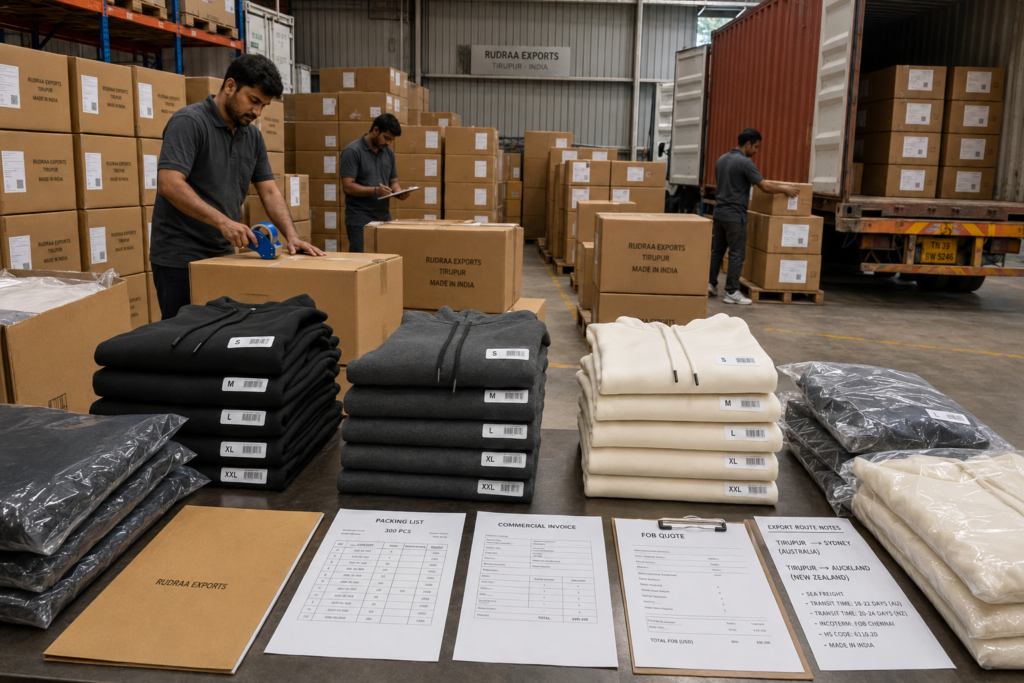
Premium heavyweight hoodies look simple from the outside.
But they are difficult to manufacture correctly.
A 500 GSM hoodie is not just a thicker hoodie.
It needs the right yarn, fleece finishing, shrinkage control, rib recovery, stitch strength, hood structure, print compatibility and QC discipline.
Without those controls, a premium hoodie can twist, pill, shrink, feel stiff, crack at the print or lose shape after a few washes.
That is why Australian and New Zealand streetwear brands looking for a 480 GSM hoodie manufacturer India should not choose a supplier only by price.
They should choose a factory that can control the full heavyweight hoodie system.
At Rudraa Exports, we help AU/NZ streetwear brands develop premium 480–520 GSM hoodies from Tirupur, India with fabric specification, anti-pilling discussion, pre-shrinkage planning, decoration testing, sampling, QC checkpoints and export packing.
Quick Answer
A 480–520 GSM hoodie manufacturer in India is a strong fit for Australian and New Zealand streetwear brands that need premium heavyweight fleece, structured silhouettes, anti-pilling finishing, shrinkage control, decoration-ready surfaces and factory-direct production. For Rudraa Exports, plan around a 300-piece starting MOQ, with stronger production efficiency at 500 and 1,000 pieces per colour/style. Buyers should specify GSM tolerance, brushed fleece or loopback fabric, yarn quality, anti-pilling target, shrinkage target, decoration method, pilling test, wash test, embroidery or print test and final QC checkpoints before bulk.
Planning premium heavyweight hoodies for AU/NZ? Contact Rudraa Exports and share your target GSM, hoodie style, fabric preference, colour count, artwork, decoration method, size range and quantity.
Why 480–520 GSM Hoodies Are Different
Most regular hoodies are made to feel comfortable and affordable.
Premium heavyweight hoodies are made to feel structured, dense and long-lasting.
The uploaded guide explains that in the 480–520 GSM range, small decisions like yarn type, fleece finishing, shrinkage control, stitch strength and print method decide whether the product lasts or fails after a few washes.
Heavyweight Hoodie Buyers Usually Want
- Thick hand feel
- Structured hood
- Premium drape
- Dense fleece body
- Stable rib cuff
- Strong waistband recovery
- Better warmth
- Better print surface
- Better embroidery support
- Less shrinkage
- Less pilling
- Long-term wash durability
The Main Risk
A hoodie can feel premium in the sample and still fail in bulk if the factory does not control GSM, finishing, shrinkage and QC.
What Does 480–520 GSM Mean?
GSM means grams per square metre.
It measures fabric weight.
The uploaded guide says GSM is the clearest shorthand for fabric weight, but it should be treated as a performance envelope because heavier GSM affects warmth, structure and durability.
GSM Range Guide
| GSM | Feel | Best For |
|---|---|---|
| 400 GSM | Heavy but still commercial | Premium basics |
| 480 GSM | Structured heavyweight | AU/NZ streetwear |
| 500 GSM | Dense premium hoodie | Winter capsules |
| 520 GSM | Very heavy, sculpted | Luxury streetwear |
| 540 GSM+ | Specialist heavy build | Advanced programs |
Buyer Tip
Do not approve only the number “500 GSM.”
Ask for:
- GSM tolerance
- Fabric construction
- Yarn type
- Shrinkage result
- Pilling result
- Final garment hand feel
The uploaded guide says buyers should specify GSM with tolerance and require GSM testing per lot for heavyweight fleece programs.
Brushed Fleece vs French Terry for Heavyweight Hoodies
Premium hoodies are usually built from either brushed fleece or French terry / loopback fabric.
The uploaded guide compares brushed fleece and French terry, explaining that brushed fleece is warm and plush while French terry is cleaner inside and generally more breathable.
Brushed Fleece
Best for:
- Winter hoodies
- Plush streetwear
- Warm heavyweight drops
- Soft inner surface
- Premium comfort positioning
Watch-Out
Brushed fleece can pill if yarn, brushing and finishing are not controlled.
French Terry / Loopback
Best for:
- Cleaner inside finish
- Premium athleisure
- Year-round hoodie programs
- Less fuzzy inner surface
- Structured heavyweight silhouettes
Watch-Out
At very high GSM, French terry can feel dense and structured instead of soft and drapey.
Anti-Pilling Finish: Why It Matters
Pilling is one of the fastest ways to make a premium hoodie feel cheap.
The uploaded guide explains that standard brushed fleece can pill because raised fibres tangle under abrasion, and that anti-pilling can be improved through mechanical and enzymatic finishing methods.
Where Pilling Happens Most
- Cuffs
- Waistband
- Side seams
- Underarms
- Pocket edges
- Areas touched by bags
- Brushed inner fleece surface
Anti-Pilling Controls
Ask about:
- Yarn quality
- Combed yarn
- Ring-spun yarn
- Brushing process
- Bio-polish option
- Surface fuzz control
- Pilling test method
- Wash test result
Buyer Tip
For 480–520 GSM brushed fleece, anti-pilling should be a required spec, not an optional upgrade.
The uploaded source says anti-pilling and shrinkage should be treated as non-negotiable specs for 480–520 GSM brushed fleece.
Pre-Shrunk vs Raw Fleece
Shrinkage can destroy fit.
A premium hoodie is usually sold on structure and fit.
If it shrinks heavily, customers will complain.
The uploaded guide explains that dimensional stability should be specified and verified, and refers to AATCC 135 as a method for measuring dimensional change after laundering.
What to Define
- Shrinkage target
- Wash method
- Test method
- Length shrinkage
- Width shrinkage
- Sleeve shrinkage
- Rib shrinkage
- Body/rib balance
Example Spec
500 GSM brushed fleece, anti-pilling finish, shrinkage target within 3% after wash testing.
Buyer Tip
Test both body fabric and rib.
A stable body with a shrinking waistband still creates a bad hoodie.
Yarn Quality: Why Ring-Spun Cotton Matters
Yarn affects hand feel, surface smoothness, durability and print outcome.
The uploaded guide says ring-spun cotton is typically finer, stronger and smoother than open-end alternatives, improving hand feel and print results.
For Premium Hoodies, Ask About
- Compact yarn
- Combed cotton
- Ring-spun cotton
- Cotton blend percentage
- Yarn count
- Surface smoothness
- Fuzz control
- Print compatibility
Why It Matters
Better yarn helps with:
- Softer hand feel
- Less fuzz
- Cleaner brushing
- Better print surface
- Better embroidery finish
- Lower pilling risk
- Better durability
Construction Details That Matter in Heavyweight Hoodies
A 500 GSM hoodie puts more stress on stitching and seams than a regular hoodie.
Check These Construction Points
- Hood shape
- Hood lining
- Neck seam
- Shoulder seam
- Armhole seam
- Kangaroo pocket bartacks
- Rib cuff recovery
- Waistband recovery
- Drawcord channel
- Stitch density
- Seam strength
- Sleeve length balance
- Body length balance
Buyer Tip
Ask for a stitch-strength and seam-integrity check, especially around the pocket and hood join.
The uploaded guide says heavyweight fleece QC should include stitch strength and seam integrity checks, especially around pocket bartacks and hood join.
Decoration Compatibility: Screen, Puff, Embroidery and DTF
Heavyweight fleece changes how decoration behaves.
The uploaded guide explains that thicker fleece affects curing, adhesion and distortion because the fabric has more loft and resists heat differently.
1. Screen Printing on 500 GSM Hoodies
Screen printing can work well on heavyweight fleece, but it needs testing.
Check:
- Ink laydown
- Cure settings
- Platen pressure
- Seam/pocket interference
- Wash test
- Cracking risk
The uploaded guide says ring-spun cotton can improve screen print outcomes because of a smoother surface and better ink laydown.
2. Puff Print on Heavyweight Hoodies
Puff print can look premium on heavyweight hoodies.
But it must be controlled.
Check:
- Puff height
- Ink deposit
- Edge sharpness
- Cure setting
- Wash durability
- Fabric stiffness
The uploaded guide says puff can look premium on heavyweight bodies, but too much puff plus thick fabric can create stiff panels if over-inked.
3. Embroidery on Heavyweight Fleece
Embroidery performs well on heavyweight fleece because the fabric can support stitch density.
But stabilizer matters.
Check:
- Cut-away stabilizer
- Topping where needed
- Stitch density
- Thread quality
- Puckering
- Logo sink-in
- Edge sharpness
The uploaded guide says embroidery on brushed fleece may require the right stabilizer and topping so stitches do not sink into the nap.
4. DTF on Heavyweight Hoodies
DTF can work for detail and smaller placements.
But large DTF areas can feel heavy on an already heavyweight garment.
Check:
- Press setting
- Adhesion
- Edge lift
- Hand feel
- Breathability
- Wash result
- Heat shine on fleece
The uploaded guide says DTF can have strong adhesion and wash durability when settings are correct, but large DTF prints can feel heavier and less breathable on heavyweight fleece.
Rudraa MOQ for Premium Heavyweight Hoodies
For Rudraa Exports, plan around a 300-piece starting MOQ.
Rudraa MOQ Direction
| Quantity | Meaning |
|---|---|
| 300 pcs per colour/style | Starting MOQ for suitable hoodie programs |
| 500 pcs per colour/style | Better production efficiency |
| 1,000 pcs per colour/style | Stronger repeat pricing |
Why 300 MOQ Is Better for Heavyweight Hoodies
A 300-piece starting MOQ supports:
- Better fabric planning
- Better fleece finishing consistency
- Better cutting efficiency
- Better decoration test value
- Better QC structure
- Better trim sourcing
- Better production scheduling
- More realistic export packing
Buyer Tip
For premium hoodies, do not split too many colours at the start.
Begin with one fabric, one fit block and one or two colours.
India vs China vs Local AUS/NZ Blanks vs Pakistan
The uploaded guide compares Rudraa Exports, China factories, local AUS blank wholesalers and Pakistan suppliers across 480–520 GSM capability, anti-pilling, pre-shrinkage, yarn quality, MOQ, pricing, compliance, transparency, lead times and scale.
Quick Comparison
| Route | Best For | Watch-Out |
|---|---|---|
| Rudraa Exports / Tirupur | Spec-controlled 480–520 GSM hoodies, export QC, factory-direct sourcing | Needs clear tech pack and 300+ MOQ planning |
| China factory | Broad capability and large-scale production | Can vary by factory tier and trading layers |
| Local AUS/NZ blanks | Very fast restock and tiny quantities | Limited spec control and higher unit cost |
| Pakistan supplier | Fleece-focused sourcing | Finishing and QC consistency varies by supplier |
Key Takeaway
For AU/NZ streetwear brands that want real spec control, India factory-direct sourcing is stronger than buying available blanks.
The uploaded guide says local blanks rarely let brands control variables such as 500 GSM brushed fleece, anti-pilling and shrinkage, while Tirupur is built around spec-based knitwear export programs.
QC Checkpoints for 480–520 GSM Hoodies
Premium heavyweight hoodie QC should be more detailed than regular hoodie QC.
The uploaded guide says QC for heavyweight fleece should include GSM testing, pilling tests, shrinkage testing, abrasion checks, stitch strength and seam integrity checks.
QC Should Include
- Fabric GSM test
- Fabric lot check
- Body and rib shrinkage test
- Pilling test
- Abrasion check
- Colour shade check
- Rib recovery check
- Hood shape check
- Pocket bartack check
- Seam strength check
- Stitch density check
- Decoration wash test
- Final measurement check
- AQL-style inspection
Stop-Ship Issues
Do not ship if:
- One colour drops below agreed GSM
- Shrinkage exceeds target
- Pilling result is poor
- Rib flares after wash
- Pocket bartacks are weak
- Print cracks after test wash
- Embroidery sinks into nap
- DTF edges lift after wash
The uploaded guide lists examples of stop-ship issues such as GSM drifting below 480, poor pilling rating and shrinkage exceeding target.
Sampling Plan for Heavyweight Hoodies
Sampling should not be treated as one hoodie approval.
It should be a validation program.
The uploaded guide recommends moving through spec, swatches, test panels, pilot and scale, with ISO/AATCC testing language where needed.
Recommended Sampling Flow
- Fabric swatch approval
- Body and rib review
- Fit sample
- Decoration test panel
- Pre-production sample
- Bulk pilot
What to Test
| Stage | What It Confirms |
|---|---|
| Fabric swatch | GSM, hand feel, brushing, loopback |
| Rib review | Recovery and colour match |
| Fit sample | Silhouette and size balance |
| Decoration panel | Screen, puff, embroidery or DTF behaviour |
| PP sample | Final approved production standard |
| Bulk pilot | Real production consistency |
Buyer Tip
Decoration tests should be done on the actual bulk fabric and finishing, not random fabric.
The uploaded guide says decoration tests should always be run on the real bulk fabric and finishing before bulk approval.
Migration Plan: Moving From Blanks to Rudraa
Many AU/NZ brands start with local blanks.
That is fine for early validation.
But once the brand needs premium control, it must move to spec-based manufacturing.
Step 1: Lock Performance Spec
Prepare:
- Target GSM
- GSM tolerance
- Fleece or loopback choice
- Yarn requirement
- Anti-pilling requirement
- Shrinkage target
- Decoration method
- QC test list
The uploaded guide recommends creating a testable tech pack with fabric, yarn, finishing, dimensional stability and QC test list.
Step 2: Review Swatches and Test Panels
Ask for:
- Body fabric swatch
- Rib swatch
- Brushing/loopback finish
- Decoration test panels
- Print test
- Embroidery test
- DTF test if needed
The uploaded guide recommends asking for a test panel pack with body, rib and pocket fabric so decoration settings can be validated before bulk.
Step 3: Approve Pre-Production Sample
The PP sample should include:
- Final fabric
- Final rib
- Final colour
- Final fit
- Final trims
- Final decoration
- Final label
- Final packaging
Step 4: Start With 300 pcs
For Rudraa, start production planning from 300 pcs.
Keep it simple:
- One fit block
- One or two colours
- One fleece base
- One decoration method
- Standard trims
- Clear packaging
Step 5: Scale to 500 and 1,000 pcs
After the first successful order:
- Increase quantity before increasing colours
- Keep the same fabric base
- Keep rib consistent
- Keep decoration specs fixed
- Schedule QC gates
- Retain golden samples
The uploaded guide says the winning workflow is spec, swatches, test panels, pilot and scale.
AU/NZ Heavyweight Hoodie Sourcing Checklist
- Target GSM selected: 480, 500 or 520 GSM
- GSM tolerance defined
- Brushed fleece or French terry selected
- Yarn quality specified
- Compact combed ring-spun cotton discussed
- Anti-pilling target defined
- Pre-shrinkage target defined
- Body and rib shrinkage tested
- Pilling test planned
- Abrasion check planned
- Rib recovery checked
- Hood shape approved
- Pocket bartack checked
- Stitch strength checked
- Decoration method selected
- Screen/puff/embroidery/DTF test panel approved
- PP sample approved
- MOQ planned from 300 pcs
- Quote requested at 300/500/1,000 pcs
- Export packing plan confirmed
How Rudraa Exports Supports AU/NZ Streetwear Brands
Rudraa Exports supports Australian and New Zealand streetwear brands with premium heavyweight hoodie manufacturing from Tirupur, India.
Rudraa Support Includes
- 480 GSM hoodie development
- 500 GSM hoodie development
- 520 GSM hoodie development
- Brushed fleece discussion
- French terry discussion
- Compact combed ring-spun cotton discussion
- Anti-pilling planning
- Pre-shrinkage discussion
- GSM tolerance planning
- Fabric swatch approval
- Rib matching
- Fit sample support
- Decoration test panels
- Screen print testing
- Puff print testing
- Embroidery testing
- DTF placement discussion
- PP sample approval
- QC checkpoint planning
- 300 pcs MOQ planning
- 500 and 1,000 pcs scale pricing discussion
- AU/NZ export packing
Products Supported
- 480 GSM hoodies
- 500 GSM hoodies
- 520 GSM hoodies
- Heavyweight fleece hoodies
- Oversized streetwear hoodies
- Boxy fit hoodies
- Brushed fleece hoodies
- French terry hoodies
- Puff print hoodies
- Embroidered hoodies
- Premium hoodie capsules
- AU/NZ streetwear programs
Why Rudraa Fits Premium Hoodie Buyers
Rudraa is a strong fit for brands that need:
- True heavyweight hoodie control
- 300+ pcs MOQ planning
- Factory-direct communication
- Fabric and finishing clarity
- Anti-pilling discussion
- Shrinkage control
- Decoration testing
- QC checkpoints
- Export-ready production
The uploaded guide says Rudraa is positioned for AU/NZ streetwear brands that want factory-direct control, predictable delivery, heavyweight fleece options, finishing pathways and QC checkpoints.
Ready to develop premium 480–520 GSM hoodies? Speak with Rudraa Exports and share your target GSM, hoodie fit, fabric choice, colour count, decoration method, size range and quantity.
FAQ: 480 GSM Hoodie Manufacturer India
1. Can India manufacture 480–520 GSM premium hoodies?
Yes. Tirupur is a strong knitwear and fleece production base for premium heavyweight hoodies when GSM, finishing, shrinkage and QC are specified properly.
2. What is the best GSM for a premium hoodie?
480 GSM gives a structured heavyweight feel, 500 GSM is a strong premium hoodie weight, and 520 GSM gives a denser luxury streetwear feel.
3. What is Rudraa’s MOQ for heavyweight hoodies?
Rudraa’s MOQ starts from 300 pieces, with better production efficiency usually at 500 and 1,000 pieces per colour/style.
4. What is anti-pilling fleece?
Anti-pilling fleece is finished to reduce surface fuzz and fibre tangling, helping the hoodie look better after wear and wash.
5. Should heavyweight hoodies be pre-shrunk?
Yes. Pre-shrinkage control is important because heavyweight hoodies rely on stable fit, structure and size consistency.
6. Is brushed fleece better than French terry?
Brushed fleece is warmer and plusher. French terry is cleaner inside and often more breathable. The best choice depends on brand positioning and climate.
7. Can screen print work on 500 GSM hoodies?
Yes, but it needs correct fabric surface, ink system, cure settings and wash testing.
8. Can puff print work on heavyweight hoodies?
Yes. Puff print can look premium on heavyweight hoodies, but it should be tested on the actual bulk fabric to avoid stiffness, cracking or inconsistent height.
9. Is embroidery suitable for heavyweight fleece?
Yes. Heavyweight fleece can support embroidery well when proper stabilizer, topping and stitch density are used.
10. Can DTF be used on heavyweight hoodies?
Yes, especially for smaller detailed placements. Large DTF areas may feel heavy, so testing is important.
11. What should I send for a quote?
Send target GSM, fabric type, fit, size chart, colour count, decoration method, artwork, label needs, packaging needs and quantity.
12. Why choose Rudraa instead of local blanks?
Rudraa allows spec-based manufacturing, including GSM, yarn, finishing, shrinkage, decoration testing and QC. Local blanks are faster but offer less control.
Conclusion
Premium 480–520 GSM hoodies need more control than standard hoodies.
The fabric is heavier.
The seams carry more stress.
The hood and pocket need better structure.
The rib must recover properly.
The fleece must resist pilling.
The garment must not shrink beyond target.
And the decoration method must be tested on the actual bulk fabric.
For AU/NZ streetwear brands, the safest path is not simply buying the cheapest hoodie.
It is building a spec-controlled hoodie program with proper GSM tolerance, anti-pilling discussion, pre-shrinkage testing, decoration test panels, PP sample approval and QC gates.
Rudraa Exports helps Australian and New Zealand brands manufacture premium heavyweight hoodies from Tirupur, India with factory-direct communication, 480–520 GSM fleece planning, brushed fleece or French terry options, compact combed ring-spun cotton discussion, screen/puff/embroidery/DTF testing, 300 pcs starting MOQ and export-ready production support.
Visit rudraaexports.com or contact the Rudraa Exports team to request a capability deck and custom quote for 480–520 GSM hoodie manufacturing.
Related reading
3 Factory Practices You Must Verify Before Placing a Heavyweight Knitwear Order
Hoodie Manufacturer in India: Why Source from Tirupur and When a Direct Factory Makes Sense
Sweatshirt Manufacturing in India: Fabric, GSM, MOQ and Private Label Guide