
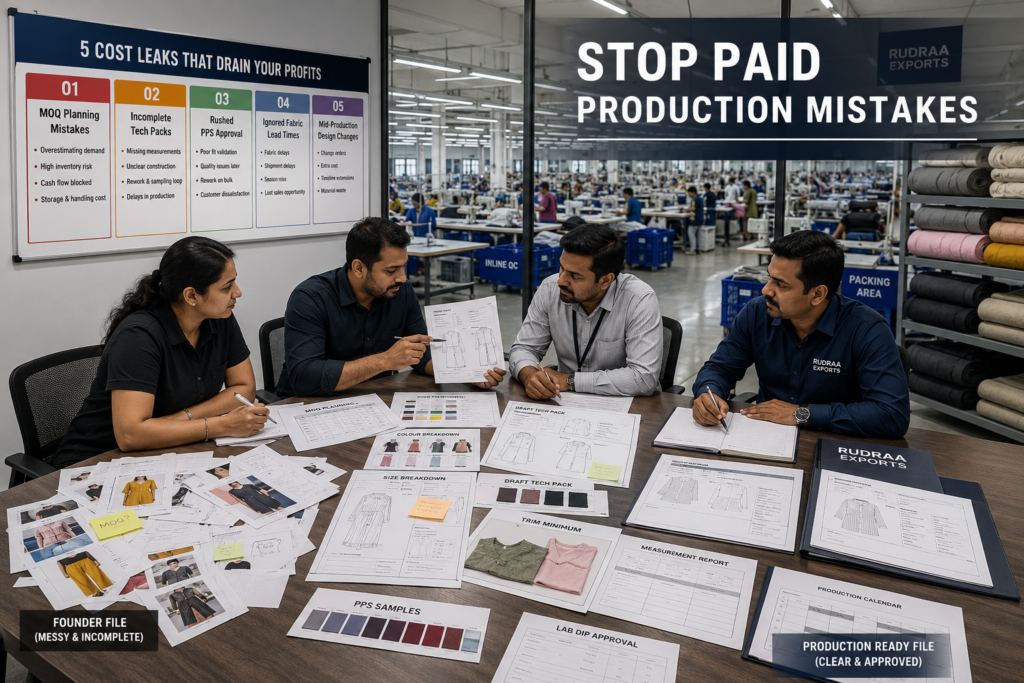
Most first-time clothing brand founders think the biggest production cost is the factory quote.
But from the factory side, that is rarely where the real money is lost.
The bigger cost leaks usually come from preventable process mistakes.
A founder wants too many colours in a small order. A tech pack leaves key decisions unclear. A pre-production sample is approved too quickly. Fabric lead time is ignored. A “small change” is requested after bulk production has already started.
Each mistake looks minor at the time.
Together, they create extra sample rounds, dead stock, idle line time, air freight, rework, remakes and missed launch dates.
At Rudraa Exports, we help early-stage clothing brands reduce these avoidable costs through factory-direct production planning, MOQ mapping, tech-pack review, fabric planning, PPS control, inline QC and export-ready production systems from Tirupur, India.
Quick Answer
Clothing brand founders waste the most money when they plan MOQs incorrectly, send incomplete tech packs, rush pre-production sample approval, ignore fabric lead times and make design changes after bulk production starts. These mistakes increase sampling costs, delay production, create leftover fabric or trims and force expensive rework. The best way to reduce production cost is to lock specifications before bulk, plan around MOQ realities and treat PPS as a hard approval gate.
Planning your first or second production run? Contact Rudraa Exports to request a pre-costing and production-readiness review.
The Real Cost Is Not Always the Unit Price
A factory quotation gives you one number.
But production cost includes every mistake that happens before, during and after production.
Hidden Production Cost Leaks
- Extra sample rounds
- Pattern corrections
- Fabric substitutions
- Trim dead stock
- Idle sewing lines
- Rejected samples
- Rush shipping
- Rework
- Remakes
- Delayed launch revenue
- Missed retail windows
- Discounting unsold stock
The uploaded source explains that the real leaks come from manufacturing-readiness mistakes such as poor MOQ planning, incomplete tech packs, weak PPS discipline, fabric lead-time issues and late bulk changes.
5 Biggest Clothing Production Money Leaks
| # | Money Leak | What It Usually Causes |
|---|---|---|
| 1 | Poor MOQ planning | Higher unit cost and dead stock |
| 2 | Incomplete tech packs | Re-sampling and disputes |
| 3 | Rushed PPS approval | Bulk mistakes and rework |
| 4 | Ignored fabric lead times | Delays and panic freight |
| 5 | Mid-production changes | Rework, wastage and schedule slips |
Factory Rule
Anything not written and approved becomes a paid experiment.
The uploaded source uses this factory-side rule to explain why unclear production decisions often become expensive later.
Mistake 1: Planning MOQs Like a Brand, Not Like a Factory
Founders often plan collections creatively.
They may want:
- Five colours
- Six sizes
- Multiple styles
- Small quantities
- Custom labels
- Custom trims
- Low total order value
But factories, fabric mills and trim suppliers work around production efficiency.
What the Factory Sees
The factory must consider:
- Fabric minimums
- Dyeing minimums
- Cutting efficiency
- Sewing line setup
- Print setup
- Embroidery setup
- Label minimums
- Trim minimums
- Packing material minimums
The uploaded guide explains that even when factories offer low MOQs, knitwear still often has practical quantity realities based on fabric, trims and setup.
How MOQ Mistakes Waste Money
| Founder Decision | Cost Impact |
|---|---|
| Too many colours | Fabric and dyeing minimums increase |
| Too many sizes | Slow-moving stock increases |
| Too many styles | Sampling and setup costs multiply |
| Custom trims too early | Minimum trim purchases create dead stock |
| Low quantity per colour | Unit cost rises |
| Poor size curve | Inventory gets stuck in weak sizes |
Example
A founder orders 240 pieces across six colours.
That means only 300 pieces per colour.
If each colour needs separate fabric, lab dip, cutting and packing handling, the production becomes inefficient.
The final unit cost may rise, or the founder may be forced to buy extra fabric and trims.
Better Approach: Build an MOQ Map
Before finalising the collection, create an MOQ map.
| MOQ Type | Question to Ask |
|---|---|
| Style MOQ | Minimum per garment style? |
| Colour MOQ | Minimum per colour? |
| Fabric MOQ | Minimum fabric order? |
| Trim MOQ | Minimum labels, zippers, buttons or drawcords? |
| Print MOQ | Minimum per artwork or colour? |
| Embroidery MOQ | Minimum per design? |
| Packing MOQ | Minimum bags, cartons or stickers? |
Better First Drop Strategy
Instead of:
- 4 styles
- 6 colours
- 7 sizes
Start with:
- 1–2 hero styles
- 2–3 colours
- Realistic size curve
- Shared trims
- Shared fabric where possible
This protects cash and simplifies production.
Mistake 2: Sending Tech Packs That Do Not Resolve Decisions
A tech pack should not only describe a design.
It should instruct production.
Founders often send:
- Reference images
- Basic sketches
- Mood boards
- Incomplete measurements
- Unclear fabric notes
- Missing construction details
- No tolerance
- No label or packing information
What the Factory Sees
When information is missing, the factory must guess.
Guessing creates:
- Wrong construction
- Wrong fit
- Wrong fabric
- Wrong trim
- Wrong print placement
- Wrong packaging
- Measurement disputes
- Extra sampling rounds
The uploaded source explains that incomplete tech packs lead to re-sampling, wrong construction and measurement disputes.
Production-Ready Tech Pack Checklist
| Section | Must Include |
|---|---|
| Style information | Style name, code and version |
| Technical sketch | Front, back and detail views |
| Fabric | Composition, GSM, finish and colour |
| BOM | Fabric, trims, labels and packing |
| Measurements | Size chart and tolerances |
| Construction | Stitch type and seam details |
| Artwork | Print or embroidery size and placement |
| Labels | Main label, size label and care label |
| Packaging | Folding, bagging, sticker and carton details |
| Substitution rule | What cannot be changed without approval |
Bad Instruction vs Good Instruction
| Weak Instruction | Production-Ready Instruction |
|---|---|
| Relaxed fit | Chest 58 cm in size M, tolerance ±1 cm |
| Premium cotton | 220 GSM 100% cotton single jersey |
| Logo on chest | Print 8 cm wide, 7 cm below neck seam |
| Good stitching | 4-thread overlock side seam, coverstitch hem |
| Nice packaging | Folded in individual polybag with size sticker |
Tech Pack Rule
If the factory cannot make the product from the document alone, the tech pack is not production-ready.
Mistake 3: Treating PPS Like Another Sample
PPS means pre-production sample.
It is the final sample before bulk production.
Many founders treat PPS casually because they are already behind schedule.
They may approve it from one photo or skip detailed checks.
What PPS Should Confirm
- Fabric
- GSM
- Colour
- Fit
- Measurements
- Stitching
- Labels
- Print placement
- Embroidery
- Trims
- Packaging
- Wash behaviour
- Final construction
The uploaded source explains that PPS should be treated as a stop/go gate and that bulk production should begin only after PPS approval.
Why Rushing PPS Is Expensive
If a problem is caught at PPS, it may be corrected before bulk.
If the same problem is caught after production, it can become:
- Rework
- Remake
- Discounting
- Rejection
- Delivery delay
- Customer complaint
PPS Approval Checklist
| Area | Check |
|---|---|
| Measurement | Compare against tech pack |
| Fit | Confirm on body or form |
| Fabric | Confirm hand feel and GSM |
| Colour | Match approved lab dip |
| Construction | Check seam and stitch details |
| Artwork | Check size and placement |
| Labels | Confirm content and position |
| Packing | Confirm final method |
| Testing | Confirm shrinkage or wash needs |
| Buyer approval | Written sign-off |
Strong PPS Approval Statement
PPS approved for bulk production according to Tech Pack Version 3 dated 12 August 2026. No changes to fabric, trims, measurements, construction, labels, artwork or packaging are allowed without written buyer approval.
Mistake 4: Ignoring Fabric Lead Times
Fabric is not always available immediately.
This is one of the biggest surprises for first-time founders.
Fabric Timing Depends On
- Fabric type
- Yarn availability
- Knitting capacity
- Dyeing schedule
- Colour approval
- Finishing process
- Custom GSM
- Print or wash requirements
- Mill workload
- Peak-season demand
The uploaded guide explains that fabric sourcing can take several weeks depending on type and customisation, and that unavailable fabric can add major delays.
Common Fabric Mistakes
- Designing before checking fabric availability
- Approving swatches without checking bulk stock
- Changing fabric after fit approval
- Ignoring lab dip time
- Booking sewing line before fabric is ready
- Assuming all colours are available
- Choosing custom fabric without enough calendar buffer
How Fabric Delays Waste Money
| Problem | Cost Impact |
|---|---|
| Fabric out of stock | Production delay |
| Late lab dip approval | Calendar slips |
| Fabric change after sample | New fit or shrinkage test |
| Sewing line waits | Factory scheduling issue |
| Launch date pressure | Air freight cost |
| Wrong fabric chosen quickly | Quality complaints |
Better Fabric Planning
Before booking bulk production, confirm:
- Fabric availability
- Fabric MOQ
- Colour MOQ
- Lab dip timeline
- Bulk dyeing timeline
- Shrinkage expectation
- GSM
- Finishing process
- Backup fabric option
Fabric Rule
Do not book a launch date until fabric availability and approval timeline are known.
Mistake 5: Making Mid-Production Design Changes
A founder may think:
“It is just a small change.”
But during production, small changes can become expensive.
Common Late Changes
- Increase logo size
- Change embroidery thread
- Change zipper pull
- Change neck label
- Adjust body length
- Change rib quality
- Move pocket position
- Change packaging
- Add extra label
- Change sleeve finish
What the Factory Sees
A late change may require:
- New artwork
- New strike-off
- New sample approval
- New trims
- Re-cutting panels
- Reprinting
- Re-embroidery
- Repacking
- Rechecking measurements
- Line rescheduling
The uploaded source identifies mid-production design changes as one of the most expensive mistakes because they create rework, delays and wastage.
Change Order Rule
After PPS approval, every change should require:
- Written request
- Cost impact
- Time impact
- Quality impact
- Buyer approval
- Updated tech pack
- Updated production schedule
Change Order Template
| Field | Details |
|---|---|
| Change requested | Example: logo size increase |
| Style affected | Style code |
| Production stage | Before cutting / after cutting / after sewing |
| Cost impact | Extra cost |
| Time impact | Extra days |
| Risk | Rework, rejection, delay |
| Approved by | Buyer name |
| Date | Approval date |
Strong Rule
No post-PPS change should be executed without written cost and timeline approval.
Cost-Control System for First-Time Founders
A cost-controlled production run needs five controls.
1. MOQ Strategy
Before design freeze, confirm:
- Style quantity
- Colour quantity
- Size curve
- Fabric minimums
- Trim minimums
- Shared materials
2. Production-Ready Tech Pack
Before sampling, confirm:
- Measurements
- BOM
- Construction
- Tolerance
- Artwork
- Labels
- Packaging
3. PPS Gate
Before bulk, confirm:
- Final sample
- Buyer approval
- Measurement report
- Fabric approval
- Trim approval
- Packing approval
4. Fabric Calendar
Before launch date, confirm:
- Fabric lead time
- Dyeing lead time
- Lab dip approval
- Shrinkage test
- Backup plan
5. Change Control
After PPS, confirm:
- No informal changes
- Written change orders only
- Cost and timeline impact approved
How to Work with Factories Like a Professional
Factories do not need founders to know every technical term.
They need founders to be clear, realistic and documented.
1. Speak Through Documents
Use:
- Tech packs
- Measurement charts
- BOMs
- Approval logs
- Change logs
- Purchase orders
Do not rely only on:
- WhatsApp messages
- Voice notes
- Mood boards
- Verbal approvals
- Scattered references
2. Respect the Sampling Loop
If a style needs more than three or four rounds, stop and diagnose.
The issue may be:
- Missing measurements
- Poor reference
- Unclear fabric
- Wrong construction
- Undefined fit standard
- Late design changes
3. Treat Lead Times as Real
A factory cannot always compress fabric, dyeing, sampling and production into a founder’s preferred launch date.
Good planning beats panic shipping.
4. Negotiate MOQs Smartly
Do not ask only:
Can you reduce MOQ?
Ask:
- Can we combine colours?
- Can we use stock fabric?
- Can we share trims across styles?
- Can we reduce colour count?
- Can we reorder best-sellers later?
- Can we use one fabric across multiple styles?
5. Make Approvals Written
Every approval should state:
- What is approved
- Which version is approved
- What cannot change
- What happens next
6–12 Week Migration Plan to Stop Cost Leaks
Week 1: Build MOQ Map
Create:
- Style list
- Colour list
- Size curve
- MOQ per style
- MOQ per colour
- Fabric MOQ
- Trim MOQ
Week 2: Clean Tech Packs
Add:
- Graded specs
- Tolerances
- BOM
- Stitch details
- Artwork placement
- Labels
- Packaging
- No-substitution notes
Week 3–4: Confirm Fabric
Check:
- Availability
- Lead time
- Colour options
- Lab dip timing
- GSM
- Shrinkage
- Bulk minimums
Week 5–6: Run PPS Properly
Prepare:
- PPS checklist
- Measurement report
- Photos or video
- Fabric approval
- Trim approval
- Written sign-off
Week 7–12: Lock Production Controls
Set:
- Production calendar
- Inline QC points
- Change-order rule
- Packing standard
- Final inspection plan
The uploaded source provides a 6–12 week transition plan covering MOQ strategy, production-ready tech packs, fabric lead-time planning, PPS approval and change-order rules.
Clothing Production Readiness Checklist
| # | Checklist Item |
|---|---|
| 1 | Hero styles selected |
| 2 | Colours reduced to realistic range |
| 3 | Size curve planned |
| 4 | MOQ per style confirmed |
| 5 | MOQ per colour confirmed |
| 6 | Fabric MOQ confirmed |
| 7 | Trim MOQ confirmed |
| 8 | Tech pack completed |
| 9 | Graded spec included |
| 10 | Measurement tolerances included |
| 11 | BOM completed |
| 12 | Construction details included |
| 13 | Artwork placement measured |
| 14 | Label details confirmed |
| 15 | Packaging details confirmed |
| 16 | Fabric availability checked |
| 17 | Lab dip timing confirmed |
| 18 | PPS checklist created |
| 19 | PPS signed off in writing |
| 20 | Change-order process agreed |
How Rudraa Exports Helps Founders Reduce Production Waste
Rudraa Exports supports first-time and growing clothing brands with a more structured manufacturing process.
Cost-Control Support
- MOQ planning
- Style and colour review
- Size-curve discussion
- Tech-pack review
- Fabric availability check
- Fabric and GSM planning
- Lab dip coordination
- Sample development
- PPS review
- Measurement reports
- Inline QC planning
- AQL inspection support
- Change-control discipline
- Export packing and documentation
Products Supported
- T-shirts
- Polo shirts
- Hoodies
- Sweatshirts
- Joggers
- Activewear
- Kidswear
- Babywear
- Nightwear
- School uniforms
- Corporate apparel
- Private-label knitwear
Why Factory-Direct Guidance Matters
A direct factory can help founders see the production consequences of design decisions earlier.
This helps reduce:
- Cost surprises
- Miscommunication
- Re-sampling
- Fabric delays
- Trim waste
- Mid-production confusion
- Rework
- Missed shipment dates
The uploaded guide explains that Rudraa’s value is not only garment production, but also pattern recognition from seeing where early-stage founders burn money before they notice it.
Ready to prevent paid production mistakes? Speak with Rudraa Exports and share your style list, target quantities, draft tech packs and delivery date.
FAQ: Clothing Production Cost Mistakes
1. Where do clothing founders waste the most money?
They usually waste money on poor MOQ planning, incomplete tech packs, extra sample rounds, rushed PPS approvals, fabric delays and late design changes.
2. Is the factory quote the biggest production cost?
Not always. The unit quote matters, but hidden costs such as rework, remakes, air freight, dead trims and sample delays can be larger.
3. Why do low MOQs sometimes become expensive?
Low MOQs can increase unit cost and may still trigger fabric, colour, trim or packing minimums.
4. What should a tech pack include?
A production-ready tech pack should include sketches, graded measurements, tolerances, BOM, fabric, construction, artwork placement, labels and packaging.
5. What is PPS?
PPS means pre-production sample. It is the final approved sample before bulk production starts.
6. Why is PPS important?
PPS locks the production standard. If it is rushed or skipped, errors may appear during bulk production when they are more expensive to fix.
7. Why do fabric lead times matter?
Fabric sourcing, dyeing, finishing and custom development can take time. Ignoring this can delay production or force expensive substitutions.
8. Why are mid-production changes expensive?
Once materials are ordered or production has started, changes can require rework, new trims, new artwork, reprinting, repacking or line rescheduling.
9. How can founders reduce production cost?
They can reduce cost by planning MOQs properly, completing tech packs, approving PPS carefully, locking fabric early and using formal change orders.
10. Can Rudraa Exports help review a draft tech pack?
Yes. Rudraa can review draft tech packs and flag missing details before they become sampling or bulk-production problems.
11. What should I send Rudraa for a pre-costing review?
Send your style list, quantity plan, colours, size range, tech packs, fabric ideas, target delivery date and destination market.
12. Should I reduce colours in my first drop?
Often, yes. Fewer colours can improve MOQ efficiency, reduce fabric complexity and protect cash flow.
Conclusion
Most clothing founders do not lose money because the factory quote is too high.
They lose money because the production process is not locked.
MOQs are planned too late. Tech packs leave decisions open. PPS is rushed. Fabric lead times are ignored. Design changes are pushed into bulk.
The fix is discipline.
Plan MOQ realities before finalising the range. Turn your tech pack into a production instruction. Treat PPS as a hard gate. Build your calendar around fabric availability. Use formal change orders after approval.
That is how a production run becomes a system instead of a gamble.
Rudraa Exports helps founders reduce avoidable production costs through factory-direct planning, MOQ strategy, tech-pack review, sampling control, PPS discipline, fabric planning and export-ready garment manufacturing from Tirupur, India.
Visit rudraaexports.com or contact the Rudraa Exports team to request a production-readiness review for your next clothing run.
Related reading
The Real Landed Cost of Importing T-Shirts from India to Australia
What Is a Bill of Materials in Garment Manufacturing? A Brand Owner’s Guide