
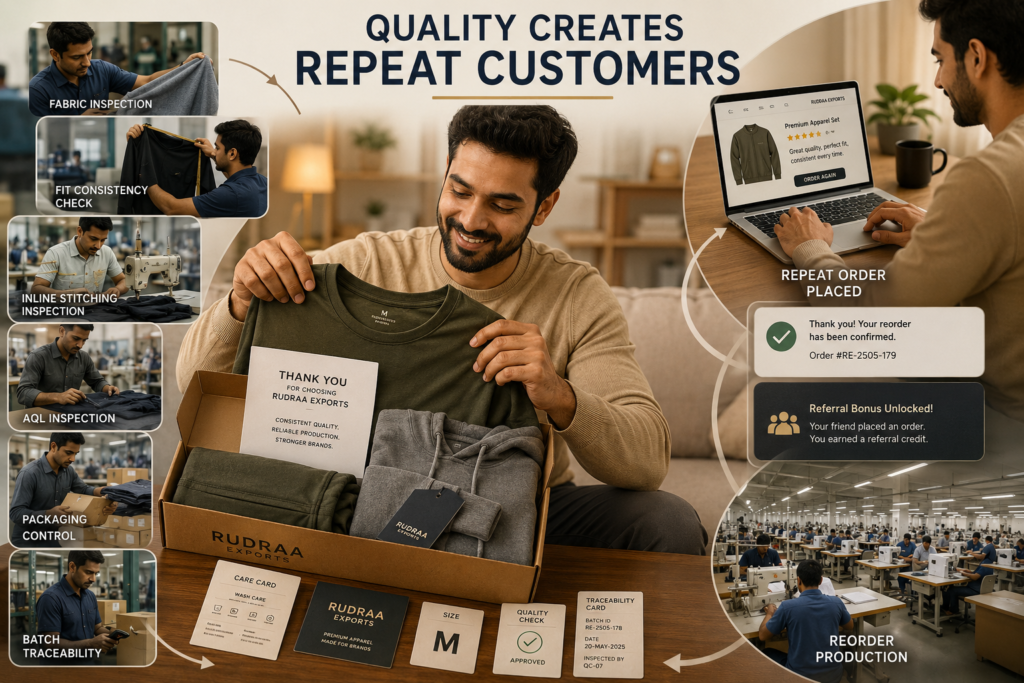
Early-stage clothing brands often think repeat customers come from better marketing.
More ads. More emails. More discounts. More influencer content.
Those tactics can help, but they cannot fix a weak product experience.
In apparel, repeat customers usually come back because the first product delivered on its promise.
The fabric felt right. The fit matched expectations. The stitching held after washing. The colour did not change unexpectedly. The packaging felt intentional. The brand story matched the physical product.
A customer does not buy again only because they saw another ad.
They buy again because they trust the brand.
That trust is built through consistent manufacturing.
At Rudraa Exports, we help early-stage clothing brands build repeatable product quality through factory-direct production, fabric control, fit consistency, inline inspections, AQL checks, traceability and export-ready packaging from Tirupur, India.
Quick Answer
Repeat customers in clothing brands are driven most strongly by product quality, fit consistency, wash performance, reliable packaging and a brand experience that matches the product promise. Marketing can bring the first purchase, but repeat buying depends on whether the garment feels, fits and performs consistently. A direct-factory manufacturing system helps reduce quality variation and makes repeat orders more reliable.
Want to improve repeat orders through better production consistency? Contact Rudraa Exports to discuss your garment quality and reorder plan.
Why Repeat Customers Matter for Clothing Brands
A first order proves interest.
A repeat order proves trust.
For early-stage clothing brands, repeat customers are valuable because they:
- Reduce dependence on paid ads
- Improve profit margins
- Increase customer lifetime value
- Create stronger reviews
- Improve word-of-mouth
- Make inventory forecasting easier
- Support repeat production planning
- Reduce pressure to discount constantly
The uploaded source explains that retention should not be treated only as a marketing problem because consistent product quality, reliable fit and post-purchase experience are major repeat-purchase drivers.
The Real Reason Customers Buy Again
Customers usually repeat when three things happen:
- The product performs as expected
- The buying experience feels reliable
- The second purchase feels low-risk
In clothing, that means customers must trust:
- The size will fit again
- The fabric will feel similar again
- The colour will match what they expect
- The garment will survive washing
- The stitching will not fail
- The brand will deliver what it promises
If the first order creates doubt, the second order becomes harder.
Marketing-Led Retention vs Manufacturing-Led Retention
| Retention Factor | Marketing-Led Approach | Manufacturing-Led Approach |
|---|---|---|
| Product quality | Promoted after production | Controlled during production |
| Fit | Explained through size charts | Built through pattern and grading control |
| Returns | Reduced through policies | Reduced through better consistency |
| Packaging | Used as branding | Used for protection and experience |
| Reviews | Requested from customers | Earned through product satisfaction |
| Discounts | Used to force repeat purchase | Reduced because customers trust the product |
| Loyalty | Driven by campaigns | Built through repeatable product delivery |
The uploaded guide compares marketing-led retention with manufacturing-led retention and identifies product quality, fit consistency, packaging and pricing stability as stronger long-term drivers.
Driver 1: Quality Consistency
Quality consistency means every batch feels like the approved product.
A customer who buys a T-shirt in black and later buys the same T-shirt in grey expects the same:
- Fabric weight
- Fit
- Stitching
- Neck shape
- Sleeve length
- Wash performance
- Overall feel
Quality Areas That Affect Repeat Purchase
| Quality Area | Why It Matters |
|---|---|
| Fabric GSM | Controls weight and feel |
| Stitching | Affects durability |
| Trims | Impacts premium perception |
| Colour consistency | Builds trust across batches |
| Print durability | Prevents disappointment |
| Embroidery quality | Signals craftsmanship |
| Shrinkage control | Protects fit after washing |
| Pilling resistance | Supports product longevity |
The uploaded source says quality consistency in fabric, stitching, trims and wash performance is a strong driver of repeat purchase in fashion.
Why One Bad Batch Hurts Retention
A customer may forgive one late email.
They rarely forget a bad garment.
A poor batch can lead to:
- Returns
- Refunds
- Negative reviews
- Lower trust
- Reduced repeat rate
- Higher customer service cost
- More discount pressure
For an early-stage brand, this is serious because the customer base is still small.
Driver 2: Fit Consistency
Fit is one of the biggest repeat-purchase drivers in apparel.
When customers find a size and silhouette they like, they are more likely to buy again.
But if the second order fits differently, trust breaks.
Fit Consistency Depends On
- Pattern control
- Grading accuracy
- Fabric shrinkage
- Measurement tolerances
- Cutting accuracy
- Sewing control
- Pressing and finishing
- Wash testing
- Size-set approval
The uploaded guide highlights fit consistency, grading, shrinkage control and tolerance management as major repeat-purchase drivers because fit and quality issues contribute heavily to apparel returns.
Repeat-Killing Fit Problems
| Problem | Customer Reaction |
|---|---|
| Same size fits differently | Hesitates to reorder |
| Shrinkage after wash | Loses trust |
| Neckline changes | Perceives poor quality |
| Sleeve length varies | Questions brand standards |
| Waistband stretches out | Complains or returns |
| Size chart mismatch | Avoids next purchase |
Buyer Tip
For every repeat order, compare the new batch against:
- Approved PP sample
- Previous shipment measurements
- Size-set records
- Shrinkage test results
- Customer return feedback
Driver 3: Packaging and Unboxing
Packaging is not only decoration.
It protects the product and shapes the first physical impression.
Good Apparel Packaging Should
- Keep garments clean
- Prevent crushing or print scuffing
- Protect embroidery or trims
- Maintain folding shape
- Support barcode or SKU accuracy
- Include care instructions
- Feel intentional
- Match the brand price point
The uploaded source explains that packaging elevates perceived value, protects the product and contributes to the post-purchase experience.
Packaging That Supports Retention
| Packaging Element | Retention Role |
|---|---|
| Inner garment bag | Protects product |
| Fold board | Maintains presentation |
| Care card | Reduces wash-related complaints |
| Thank-you card | Builds emotional connection |
| Size sticker | Helps fulfilment accuracy |
| Traceability card | Builds trust |
| Return instruction | Reduces friction |
| Reorder QR code | Encourages next purchase |
Driver 4: Brand Storytelling That Matches the Product
Storytelling helps customers remember the brand.
But storytelling works only when the product supports the story.
If a brand says “premium heavyweight essentials” but the fabric feels thin, the story becomes a problem.
Strong Brand Storytelling Can Include
- Where the product was made
- How fabric was selected
- Why a certain GSM was chosen
- How quality is checked
- How to care for the garment
- What makes the fit special
- How the product supports better buying
The uploaded source says storytelling through hangtags, care cards, traceability and origin information can strengthen retention when the product quality supports the message.
Storytelling Rule
Do not claim what production cannot consistently deliver.
Driver 5: Pricing Stability
Brands often use discounts to drive repeat purchases.
But heavy discounting can train customers to wait.
Consistent quality allows brands to maintain stronger pricing confidence.
Why Quality Supports Stable Pricing
| Quality Strength | Pricing Benefit |
|---|---|
| Fewer defects | Fewer refunds |
| Better fit | Fewer returns |
| Stronger packaging | Higher perceived value |
| Consistent reorders | More customer trust |
| Lower complaint rate | Less discount pressure |
| Better reviews | Easier full-price selling |
The uploaded source explains that stable quality reduces returns and promotion dependence, which can support stronger loyalty and margin.
Why Manufacturing Beats More Discounts
Discounts can create a second purchase.
But they do not always create loyalty.
A customer who returns only for a discount may disappear when the discount stops.
A customer who returns because the product is reliable is more valuable.
Discount-Driven Repeat Purchase
- Short-term lift
- Lower margin
- Trains price sensitivity
- Does not fix product issues
- Can hide churn temporarily
Quality-Driven Repeat Purchase
- Stronger loyalty
- Better margin
- More word-of-mouth
- Better reviews
- Easier product expansion
- Better reorder planning
How Factory Discipline Creates Repeat Customers
Manufacturing consistency does not happen by accident.
It requires documented systems.
Factory Controls That Support Retention
| Factory Control | Customer Impact |
|---|---|
| Fabric inspection | Better hand-feel consistency |
| GSM control | Stable product weight |
| Lab dip approval | Better colour consistency |
| Pattern control | Repeatable fit |
| Size-set approval | Better sizing across range |
| Inline inspection | Defects caught early |
| AQL inspection | Objective shipment approval |
| Traceability | Faster root-cause investigation |
| Packing standards | Better delivery experience |
The uploaded source highlights inline inspections, AQL sampling and lean quality methods as important manufacturing tools for reducing defects and improving consistency.
Why Direct-Factory Manufacturing Helps Retention
A direct-factory model reduces communication gaps.
When buyers work through too many intermediaries, small technical details can become unclear.
Common Intermediary Problems
- Fit comments are misunderstood
- Material changes are not explained
- Production updates are delayed
- Quality problems are filtered
- Corrective action takes longer
- Repeat-order standards are not preserved
Factory-Direct Advantages
- Faster technical clarification
- Clearer accountability
- Better access to production records
- Easier sample correction
- Better material traceability
- Faster corrective action
- Stronger repeat-order consistency
The uploaded source connects Rudraa’s direct-factory model with fewer communication errors and faster corrective action, supporting consistent restocks and repeat purchase.
How to Identify Your Retention Leak
Before changing suppliers or increasing ad spend, audit your customer feedback.
Step 1: Review Repeat Purchase Rate
Look at:
- 30-day repeat rate
- 60-day repeat rate
- 90-day repeat rate
- Annual repeat rate
- Repeat rate by product
- Repeat rate by customer segment
Step 2: Review Return Reasons
Tag returns by:
- Size too small
- Size too large
- Fabric not expected
- Colour mismatch
- Poor stitching
- Print issue
- Shrinkage
- Damaged on arrival
- Wrong item
- Late delivery
Step 3: Review Customer Support Tickets
Search for repeated phrases such as:
- Feels different
- Fit changed
- Shrunk after wash
- Stitching opened
- Colour is off
- Not like last time
- Packaging damaged
- Print cracked
Step 4: Identify the Hero SKU
Focus first on the product most likely to be reordered.
Improving the hero SKU usually creates the fastest retention gain.
The uploaded source recommends auditing 90-day cohorts, return reasons, defect codes and hero SKUs before deciding whether the problem is marketing or manufacturing.
When to Prioritise Manufacturing Quality
You should prioritise manufacturing-led retention if:
- Reviews mention inconsistent quality
- Customers complain about fit changes
- Return reasons mention sizing or defects
- You are preparing for repeat orders
- You plan to increase SKU count
- You want premium positioning
- You are using paid ads heavily
- You want fewer discounts
- You need wholesale reorders
When Marketing May Be the Bigger Priority
Marketing may be the larger constraint if:
- Product reviews are strong
- Return reasons are low
- Fit feedback is positive
- Repeat rate is healthy
- Demand volume is too low
- Customers are not discovering the brand
The uploaded guide notes that brands should not over-engineer manufacturing before product-market fit, but should prioritise quality once returns, reviews or restocks show inconsistency.
Migration Plan: From Inconsistent Production to Repeatable Retention
Step 1: Audit the Last 90 Days
Collect:
- First-time customers
- Repeat customers
- Return reasons
- Defect complaints
- Product reviews
- Delivery complaints
- Packaging issues
- Hero SKU performance
Step 2: Review Factory Quality System
Ask whether your supplier has:
- Fabric inspection
- GSM testing
- Size-set approval
- Inline QC
- Final AQL inspection
- Defect records
- Corrective-action process
- Batch traceability
Step 3: Select a Pilot Product
Choose one repeatable product:
- T-shirt
- Hoodie
- Legging
- Jogger
- Polo shirt
- Kidswear item
- Core uniform style
Step 4: Define Quality Gates
For the pilot, define:
- Fabric approval
- Measurement tolerance
- Shrinkage target
- Print or embroidery standard
- Inline inspection points
- Final AQL inspection
- Packaging standard
Step 5: Track Customer Response
After delivery, measure:
- Product reviews
- Return rate
- Repeat purchase rate
- Complaint reasons
- Second-order timing
- UGC and referrals
The uploaded guide recommends a controlled pilot with one or two repeatable styles, locked measurement specs, QC gates and packaging standards before scaling.
Quality Checklist for Repeat Customers
| # | Checkpoint |
|---|---|
| 1 | Approved fabric source |
| 2 | GSM confirmed |
| 3 | Shrinkage tested |
| 4 | Lab dip approved |
| 5 | Fit sample approved |
| 6 | Size set approved |
| 7 | PP sample retained |
| 8 | Measurement tolerance documented |
| 9 | Stitching standard defined |
| 10 | Print or embroidery placement approved |
| 11 | Inline QC completed |
| 12 | AQL inspection completed |
| 13 | Defect records reviewed |
| 14 | Packing method approved |
| 15 | Care card included |
| 16 | SKU and barcode checked |
| 17 | Batch traceability recorded |
| 18 | Return reasons tagged |
| 19 | Customer feedback reviewed |
| 20 | Reorder corrections documented |
How Rudraa Exports Supports Repeat-Customer Growth
Rudraa Exports helps clothing brands build consistent production systems that support repeat purchasing.
Manufacturing Support
- Product brief review
- Tech-pack guidance
- Fabric and GSM planning
- Fit sample development
- Size-set approval
- PP sample approval
- Material traceability
- Inline QC checkpoints
- AQL 2.5 inspection support
- Packaging coordination
- Export packing
- Repeat-order planning
- Corrective-action tracking
Products Supported
- T-shirts
- Polo shirts
- Hoodies
- Sweatshirts
- Joggers
- Leggings
- Activewear
- Kidswear
- Babywear
- Nightwear
- Corporate apparel
- School uniforms
- Private-label knitwear
Retention Benefits for Brands
- More consistent fit
- More stable fabric quality
- Fewer batch surprises
- Better wash performance
- Lower defect risk
- Better packaging experience
- Easier reorders
- Stronger customer trust
- Less dependence on discounts
- Better long-term margins
Ready to improve repeat orders through better manufacturing consistency? Speak with Rudraa Exports and share your product, quality issues, return reasons and reorder plan.
FAQ: Repeat Customers for Clothing Brands
1. What drives repeat customers in clothing brands?
The strongest drivers are consistent product quality, reliable fit, good wash performance, clear sizing, strong packaging and a trustworthy brand experience.
2. Can marketing improve repeat purchase rate?
Yes, but marketing works best after the product experience is stable. Discounts and emails cannot fix poor fit or inconsistent quality.
3. Why do customers not buy clothing again?
Common reasons include poor fit, shrinkage, fabric mismatch, weak stitching, damaged packaging, wrong sizing and loss of trust after the first order.
4. How does manufacturing affect customer retention?
Manufacturing controls fabric, fit, stitching, trims, colour, shrinkage, packaging and repeat-order consistency, all of which influence whether customers trust the brand again.
5. What is AQL inspection?
AQL inspection is a sampling method used to decide whether finished goods meet acceptable quality limits before shipment.
6. Why is fit consistency important?
When a customer finds a size they like, they expect future orders to fit similarly. Fit changes create sizing anxiety and reduce repeat purchase.
7. Does packaging affect repeat orders?
Yes. Packaging protects garments and shapes the first physical impression of the brand. It can also reduce damage and improve perceived value.
8. Should early-stage brands focus on quality or ads?
If returns and complaints are high, quality should be fixed first. If reviews are strong but traffic is low, marketing may be the priority.
9. How can I find my retention problem?
Review repeat purchase rate, return reasons, customer support tickets, product reviews and defect reports by SKU.
10. How can Rudraa Exports help improve retention?
Rudraa supports consistent garment manufacturing through fabric planning, fit control, sampling, inline QC, AQL inspection, packaging and repeat-order management.
11. What product should I improve first?
Start with the hero SKU that customers are most likely to reorder, such as a core T-shirt, hoodie, legging, jogger or polo.
12. What should I send Rudraa Exports?
Send your product details, tech pack, current quality issues, return reasons, target MOQ, fabric requirements and repeat-order plan.
Conclusion
Repeat customers are not created only by better marketing.
They are created by trust.
In apparel, trust comes from consistent quality, reliable fit, strong packaging, clear product storytelling and repeatable manufacturing.
Ads may bring a customer to the first purchase.
The product experience decides whether they come back.
For early-stage clothing brands, the smartest retention strategy is often operational: improve the garment, control the fit, inspect the quality, protect the packaging and make every reorder match the approved standard.
Rudraa Exports helps brands build repeatable product quality through factory-direct manufacturing, fabric control, fit consistency, inline QC, AQL inspections, packaging support and traceability from Tirupur, India.
Visit rudraaexports.com or contact the Rudraa Exports team to discuss how better manufacturing consistency can support stronger repeat customer growth.
Related reading
B2B vs D2C Garment Manufacturing in 2026: Which Model Works Better?
How to Start a T-Shirt Supply Partnership with an OEM Manufacturers
How to Start a Clothing Brand in Australia: From Idea to First Order