
Australian clothing brands often face a difficult sourcing decision.
Local manufacturing gives speed and easier communication, but unit costs can be high.
Overseas sourcing can improve margin, but it may create concerns about quality, communication, shipping, compliance and hidden costs.
The safest path is not simply choosing the cheapest supplier.
It is choosing the sourcing model that gives you the right balance of cost, control, transparency and delivery reliability.
For many Australian streetwear, activewear and private-label brands, a direct Indian factory model can provide that balance when the process is managed properly.
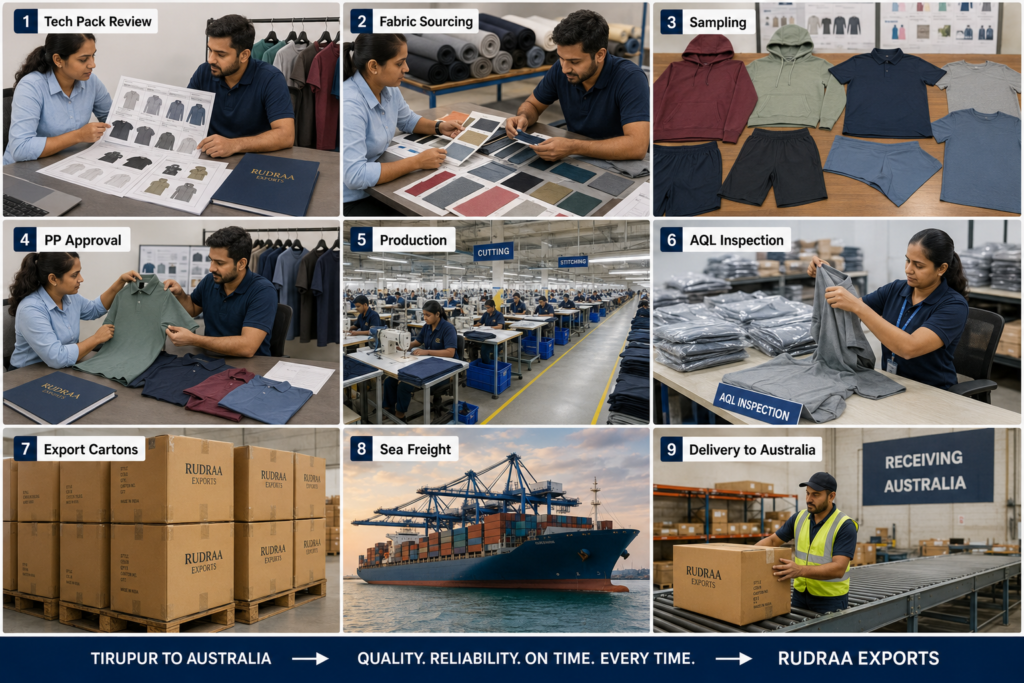
At Rudraa Exports, we support Australian brands with factory-direct garment manufacturing from Tirupur, India, including tech-pack review, low-MOQ planning, sampling, fabric sourcing, PP sample approval, quality checks, export packing and DDP or FOB shipment coordination.
Quick Answer
Australian brands can source garments from India safely by working directly with a verified factory, using clear tech packs, confirming MOQ and fabric requirements, approving PP samples, checking compliance documents, comparing FOB and DDP quotes, and calculating landed cost before placing the bulk order. A direct factory model reduces middleman markups and improves production visibility, but it works best when the brand provides clear specifications and approval discipline.
Looking for a clothing manufacturer for Australian brands? Contact Rudraa Exports and share your product category, quantity, fabric, GSM and delivery destination.
The Three Main Sourcing Options for Australian Brands
Most Australian apparel founders compare three sourcing paths:
- Local Australian production
- Overseas production through an agent or middleman
- Direct factory sourcing from India
Each model has strengths and risks.
The uploaded guide compares these three pathways across cost, MOQ, compliance, communication, freight, lead time and landed-cost clarity.
Quick Comparison
| Criteria | Australia Local Production | India Through Agent | India Direct Factory |
|---|---|---|---|
| Unit cost | Usually higher | Medium, with agent markup | More transparent factory cost |
| MOQ | Can be low | Depends on agent network | Low to medium depending on product |
| Speed | Faster freight | Variable | Requires planned shipping |
| Communication | Easy | Indirect | Direct with factory team |
| Factory visibility | High if local | Often limited | Better with live video and direct updates |
| Compliance proof | Easier to inspect | May be filtered through agent | Must be verified directly |
| Landed cost | Simple | Can be unclear | Clear if FOB/DDP quoted properly |
| Best for | Micro runs and prototyping | Buyers needing sourcing support | Brands ready for structured production |
Option 1: Manufacturing Locally in Australia
Local production can be useful for very small runs, rapid prototypes or products that require close in-person development.
Benefits of Australian Local Production
- Same country communication
- Easier sample fittings
- Faster domestic delivery
- Lower import complexity
- Easier facility visits
- Good for micro-runs
- Useful for urgent prototypes
Limitations
- Higher labour cost
- Higher unit cost
- Limited local fabric base
- Smaller production capacity in some categories
- Price pressure at scale
- More difficult to hit wholesale margins
The uploaded source explains that local Australian production can offer speed and control, but higher labour and overhead costs can make scaling difficult for many streetwear and activewear brands.
Best Fit
Local production may suit you when:
- You need 20–80 units
- You are still testing fit
- You need weekly micro-drops
- You have premium Australian-made positioning
- Cost is less important than speed
- You are not ready for overseas logistics
Option 2: Sourcing from India Through an Agent
Agents or sourcing companies can help brands find factories, manage communication and organise production.
This can be useful if the buyer has limited sourcing experience.
Benefits of Using an Agent
- Supplier search support
- Communication help
- Sampling coordination
- Quality follow-up
- Freight support
- Reduced buyer workload
Limitations
- Agent markup
- Less direct factory visibility
- Slower technical clarification
- Factory name may not be disclosed
- Quality issues may be filtered
- Cost breakdown may be unclear
- Risk of “telephone-game” communication
The uploaded guide notes that agent-led sourcing may reduce workload, but can add margin opacity and communication layers.
Questions to Ask an Agent
- Will you disclose the actual factory name?
- Can I have a live factory video tour?
- What is your margin or service fee?
- Will I receive factory inspection records?
- Who handles quality disputes?
- Are quotes FOB, CIF, DDP or EXW?
- Can I speak directly to the factory merchandiser?
Best Fit
Agent sourcing may suit you when:
- You need full sourcing support
- You lack time to manage suppliers
- You do not have a tech pack
- You want someone to coordinate multiple factories
- You accept a markup for service
Option 3: Sourcing Directly from an Indian Factory
Direct factory sourcing means the brand communicates with the manufacturer producing the goods.
For Australian brands, this can improve:
- Cost transparency
- Technical communication
- Sampling discipline
- Production visibility
- Quality accountability
- Landed-cost planning
Benefits of Direct Factory Sourcing
- No middleman communication layer
- Clearer production responsibility
- Better technical clarification
- Better access to samples and QC records
- More transparent costing
- Better repeat-order consistency
- Easier material and trim control
- Faster corrective action
The uploaded source positions Rudraa’s direct Indian factory model as a way to reduce risk by removing middlemen, improving communication and offering clearer landed-cost options.
Limitations
Direct sourcing is not suitable for vague or unprepared buyers.
It requires:
- Clear product brief
- Tech pack or detailed reference
- Approval discipline
- Realistic MOQ planning
- Sampling patience
- Understanding of Incoterms
- Landed-cost calculation
Best Fit
Direct Indian factory sourcing may suit you when:
- You are ready for bulk or repeat production
- You need better margin
- You produce knitwear, streetwear or activewear
- You can approve samples properly
- You want production transparency
- You want factory-direct communication
- You are willing to plan shipping and approvals
Why India Works for Australian Clothing Brands
India has strong apparel manufacturing ecosystems.
For knitwear, Tirupur is especially relevant.
Tirupur Strengths
- T-shirts
- Polo shirts
- Hoodies
- Sweatshirts
- Joggers
- Kidswear
- Babywear
- Uniforms
- Cotton knitwear
- Export packing
- Printing and embroidery
- Fabric sourcing
- Dyeing and finishing support
The uploaded guide highlights Tirupur as a knit-focused supply chain with strong cotton and garment production capability.
Why Australian Brands Source from India
- Better margin potential
- Export manufacturing experience
- Cotton and knitwear strength
- Private-label capability
- Custom fabric and GSM options
- Print and embroidery support
- Low to medium MOQ options
- Direct communication possible
- DDP and FOB shipping options
Cost: Local vs Agent vs Direct Factory
Cost is one of the biggest reasons Australian brands look offshore.
But cost must be compared correctly.
Do not compare only:
Local unit price vs Indian ex-factory price
Compare:
Total landed cost per garment
Cost Factors to Include
| Cost Area | Why It Matters |
|---|---|
| Factory price | Base production cost |
| Sampling | Development cost |
| Fabric | Main cost driver |
| Trims | Labels, zippers, drawcords |
| Printing or embroidery | Decoration cost |
| Packing | Bags, cartons, stickers |
| Freight | Air or sea cost |
| Duty | Depends on classification and trade paperwork |
| GST | Cash-flow impact |
| Brokerage | Customs entry support |
| Local delivery | Port to warehouse |
The uploaded guide recommends comparing suppliers using landed cost rather than only factory quotation.
Why Middleman Markup Matters
An agent may be worthwhile if they add real technical, compliance or logistics value.
But if the buyer still manages the hard work, the markup can reduce margin without reducing risk.
Direct Factory Cost Advantage
A direct factory model can help brands see:
- Actual production cost
- Fabric cost impact
- Print or embroidery cost
- Packing cost
- MOQ trade-offs
- Shipping options
- Cost difference between FOB and DDP
MOQ: What Australian Startups Should Know
MOQ means Minimum Order Quantity.
It can apply to:
- Style
- Colour
- Fabric
- Trim
- Embroidery
- Packaging
Common MOQ Mistake
A brand asks for:
- 100 total pieces
- 5 colours
- 6 sizes
This creates very small quantities per colour and size.
Even if the factory accepts the order, unit cost may rise.
Better MOQ Planning
| Better Choice | Why It Helps |
|---|---|
| Fewer colours | Improves production efficiency |
| Shared fabric | Reduces material complexity |
| Simple trims | Reduces minimum purchases |
| Realistic size curve | Reduces dead stock |
| One hero style | Protects cash |
| Repeat best-sellers | Builds scale gradually |
The uploaded source states that low MOQs may be possible in Tirupur ecosystems, but brands must still control style, colour and size planning.
Sampling: How to Reduce Risk Before Bulk
A direct Indian factory relationship works best when sampling is structured.
Recommended Sampling Ladder
1. Proto Sample
Checks:
- Silhouette
- Basic construction
- Fit direction
- Fabric direction
2. Size Set
Checks:
- Grading
- Fit across sizes
- Measurement balance
- Size consistency
3. PP Sample
Checks:
- Bulk fabric
- Final trims
- Final print or embroidery
- Labels
- Packaging
- Final measurements
The uploaded guide recommends a disciplined sampling ladder of proto sample, size set and PP sample before bulk production.
Sampling Rule
Do not begin bulk production until the PP sample is approved in writing.
Compliance: How to Avoid Ethical Washing
Compliance is not proven by words such as “ethical,” “premium” or “sustainable.”
It requires documents and verification.
Compliance Documents to Request
- OEKO-TEX certificate where applicable
- Factory audit reports where available
- Social compliance documents
- Restricted substances information
- Product test reports
- Material traceability records
- Factory registration details
The uploaded source highlights OEKO-TEX scope and validity as important items to verify before paying for samples.
What to Check
| Document | Check |
|---|---|
| Certificate | Is it valid? |
| Scope | Does it cover your product or facility? |
| Legal entity | Does it match the factory? |
| Address | Does it match production site? |
| Date | Is it current? |
| Product coverage | Is your product included? |
Verification Tip
Ask for a live factory video walkthrough before paying for samples.
Incoterms: FOB vs DDP for Australian Brands
Incoterms decide who pays for what and where responsibility changes.
FOB
FOB means the supplier delivers goods to the export port and loads them onto the vessel.
The buyer then manages:
- Sea freight
- Insurance
- Import clearance
- Duty or GST
- Local delivery
DDP
DDP means the supplier quotes delivery to the buyer’s location with import handling included in the agreed structure.
This can simplify budgeting for first-time importers.
The uploaded guide recommends asking suppliers to quote both FOB and DDP to compare landed costs more clearly.
When DDP Helps
DDP may help when:
- You are importing for the first time
- You do not have a freight forwarder
- You want a predictable landed estimate
- You need fewer surprise invoices
- You want one coordinated shipping process
When FOB Helps
FOB may help when:
- You have a reliable broker
- You import regularly
- You consolidate shipments
- You want more freight control
- You want to compare forwarder rates
Best First-Import Strategy
For the first shipment, DDP can reduce logistics confusion.
Once SKUs are stable, FOB may help optimise cost.
Shipping Timeline from India to Australia
Shipping time depends on:
- Freight mode
- Port
- Destination city
- Customs clearance
- Local delivery
- Peak season
- Documentation quality
Practical Planning Direction
| Freight Mode | Best For |
|---|---|
| Air freight | Samples, urgent stock and small top-ups |
| Sea freight | Bulk stock and planned replenishment |
| DDP courier/forwarder solution | First-time importers needing simplicity |
The uploaded source gives planning guidance that air is faster while sea freight requires longer door-to-door planning.
Shipping Rule
Do not set your public launch date based only on factory completion date.
Add time for:
- Export packing
- Freight booking
- Transit
- Customs clearance
- Local delivery
- Warehouse receiving
- Quality spot check
India-Australia Trade Documentation
Australian importers should check whether their garments qualify for preferential duty treatment under India-Australia trade arrangements.
The uploaded guide notes that apparel lines may receive duty benefits when the correct Certificate of Origin and product classification are in place.
Ask Your Supplier or Broker
- What is the HS code?
- Is the product eligible?
- Is a Certificate of Origin available?
- Does the invoice match the origin document?
- Who prepares the export documents?
- Who checks duty and GST treatment?
Important
Always confirm duty, GST and classification with a qualified customs broker.
Fit / Fit-Not Guide
Rudraa Exports May Be a Good Fit If
- You are an Australian streetwear brand
- You are developing activewear or knitwear
- You need better margin
- You want direct factory communication
- You can provide a tech pack or clear reference
- You are ready for structured sampling
- You want low-MOQ discussion
- You need DDP or FOB options
- You want export-ready documentation
- You value compliance transparency
Rudraa May Not Be the Right Fit Yet If
- You need 20–40 units every week
- You want only rapid local prototyping
- Your design changes daily
- You cannot approve samples on time
- You do not have product specifications
- You need ultra-complex garments at tiny quantities
- You are not ready to manage decisions
The uploaded source explains that direct Indian factory sourcing works best for brands that can manage specifications and approvals, and may not suit ultra-fast micro-runs or vague designs.
Migration Plan: Moving from Local or Agent Sourcing to Direct Factory
Step 1: Lock Your Commercial Target
Before requesting a quote, define:
- Target retail price
- Target landed cost
- Target gross margin
- Quantity
- Destination city
- Freight preference
- Delivery deadline
Step 2: Build a No-Guess Tech Pack
Include:
- Measurements
- Tolerances
- Fabric GSM
- Composition
- Stitching
- Artwork placement
- Labels
- Packing
- Testing expectations
Step 3: Run Sampling in Sequence
Use:
- Proto sample
- Fit or size-set sample
- PP sample
Step 4: Choose Shipping Terms
For shipment one:
- Compare DDP and FOB
- Review landed-cost line items
- Confirm GST and duty treatment with broker
- Confirm shipment timeline
Step 5: Install Quality Checkpoints
Use:
- Fabric approval
- Lab dip approval
- Inline checks
- Final inspection
- Packing verification
- Photo or video updates
The uploaded guide presents a phased migration plan covering landed-cost targets, tech packs, sampling, DDP/FOB selection and ongoing quality checks.
Quote Request Checklist
Before contacting a clothing manufacturer, prepare:
| # | Information |
|---|---|
| 1 | Product category |
| 2 | Reference images |
| 3 | Tech pack if available |
| 4 | Fabric composition |
| 5 | GSM target |
| 6 | Quantity |
| 7 | Number of colours |
| 8 | Size range |
| 9 | Print or embroidery details |
| 10 | Label requirements |
| 11 | Packaging requirements |
| 12 | Destination city in Australia |
| 13 | Preferred Incoterm |
| 14 | Delivery timeline |
| 15 | Compliance requirements |
How Rudraa Exports Supports Australian Brands
Rudraa Exports helps Australian clothing brands source directly from India with structured production support.
Manufacturing Support
- Product brief review
- Tech-pack review
- Fabric sourcing
- GSM planning
- Pattern and fit support
- Proto sample development
- Size-set coordination
- PP sample approval
- Print and embroidery support
- Label and packaging coordination
- Low-MOQ discussion
- Production planning
- Inline QC
- AQL inspection support
- Export packing
- DDP and FOB shipment coordination
Products Supported
- T-shirts
- Oversized T-shirts
- Polo shirts
- Hoodies
- Sweatshirts
- Joggers
- Shorts
- Activewear
- Gym wear
- Kidswear
- Babywear
- Nightwear
- School uniforms
- Corporate apparel
- Private-label knitwear
Benefits for Australian Brands
- Factory-direct communication
- Fewer sourcing layers
- Better cost visibility
- Better sample control
- Better fabric options
- Better production updates
- Better shipment planning
- Better repeat-order consistency
Ready to source from India without unnecessary risk? Speak with Rudraa Exports and share your product category, target quantity, fabric, GSM and delivery postcode.
FAQ: Clothing Manufacturer for Australian Brands
1. Is India a good place for Australian brands to manufacture clothing?
Yes. India, especially Tirupur, is strong for knitwear products such as T-shirts, polos, hoodies, joggers, kidswear, uniforms and activewear.
2. Is local Australian manufacturing better than India?
Local manufacturing may be better for micro-runs and urgent prototypes. India may be better for brands that need margin, scale and wider knitwear manufacturing support.
3. What is the benefit of sourcing directly from a factory?
Direct sourcing can reduce middleman layers, improve technical communication, increase cost visibility and support better repeat-order control.
4. What MOQ should Australian startups expect?
MOQ depends on product, fabric, colour, trims and complexity. Low-MOQ discussions may be possible for simple basics using available fabrics.
5. Should I use DDP or FOB?
DDP can be useful for first shipments because it simplifies budgeting. FOB may be better once you have your own broker or freight forwarder.
6. What documents should I check before sourcing?
Check factory details, compliance certificates, product scope, sampling policy, quote terms, Incoterms and export documentation.
7. How do I avoid hidden costs?
Ask for both FOB and DDP quotes, confirm packed CBM, check GST and duty with a broker, and calculate landed cost per garment.
8. Do I need a tech pack?
A tech pack is strongly recommended. It reduces misunderstanding and helps the factory quote and sample accurately.
9. How long does shipping from India to Australia take?
Air freight is faster and used for samples or urgent stock. Sea freight is better for planned bulk shipments and requires longer door-to-door planning.
10. Can Rudraa Exports support activewear?
Yes. Rudraa supports activewear, gym wear, T-shirts, hoodies, joggers, polos and private-label knitwear.
11. Can Rudraa Exports provide DDP shipping?
Rudraa can discuss DDP and FOB shipment options depending on product, destination and order details.
12. What should I send for a quote?
Send your product type, tech pack or reference images, fabric, GSM, quantity, colours, sizes, branding details, packaging needs and Australian delivery postcode.
Conclusion
Australian clothing brands do not need to choose blindly between high-cost local production and risky overseas sourcing.
The better approach is controlled direct sourcing.
Local production is useful for prototypes and micro-runs. Agents may help if you need sourcing support. But a direct Indian factory model can give Australian brands better cost visibility, production communication, compliance documentation, sampling control and landed-cost planning.
The key is process.
Use clear tech packs. Approve samples properly. Verify certificates. Compare FOB and DDP. Calculate landed cost. Keep your first production run simple. Build trust with a factory that can support repeat orders.
Rudraa Exports helps Australian brands source streetwear, activewear, basics, uniforms and private-label knitwear from Tirupur, India with factory-direct communication, low-MOQ discussions, sampling, QC, export packing and shipping coordination.
Visit rudraaexports.com or contact the Rudraa Exports team to request a quote for your next Australia-focused garment production run.
Related reading
How to Forecast Garment Landed Costs from India to Australia
Cut-and-Sew vs Blank Customisation: Which Model Fits Your Australian Streetwear Brand?