
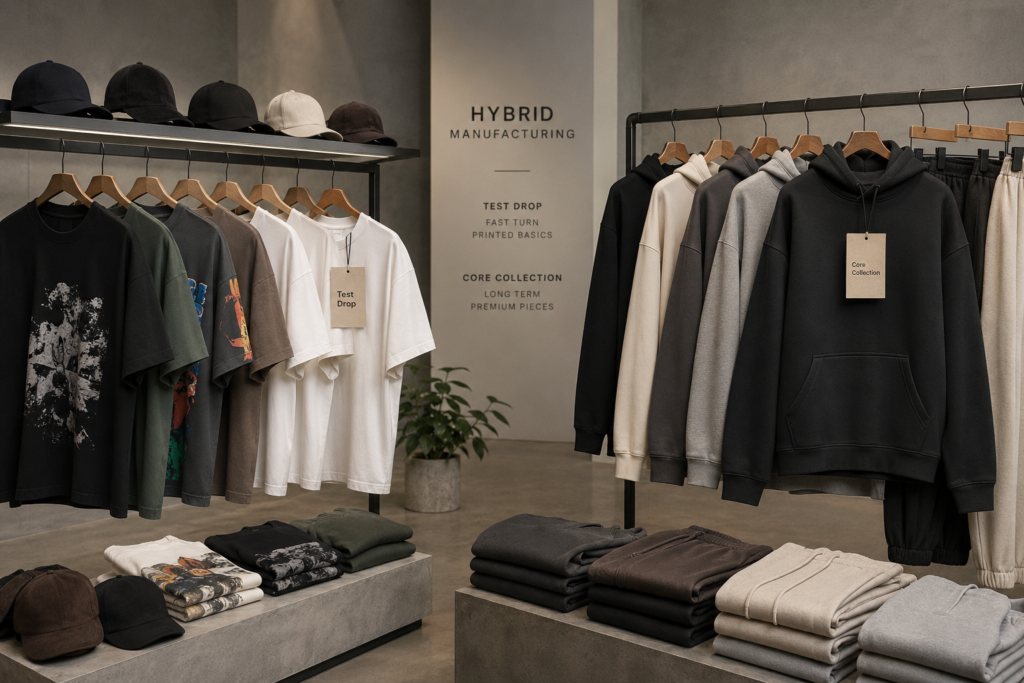
Choosing between decorated blanks and full cut-and-sew manufacturing is one of the most important production decisions an Australian streetwear brand will make.
Both models can work.
The right choice depends on your:
- Sales volume
- Available cash
- Product complexity
- Launch schedule
- Margin target
- Brand positioning
- Need for custom fit
- Ability to carry inventory
Blank customisation helps brands move quickly with lower initial risk.
Cut-and-sew manufacturing gives brands greater control over fit, fabric, construction, trims and product identity.
Many successful labels do not choose only one.
They use a hybrid model: blanks for testing and fast drops, then cut-and-sew for proven hero products.
At Rudraa Exports, we help Australian streetwear and lifestyle brands move from standard garments to fully customised T-shirts, hoodies, sweatshirts, joggers and private-label collections through factory-direct cut-and-sew manufacturing from Tirupur, India.
Quick Answer
Use blank customisation when speed, low upfront cost and small quantities matter most. Use cut-and-sew when your brand needs a unique fit, custom GSM, proprietary construction, custom trims or stronger long-term margins. A hybrid model is often best: test graphics using blanks, then move proven high-selling products into custom cut-and-sew production.
Planning your next streetwear drop? Contact Rudraa Exports to discuss whether blanks, cut-and-sew or a hybrid production plan fits your range.
What Is Blank Customisation?
Blank customisation means purchasing ready-made garments and adding your branding or decoration.
Common additions include:
- Screen printing
- DTG printing
- Embroidery
- Patches
- Heat transfers
- Neck labels
- Hangtags
- Packaging
The base garment already exists.
You do not control the original:
- Pattern
- Fabric construction
- Collar shape
- Sleeve opening
- Shoulder slope
- Body length
- Grading
- Stitch construction
The uploaded source explains that blank customisation uses ready-made garments and adds value through decoration, labels or patches.
Blank Customisation Is Best For
- First clothing drops
- Graphic T-shirts
- Creator merchandise
- Event apparel
- Influencer collections
- Small community brands
- Fast market testing
- Low-risk product launches
- Frequent design changes
What Is Cut-and-Sew Manufacturing?
Cut-and-sew manufacturing means developing the garment from fabric roll to finished product.
The manufacturer creates the garment according to your specifications.
You control:
- Fabric composition
- GSM
- Pattern
- Fit
- Size grading
- Collar
- Sleeve shape
- Hood construction
- Rib
- Pockets
- Trims
- Stitching
- Wash treatment
- Printing
- Embroidery
- Labels
- Packaging
The uploaded source describes cut-and-sew as a manufacturing model where the buyer develops a custom pattern and controls the garment from fabric through finishing.
Cut-and-Sew Is Best For
- Signature streetwear fits
- Premium heavyweight T-shirts
- Oversized silhouettes
- Custom hoodies
- Technical activewear
- Unique women’s fits
- Retail-ready collections
- Wholesale programs
- Core repeat products
- Long-term private-label brands
Cut-and-Sew vs Blank Customisation: Quick Comparison
| Criteria | Blank Customisation | Cut-and-Sew |
|---|---|---|
| Startup cost | Lower | Higher |
| MOQ | Very low to low | Medium |
| Speed | Faster | Slower initially |
| Fit control | Limited | Full control |
| Fabric control | Limited | Full control |
| Product uniqueness | Lower | Higher |
| Sampling | Minimal | Required |
| Restocking | Easy | Requires planning |
| Margin at scale | Often limited | Can improve |
| Brand defensibility | Mainly artwork | Product and artwork |
| Best use | Testing and fast drops | Hero products and scale |
1. Cost Comparison
Cost should be compared using total landed cost, not only garment price.
Blank Customisation Cost Structure
A decorated blank may include:
- Blank garment
- Local freight
- Screen printing or DTG
- Embroidery
- Label replacement
- Hangtags
- Packaging
- GST
Illustrative Blank T-Shirt Cost
| Cost Line | Example |
|---|---|
| Premium blank T-shirt | AUD 16.30 |
| One-colour screen print | AUD 6.59 |
| Estimated product cost | AUD 22.89 |
This does not include every possible cost, such as premium packaging, fulfilment or shipping to customers.
The uploaded source uses an illustrative decorated-blank example of approximately AUD 22.89 per T-shirt before some additional costs.
Cut-and-Sew Cost Structure
A cut-and-sew import may include:
- Fabric
- Cutting
- Stitching
- Trims
- Labels
- Decoration
- Packing
- FOB charges
- Freight
- Insurance
- Duty if applicable
- GST
- Brokerage
- Port charges
- Inland delivery
- Quality inspection
Indicative Cut-and-Sew Direction
The uploaded source gives indicative India FOB ranges of approximately:
- USD 1.60–3.50 for a basic 180 GSM cotton T-shirt
- USD 2.67–8.00 for a 350 GSM loopback hoodie
These are planning ranges only. Final costs depend on fabric, construction, trims, order quantity, testing and decoration.
Important Cost Rule
Do not compare:
Indian FOB garment price
with:
Australian decorated blank final price
without adding:
- Freight
- GST
- Duty
- Sampling
- Quality inspection
- Local delivery
- Cost of defects
- Cost of delays
2. Margin Comparison
Streetwear brands need enough gross margin to cover:
- Marketing
- Photography
- Content
- Packaging
- Fulfilment
- Payment fees
- Returns
- Discounts
- Staff
- Software
- Warehousing
The uploaded source notes that DTC streetwear brands often target gross margins around 55–65%, depending on the business model.
Blank Margin Challenge
Blank customisation can become expensive because:
- Premium blanks have a high starting price
- Decoration adds another cost layer
- Your product may still use the same base as competitors
- Retail pricing may look premium without unique garment construction
Cut-and-Sew Margin Opportunity
Cut-and-sew can help brands:
- Lower cost at scale
- Improve fabric quality at the same retail price
- Create stronger product differentiation
- Build custom hero products
- Control repeat margins more effectively
The key is reaching enough volume to justify sampling and production setup.
3. Product Differentiation
What You Can Change on a Blank
With blanks, you can usually control:
- Print artwork
- Embroidery
- Patches
- Labels
- Hangtags
- Packaging
You usually cannot control:
- Pattern shape
- Fit block
- Collar dimensions
- Sleeve length
- Shoulder drop
- Fabric GSM
- Fabric composition
- Stitching details
- Shrinkage specification
What You Can Change with Cut-and-Sew
With full custom manufacturing, you can create:
- Boxy T-shirts
- Cropped T-shirts
- Drop shoulders
- Wide sleeves
- Heavy collars
- Custom rib
- Double-layer hoods
- Oversized hoodies
- Custom pocket shapes
- Custom fabric washes
- Garment-dyed products
- Private-label activewear
- Custom shorts and joggers
The uploaded source explains that cut-and-sew gives brands control over pattern, grading, GSM, yarn, trims, labels, finishing and garment construction.
Simple Brand Rule
If customers buy primarily for the artwork, blanks may be sufficient.
If customers buy for the fit, fabric and garment feel, cut-and-sew becomes more important.
4. Lead-Time Comparison
Blank Customisation Timeline
Blank customisation is normally faster because the garment already exists.
Typical steps include:
- Select blank garment
- Confirm stock availability
- Approve artwork
- Print or embroider
- Pack and dispatch
Some Australian decorators may offer quick services, depending on stock and workload.
The uploaded source notes that blank customisation may offer delivery around two weeks or faster for selected local workflows.
Cut-and-Sew Timeline
Cut-and-sew requires development.
Typical steps include:
- Product brief
- Tech pack
- Pattern development
- Proto sample
- Fit correction
- Size set
- Lab dips
- Print or embroidery approval
- PP sample
- Bulk production
- Inspection
- Shipping
The uploaded source gives an indicative sampling and approval period of approximately 20–45 days, depending on product complexity and fabric availability.
Lead-Time Decision
Choose blanks when:
- Launch speed is critical
- The design is trend-led
- You need to restock quickly
- You are testing demand
Choose cut-and-sew when:
- Product identity matters more than speed
- The range is seasonal
- You can plan months ahead
- You need repeatable custom fits
5. MOQ Comparison
Print-on-Demand
Possible MOQ:
1 piece
Best for:
- Design testing
- Creator products
- No-inventory launches
- Early audience building
Decorated Blanks
Practical MOQ may begin around:
24–100 pieces
This depends on:
- Decoration method
- Number of colours
- Artwork
- Supplier
- Garment availability
Cut-and-Sew
Simple cut-and-sew T-shirts may require:
300 pieces per style or colour
More complex products may require higher quantities.
The uploaded source explains that blanks can support very low quantities, while cut-and-sew commonly requires larger production runs because of fabric and setup minimums.
Important MOQ Question
Always ask:
- MOQ per style?
- MOQ per colour?
- MOQ per fabric?
- MOQ per print?
- Can sizes be combined?
6. Quality Consistency
Blank Quality Advantages
Established blank products may offer:
- Stable sizing
- Standard colours
- Consistent fabric
- Proven shrinkage
- Easy repeat ordering
This reduces development risk.
Blank Quality Limitations
You depend on the blank supplier for:
- Fit
- Fabric changes
- Colour availability
- Stock availability
- Discontinued styles
- Construction quality
Cut-and-Sew Quality Advantages
A good custom manufacturer can lock:
- Approved pattern
- Grading
- Fabric source
- GSM tolerance
- Colour standard
- Trim specification
- Stitch construction
- Inspection standards
However, this requires strong:
- Tech packs
- Sample approvals
- Version control
- Quality inspections
- Reorder records
7. Brand Positioning
Your manufacturing model affects how customers perceive the brand.
Blank-Based Brand Positioning
Blank customisation works well for:
- Graphic-driven labels
- Music merchandise
- Creator brands
- Community-led apparel
- Event drops
- Low-risk launches
But competitors may use the same garments.
Cut-and-Sew Brand Positioning
Cut-and-sew supports:
- Premium streetwear
- Designer-led silhouettes
- Technical apparel
- Custom activewear
- Luxury basics
- Proprietary fits
- Wholesale-ready ranges
A custom garment is harder to copy because the product itself is part of the brand identity.
8. Inventory and Cash-Flow Risk
Blank Customisation Risk
Lower because:
- Smaller quantities are possible
- Production is faster
- You can test more designs
- Unsold inventory exposure is lower
Cut-and-Sew Risk
Higher because:
- More cash is committed
- Sampling is required
- MOQ is higher
- Lead time is longer
- Forecasting mistakes are more expensive
However, successful cut-and-sew products can create:
- Better margins
- Stronger repeat sales
- Greater brand loyalty
- Higher wholesale potential
When Blanks Are the Better Choice
Use blanks when:
- You are launching your first collection
- You have not proven product demand
- Your strength is graphic design
- Your monthly volume is low
- You need a fast launch
- You want multiple experimental designs
- You cannot carry inventory
- You need quick local restocking
Example
An Australian startup launching four graphic tees may be safer using quality blanks rather than producing four separate custom T-shirt bodies.
When Cut-and-Sew Is the Better Choice
Use cut-and-sew when:
- You need a signature fit
- Fabric quality is part of your positioning
- You repeatedly sell the same style
- You need higher margin at scale
- You want custom women’s or unisex blocks
- You are preparing for wholesale
- You want exclusive products
- You need custom trims or construction
Example
A brand selling the same oversized T-shirt for two successful restocks may be ready to develop a custom heavyweight pattern.
When Should You Move from Blanks to Cut-and-Sew?
The uploaded source suggests using sales consistency and repeat demand as transition signals rather than moving only because the brand appears more established.
Strong Transition Signals
- One product has sold out twice
- Return rates are stable
- Customers request restocks
- Blank fit limits customer satisfaction
- Your retail price needs better margin
- You are ready to order 200+ units
- You can afford sampling
- You have a reliable production calendar
Transition Rule
Two successful restocks plus stable returns can justify moving a hero SKU into cut-and-sew development.
Recommended Hybrid Manufacturing Model
A hybrid model allows you to balance speed and product ownership.
Example Hybrid Range
| Product | Manufacturing Model |
|---|---|
| Experimental graphic tee | Blank customisation |
| Monthly creator drop | POD or blank |
| Core heavyweight tee | Cut-and-sew |
| Signature hoodie | Cut-and-sew |
| Event merchandise | Blank |
| Limited trend design | Blank |
| Core jogger | Cut-and-sew |
| Cap | Blank or custom depending on volume |
Benefits of Hybrid Production
- Lower inventory risk
- Faster testing
- Better cash flow
- Stronger hero products
- Gradual customisation
- Easier range planning
- More flexible launches
Two-Calendar Production Strategy
A hybrid brand should run two production calendars.
Calendar 1: Fast-Turn Products
Used for:
- Blanks
- Creator collaborations
- Graphic tests
- Event products
- Rapid restocks
Calendar 2: Seasonal Custom Products
Used for:
- Custom T-shirts
- Heavyweight hoodies
- Joggers
- Technical garments
- Wholesale ranges
This prevents custom production delays from stopping the brand’s monthly revenue.
Decision Framework by Sales Volume
| Expected Sales per SKU | Recommended Direction |
|---|---|
| Under 50 units | POD or decorated blanks |
| 50–200 units | Decorated blanks |
| 200–500 units | Compare blanks and cut-and-sew |
| 500+ units | Cut-and-sew becomes more attractive |
| Proven repeat style | Strong candidate for custom production |
These are planning directions rather than fixed rules.
Product complexity, margin and customer demand still matter.
Cut-and-Sew Decision Checklist
Product Questions
- Is the garment a hero product?
- Does fit matter to the brand?
- Do you need custom GSM?
- Do you need a custom collar or hood?
- Do you need exclusive construction?
- Do customers complain about blank fit?
Financial Questions
- Can you fund sampling?
- Can you carry the MOQ?
- Can you absorb one revision cycle?
- Does the product sell consistently?
- Will custom production improve gross margin?
- Have you calculated landed cost?
Operational Questions
- Do you have a tech pack?
- Can you approve samples on time?
- Do you have a production calendar?
- Can you wait for sea freight?
- Do you have inspection standards?
- Can you manage reorders?
How Rudraa Exports Supports Cut-and-Sew Manufacturing
Rudraa Exports supports Australian streetwear, lifestyle and private-label brands with custom garment production from Tirupur, India.
Cut-and-Sew Products
- Custom T-shirts
- Heavyweight T-shirts
- Oversized T-shirts
- Polo shirts
- Hoodies
- Zip hoodies
- Sweatshirts
- Joggers
- Shorts
- Activewear
- Kidswear
- Uniforms
- Private-label knitwear
Customisation Support
- Pattern development
- Fit sampling
- Fabric sourcing
- GSM selection
- Custom dyeing
- Lab dips
- Custom rib
- Printing
- Embroidery
- Private labels
- Hangtags
- Packaging
- Size grading
- AQL inspection support
Manufacturing Support
- Factory-direct communication
- Tech-pack review
- Sample development
- PP sample approval
- Production planning
- Inline QC
- Export packing
- Documentation
- Shipment coordination
- Repeat-order support
The uploaded source positions Tirupur as a strong cut-and-sew sourcing base because of its cotton jersey, fleece, printing, stitching and export manufacturing ecosystem.
Cut-and-Sew vs Blanks Checklist
| # | Decision Question |
|---|---|
| 1 | Is this a test product or hero product? |
| 2 | What is expected 60-day sales volume? |
| 3 | Is custom fit essential? |
| 4 | Is custom GSM required? |
| 5 | What gross margin is needed? |
| 6 | Can the brand fund sampling? |
| 7 | Can the brand accept the MOQ? |
| 8 | Is delivery needed within two weeks? |
| 9 | Can production be planned months ahead? |
| 10 | Does the product already have repeat demand? |
| 11 | Is the blank fit limiting the product? |
| 12 | Is the same blank used by competitors? |
| 13 | Can colours be consolidated? |
| 14 | Is sea freight practical? |
| 15 | Are quality standards documented? |
| 16 | Is a hybrid model possible? |
| 17 | Which products should remain on blanks? |
| 18 | Which hero product should move first? |
| 19 | Is landed cost fully calculated? |
| 20 | Is there a repeat-order plan? |
FAQ: Cut-and-Sew vs Blank Customisation
1. What is blank customisation?
Blank customisation means buying ready-made garments and adding printing, embroidery, patches, labels or packaging.
2. What is cut-and-sew manufacturing?
Cut-and-sew means developing the garment from fabric and producing it according to a custom pattern, fit, fabric and construction specification.
3. Which model is cheaper?
Blanks are usually safer and cheaper at very low quantities. Cut-and-sew can become more cost-effective at higher volumes when all landed costs are managed properly.
4. Which model has the lowest MOQ?
Print-on-demand and blank customisation offer the lowest MOQs. Cut-and-sew generally requires higher quantities.
5. When should a streetwear brand move to cut-and-sew?
Move a proven hero product when sales are stable, the style has been restocked, and custom fit or fabric can improve customer experience and margin.
6. Can a startup use cut-and-sew?
Yes, but it should begin with one simple product, limited colours and a realistic MOQ rather than attempting a large custom collection.
7. Are blanks bad for premium brands?
No. High-quality blanks can work well for graphic-led or community-driven premium brands. The limitation is reduced control over fit and construction.
8. What is a hybrid manufacturing model?
A hybrid model uses blanks for fast or experimental products and cut-and-sew for core, high-volume or signature garments.
9. What product should move to cut-and-sew first?
Move your most consistent best-selling T-shirt, hoodie or jogger first because demand is easier to forecast.
10. How long does cut-and-sew development take?
Sampling and approvals may take several weeks, followed by bulk production and international shipping.
11. Can Rudraa Exports manufacture custom streetwear?
Yes. Rudraa supports custom T-shirts, hoodies, sweatshirts, joggers, activewear and private-label streetwear from Tirupur.
12. What should I send Rudraa Exports?
Send your product reference, tech pack if available, fabric, GSM, quantity, colours, size range, artwork, trims, packaging and Australian delivery date.
Conclusion
Blank customisation and cut-and-sew manufacturing are not competing business models.
They solve different problems.
Blanks are ideal for speed, testing, low MOQs and design experimentation.
Cut-and-sew is ideal for custom fit, fabric ownership, product differentiation, improved margins and long-term brand development.
For many Australian streetwear brands, the strongest strategy is hybrid.
Keep fast-turn products on blanks while moving proven hero products into custom production one at a time.
Rudraa Exports helps Australian brands develop custom cut-and-sew garments from Tirupur with factory-direct communication, fabric sourcing, sampling, private labels, quality control, packing and export support.
Visit rudraaexports.com or contact the Rudraa Exports team to discuss your blank-to-cut-and-sew transition.
Related reading
How to Write a Garment Tech Pack: Step-by-Step Guide for Clothing Brands
OEM vs CMT vs Full-Package Apparel Manufacturing: Which Model Should Buyers Choose?
How to Find a Reliable Garment Manufacturer for Your Australian Fashion Brand
Clothing Manufacturer for Australian Brands: How to Source from India Without the Risk