
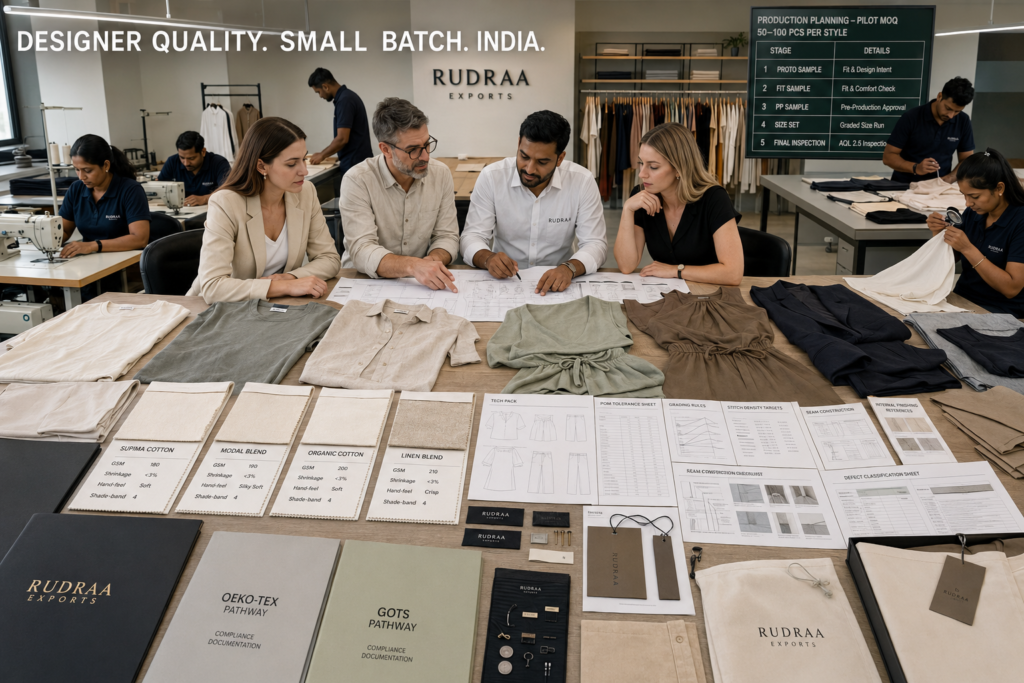
Polish premium fashion brands need more than basic garment production.
They need designer-level manufacturing.
That means the garment must feel premium, fit correctly, hold its shape, use the right fabric, show clean finishing and arrive with documentation that supports EU retail expectations.
The challenge is simple.
Customers expect designer-quality hand feel and finishing.
The brand needs smaller production runs, controlled cost, reliable sampling, verifiable compliance and enough margin to grow.
This is why many Polish labels are now evaluating India as a premium private-label manufacturing base.
India is not only a basic garment sourcing destination. With the right factory, process and quality controls, India can support designer clothing manufacturing for Polish and EU-facing brands.
At Rudraa Exports, we help premium and private-label brands source from India with fabric planning, pattern development, fit engineering, small-batch production discussions, sampling gates, AQL inspection, export packing and EU documentation support.
Quick Answer
A designer clothing manufacturer in India can be a strong fit for Polish premium brands when the factory can support premium fabrics, tight measurement tolerances, clean internal finishing, controlled sampling, AQL inspection, low-MOQ pilot runs and EU compliance documentation. The safest approach is to start with a 50–100 pcs pilot style, approve proto, fit and PP samples, verify OEKO-TEX or GOTS pathways where relevant and scale only after fabric, fit and finishing are proven.
Looking for premium private-label manufacturing from India? Contact Rudraa Exports and share your tech pack, fabric direction, MOQ, fit standard and EU compliance needs.
What Designer Clothing Manufacturing Really Means
Designer manufacturing is not only good stitching.
It is the ability to repeatedly translate a brand’s design into a premium garment that meets the same standard across fabric, fit, construction, finishing and packaging.
Designer-Level Manufacturing Includes
- Premium fabric selection
- Strong fabric behaviour control
- Accurate pattern development
- EU fit and grading discipline
- Tight measurement tolerances
- Clean stitch quality
- Controlled seam construction
- Premium internal finishing
- Defect classification
- Inline and final inspection
- Custom label and packaging execution
- Chemical and material documentation
The uploaded guide explains that designer manufacturing requires repeatable control across fabric behaviour, pattern precision, construction engineering, finishing and QC documentation.
Why Polish Premium Brands Consider India
Polish premium labels face a sourcing squeeze.
They need high-quality garments, but they also need commercial feasibility.
India can help when the brand needs:
- Premium fabric access
- Better cost-to-quality ratio
- Small-batch pilot production
- Private-label customisation
- Skilled garment construction
- Export experience
- EU-facing documentation support
- Long-term production scale
The uploaded source notes that India’s apparel exports to the EU have grown significantly, showing mature vendor management, compliance literacy and European-market production experience.
What Polish Brands Should Check Before Choosing a Factory
Before discussing price, score each factory on designer-level capability.
Premium Factory Evaluation Table
| Criteria | What to Check |
|---|---|
| Fabric capability | Premium cotton, modal, linen, organic and sustainable blends |
| Pattern engineering | Base block, balance, grading and POM control |
| Construction quality | Stitch density, seam types, internal finishing |
| Sampling workflow | Proto, fit, PP and size-set process |
| MOQ flexibility | 50–100 pcs pilot feasibility |
| QC process | Inline, end-line and final inspection |
| AQL standard | Defect limits and inspection level |
| Compliance | OEKO-TEX, GOTS or relevant documentation |
| Traceability | Fabric lot, batch and supplier records |
| Packaging | Labels, hangtags, folding, barcodes and cartons |
| Export experience | EU documentation and shipping support |
The uploaded guide recommends using a scorecard before discussing price because premium manufacturing must be assessed through capability, evidence and process discipline.
Premium Fabric Capability
Fabric is the first thing the customer feels.
For designer private-label production, the fabric must match the price point and brand promise.
Premium Fabric Options
Supima Cotton or Long-Staple Cotton
Best for:
- Elevated T-shirts
- Premium jersey basics
- Soft tops
- Designer loungewear
Benefits:
- Softer hand feel
- Better fibre strength
- Premium surface
- Better customer perception
Modal and Modal Blends
Best for:
- Drape tops
- Women’s basics
- Premium loungewear
- Jersey dresses
- Soft co-ord sets
Benefits:
- Smooth hand feel
- Good drape
- Rich colour appearance
- Elevated comfort
Linen and Linen Blends
Best for:
- Resort wear
- Summer shirts
- Relaxed dresses
- Premium casualwear
- Warm-weather capsules
Benefits:
- Natural texture
- Breathability
- Premium appearance
- Strong seasonal appeal
Organic Cotton
Best for:
- Sustainable premium basics
- Babywear
- Women’s tops
- Loungewear
- Private-label essentials
Important:
Organic claims should be supported by chain-of-custody documentation.
Sustainable Blends
Best for:
- Brands with lower-impact positioning
- Athleisure
- Travel wear
- Modern casual basics
Buyer should check:
- Recycled content
- Fibre origin
- Chemical documentation
- Pilling performance
- Shrinkage
- Colourfastness
The uploaded source recommends building a premium fabric shortlist including Supima or long-staple cotton, modal blends, linen blends, organic cotton and sustainable blends.
Fabric Test Checklist for Premium Brands
Premium fabric approval should not be based on hand feel alone.
Request Tests or Records For
| Test Area | Why It Matters |
|---|---|
| GSM | Controls weight and feel |
| Shrinkage | Protects fit after wash |
| Shade consistency | Reduces colour disputes |
| Skew or torque | Prevents twisting |
| Pilling | Protects long-term appearance |
| Colourfastness | Protects customer use |
| Stretch recovery | Important for knits |
| Seam performance | Important for construction |
| Fabric lot tracking | Supports repeat consistency |
Pattern and Fit Engineering
Designer-level garments must fit consistently.
Pattern quality is one of the biggest differences between basic production and premium production.
Premium Fit Engineering Should Include
- Base size definition
- Target customer body profile
- EU measurement review
- Garment measurement chart
- POM map
- Tolerances
- Grading rules
- Fabric shrinkage allowance
- Stretch and recovery review
- Size-set validation
- Fit-sample sign-off
The uploaded guide highlights pattern precision, controlled ease, graded size consistency and measurement tolerances by POM as key designer-level criteria.
POM Examples
POM means Point of Measurement.
Common POMs include:
- Chest
- Waist
- Hip
- Shoulder
- Sleeve length
- Armhole
- Bicep
- Body length
- Hem
- Front rise
- Back rise
Premium Rule
A designer garment cannot depend on vague fit comments.
It needs exact measurements and tolerance rules.
Construction and Internal Finishing
Luxury perception is often created inside the garment.
Customers may not know the technical terms, but they notice quality.
Designer-Level Construction Checks
| Area | What to Check |
|---|---|
| Stitch density | SPI target and consistency |
| Seam type | Suitable for fabric and stretch |
| Binding | Clean and even |
| Hem | No twisting or waviness |
| Neckline | Stable and balanced |
| Armhole | Smooth and comfortable |
| Internal finishing | Clean inside appearance |
| Fusing | Correct weight and bonding |
| Labels | Neat placement and comfort |
| Threads | Colour and strength consistency |
The uploaded source explains that designer-level construction includes stable seams, clean bindings, consistent SPI, controlled stretch seams and neat internal finishing.
Sampling Workflow for Designer Private Label
Premium garments should follow a controlled sampling ladder.
Step 1: Proto Sample
Purpose:
- Check silhouette
- Review pattern direction
- Identify construction challenges
- Confirm first design interpretation
Step 2: Fit Sample
Purpose:
- Refine balance
- Check measurements
- Review movement
- Adjust pattern
- Confirm EU fit direction
Step 3: PP Sample
Purpose:
- Lock bulk fabric
- Lock trims
- Lock labels
- Lock finishing
- Lock packaging
- Approve final production standard
Step 4: Size Set
Purpose:
- Check grading
- Confirm EU size range
- Validate fit across sizes
- Catch size-specific issues
The uploaded guide recommends a premium workflow using proto, fit, PP and optional size-set samples before scaling.
Sampling Rule
Do not move to bulk because the garment looks close.
Move to bulk only when the PP sample is approved against the full technical standard.
Small-Batch MOQ: 300 Pieces Per Style
Premium Polish labels often need smaller batches.
They may not want to order thousands of units before proving demand.
The uploaded guide positions 300 pcs per style as a realistic small-batch pilot range for boutique or premium programs when fabric and trim constraints are planned correctly.
What Makes 50–100 pcs Possible
- Shared fabric across styles
- Limited colourways
- Available fabric stock
- Simple trim strategy
- Clear tech pack
- Standardised packaging
- Controlled size range
- Realistic sampling calendar
What Makes Low MOQ Difficult
- Custom dyed fabric
- Too many colours
- Complex trims
- Custom hardware
- Multiple print techniques
- High embroidery density
- Many sizes
- Changing design after sampling
Low-MOQ Planning Example
Instead of:
- 5 styles
- 4 colours each
- Custom fabric for every style
- Custom trims for every garment
Start with:
- 2 styles
- 1 shared premium fabric
- 2 colourways
- 300 pcs per style
- Shared labels and packaging
This keeps the program premium but commercially realistic.
Quality Control and AQL Inspection
Designer garments need objective inspection standards.
AQL means Acceptable Quality Limit.
It is used to decide whether a production batch meets the agreed quality level.
QC Stages
Inline Inspection
Checks during production:
- Stitching
- Measurements
- Seam quality
- Construction method
- Label placement
- Print or embroidery position
End-Line Inspection
Checks after sewing and finishing:
- Appearance
- Loose threads
- Pressing
- Stains
- Shape
- Measurements
Final Inspection
Checks before shipment:
- Quantity
- Defect classification
- Measurements
- Packaging
- Carton details
- Buyer standards
The uploaded source identifies AQL 2.5 as a common baseline for apparel inspection while noting that premium brands may tighten inspection levels.
Defect Classification
| Defect Type | Example |
|---|---|
| Critical | Safety issue or illegal labelling |
| Major | Visible defect, wrong measurement, wrong material |
| Minor | Small thread issue or slight non-critical finishing mark |
Premium Buyer Tip
State your AQL level and defect definitions before bulk production begins.
Certifications and EU Compliance
Polish brands selling in the EU must pay attention to chemical safety, organic claims and traceability.
OEKO-TEX STANDARD 100
OEKO-TEX STANDARD 100 focuses on textile testing for harmful substances.
It is useful for close-to-skin apparel categories.
The uploaded guide explains that OEKO-TEX STANDARD 100 focuses on harmful-substance testing and is renewed annually.
GOTS
GOTS is relevant when a brand wants to make organic textile claims.
It covers organic fibre integrity and environmental and social criteria across the textile supply chain.
The uploaded guide notes that GOTS verifies organic fibre integrity and requires supply-chain controls and annual audits.
Compliance Verification Checklist
| Check | Question |
|---|---|
| Certificate validity | Is it current? |
| Product scope | Does it cover the product type? |
| Facility scope | Does it cover the production site? |
| Material scope | Does it cover the ordered fabric? |
| Chain of custody | Is the claim supported through the supply chain? |
| Audit timing | When is renewal due? |
| Buyer requirement | Does it match your retail or marketplace needs? |
Important Rule
Do not use sustainability claims unless the documentation supports them.
Traceability Readiness
Premium brands increasingly need visibility into their supply chain.
Traceability helps with:
- EU compliance
- Retailer requirements
- Product claims
- Quality disputes
- Repeat order control
- Customer trust
Traceability Records to Request
- Fabric supplier
- Fabric lot
- Yarn or fibre source where applicable
- Dye lot
- Trim supplier
- Batch ID
- Cutting lot
- QC report
- Packing list
- Certificate scope
- Shipment documents
The uploaded source identifies traceability readiness as an important factor for upcoming EU transparency expectations.
Premium Packaging and Brand Experience
Designer private label does not stop at the garment.
Packaging affects first impression.
Premium Packaging Elements
- Custom woven label
- Care label
- Size pip
- Hangtag
- Tissue wrap
- Inner garment bag
- Barcode sticker
- Fold board
- Carton mark
- Premium insert card
- Sustainable packaging option
The uploaded guide lists custom labels, hangtags, premium packaging, polybag rules and carton marking as important designer-level brand experience criteria.
Packaging Checklist
| Item | Check |
|---|---|
| Main label | Correct design and placement |
| Size label | EU size shown clearly |
| Care label | Accurate composition and care |
| Hangtag | Brand and product information |
| Inner bag | Protection and presentation |
| Barcode | SKU accuracy |
| Carton | Correct markings |
| Folding | Consistent presentation |
India vs Nearshore: Which Is Better for Polish Premium Brands?
Polish premium brands often compare India with Portugal, Turkey or nearby EU suppliers.
Nearshore May Be Better When
- Speed is the main priority
- Replenishment is needed in 2–3 weeks
- You need frequent in-person visits
- Quantities are extremely small
- Product is still changing weekly
- Transit time is more important than cost
India May Be Better When
- Cost-to-quality ratio matters
- Premium fabrics are needed
- Low-MOQ pilot is planned
- Repeat production is likely
- Designer details are documented
- EU compliance records are required
- The brand wants long-term scale
The uploaded source explains that nearshore sourcing usually wins on transit time and fast replenishment, while India can win on premium fabric capability, small-batch readiness and cost-to-quality ratio.
Fit / Fit-Not Guide
Rudraa Exports May Be a Strong Fit If
- You are a Polish premium label
- You need small-batch production
- You want 50–100 pcs pilot runs
- You need premium fabrics
- You have designer-level tech packs
- You care about fit and construction
- You need custom labels and packaging
- You sell into the EU
- You need OEKO-TEX or GOTS pathways
- You want factory-direct accountability
Rudraa May Not Be the Best Fit If
- You need 2–3 week delivery after PO
- You cannot fund proper sampling
- You do not have clear tech packs
- You expect the factory to design the collection
- You change styles constantly
- You want ultra-tiny micro-runs with complex custom details
The uploaded guide says India and Rudraa are strongest when the brand can define premium standards clearly, fund sampling properly and treat supplier selection as a technical partnership rather than a price auction.
Migration Plan: Premium Production from Poland to India
Week 0–1: Define Your Designer Standard
Create a one-page quality standard.
Include:
- Fabric type
- GSM range
- Shrinkage target
- Skew or torque limit
- Stitch density
- Seam type
- Internal finishing method
- POM tolerances
- Defect classification
- AQL level
- Packaging standard
The uploaded source recommends defining what designer manufacturing means for your own brand before starting supplier selection.
Week 1–2: Build a Premium Fabric Shortlist
Request swatches for:
- Supima cotton or long-staple cotton
- Modal blends
- Linen blends
- Organic cotton
- Sustainable knit blends
Review:
- Hand feel
- GSM
- Opacity
- Drape
- Shrinkage
- Colour response
- Certification support
Week 2–6: Run the Sampling Ladder
Develop:
- Proto sample
- Fit sample
- PP sample
- Size set if needed
Do not rush to bulk until the PP sample is signed.
Pre-Production to Bulk: Set QC Documentation
Define:
- Inline inspection
- End-line inspection
- Final AQL inspection
- Defect categories
- Measurement audit
- Certificate requirements
- Traceability records
Week 6–12+: Pilot and Scale
Start with:
- 50–100 pcs
- One or two colourways
- Controlled size range
- Approved fabric
- Approved PP sample
- Final QC report
After the pilot, review:
- Fit
- Defects
- Returns
- Hand feel
- Wash performance
- Packaging
- Customer response
Then scale by adding styles or increasing colourways.
The uploaded guide recommends starting with a 50–100 pcs pilot and tracking defects, measurement variance, shade consistency and hand-feel consistency before scaling.
Quote Request Checklist
Before requesting a quote, prepare:
| # | Information |
|---|---|
| 1 | Product category |
| 2 | Tech pack |
| 3 | Reference sample photos |
| 4 | Target fabric |
| 5 | GSM range |
| 6 | Required hand feel |
| 7 | Shrinkage target |
| 8 | Size range |
| 9 | POM tolerance |
| 10 | Stitch density target |
| 11 | Seam construction |
| 12 | Label requirements |
| 13 | Packaging specification |
| 14 | Certification requirements |
| 15 | Target MOQ |
| 16 | AQL level |
| 17 | Defect classification |
| 18 | Destination country |
| 19 | Delivery timeline |
| 20 | Target landed cost |
How Rudraa Exports Supports Polish Premium Private Labels
Rudraa Exports supports premium private-label apparel production from Tirupur, India.
Premium Manufacturing Support
- Product brief review
- Tech-pack review
- Premium fabric sourcing
- GSM planning
- Pattern development
- Fit sample support
- Size-set coordination
- PP sample approval
- Stitch and construction review
- Label and packaging coordination
- Small-batch pilot discussion
- Inline QC
- AQL inspection support
- Defect classification
- Traceability records
- Export packing
- EU-facing documentation support
Products Supported
- Premium T-shirts
- Elevated jersey tops
- Modal tops
- Linen-blend shirts
- Jersey dresses
- Resort sets
- Co-ord sets
- Loungewear
- Lightweight sweatshirts
- Private-label basics
- Tailored-casual pieces
- Women’s premium knitwear
Why Factory-Direct Helps Premium Brands
Factory-direct communication helps with:
- Faster technical clarification
- Better fabric selection
- Better pattern corrections
- Clearer inspection standards
- Better documentation access
- Fewer middle layers
- Stronger accountability
- Better repeat-order consistency
Ready to develop premium private-label garments in India? Speak with Rudraa Exports and share your tech pack, fabric shortlist, target MOQ, quality standard and EU compliance requirements.
FAQ: Designer Clothing Manufacturer in India for Polish Brands
1. Can India produce designer-quality clothing for Polish brands?
Yes. India can produce designer-quality garments when the factory has premium fabric access, strong pattern development, proper sampling, tight QC and clear documentation.
2. What makes designer manufacturing different from basic manufacturing?
Designer manufacturing requires better fabric control, fit precision, construction engineering, internal finishing, inspection standards and brand packaging.
3. What MOQ can Polish premium brands expect?
MOQ depends on fabric, trims, colour count and complexity. A 50–100 pcs pilot may be realistic for selected premium programs.
4. What fabrics are suitable for premium private label?
Premium options include long-staple cotton, Supima cotton, modal blends, linen blends, organic cotton and sustainable knit blends.
5. Is OEKO-TEX important for EU brands?
Yes. OEKO-TEX STANDARD 100 can support harmful-substance testing expectations for textiles, especially close-to-skin products.
6. Is GOTS required for organic cotton?
If the brand wants to make credible organic textile claims, GOTS or equivalent chain-of-custody documentation should be verified.
7. What is AQL inspection?
AQL inspection is a sampling method used to decide whether a batch meets agreed quality limits before shipment.
8. Should premium brands use AQL 2.5?
AQL 2.5 is commonly used as a general apparel baseline, but premium brands may choose stricter levels depending on product and risk.
9. Should I approve a PP sample before bulk?
Yes. The PP sample should lock fabric, fit, trims, labels, packaging and finishing before production begins.
10. Is India better than nearshore production?
India can be better for cost-to-quality ratio, fabric variety and scalable production. Nearshore may be better for very fast replenishment.
11. Can Rudraa Exports support premium packaging?
Yes. Rudraa can support custom labels, hangtags, folding, inner packaging, carton marking and export packing requirements.
12. What should I send Rudraa for a premium quote?
Send your tech pack, reference photos, target fabric, GSM, size range, tolerance standards, label requirements, packaging specs, MOQ and compliance needs.
Conclusion
Polish premium brands should not evaluate India only as a low-cost sourcing destination.
The better question is whether the factory can deliver designer manufacturing as a repeatable system.
That means premium fabric control, precise fit, clean construction, documented sampling, AQL inspection, certification pathways, traceability and brand-level packaging.
India can support designer private-label production when the buyer chooses the right factory and manages the process professionally.
For premium Polish labels, the safest path is to start with a controlled pilot: one or two styles, 50–100 pcs, approved fabric, clear tech pack, PP sample, defined AQL level and documented QC.
Rudraa Exports helps Polish and EU-facing brands develop premium private-label garments from Tirupur with factory-direct communication, fabric sourcing, fit development, small-batch planning, QC documentation and export support.
Visit rudraaexports.com or contact the Rudraa Exports team to discuss designer clothing manufacturing in India for your next premium collection.
Related reading
Shipping Finished Garments from Tirupur to Poland: Sea, Air and Hybrid Freight Compared
How Polish Fashion Brands Source Garments from India: Step-by-Step Procurement Guide
How to Import Garments from India to Poland: Customs, Duties and Compliance Guide 2026