
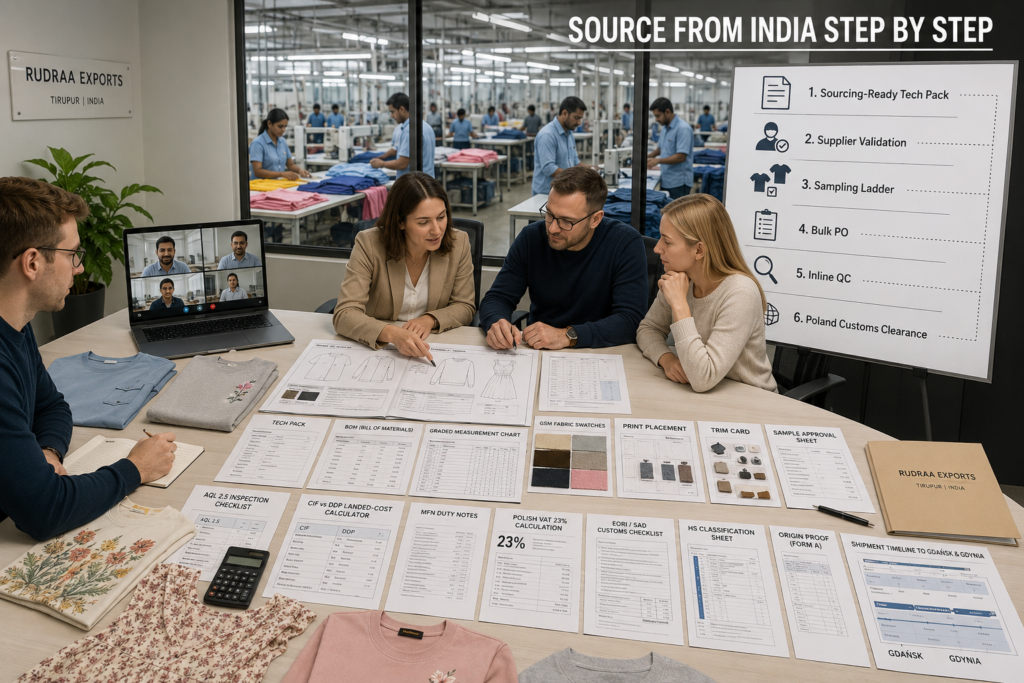
Polish fashion brands are becoming more professional in how they source garments.
Many founders and sourcing teams are now looking beyond local and nearshore options to build stronger supplier networks, improve margins and access better development capability.
India is an important option in that strategy.
India offers strength in cotton knits, sweat sets, casual dresses, printed styles, embroidery, trims, private-label development and scalable apparel production.
But sourcing from India is not only about finding a factory.
It is about building a controlled procurement system.
You need a clear tech pack, supplier validation, sampling discipline, quality checks, Incoterms understanding, landed-cost modelling and customs-ready documentation for Poland.
At Rudraa Exports, we help Polish and EU-facing apparel brands source garments from India with factory-direct production support, fabric sourcing, sampling coordination, production follow-up, QC planning, export documentation and Poland-ready shipment preparation.
Quick Answer
Polish brands source garments from India by first preparing a sourcing-ready tech pack, shortlisting suppliers by product capability, validating factory evidence, running structured sampling, issuing a detailed bulk PO, inspecting production with AQL-based criteria and preparing customs documents for Poland. The safest first order should be treated as a pilot with limited SKUs, clear specifications, CIF or DDP landed-cost modelling, and pre-shipment inspection before goods leave India.
Planning your first India sourcing order? Contact Rudraa Exports and share your tech pack, target quantity, product category and Poland delivery destination.
Why Polish Brands Are Looking at India
Poland’s apparel market is growing, and sourcing teams are becoming more serious about cost control, product development and supplier diversification.
The uploaded source notes that Poland’s apparel imports grew strongly in Jan–Aug 2025, showing why procurement teams need to professionalise their supplier base.
Why India Is Attractive
India can support Polish brands with:
- Cotton knitwear
- T-shirts
- Sweatshirts
- Hoodies
- Casual dresses
- Printed garments
- Embroidery
- Trims
- Fabric variety
- Small-to-mid scale development
- Scalable repeat production
- Export documentation support
What Makes India Different
India works well when brands can manage:
- Clear specifications
- Measurable quality standards
- Sampling approvals
- Freight timelines
- Duties and VAT
- Customs documents
- EU compliance expectations
The uploaded guide explains that buying from India requires stronger process discipline around specs, sampling, QC, Incoterms and EU customs.
Step 1: Decide Whether India Is the Right Sourcing Move
Before emailing suppliers, Polish brands should check whether India fits the product and business model.
India Is Usually a Good Fit For
- Cotton T-shirts
- Sweatshirts
- Hoodies
- Casual dresses
- Printed tops
- Embroidered styles
- Private-label basics
- Knitwear collections
- Repeat styles
- Planned seasonal production
India May Not Be the Best First Choice For
- Ultra-fast replenishment under 3–4 weeks
- Highly experimental micro-runs
- Products with unclear specifications
- Very technical outerwear without proven supplier capability
- Brands unable to manage sampling and QC
The uploaded source explains that India is a strong fit when brands sell cotton-forward categories, need design details such as prints or embroidery, can plan seasonally and can commit to disciplined specifications.
Step 2: Build a Sourcing-Ready Tech Pack
A supplier cannot quote or sample properly from vague descriptions.
A proper tech pack reduces misunderstandings before they become paid mistakes.
What to Include in a Tech Pack
| Section | What to Add |
|---|---|
| Product overview | Style name, code and category |
| Technical sketches | Front, back and detail views |
| BOM | Fabric, trims, labels and packaging |
| Fabric spec | Composition, GSM, finish and colour |
| Measurements | Graded spec and tolerances |
| Construction | Seam, stitch and finish details |
| Artwork | Print or embroidery placement files |
| Labels | Main label, size label and care label |
| Packaging | Folding, polybag, carton and barcode rules |
| Testing | Shrinkage, print durability or special tests |
The uploaded guide recommends preparing BOM, graded measurement chart, stitch details, GSM targets, shrinkage expectations, print placement, labels, packaging and tolerance rules before approaching suppliers.
Weak Spec vs Strong Spec
| Weak Spec | Strong Spec |
|---|---|
| Soft premium tee | 200 GSM cotton single jersey, enzyme washed |
| Logo on front | Screen print 9 cm wide, 8 cm below front neck |
| Relaxed fit | Chest 58 cm in M, tolerance ±1 cm |
| Nice label | Woven neck label, 4 cm × 2 cm, centre back neck |
| Good quality | AQL 2.5 final inspection, measurement audit required |
Step 3: Prepare a Landed-Cost Sheet
Do not compare suppliers only by ex-factory price.
Polish brands must calculate landed cost.
Landed Cost Should Include
- Factory price
- Sampling
- Fabric and trims
- Printing or embroidery
- Packaging
- Freight
- Insurance
- Customs duty
- Polish VAT
- Broker fees
- Inland delivery
- QC inspection
- Currency buffer
The uploaded source warns that Polish buyers should not order until they understand landed-cost math, including duty, VAT, broker and freight.
Poland Landed-Cost Formula
Customs value + duty = VAT base
VAT base × Polish VAT rate = import VAT
The uploaded guide notes that Polish import VAT is 23% and must be considered when modelling real unit economics.
Example Planning Table
| Cost Line | Example |
|---|---|
| CIF value | €10,000 |
| Duty estimate | €1,200 |
| VAT base | €11,200 |
| Import VAT at 23% | €2,576 |
| Broker and local charges | Add separately |
| Total landed planning cost | Calculate before PO |
Step 4: Understand 2026 Duty Reality
Polish brands importing from India must check current EU tariff treatment.
The uploaded guide explains that India was removed from EU GSP as of 2026, so many categories now face full MFN duty rather than earlier preferential treatment.
What to Check
- HS code
- TARIC duty rate
- Fibre composition
- Knit or woven construction
- Product type
- Gender or age category
- Origin proof
- Incoterm
Common Apparel Heading Example
Cotton knitted T-shirts are often classified under HS 6109, and the uploaded source references 12% MFN duty for cotton T-shirts under HS 61091000.
Important Rule
Never use the same HS code for every garment.
A hoodie, baby garment, woven dress and cotton T-shirt may require different classification.
Step 5: Shortlist and Validate Suppliers
Do not select a supplier only because the quote is low.
Build a shortlist and validate capability.
Supplier Shortlist Process
- Shortlist 6–10 suppliers
- Ask for portfolio evidence
- Review similar styles
- Ask for fabric and trim library
- Check production capability
- Review compliance posture
- Request sample timeline
- Compare communication quality
- Narrow to 2–3 serious options
- Start sampling
The uploaded guide recommends shortlisting suppliers and narrowing by evidence such as similar styles, production capacity and compliance posture.
What to Ask Suppliers
| Question | Why It Matters |
|---|---|
| Have you made similar products? | Product-fit check |
| Can you share fabric options? | Development capability |
| What is your MOQ? | Commercial fit |
| What is your sampling timeline? | Calendar planning |
| Can you support AQL inspection? | QC readiness |
| Can you provide export documents? | Customs readiness |
| Can you quote CIF and DDP? | Landed-cost clarity |
| Can you support EU labelling? | Compliance control |
Step 6: Validate Product Capability
India has many apparel suppliers, but not every supplier is right for every product.
Ask for Evidence
- Photos of similar products
- Fabric swatch options
- Trim cards
- Print examples
- Embroidery examples
- Fit sample examples
- Inspection report template
- Export packing examples
- Compliance documents where relevant
The uploaded source recommends asking for factory portfolio, fabric or trim library, photos and prior technical capability evidence before placing orders.
Step 7: Run a Structured Sampling Ladder
Sampling should match production reality.
Do not approve a beautiful sample if it does not use the intended bulk fabric or production method.
Sampling Ladder
1. Proto Sample
Purpose:
- Confirm shape
- Confirm first construction direction
- Identify design feasibility
- Review fabric direction
2. Fit Sample
Purpose:
- Correct measurements
- Review comfort
- Confirm POMs
- Adjust pattern
3. Size Set
Purpose:
- Check grading
- Confirm fit across sizes
- Review measurement consistency
4. Pre-Production Sample
Purpose:
- Lock bulk fabric
- Lock trims
- Lock print or embroidery
- Lock labels
- Lock packaging
- Approve final standard
The uploaded guide recommends a structured sample ladder of proto, fit, size set and pre-production sample to reduce risk before bulk.
Sampling Rule
The PP sample should match bulk production conditions.
If the PP sample uses different fabric, different trims or a different factory process, it is not a true production approval.
Step 8: Issue a Detailed Bulk PO
A bulk purchase order should not only state quantity and price.
It should lock the commercial and technical agreement.
Bulk PO Should Include
| PO Field | Details |
|---|---|
| Style code | Product identification |
| Quantity | Per style, colour and size |
| Unit price | Agreed price and currency |
| Incoterm | CIF, FOB, DDP etc. |
| Delivery date | Ex-factory or delivery date |
| Fabric | Composition, GSM and finish |
| Labels | Approved label details |
| Packaging | Bag, carton and barcode requirements |
| QC standard | AQL level and measurement tolerance |
| Shipment split | Partial shipment rules |
| Payment terms | Deposit and balance structure |
| Customs role | Importer of record and document responsibility |
The uploaded guide recommends specifying Incoterms, shipment split rules, tolerance limits, labelling, packing instructions and customs responsibility in the PO.
Important Rule
DDP is not “everything included” unless the PO clearly says what it includes.
Step 9: Use AQL-Based Quality Control
Quality should be measurable.
AQL means Acceptable Quality Limit.
Many brands use AQL inspection to decide whether finished goods are acceptable before shipment.
QC Stages
Inline QC
Checks during production:
- Stitching
- Measurements
- Print placement
- Embroidery
- Label placement
- Construction accuracy
Final Inspection
Checks before shipment:
- Quantity
- Defects
- Measurements
- Packaging
- Carton markings
- Packing list match
The uploaded guide recommends measurable inspection criteria such as AQL levels and measurement checks, rather than treating quality as a general feeling.
AQL Checklist
| Check | Example |
|---|---|
| Major defects | Open seams, stains, wrong label |
| Minor defects | Small loose threads |
| Measurements | Critical POMs within tolerance |
| Packing | Correct folding and carton marks |
| Quantity | Matches PO and packing list |
| Artwork | Print or embroidery placement correct |
Buyer Tip
Inspect before goods leave India.
Fixing issues after arrival in Poland is more expensive.
Step 10: Choose Incoterms Carefully
Incoterms define responsibility for freight, customs and risk.
CIF
CIF means the supplier includes cost, insurance and freight to the destination port.
The buyer usually handles:
- Import clearance
- Duty
- VAT
- Broker
- Inland delivery
DDP
DDP means the seller delivers to the buyer’s destination with duty and tax handling included in the agreed structure.
It can be convenient for first-time importers, but documentation must still be transparent.
The uploaded guide explains that CIF gives the buyer customs control, while DDP is convenient but must be checked carefully for declared values, documentation and included charges.
CIF vs DDP Comparison
| Area | CIF | DDP |
|---|---|---|
| Customs control | Buyer | Seller manages more |
| Simplicity | Moderate | Easier for first order |
| Transparency | Higher if buyer has broker | Must request document clarity |
| VAT handling | Buyer | Depends on structure |
| Risk | Buyer manages import | Risk if paperwork is unclear |
Step 11: Prepare Customs Documents for Poland
Before shipment, prepare a customs-ready file.
Documents Commonly Needed
- Commercial invoice
- Packing list
- Transport document
- Origin proof
- HS classification details
- Fibre composition
- Label information
- EORI details
- SAD entry support
- Compliance evidence where needed
The uploaded source mentions EORI, SAD entry, origin proof and correct tariff classification as important parts of customs clearance into Poland.
Documentation Rule
Invoice, packing list, HS codes and product descriptions must match.
Mismatch creates customs questions and delays.
Step 12: Plan Payment Terms Safely
Payment terms should protect both sides.
Common First-Order Structure
- Deposit before sampling or bulk
- Balance before shipment or against documents
- Clear bank details
- Written invoice
- Payment schedule in PO
- Currency confirmed
- Refund or remake terms clarified
The uploaded guide recommends secure payment terms such as deposit plus balance and clear bank details for first orders.
Payment Risk Tips
- Verify company bank details
- Avoid last-minute bank changes
- Match invoice company and bank beneficiary
- Use written contracts or POs
- Keep payment proof
- Confirm sample fees separately
Step 13: Manage Communication Rhythm
India and Poland are in different time zones.
Good communication prevents delays.
Practical Communication Setup
- Weekly production call
- Written sample comments
- Shared approval tracker
- Version-controlled tech pack
- Photo or video updates
- Clear response deadlines
- One main decision-maker from buyer side
- One factory merchandiser contact
The uploaded guide recommends planning communication rhythm around the India–Poland time difference and using late-morning Poland calls where practical.
Important Rule
Do not approve critical changes only through casual messages.
Update the tech pack and approval log.
First Order Strategy: Treat It as a Pilot
Your first India order should prove the system.
Do not overload it.
Pilot Order Rules
- Limit SKUs
- Use clear fabrics
- Reduce colour count
- Use a realistic size curve
- Approve samples carefully
- Inspect before shipment
- Document everything
- Review landed cost after arrival
The uploaded guide recommends treating the first order as a pilot, limiting SKUs, investing in sampling and inspection, and documenting everything for faster reorders.
Common Mistakes Polish Brands Should Avoid
Mistake 1: Ordering Without Landed-Cost Math
Factory price is not enough.
Include duty, VAT, freight, broker and inspection cost.
Mistake 2: One-Paragraph Specifications
“Premium quality, soft handfeel” is not a production instruction.
Use measurable specs.
Mistake 3: Choosing Only the Lowest Quote
A low quote can become expensive through rework, delays or poor quality.
Mistake 4: Approving Samples That Do Not Match Bulk
Sample fabric and bulk fabric must be aligned.
Mistake 5: Inspecting Only After Arrival
Inspection after arrival is too late for economical correction.
Mistake 6: Vague Incoterms
CIF, FOB and DDP must be clearly defined in the PO.
The uploaded guide lists these early mistakes, including vague specs, ignoring EU import realities, vague Incoterms and document mismatches.
Step-by-Step Garment Procurement Checklist for Poland
| # | Procurement Step |
|---|---|
| 1 | Confirm product category |
| 2 | Prepare tech pack |
| 3 | Build landed-cost sheet |
| 4 | Check HS code |
| 5 | Confirm duty and VAT impact |
| 6 | Shortlist suppliers |
| 7 | Request portfolio evidence |
| 8 | Request fabric swatches |
| 9 | Validate MOQ |
| 10 | Confirm sampling timeline |
| 11 | Run proto sample |
| 12 | Approve fit sample |
| 13 | Approve size set |
| 14 | Approve PP sample |
| 15 | Issue detailed bulk PO |
| 16 | Confirm Incoterm |
| 17 | Run inline QC |
| 18 | Run final inspection |
| 19 | Prepare customs documents |
| 20 | Review landed cost after delivery |
How Rudraa Exports Supports Polish Garment Procurement
Rudraa Exports helps Polish fashion brands source garments from India with a structured procurement process.
Rudraa Support Includes
- Product brief review
- Tech-pack review
- Fabric and GSM planning
- Fabric swatch coordination
- MOQ discussion
- Sampling coordination
- Proto, fit, size-set and PP sample support
- Production follow-up
- AQL inspection coordination
- Measurement check support
- Export packing coordination
- CIF and DDP discussion
- Customs-ready documentation support
- Poland shipment planning
- Reorder planning
Products Supported
- Cotton T-shirts
- Sweatshirts
- Hoodies
- Joggers
- Casual dresses
- Women’s tops
- Printed styles
- Embroidered garments
- Kidswear
- Babywear
- Nightwear
- Corporate apparel
- School uniforms
- Private-label knitwear
Why Factory-Direct Procurement Helps
A factory-direct workflow helps reduce:
- Communication gaps
- Vague sampling
- Hidden markups
- Quality ambiguity
- Document mismatches
- Customs delays
- Reorder confusion
The uploaded source explains that Rudraa can support supplier matching by product category, sampling coordination, production follow-up, AQL-based inspection coordination and export documentation aligned to EU customs expectations.
Ready to build your first India sourcing order? Speak with Rudraa Exports and share your tech pack, target landed cost, product category and Poland delivery destination.
FAQ: How Polish Brands Source Garments from India
1. Can Polish fashion brands source garments from India?
Yes. Polish brands can source garments from India when they manage tech packs, sampling, quality control, Incoterms, landed cost and customs documentation properly.
2. What products are suitable for India sourcing?
India is strong for cotton T-shirts, sweatshirts, hoodies, casual dresses, printed styles, embroidery, kidswear, babywear and private-label knitwear.
3. What should I prepare before contacting suppliers?
Prepare a tech pack, fabric requirements, GSM target, size range, quantity, colour plan, label details, packaging needs, target landed cost and delivery destination.
4. Should I choose CIF or DDP?
CIF gives the buyer more customs control. DDP can be easier for first orders, but you must confirm what is included and check paperwork transparency.
5. What is AQL inspection?
AQL is a sampling method used to inspect finished goods and decide whether a shipment meets agreed quality limits.
6. Do Polish importers need to calculate VAT?
Yes. Polish import VAT is a major cash-flow factor and should be included in landed-cost planning.
7. What customs documents are needed?
Common documents include commercial invoice, packing list, transport document, origin proof, HS classification details and compliance evidence where required.
8. Why is a tech pack important?
A tech pack turns your design into production instructions. It reduces sampling mistakes, quality disputes and cost surprises.
9. How should a first India order be planned?
Treat the first order as a pilot. Limit styles, approve samples carefully, inspect before shipment and document every decision for future reorders.
10. Should I inspect goods before they leave India?
Yes. Pre-shipment inspection is strongly recommended because fixing defects after goods arrive in Poland is more expensive.
11. Can Rudraa Exports help with sourcing from India to Poland?
Yes. Rudraa supports Polish brands with fabric sourcing, sampling, production follow-up, QC coordination, export packing and customs-ready documentation.
12. What should I send Rudraa Exports for a quote?
Send your tech pack, reference images, product category, fabric, GSM, quantity, colour count, size range, Incoterm preference and Poland delivery destination.
Conclusion
Polish fashion brands can source garments from India successfully when they treat procurement as a system.
The process should start before the first supplier email.
Build a sourcing-ready tech pack. Model landed cost. Understand MFN duty and Polish VAT. Shortlist suppliers by evidence. Run structured sampling. Lock the bulk PO. Inspect before shipment. Prepare customs documents carefully.
India can offer Polish brands strong development capability, fabric access, printing, embroidery, knitwear production and scalable repeat manufacturing.
But the benefits only show when the process is disciplined.
Rudraa Exports helps Polish and EU-facing fashion brands source garments from India with factory-direct communication, fabric planning, sampling, production follow-up, AQL inspection coordination, export packing and Poland-ready documentation support.
Visit rudraaexports.com or contact the Rudraa Exports team to start your India sourcing pilot with a structured procurement plan.
Related reading
Shipping Finished Garments from Tirupur to Poland: Sea, Air and Hybrid Freight Compared
Women’s Clothing Manufacturer in India for Polish Brands: Fabric, MOQ and Sizing Guide
India vs Poland Garment Manufacturing: Cost, Quality and Lead Time Comparison