
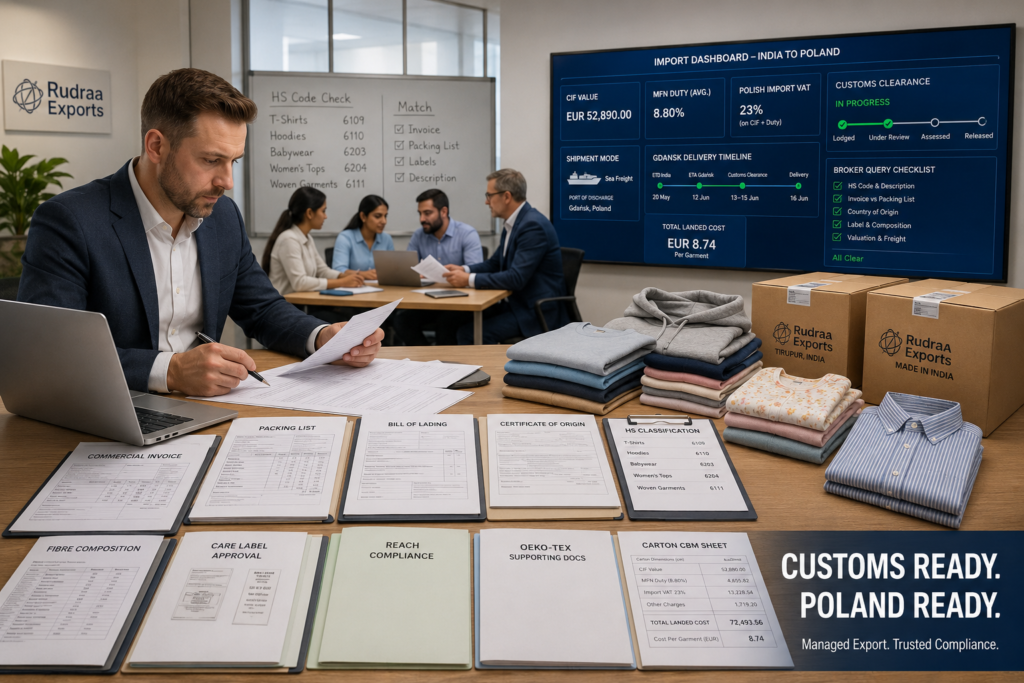
Importing garments from India to Poland can still be commercially attractive.
India offers strong apparel manufacturing capacity, competitive production costs and export experience across knitwear, basics, babywear, women’s apparel, streetwear and private-label programs.
But in 2026, Polish importers need to be more careful.
The landed cost is not only the factory price.
You must plan for:
- HS classification
- Customs duty
- Polish import VAT
- Commercial invoice accuracy
- Packing list accuracy
- Fibre composition
- Textile labelling
- REACH chemical compliance
- Customs broker requirements
- Shipment documentation
- Freight and Incoterms
- Low-value parcel changes where relevant
The uploaded guide explains that the EU suspended India’s GSP tariff preferences from 1 January 2026, meaning many garments entering Poland now need to be priced using full MFN third-country duty assumptions instead of reduced preferential rates.
At Rudraa Exports, we help Polish and EU-facing buyers reduce import friction through structured product data, export-ready documentation, HS-ready descriptions, labelling coordination, compliance evidence and shipment support from Tirupur, India.
Quick Answer
To import garments from India to Poland in 2026, Polish buyers should classify each product using the correct HS/TARIC code, calculate MFN customs duty, apply Polish import VAT at 23% on the correct taxable base, prepare accurate commercial invoices and packing lists, confirm fibre labels, collect REACH-related compliance evidence and work with a customs broker before the shipment leaves India. The safest method is to create a customs-ready product master for every style before placing the bulk order.
Planning an India-to-Poland garment shipment? Contact Rudraa Exports to request a landed-cost and documentation checklist for your products.
Why Import Compliance Matters in 2026
Many brands focus on production cost.
But customs and compliance errors can remove the savings quickly.
Common Import Problems
- Wrong HS code
- Duty calculated incorrectly
- VAT base misunderstood
- Invoice and packing list mismatch
- Missing fibre composition
- Incorrect care label
- REACH evidence not available
- Customs broker asks for amendments
- Shipment sits at port
- Storage or demurrage charges increase
- Goods need relabelling after arrival
The uploaded source explains that a single compliance gap can erase margin faster than currency movement because duty, VAT, REACH, labelling and customs documentation all affect import risk.
DIY Importing vs Managed Export Support
Polish brands can manage imports themselves, or they can work with a manufacturer that provides a structured export and compliance pack.
Comparison Table
| Criteria | DIY Importing | Rudraa Managed Export Support |
|---|---|---|
| Landed cost control | Can appear cheaper but has higher variance | More predictable through document discipline |
| HS code support | Buyer and broker must chase details | Product data prepared upfront |
| Documentation | Varies by supplier | Standardised invoice and packing details |
| Compliance evidence | Fragmented across emails | Organised shipment dossier |
| Labelling | Buyer must coordinate | Label details checked before production |
| Customs clearance | More broker queries possible | Cleaner file for broker review |
| Issue handling | Buyer coordinates all parties | One factory-side contact for corrections |
The uploaded guide compares DIY importing with partnering with Rudraa Exports and notes that document accuracy, compliance evidence and traceability become harder when buyers source from multiple suppliers.
Step 1: Understand the 2026 Duty Reality
The first cost change Polish importers must understand is duty.
The uploaded source states that India’s GSP tariff preferences were suspended from 1 January 2026, so many garments are now assessed using MFN third-country duty rates.
What This Means
You should not assume older preferential duty rates still apply.
Instead, confirm:
- Exact HS/TARIC code
- Fibre composition
- Knit or woven construction
- Product category
- Gender or age category
- Applicable third-country duty
- Any special tariff measure
Example Product Headings
| HS Heading | Product Type |
|---|---|
| 6109 | T-shirts, singlets and similar knitted garments |
| 6110 | Jerseys, pullovers, cardigans and similar knitted garments |
| 6111 | Babies’ garments and clothing accessories |
| 6203 | Men’s or boys’ woven suits, jackets and trousers |
| 6204 | Women’s woven suits, dresses, skirts and trousers |
The uploaded guide lists these common apparel headings and explains that product descriptors must match construction and fibre content.
Important Rule
Do not use one generic HS code for all clothing.
Each style should be classified separately.
Step 2: Calculate Polish Import VAT Correctly
Poland’s standard VAT rate is 23%.
For imports, VAT is not usually calculated only on the supplier invoice.
The uploaded guide explains that Polish import VAT is calculated on a base that typically includes CIF value, customs duty and certain import-related costs.
Basic Landed Cost Formula
CIF Value + Customs Duty = VAT Base
VAT Base × 23% = Import VAT
Example: T-Shirts Imported to Poland
| Cost Line | Amount |
|---|---|
| CIF value | €50,000 |
| Customs duty at 12% | €6,000 |
| VAT base | €56,000 |
| Import VAT at 23% | €12,880 |
| Duty + VAT cash outlay | €18,880 |
The uploaded source gives this same kind of example for knit T-shirts entering Poland and shows how duty increases the VAT base.
Buyer Tip
Always check whether import VAT must be paid upfront or whether your business can use an available VAT deferment or accounting mechanism with professional advice.
Step 3: Build a Customs-Ready Product Master
Before production starts, create one customs-ready sheet for every SKU.
Product Master Fields
| Field | Example |
|---|---|
| Style code | REX-TEE-001 |
| Product description | Men’s cotton knitted T-shirt |
| Knit or woven | Knitted |
| Fibre composition | 100% cotton |
| Gender / age | Men’s |
| HS heading | 6109 |
| Country of origin | India |
| Unit value | €X.XX |
| Carton count | 24 cartons |
| Gross weight | 240 kg |
| Net weight | 210 kg |
| Label content | 100% cotton |
| Care instruction | Machine wash etc. |
| Compliance evidence | OEKO-TEX / supplier declaration where required |
The uploaded guide recommends creating a SKU-level customs-ready product master with construction, fibre percentage, gender or age category, proposed HS heading and label requirements.
Step 4: Confirm HS Codes with TARIC
TARIC is the EU customs tariff reference system.
Polish importers and customs brokers use exact TARIC classification to confirm tariff measures.
Classification Must Consider
- Garment type
- Construction
- Fibre content
- Gender
- Age category
- Knitted or woven
- Product function
- Special features
Example Problem
Invoice description:
Tops
This is too vague.
Better description:
Women’s knitted cotton T-shirts, 95% cotton 5% elastane, short sleeve, HS heading 6109
Why This Matters
A vague description can cause customs questions.
A specific description helps the broker classify correctly.
The uploaded source says customs brokers may request clarifications when invoices do not state knit versus woven, fibre percentage or gender and age category.
Step 5: Prepare the Correct Document Pack
Customs clearance depends on document consistency.
Core Import Documents
| Document | Purpose |
|---|---|
| Commercial invoice | Values, product descriptions and seller-buyer details |
| Packing list | Cartons, quantities, weights and dimensions |
| Bill of Lading / Air Waybill | Transport evidence |
| Certificate of Origin | Origin context where required |
| Product composition sheet | Fibre and label support |
| Compliance evidence | REACH, OEKO-TEX or test evidence where required |
| Freight invoice | CIF or freight-cost support |
| Insurance details | Import value support |
The uploaded guide lists the commercial invoice, packing list, transport document, origin evidence, product composition and testing evidence as core parts of the clearance file.
Consistency Rule
The following must match:
- Invoice product description
- Packing list quantities
- Carton count
- HS classification
- Fibre label
- Certificate or origin details
- Freight document
If one document says “cotton T-shirts” and another says “mixed garments,” expect questions.
Step 6: Control Textile Labelling Before Bulk
Customs clearance is only one part of compliance.
The product must also be correct for the EU market after it arrives.
Textile Label Checks
Polish and EU-facing brands should control:
- Fibre composition
- Care instructions
- Country of origin statement where used
- Size label
- Brand label
- Product label language strategy
- Consistency between sewn label, hangtag and online product listing
The uploaded guide explains that EU textile labelling obligations continue into the on-shelf phase and non-compliant labels can require costly relabelling.
Label Mistake Example
A dress contains cotton and viscose.
The label says only:
Cotton
This may create compliance risk because the label does not match the actual fibre composition.
Better Approach
Confirm label copy before production:
- 60% cotton
- 40% viscose
- Care instructions
- Size
- Country of origin statement where applicable
Step 7: Prepare for REACH Chemical Compliance
REACH is the EU chemical regulation framework.
For apparel, risk can come from:
- Dyes
- Prints
- Coatings
- Finishes
- Buttons
- Zippers
- Drawcords
- Heat transfers
- Packaging chemicals
The uploaded source explains that REACH non-compliance can lead to recalls, write-offs, brand damage and inventory quarantine.
Higher-Risk Apparel Categories
| Category | Risk Area |
|---|---|
| Kidswear | Higher safety scrutiny |
| Babywear | Close-to-skin sensitivity |
| Printed T-shirts | Print chemicals |
| Water-repellent garments | Finishes |
| Dark dyed garments | Dye chemistry |
| Metal trims | Nickel or restricted substances |
| Performancewear | Chemical finishes |
REACH Checklist
- Supplier declarations collected
- OEKO-TEX support where relevant
- Print and dye details reviewed
- Trim materials checked
- Testing plan agreed for high-risk items
- Evidence stored by PO or shipment
- Buyer requirements shared before production
Buyer Tip
Do not ask for REACH evidence after shipment.
Set the compliance evidence requirement before production.
Step 8: Review Incoterms and Freight
Incoterms decide which party handles cost and responsibility at each stage.
Common Incoterms
| Incoterm | Meaning |
|---|---|
| EXW | Buyer controls almost everything from factory |
| FOB | Supplier delivers goods to export port |
| CIF | Supplier includes cost, insurance and freight to port |
| DDP | Supplier quotes delivered-cost arrangement |
Why Incoterms Matter
Your customs value and VAT planning depend on knowing:
- Product value
- Freight cost
- Insurance cost
- Delivery responsibility
- Who prepares documents
- Who pays customs-related charges
First-Time Import Tip
Ask for both:
- FOB quote
- DDP quote
Then compare the landed cost.
The uploaded source highlights that misaligned Incoterms can cause freight and insurance costs to be reflected incorrectly in customs entries.
Step 9: Watch Low-Value Parcel Changes
Some brands use small parcels for:
- Samples
- D2C shipments
- Small replenishment
- Return replacements
- Urgent micro-orders
The uploaded guide notes that the EU introduced a €3 flat customs duty for low-value consignments effective 1 July 2026, linked to low-value parcel reform.
Why This Matters
If your brand imports many small parcels, small duty changes can add up.
Review parcel flows for:
- Sampling
- Influencer drops
- Returns
- Replacement units
- Small-batch replenishment
Step 10: Use a Pre-Shipment Compliance Check
Before goods leave India, run one final check.
Pre-Shipment Checklist
| Check | Question |
|---|---|
| Invoice | Are descriptions and values correct? |
| Packing list | Do cartons and quantities match? |
| HS sheet | Is classification reviewed? |
| Labels | Do fibre labels match composition? |
| Care labels | Are they approved? |
| REACH evidence | Is risk-based evidence ready? |
| Certificate files | Are required documents collected? |
| Freight | Does Incoterm match quote? |
| Cartons | Are weights and CBM recorded? |
| Broker file | Can the Polish broker review before dispatch? |
The uploaded source recommends a pre-shipment compliance checkpoint to confirm labels, restricted-substance evidence, shipment values and quantities before cargo departs India.
Migration Plan: From Ad-Hoc Importing to Managed Import Process
Week 1: Build Product Master
Create SKU-level records for:
- Construction
- Fibre composition
- Gender or age category
- HS heading
- Label requirement
Week 1–2: Update Landed-Cost Model
Include:
- CIF value
- MFN duty
- Import VAT
- Broker fees
- Freight
- Insurance
- Customs-related charges
- Currency buffer
The uploaded guide recommends updating landed-cost models for 2026 using MFN duty and Polish import VAT.
Week 2: Review VAT Cash Flow
Discuss with your accountant or customs advisor:
- VAT payment timing
- Import VAT accounting options
- Cash-flow impact
- Documentation requirements
Week 2–3: Standardise Document Pack
Prepare:
- Invoice template
- Packing list template
- HS-ready descriptions
- Product composition sheets
- Certificate folders
- Compliance evidence folder
Every PO: Run Pre-Shipment Check
Before dispatch, verify:
- Labels
- Documents
- HS descriptions
- Carton data
- Freight terms
- Compliance evidence
Ongoing: Optimise Shipment Mode
Use:
- Air for samples and urgent stock
- Sea for planned bulk shipments
- LCL for smaller commercial shipments
- FCL for larger consolidated orders
Import Readiness Checklist for Polish Apparel Brands
| # | Import Check |
|---|---|
| 1 | Product category confirmed |
| 2 | Knit or woven construction identified |
| 3 | Fibre composition confirmed |
| 4 | Gender or age category confirmed |
| 5 | HS/TARIC code reviewed |
| 6 | MFN duty modelled |
| 7 | CIF value calculated |
| 8 | Polish VAT base calculated |
| 9 | Import VAT cash flow reviewed |
| 10 | Commercial invoice prepared |
| 11 | Packing list prepared |
| 12 | Transport document ready |
| 13 | Certificate of origin checked |
| 14 | Fibre label approved |
| 15 | Care label approved |
| 16 | REACH evidence collected |
| 17 | OEKO-TEX support checked if required |
| 18 | Carton CBM recorded |
| 19 | Broker reviewed documents |
| 20 | Pre-shipment compliance check completed |
How Rudraa Exports Supports Poland Import Programs
Rudraa Exports helps Polish brands source and import garments from India with cleaner production and export documentation.
Rudraa Support Includes
- Product brief review
- Tech-pack review
- Fabric and GSM planning
- HS-ready product description support
- Commercial invoice coordination
- Packing list coordination
- Carton CBM and weight data
- Fibre composition records
- Label content coordination
- Compliance evidence support
- REACH-focused documentation support
- OEKO-TEX supporting documents where applicable
- Export packing
- Shipment coordination
- Pre-shipment document review
Products Supported
- T-shirts
- Polo shirts
- Hoodies
- Sweatshirts
- Joggers
- Leggings
- Women’s tops
- Jersey dresses
- Babywear
- Kidswear
- Corporate apparel
- School uniforms
- Private-label knitwear
Why Rudraa’s Managed Export Process Helps
A managed process reduces:
- Vague descriptions
- Invoice mismatches
- Packing list errors
- Label mistakes
- Missing composition data
- Compliance evidence gaps
- Customs broker queries
- Last-minute document amendments
The uploaded source explains that Rudraa’s role is to prevent mismatches by aligning invoice and packing list templates, product descriptions, HS headings and pre-shipment document checks.
Ready to import from India to Poland with fewer surprises? Speak with Rudraa Exports and share your top SKUs, fibre composition, quantity, Incoterm preference and Poland delivery destination.
FAQ: Import Garments from India to Poland
1. Can Polish brands import garments from India in 2026?
Yes. Importing garments from India to Poland remains possible, but buyers should model MFN duty, Polish import VAT and EU compliance requirements carefully.
2. What duty applies to garments from India to Poland?
Duty depends on the exact TARIC code and product composition. Many garments may now need MFN third-country duty assumptions after India’s GSP preference suspension.
3. What is Poland’s import VAT rate?
Poland’s standard VAT rate is 23%. Import VAT is usually calculated on a base that includes CIF value and customs duty.
4. What is an HS code?
An HS code is a customs classification code used to identify the product type and duty rate.
5. What HS codes are common for garments?
Common headings include 6109 for knitted T-shirts, 6110 for pullovers, 6111 for baby garments, 6203 for men’s woven garments and 6204 for women’s woven garments.
6. What documents are needed to import garments into Poland?
Common documents include commercial invoice, packing list, bill of lading or airway bill, certificate of origin where needed, product composition data and compliance evidence.
7. Why does fibre composition matter?
Fibre composition affects HS classification, labelling, compliance and product descriptions used in customs documentation.
8. What is REACH compliance?
REACH is the EU chemical regulation framework. Apparel brands should control restricted substances in dyes, prints, finishes, trims and accessories.
9. What happens if labels are wrong?
Wrong fibre labels can lead to relabelling costs, market surveillance issues, sales delays or product withdrawal.
10. Should I ask for FOB or DDP?
Ask for both. FOB gives more control if you have a broker. DDP may simplify first shipments, but landed cost should still be reviewed carefully.
11. How can Rudraa Exports help Polish importers?
Rudraa can support HS-ready product descriptions, export documents, packing lists, carton data, labelling coordination, compliance evidence and pre-shipment checks.
12. What should I send Rudraa for a quote?
Send product type, fibre composition, tech pack, quantity, colours, size range, Incoterm preference, compliance needs and destination in Poland.
Conclusion
Importing garments from India to Poland in 2026 requires more than choosing a good factory.
You need a customs-ready process.
That means correct HS classification, realistic MFN duty modelling, Polish VAT planning, consistent commercial documents, accurate fibre labels, REACH evidence and pre-shipment checks before the cargo leaves India.
The safest importers treat every garment style as a structured data record, not just a product sample.
Rudraa Exports helps Polish apparel brands reduce import friction through factory-direct manufacturing, export documentation, HS-ready descriptions, label coordination, carton data, compliance evidence and shipment support from Tirupur, India.
Visit rudraaexports.com or contact the Rudraa Exports team to request a landed-cost and compliance checklist for your India-to-Poland garment imports.
Related reading
Designer Clothing Manufacturer in India for Polish Brands: Premium Private Label Guide
Women’s Clothing Manufacturer in India for Polish Brands: Fabric, MOQ and Sizing Guide
India vs Poland Garment Manufacturing: Cost, Quality and Lead Time Comparison