
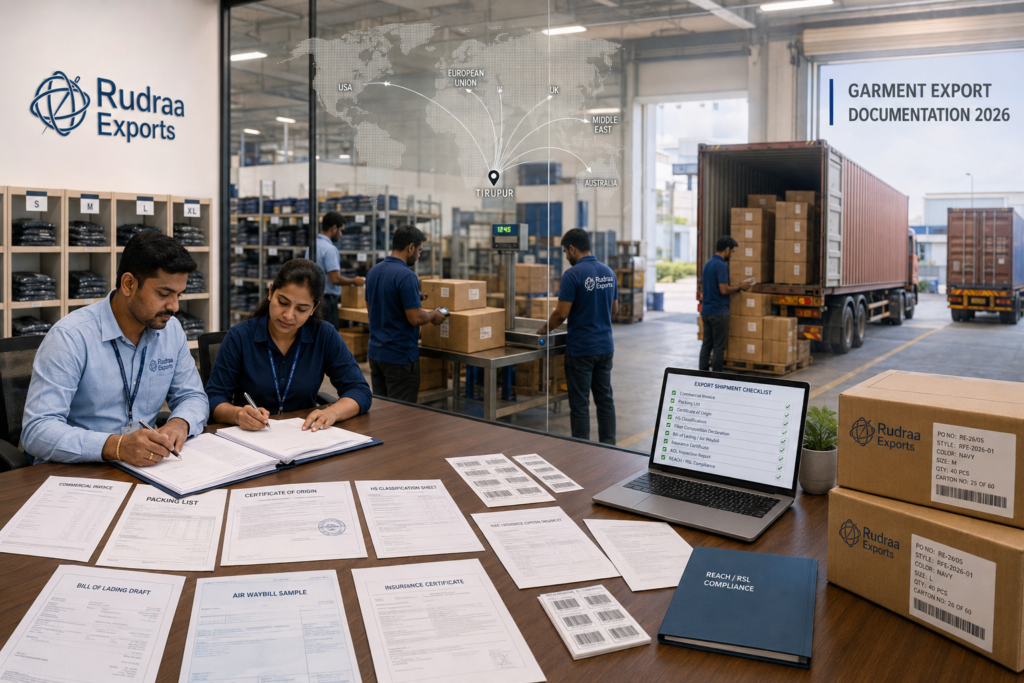
For global garment buyers, export documentation is not a small admin task. It is the foundation that decides whether a shipment clears customs smoothly, qualifies for duty preferences, passes buyer compliance checks, and avoids costly delays.
A garment order can be perfectly manufactured and still get delayed if the commercial invoice is vague, the packing list does not match the cartons, the certificate of origin has an error, the HS code is inconsistent, or the buyer’s importer details are missing. Customs teams do not inspect your factory process first. They inspect your documents.
This is especially important for textiles and apparel because classification, origin, fiber composition, value, Incoterms, and packaging details directly affect duty, admissibility, customs risk, and clearance speed.
At Rudraa Exports, we support overseas garment buyers with factory-direct production and export-ready documentation workflows for T-shirts, polos, uniforms, kidswear, activewear, corporate apparel, and private-label knitwear from Tirupur.
Quick Answer
Garment export documentation usually includes a commercial invoice, packing list, HS classification details, fiber composition declaration, certificate of origin where required, Bill of Lading or Air Waybill, shipping instructions, insurance certificate where applicable, test reports, compliance certificates, and final document approval records. For U.S. shipments, invoices must include detailed product, value, origin, and apparel composition information. For EU shipments, buyers must ensure HS/TARIC accuracy, EORI details, and ICS2-ready pre-arrival data. The safest workflow is to build one controlled document dataset before cargo handover.
Planning an export garment shipment? Contact Rudraa Exports to prepare a shipment-ready documentation checklist for your destination market.
Why Export Documentation Determines Clearance Success
Export documentation is where many garment shipments fail.
Not because the goods are wrong, but because the paperwork is incomplete, inconsistent, or unclear.
Common problems include:
- Vague product descriptions
- Wrong HS code
- Missing fiber composition
- Invoice and packing list mismatch
- Incorrect country of origin
- Missing buyer importer number
- Wrong Incoterm
- Missing freight or insurance value
- Certificate of origin mismatch
- Incorrect carton count
- Weight mismatch
- Draft Bill of Lading not checked
- No final document approval before cargo handover
For apparel shipments, customs authorities need enough information to classify the goods, verify value, confirm origin, and assess risk. If the documents are weak, clearance slows down.
Garment Export Documentation Checklist
| Document | Purpose |
|---|---|
| Commercial invoice | Customs valuation, product description, HS code, origin, value |
| Packing list | Carton-level shipment details and physical verification |
| HS classification sheet | Internal control for product classification |
| Fiber composition declaration | Supports apparel classification and buyer compliance |
| Certificate of origin | Supports origin claims and duty preference where applicable |
| Origin support file | Audit evidence for preference claims |
| Bill of Lading / Air Waybill | Transport and routing document |
| Shipping instructions | Controls carrier document data |
| Insurance certificate | Required for certain Incoterms or buyer terms |
| EU ICS2 data set | Pre-arrival safety and security data for EU lanes |
| Testing / RSL documents | Buyer compliance and product safety support |
| Final document sign-off log | Prevents last-minute version errors |
This checklist should be completed before goods move to port or airport.
Step 1: Build the Document Map Before Shipment
Do not wait until production is packed to start documents.
A good export workflow starts when the purchase order is confirmed.
Confirm These Details Early
| Item | Why It Matters |
| Destination country | Determines customs and document needs |
| Buyer/importer details | Needed for clearance |
| EORI / importer ID | Required in many markets |
| Incoterm | Affects value and cost responsibility |
| Currency | Needed for invoice and customs value |
| Product description | Supports classification |
| HS code | Determines duty and controls |
| Country of origin | Supports marking and preference |
| Fiber composition | Critical for garments |
| Carton plan | Must match packing list and B/L |
| Compliance requirements | Needed before dispatch |
The goal is to create a single “golden dataset” for the shipment.
That dataset should include:
- PO number
- Style number
- Product description
- Fiber content
- HS code
- Quantity
- Unit price
- Carton count
- Net weight
- Gross weight
- Country of origin
- Incoterm
- Buyer details
- Destination details
Every document should match this dataset.
Step 2: Prepare the Commercial Invoice
The commercial invoice is the most important customs document.
It supports:
- Customs value
- HS classification
- Country of origin
- Duty calculation
- Buyer/seller relationship
- Incoterm
- Shipment declaration
A weak commercial invoice creates customs queries.
Commercial Invoice Fields for Garment Exports
| Field | What to Include |
| Exporter details | Legal name, address, contact |
| Buyer details | Legal name and address |
| Consignee | Delivery/importer party |
| Invoice number and date | Unique reference |
| PO number | Buyer order reference |
| Product description | Clear garment description |
| Style number | Buyer or factory style code |
| HS code | Correct classification |
| Fiber composition | Example: 100% cotton knitted T-shirt |
| Quantity | Pieces, sets, or units |
| Unit price | Price per piece |
| Total value | Line and invoice total |
| Currency | USD, EUR, GBP, etc. |
| Incoterm | FOB, CIF, DAP, etc. |
| Country of origin | Example: India |
| Freight / insurance / packing charges | Where applicable |
| Authorized signature | Responsible sign-off |
Good Product Description Example
“Men’s 100% cotton knitted crew-neck T-shirt, short sleeve, style TS-4402, size S–XXL, HS 610910, country of origin India, quantity 2,400 pcs.”
Weak Product Description Example
“Garments.”
This is not enough.
Why Fiber Composition Matters
For apparel, fiber composition can affect classification and duty. A 100% cotton T-shirt, a polyester T-shirt, and a cotton-poly blend may not be treated the same.
Always include material breakdown clearly.
Examples:
- 100% cotton knitted T-shirt
- 60% cotton / 40% polyester hoodie
- 95% cotton / 5% elastane leggings
- 100% polyester sports jersey
- 65% polyester / 35% cotton polo shirt
Step 3: Prepare the Packing List
The packing list helps customs, forwarders, and buyers verify the physical shipment.
It must match the commercial invoice.
Packing List Fields
| Field | What to Include |
| Exporter and consignee | Must match invoice |
| Invoice number | Reference to invoice |
| PO number | Buyer order reference |
| Total cartons | Number of cartons shipped |
| Carton numbering | Example: 1–200 |
| Style details | Style, colour, size |
| Pieces per carton | Quantity breakdown |
| Net weight | Product weight |
| Gross weight | Product + carton weight |
| Carton dimensions | Length × width × height |
| Total CBM | Freight volume |
| Marks and numbers | Carton markings |
Good Packing List Example
Cartons 1–20: Style TS-4402, Black, Size M, 40 pcs/carton
Cartons 21–40: Style TS-4402, Black, Size L, 40 pcs/carton
Cartons 41–60: Style TS-4402, Navy, Size M, 40 pcs/carton
This makes customs examination and warehouse receiving easier.
Common Packing List Mistakes
| Mistake | Risk |
| Carton count mismatch | Customs or carrier query |
| Missing carton numbers | Inspection delay |
| Wrong weight | Freight and clearance issue |
| Mixed cartons not explained | Warehouse confusion |
| Packing list does not match invoice | Clearance delay |
| No size-wise breakdown | Buyer receiving problem |
Before shipment, do a three-way match:
Commercial Invoice ↔ Packing List ↔ Bill of Lading / Air Waybill
Step 4: Confirm HS Classification
HS code errors can cause duty mistakes, clearance delays, penalties, and post-entry audit issues.
A factory can support product data, but the importer or customs broker should confirm final classification.
HS Classification Sheet Should Include
| Field | Example |
| Style number | TS-4402 |
| Product name | Men’s cotton knitted T-shirt |
| Construction | Knitted |
| Fiber content | 100% cotton |
| Gender/age | Men’s |
| HS code | 610910 |
| Destination tariff code | TARIC / HTS / national extension |
| Classification notes | Confirmed by broker |
| Approval date | Date of sign-off |
Do not type HS codes manually every time. Maintain a controlled HS master sheet.
Step 5: Prepare the Fiber Composition Declaration
Garments need accurate fiber information because classification and compliance depend on composition.
Fiber Declaration Example
| Style | Shell | Rib | Lining | Trim |
| Basic T-shirt | 100% cotton | 95% cotton / 5% elastane | N/A | Polyester label |
| Hoodie | 60% cotton / 40% polyester | 95% cotton / 5% elastane | N/A | Cotton drawcord |
| Jacket | 100% polyester | N/A | 100% polyester | Metal zipper |
This declaration should match the commercial invoice, lab reports, care labels, and buyer tech pack.
Step 6: Prepare the Certificate of Origin
A Certificate of Origin confirms where the goods originate.
It may be required for:
- Customs clearance
- Duty preference
- Buyer compliance
- Bank documents
- Middle East/GCC import procedures
- Tender documentation
Certificate of Origin Types
| Type | Use Case |
| Non-preferential CO | Confirms origin but does not claim duty preference |
| Preferential CO | Supports reduced duty under a trade scheme |
| REX statement | Used in eligible EU preference systems where applicable |
| EUR.1 | Used under certain EU preferential arrangements |
| GCC / consularized CO | Required in some Gulf markets |
| Buyer-specific origin declaration | Required by some retailers or institutions |
Common CO Mistakes
- Invoice number mismatch
- Wrong quantity
- Wrong origin
- Wrong HS code
- Missing signature
- Wrong certificate type
- Claiming preference without proof
- No supporting origin records
A CO should never be prepared casually. Origin must be supported by production and material records.
Step 7: Prepare the Bill of Lading or Air Waybill
The Bill of Lading is used for sea freight. The Air Waybill is used for air freight.
These documents must match the invoice and packing list.
Check Before Final Approval
| Field | What to Verify |
| Shipper | Correct exporter |
| Consignee | Correct buyer/importer |
| Notify party | Correct broker or forwarder |
| Carton count | Matches packing list |
| Weight | Matches final shipment data |
| Description | Matches invoice |
| Port of loading | Correct |
| Port of discharge | Correct |
| Freight terms | Matches Incoterm |
Do not approve a draft Bill of Lading without checking it line by line.
Step 8: Prepare Insurance Documents
Insurance is required when the Incoterm or buyer contract demands it.
For CIF and CIP shipments, insurance is usually part of the seller’s responsibility. For FOB shipments, the buyer usually controls main freight and insurance.
Insurance Certificate Should Match
- Invoice value
- Shipment details
- Buyer/seller details
- Cargo description
- Voyage or airway details
- Currency
- Coverage terms
Insurance value and freight charges can affect customs valuation depending on the market and Incoterm.
Step 9: Prepare EU ICS2-Ready Data
For shipments entering the EU, ICS2 requires advance cargo safety and security data.
That means shipment data must be complete before arrival.
ICS2-Ready Data Should Include
| Data Area | Requirement |
| Consignor | Exporter details |
| Consignee | Importer details |
| EORI | Importer/exporter where applicable |
| Goods description | Clear and specific |
| HS code | Accurate classification |
| Packages | Carton count and marks |
| Weight | Accurate gross weight |
| Transport details | Carrier and route |
| Party identifiers | Broker/forwarder/importer data |
The EU customs environment is moving toward stronger structured data. A PDF that “looks okay” is not enough if the electronic data is weak.
Step 10: Prepare Testing and Compliance Documents
Customs documents clear goods at the border. Compliance documents help buyers release goods into commerce.
For garment exports, buyers may ask for:
- OEKO-TEX certificate
- GOTS transaction certificate
- GRS certificate
- BSCI audit evidence
- SMETA audit report
- WRAP certificate
- RSL test reports
- REACH test reports
- CPSIA documentation for children’s products
- AQL inspection report
- Fabric test report
- Shrinkage report
- Colourfastness report
Compliance Folder Structure
| Folder | Documents |
| Customs | Invoice, packing list, B/L or AWB, CO |
| Compliance | Certificates, lab reports, RSL/REACH/CPSIA documents |
| Quality | AQL report, measurement report, inspection photos |
| Production | Fabric lot, dye lot, trims record, packing record |
This makes audits easier.
Step 11: Final Document Review Before Cargo Handover
Before goods leave the factory, review every document.
Final Review Checklist
| Check | Status |
| Invoice quantity matches packing list | |
| Packing list cartons match shipping instruction | |
| HS code confirmed | |
| Fiber composition included | |
| Country of origin correct | |
| Incoterm correct | |
| Currency correct | |
| Buyer/importer details correct | |
| Certificate of origin matches invoice | |
| B/L or AWB draft checked | |
| Compliance reports attached | |
| Final version saved |
This sign-off prevents last-minute confusion.
Step 12: Create a Final Document Set Approval Record
Every shipment should have a final sign-off log.
Sign-Off Log Fields
| Field | Example |
| Shipment ID | RE-EXP-2026-041 |
| Buyer | ABC Apparel Ltd |
| Destination | Germany |
| Invoice version | V3 Final |
| Packing list version | V4 Final |
| CO version | Final |
| B/L draft approved | Yes |
| Approved by | Export manager |
| Approval date | 14 June 2026 |
| Broker shared date | 15 June 2026 |
This creates accountability and audit readiness.
Common Garment Export Documentation Mistakes
| Mistake | Result |
| Vague invoice description | Customs query |
| Missing composition | Apparel classification issue |
| Invoice and packing list mismatch | Clearance delay |
| Wrong HS code | Duty error and audit risk |
| Wrong origin claim | Preference denial |
| Missing EORI | EU clearance issue |
| No ICS2 data readiness | EU pre-arrival filing risk |
| Incorrect B/L draft | Carrier amendment delay |
| No document version control | Broker files wrong version |
| Testing reports not linked to shipment | Buyer compliance delay |
The fix is simple: create one controlled dataset and do not allow document drift.
Why Rudraa Exports
Rudraa Exports supports overseas buyers with factory-direct garment manufacturing and export documentation discipline from Tirupur.
Manufacturing and Export Support
- Factory-direct Tirupur garment manufacturing
- 72,000+ units per month production capacity
- T-shirts, polos, uniforms, kidswear, activewear, corporate apparel, sportswear, and private-label knitwear
- Export documentation support for commercial invoice, packing list, certificate of origin, Bill of Lading, Air Waybill, and compliance documents
- Multi-port shipping support through Chennai, Tuticorin, and Cochin
- FOB, CIF, DAP, and buyer-nominated forwarder coordination support
Quality and Compliance Support
- ISO 9001:2015 certified manufacturing approach
- AQL 2.5 inspection standards
- Support for OEKO-TEX, GOTS, GRS, BSCI, SMETA, WRAP, AEO, and related buyer requirements where applicable
- Fabric lot, dye lot, trims, production batch, and packing traceability
- RSL/REACH/CPSIA-style documentation support where required by buyer and market
Documentation Advantages for Buyers
- Single source of truth for PO, style, quantity, composition, HS code, cartons, and shipment data
- Draft document review before shipment
- Invoice and packing list reconciliation
- Certificate of origin coordination where required
- Shipment-ready document folder
- Support for customs broker and freight forwarder data needs
Ready to standardize your export document workflow? Speak with Rudraa Exports to map your destination market, shipment documents, compliance files, and customs-ready checklist.
12-Item Export Documentation Checklist
| # | Document / Control | Owner | Status |
| 1 | Commercial invoice final | Export docs team | |
| 2 | Packing list final | Packing/export team | |
| 3 | HS classification sheet | Compliance/broker | |
| 4 | Fiber composition declaration | Production/compliance | |
| 5 | Certificate of origin | Export docs team | |
| 6 | Origin support file | Compliance team | |
| 7 | Bill of Lading or Air Waybill | Forwarder/logistics | |
| 8 | Shipping instructions | Logistics team | |
| 9 | Insurance certificate | Logistics/accounts | |
| 10 | EU ICS2 data confirmation | Forwarder/broker | |
| 11 | Testing/RSL compliance documents | Quality/compliance | |
| 12 | Final document sign-off log | Export manager |
FAQ: Garment Export Documentation
1. What is the most important export document for garments?
The commercial invoice is usually the most important document because it supports customs valuation, classification, origin, quantity, and duty calculation.
2. What should a garment commercial invoice include?
It should include buyer/seller details, invoice number, PO number, product description, style number, HS code, fiber composition, quantity, unit price, total value, currency, Incoterm, country of origin, and charges where applicable.
3. Why is fiber composition important on garment invoices?
Fiber composition affects classification and duty treatment. A cotton T-shirt, polyester T-shirt, and cotton-polyester blended garment may be treated differently by customs.
4. What is the difference between commercial invoice and packing list?
The commercial invoice explains the value and classification of the goods. The packing list explains how the goods are physically packed by carton, weight, size, and quantity.
5. Do garment exports always need a Certificate of Origin?
Not always. A CO is required when the buyer, destination country, bank, customs authority, or duty preference program requires it.
6. What causes customs delays in garment shipments?
Common causes include vague descriptions, wrong HS codes, invoice/packing mismatch, incorrect origin claims, missing importer identifiers, wrong weights, and incomplete electronic filing data.
7. What is EORI?
EORI is the Economic Operators Registration and Identification number used for EU customs identification. It is required for customs clearance in the EU.
8. What is ICS2?
ICS2 is the EU Import Control System 2. It requires advance safety and security data for goods entering or transiting the EU.
9. Should the Bill of Lading match the packing list?
Yes. Carton count, weight, shipper, consignee, and description should match the invoice and packing list.
10. What documents do buyers need for compliance?
Depending on product and market, buyers may need OEKO-TEX, GOTS, GRS, BSCI, SMETA, WRAP, REACH/RSL test reports, CPSIA documents, and AQL inspection reports.
11. How can exporters prevent document mistakes?
Use a single golden dataset, controlled HS master, document version control, three-way matching, draft review, and final sign-off before cargo handover.
12. Why choose Rudraa Exports for garment export documentation?
Rudraa Exports helps buyers manage factory-direct garment production, shipment document preparation, invoice and packing accuracy, origin documents, compliance files, and freight-forwarder coordination from Tirupur.
Conclusion
Garment export documentation is not paperwork after production. It is part of the production and shipment control system. A clean document workflow helps shipments clear customs faster, reduces buyer stress, protects duty treatment, supports compliance audits, and avoids expensive corrections.
For global garment brands sourcing from India, the safest approach is to standardize the document process before shipment: build one golden dataset, confirm HS and origin, prepare accurate commercial invoices and packing lists, check certificates, review transport documents, and complete a final sign-off before cargo leaves the factory.
Visit rudraaexports.com or contact our team directly to share your tech pack, destination market, MOQ, Incoterm, and document requirements — and receive a factory-direct export documentation workflow from Tirupur.
Related reading
How to Export Garments from India to the USA: HS Codes, Duties and Compliance Guide
How to Import Garments from India to Australia: Duties, GST and Customs Guide 2026