Choosing between OEM vs ODM garment manufacturing is one of the first major sourcing decisions an apparel brand must make. Many foreign buyers think the main challenge is finding a reliable factory. But before that, they must decide what type of manufacturing relationship they actually need.
Do you want to fully control the design, fit, fabric, trims, and construction? Then OEM may be the right model. Do you want to launch faster using an existing factory-developed style and customize it with your branding? Then ODM may work better. Do you want to test quickly first and later own the design? Then a hybrid approach may be the smartest path.
For apparel brands sourcing from India in 2026, this decision affects cost, speed, minimum order quantity, design control, intellectual property, sampling time, and production risk. It also decides how much preparation you need before your first purchase order.
At Rudraa Exports, we support overseas buyers with OEM, ODM, and hybrid garment manufacturing from Tirupur, India — especially for knitwear categories such as T-shirts, polos, hoodies, babywear, loungewear, activewear, kidswear, corporate apparel, and private-label basics.
Quick Answer
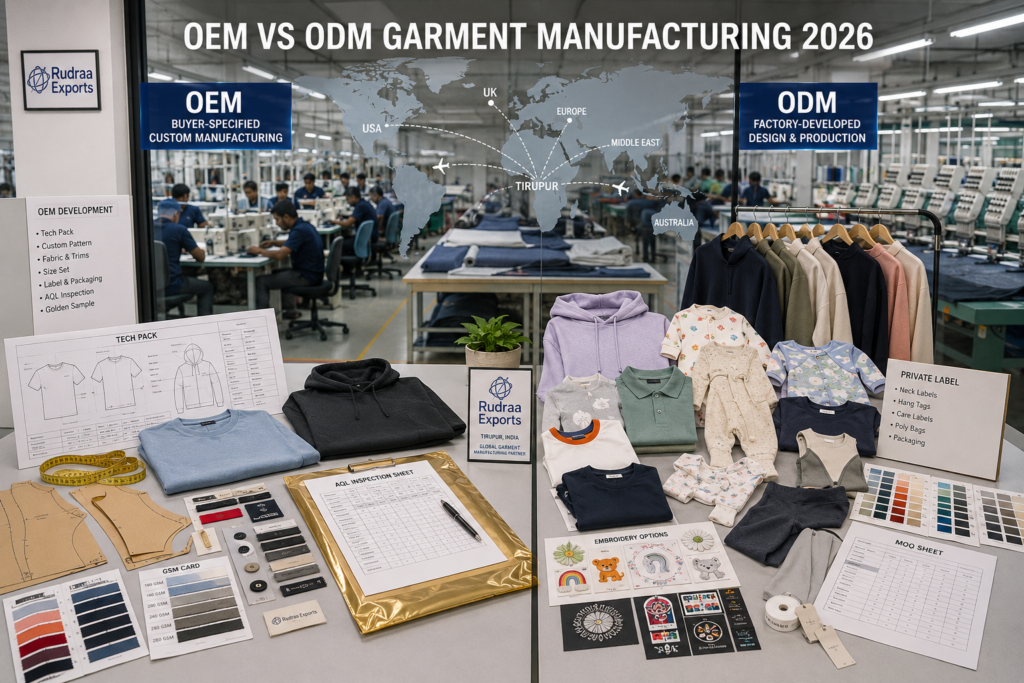
OEM garment manufacturing is best when the brand owns the design and needs full control over fabric, fit, construction, trims, labels, measurements, and quality standards. ODM garment manufacturing is best when the buyer wants to launch faster using factory-developed styles with limited customization such as colour, print, embroidery, and branding. A hybrid model works well for brands that want to start with ODM to test demand, then convert winning styles into OEM products with buyer-owned specifications and stronger IP protection.
Planning your first OEM or ODM apparel order from India? Contact Rudraa Exports to share your product idea, tech pack, target MOQ, fabric, and destination market.
What Is OEM in Garment Manufacturing?
OEM means Original Equipment Manufacturing.
In simple terms, OEM means the brand owns the design and the factory manufactures according to the buyer’s specifications.
The buyer usually provides:
- Tech pack
- Measurement chart
- Fabric specification
- GSM requirement
- Construction details
- Stitching instructions
- Artwork
- Label files
- Trim details
- Packing instructions
- Compliance requirements
- Quality tolerance standards
The factory’s role is to execute the product according to the buyer’s approved specification.
OEM Example
A premium athleisure brand creates a custom raglan T-shirt pattern, specifies recycled polyester-elastane fabric, defines seam construction, sets stitch density, chooses custom labels, and requires lab testing. Rudraa Exports manufactures the product according to that tech pack.
That is OEM.
What Is ODM in Garment Manufacturing?
ODM means Original Design Manufacturing.
In this model, the factory already has base designs, patterns, blocks, and construction ideas. The buyer chooses from available styles and customizes them.
ODM customization may include:
- Brand label
- Logo embroidery
- Print artwork
- Colour options
- Fabric upgrade
- GSM change
- Minor fit adjustment
- Packaging change
- Hangtag and care label
- Small construction edits
ODM is useful when buyers want speed and lower development effort.
ODM Example
A startup wants to launch a hoodie quickly. Instead of developing a hoodie from scratch, it chooses Rudraa’s existing hoodie block, changes the GSM, adds chest embroidery, uses custom neck labels, and places a small test order.
That is ODM.
Private Label vs OEM Manufacturing
Many buyers confuse private label, OEM, and ODM.
Private label usually means choosing an existing product and adding your brand label. In many cases, private label is closer to ODM than OEM.
OEM is not just adding your logo. OEM means the product is built from your specification.
Simple Difference
| Model | Who Owns the Product Design? | Customization Level |
|---|---|---|
| Private Label | Factory usually owns base style | Low |
| ODM | Factory owns base design, buyer customizes | Medium |
| OEM | Brand owns design and specifications | High |
If you are only adding your logo to an existing style, that is not true OEM.
OEM vs ODM: Side-by-Side Comparison
| Dimension | OEM Garment Manufacturing | ODM Garment Manufacturing |
| Design ownership | Brand owns design | Factory usually owns base design |
| Speed | Slower due to development | Faster using existing blocks |
| MOQ | Usually higher | Usually lower |
| Development cost | Higher | Lower |
| Sampling rounds | More | Fewer |
| Customization | Full control | Limited to medium |
| IP protection | Stronger if contracts are clear | Weaker unless exclusivity is negotiated |
| Best for | Established brands and unique products | Startups and quick launches |
| Risk | Higher development responsibility | Higher copy/design overlap risk |
| Long-term brand value | Stronger differentiation | Faster testing but less uniqueness |
The key question is simple: do you want to own the product or launch quickly?
Cost Difference: OEM vs ODM
New buyers often compare only unit cost. That is not enough.
The real cost includes:
- Design development
- Tech pack creation
- Sampling
- Fit corrections
- Lab dips
- Strike-offs
- Fabric sourcing
- Trim development
- MOQ risk
- Lead time
- Defect risk
- Inventory risk
OEM Cost Structure
OEM usually costs more upfront because the buyer is creating something more specific.
OEM costs may include:
- Designer or technical designer cost
- Tech pack preparation
- Pattern development
- Multiple sample rounds
- Custom fabric sourcing
- Custom trims
- Testing
- Longer development time
But OEM can be more valuable long term because the brand owns the fit, design, and product identity.
ODM Cost Structure
ODM usually has lower development cost because the factory has already built the base style.
ODM saves money on:
- Pattern development
- Fit testing
- Initial construction decisions
- Sampling time
- Fabric trial uncertainty
But ODM may offer less differentiation, and similar styles may be available to other buyers unless exclusivity is negotiated.
MOQ Difference: OEM vs ODM
MOQ depends on product type, fabric, colour, trims, decoration, and packaging.
But generally:
| Model | Typical MOQ Logic |
| ODM | Lower MOQ because base style already exists |
| OEM | Higher MOQ because custom development needs more setup |
| Hybrid | Starts lower, scales after demand is proven |
At Rudraa Exports, MOQ discussions can start from around 300 pieces per style for suitable programs, depending on fabric, colour, logo method, trims, and customization.
MOQ Drivers
| Factor | Why It Affects MOQ |
| Fabric type | Custom fabric may require mill minimums |
| Colour | Dyeing often requires colour-wise minimums |
| GSM | Non-standard GSM may need special sourcing |
| Print method | Screen setup and strike-offs affect quantity |
| Embroidery | Digitizing and machine setup add cost |
| Trims | Custom labels, zippers, buttons, elastics may have vendor MOQ |
| Packaging | Custom polybags, barcodes, inserts may increase MOQ |
For first-time buyers, ODM can reduce MOQ pressure. For established buyers, OEM can justify higher MOQ through stronger brand control.
Lead Time Difference: OEM vs ODM
ODM is usually faster because the base product already exists.
OEM takes longer because the product must be developed, sampled, corrected, approved, and locked before bulk.
Lead Time Comparison
| Stage | OEM | ODM |
| Product development | Longer | Shorter |
| Sampling | More rounds | Fewer rounds |
| Fabric sourcing | Custom or specific | Existing or available |
| Fit approval | Detailed | Faster |
| Bulk production | Depends on category | Faster if style is proven |
| Total timeline | Longer but more controlled | Faster but less customized |
Rudraa Planning Range
For suitable knitwear programs, Rudraa Exports can support sampling discussions within 7–10 days and bulk production planning based on product complexity, fabric availability, approval speed, and order volume.
Design Ownership and IP Risk
This is one of the most important differences.
In OEM, the brand usually owns the design, tech pack, measurements, patterns, artwork, and product details if agreed clearly in writing.
In ODM, the factory may own the base design, pattern, and style block. The buyer may only own the logo, branding, and limited custom changes.
IP Questions to Ask Before Sampling
- Who owns the pattern?
- Who owns the graded size set?
- Who owns the artwork?
- Can the factory sell the same base style to others?
- Can the buyer buy exclusivity?
- Will the factory sign an NDA?
- Can the design be converted from ODM to OEM later?
- Who owns sample files and tech pack updates?
If you cannot answer these questions, do not start production yet.
When Should You Choose OEM?
Choose OEM if your brand needs deep control.
OEM Is Best For:
- Established brands
- Premium products
- Signature fits
- Unique garment construction
- Custom fabric programs
- Retailer-approved products
- Corporate uniform systems
- Licensed products
- IP-sensitive styles
- Long-term repeat programs
OEM Buyer Example
A European retailer wants a core polo shirt range with a custom fit, proprietary collar shape, specific pique fabric, branded trims, and strict shrinkage limits. This should be OEM because the product needs repeatability and brand ownership.
When Should You Choose ODM?
Choose ODM if your priority is speed and market testing.
ODM Is Best For:
- Startup brands
- DTC launches
- Small test drops
- Trend capsules
- Promotional apparel
- Quick seasonal products
- Lower development budget
- Limited design team
- Fast sampling needs
- Simple customization
ODM Buyer Example
A UK DTC brand wants to launch a loungewear set quickly. It chooses an existing jogger and hoodie block, adds embroidery, custom labels, and two colours, then tests 300 pieces per style.
This is a good ODM use case.
When Should You Choose Hybrid?
Hybrid is often the best model for new brands.
You can start with ODM to test demand, then convert winning products into OEM for long-term differentiation.
Hybrid Example
A brand starts with an ODM oversized T-shirt using Rudraa’s existing block. After the first drop sells well, the brand modifies the fit, owns the measurement chart, creates a custom neck rib, changes fabric GSM, and turns it into an OEM product.
Hybrid Strategy
| Phase | Manufacturing Model | Goal |
| Phase 1 | ODM | Test demand quickly |
| Phase 2 | ODM with edits | Improve fit and branding |
| Phase 3 | OEM | Own product identity |
| Phase 4 | OEM repeat program | Scale with consistency |
Hybrid is not confused sourcing. It is a smart upgrade path.
Buyer Persona Guide
1. Startup or DTC Founder
Best model: ODM first, then hybrid.
Why: Startups need speed, low MOQ, and reduced development cost. ODM helps test demand before committing to expensive custom development.
2. Corporate Buyer or Brand Manager
Best model: OEM.
Why: Corporate programs need repeatability, controlled measurements, consistent fabric, logo accuracy, and compliance. OEM gives better control.
3. Established Retailer
Best model: Hybrid.
Why: Retailers need both unique core styles and fast seasonal capsules. OEM can support core programs, while ODM can support quick trend tests.
4. Private Label Buyer
Best model: ODM or hybrid.
Why: Private label buyers may start with factory-developed products and later customize successful styles more deeply.
5. Premium Apparel Brand
Best model: OEM.
Why: Premium brands need original fit, fabric, finishing, and design ownership.
Manufacturer Evaluation Questions
Ask these before choosing an OEM or ODM clothing manufacturer.
| Question | Why It Matters |
| Do you support OEM, ODM, or both? | Confirms model fit |
| What products are you strongest in? | Avoids category mismatch |
| What are your MOQs by category? | Helps budget planning |
| What is your sampling timeline? | Affects launch date |
| What fabrics are available immediately? | Helps ODM speed |
| Can you develop custom fabrics? | Supports OEM |
| Who owns ODM patterns? | Prevents IP confusion |
| Can you sign NDA for OEM? | Protects buyer design |
| What QC checkpoints do you use? | Reduces defects |
| What certifications can you support? | Supports compliance |
| Can you share a production calendar? | Reveals real lead time |
| How do you handle delays? | Shows operational maturity |
Red Flags When Choosing OEM or ODM Manufacturers
Be careful if a factory:
- Says yes to everything immediately
- Cannot explain OEM vs ODM clearly
- Avoids design ownership questions
- Gives unrealistic lead times
- Refuses to define MOQ by fabric and colour
- Has no sampling process
- Cannot show QC checkpoints
- Avoids certification proof
- Gives vague pricing
- Cannot explain export documents
- Has no clear communication rhythm
A reliable manufacturer will ask questions before giving promises.
Why Tirupur Is Strong for OEM and ODM Knitwear
Tirupur is especially strong for knitwear, making it suitable for both OEM and ODM garment manufacturing.
Tirupur Strengths
| Tirupur Capability | OEM Benefit | ODM Benefit |
| Knitwear cluster | Custom product development | Existing style library |
| Fabric sourcing | Custom GSM and fabric programs | Available fabric options |
| Dyeing support | Custom colours and lab dips | Faster colourways |
| Printing and embroidery | Custom branding and artwork | Quick decoration |
| Skilled workforce | Repeatable construction | Faster production |
| Export documentation | International shipment support | Easier first-time buying |
For foreign buyers, Tirupur reduces the complexity of sourcing because many processes are located within the same manufacturing ecosystem.
Why Rudraa Exports
Rudraa Exports is positioned as a factory-direct OEM/ODM garment manufacturer from Tirupur for overseas apparel buyers.
Manufacturing Capabilities
- Factory-direct Tirupur knitwear manufacturing
- 72,000+ units per month production capacity
- OEM and ODM support for T-shirts, polos, hoodies, babywear, kidswear, loungewear, activewear, corporate apparel, and private-label garments
- MOQs starting from around 300 pieces per style, depending on fabric, colour, logo method, trims, and customization
- Sampling support for suitable programs within 7–10 days
- Bulk production planning based on product complexity and buyer approvals
Quality and Compliance
- ISO 9001:2015 certified manufacturing approach
- AQL 2.5 inspection standards
- Support for OEKO-TEX, GOTS, BSCI, SEDEX/SMETA, WRAP, AEO, and related buyer requirements where applicable
- Fabric, GSM, shade, measurement, print, embroidery, trims, and packing controls
- Traceability support across fabric lots, production batches, samples, inspection records, and shipment documents
International Buyer Advantages
- Factory-direct pricing without trading-company markups
- Up to 40% cost-saving positioning compared with indirect sourcing models
- English-language communication for overseas buyers
- Export support for USA, UK, Europe, Australia, and Middle East markets
- Multi-port shipping through Chennai, Tuticorin, and Cochin
- Support for export documents, compliance packs, and buyer-nominated freight forwarders
Ready to choose between OEM, ODM, or hybrid manufacturing? Speak with Rudraa Exports for a free consultation and a manufacturing model recommendation based on your product, MOQ, budget, and timeline.
12-Point OEM vs ODM Readiness Checklist
Use this checklist before contacting factories.
| # | Checklist Question |
| 1 | Do I have a complete tech pack? |
| 2 | Do I need full design ownership? |
| 3 | Is speed more important than deep customization? |
| 4 | What is my minimum viable order quantity? |
| 5 | Am I flexible on fabric and colour? |
| 6 | Do I need custom pattern development? |
| 7 | Do I need GOTS, OEKO-TEX, BSCI, SMETA, or other documents? |
| 8 | Can I approve samples within 24–72 hours? |
| 9 | Do I need NDA or design ownership clauses? |
| 10 | Is this a test drop or a long-term core product? |
| 11 | Can the factory support both test and scale? |
| 12 | Do I have a plan to convert ODM winners into OEM products? |
Interpretation
Mostly ODM if you need speed, lower MOQ, and lower development cost.
Mostly OEM if you need IP control, deep customization, and repeatability.
Hybrid if you want to test quickly and own the design later.
FAQ: OEM vs ODM Garment Manufacturing
1. What is OEM in garment manufacturing?
OEM means the buyer owns the product design and provides the factory with specifications such as tech pack, measurements, fabric, trims, labels, and quality standards. The factory manufactures according to the buyer’s requirements.
2. What is ODM in garment manufacturing?
ODM means the factory already has base styles, patterns, or product concepts. The buyer selects one and customizes details such as colour, print, embroidery, labels, or packaging.
3. Which is better, OEM or ODM?
Neither is always better. OEM is better for control and differentiation. ODM is better for speed, lower development cost, and market testing. Hybrid is often best for growing brands.
4. Is private label the same as OEM?
No. Private label often means adding your brand to an existing product, which is closer to ODM. OEM means the product is made from your own specification.
5. Which model has lower MOQ?
ODM usually has lower MOQ because the factory already has the product base. OEM usually needs higher MOQ because of custom development and setup.
6. Which model is faster?
ODM is usually faster because the style, pattern, and construction already exist. OEM takes longer because the product must be developed from scratch or from a detailed buyer tech pack.
7. Who owns the design in ODM?
Usually the factory owns the base design unless the buyer negotiates exclusivity or buys the rights. This must be written clearly before sampling.
8. Can I start with ODM and move to OEM later?
Yes. This is a strong strategy for startups. You can test demand with ODM, then convert winning products into OEM with custom fit, measurements, and trims.
9. Is OEM more expensive than ODM?
OEM usually has higher development cost and may have higher MOQ, but it gives stronger design ownership and long-term differentiation.
10. Is ODM good for startups?
Yes. ODM is often useful for startups because it allows faster launches, lower development risk, and smaller test runs.
11. Why choose Tirupur for OEM and ODM knitwear?
Tirupur has a strong knitwear ecosystem covering fabric, dyeing, stitching, printing, embroidery, finishing, packing, and export support. This makes it suitable for both custom OEM and faster ODM programs.
12. Why choose Rudraa Exports?
Rudraa Exports supports OEM, ODM, and hybrid garment manufacturing from Tirupur with factory-direct communication, sampling, quality control, compliance support, export documentation, and scalable knitwear production.
Conclusion
OEM vs ODM garment manufacturing is not just a technical sourcing term. It is a business decision. OEM gives brands more control, stronger differentiation, and clearer IP ownership. ODM gives buyers faster speed, lower development effort, and easier market testing. Hybrid gives growing brands the best of both: test quickly, then own what works.
For first-time buyers, the safest route is often ODM or hybrid. For established brands and long-term repeat products, OEM is usually stronger. The right decision depends on your product stage, budget, MOQ, timeline, design control, and growth plan.
Visit rudraaexports.com or contact our team directly to share your product idea, tech pack, target MOQ, fabric, and launch timeline — and receive a factory-direct OEM/ODM manufacturing recommendation from Tirupur.
Related reading
OEM vs CMT vs Full-Package Apparel Manufacturing: Which Model Should Buyers Choose?
How to Find Reliable OEM Clothing Manufacturers: A Buyer’s Vetting Guide