
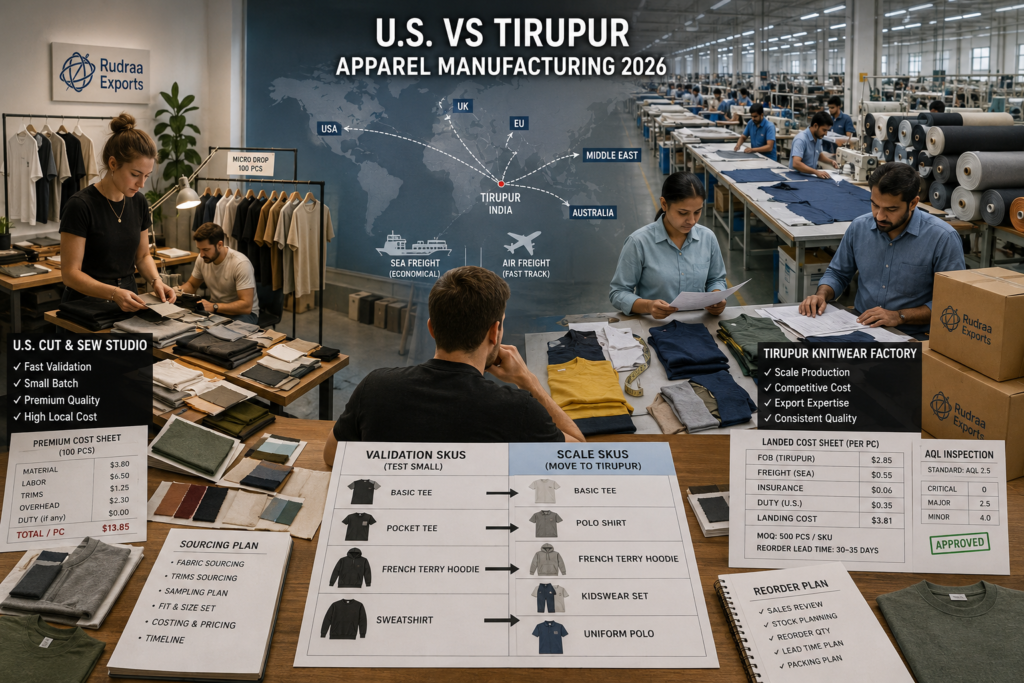
Exporting garments from India to the USA is not only about manufacturing quality products.
It is also about getting classification, documentation, labeling, duty calculation, and customs clearance right.
Many garment shipments are delayed not because the T-shirts, hoodies, polos, uniforms, or kidswear are poor quality, but because the paperwork is incomplete or inconsistent.
Common problems include:
- Wrong HTS code
- Generic invoice description
- Missing fibre content
- Wrong country-of-origin statement
- Late ISF filing for ocean shipments
- Incorrect packing list
- Missing buyer PO details
- Label mismatch
- Kidswear testing assumptions
- Broker follow-up due to unclear documents
For Indian exporters, especially Tirupur knitwear manufacturers, success in the USA market depends on building a repeatable compliance system before goods leave the factory.
At Rudraa Exports, we help USA buyers and importers source export-ready garments from Tirupur, India, with factory-direct production, style-level documentation, packing accuracy, quality checks, and USA shipment planning.
Quick Answer
To export garments from India to the USA, the exporter and buyer must classify each style under the correct HTS code, calculate the applicable MFN duty, prepare a complete commercial invoice and packing list, align fibre content and country-of-origin labeling, support the buyer’s customs broker with entry data, file ISF 10+2 for ocean shipments, and keep compliance records for each style. For cotton knit T-shirts, HTS 6109.10 is commonly used, but final classification must be confirmed based on fabric, construction, gender, and garment features.
Planning to export garments from India to the USA? Contact Rudraa Exports to request a USA-ready garment export documentation plan.
Why USA Garment Export Compliance Matters
The USA is one of the most important apparel markets in the world.
But it is also documentation-driven.
A shipment can be good in quality but still face problems if customs data does not match.
USA garment imports need clear information about:
- Product description
- Fibre content
- Knit or woven construction
- Gender category
- HTS code
- Country of origin
- Quantity
- Unit value
- Carton count
- Net and gross weight
- Buyer PO number
- Manufacturer details
- Importer details
- Care and content labeling
A small mistake can create delay, duty correction, broker queries, or buyer chargebacks.
Step 1: Classify the Garment with the Correct HTS Code
The first compliance step is classification.
For USA imports, apparel is classified under the Harmonized Tariff Schedule of the United States, commonly called HTSUS or HTS.
Do not use only a general 4-digit or 6-digit HS code for shipment planning. USA entry usually requires a more specific HTS classification.
Common Garment HTS Areas
| Product Type | Common HTS Area |
|---|---|
| Cotton knit T-shirts | 6109.10 |
| Synthetic knit T-shirts | 6109.90 |
| Cotton sweatshirts / pullovers | 6110.20 |
| Men’s woven trousers | 6203 |
| Women’s woven garments | 6204 |
| Kidswear | Depends on garment type |
| Polo shirts | Depends on knit/woven, gender, and construction |
| Hoodies | Often under 6110 depending on fibre and construction |
The uploaded source highlights 6109.10 for cotton knit T-shirts, 6110.20 for cotton pullovers and sweatshirts, and 6203/6204 for woven garment families.
Buyer Tip
HTS classification should be confirmed at style level, not shipment level.
Each style should have its own classification logic.
Step 2: Understand USA Duty Rates
Once the HTS code is confirmed, the buyer can estimate duty.
Duty depends on:
- HTS code
- Fibre composition
- Knit or woven construction
- Gender category
- Garment type
- Country of origin
- Current tariff rules
- Any special trade remedy actions
Example
Cotton knit T-shirts under 6109.10 are commonly referenced with a USA MFN duty rate of 16.5%, but the buyer’s customs broker should confirm the final rate before import.
Duty Planning Table
| Product | HTS Area | Duty Planning Note |
| Cotton knit T-shirt | 6109.10 | Often referenced at 16.5% MFN |
| Cotton sweatshirt | 6110.20 | Depends on exact suffix |
| Cotton woven trousers | 6203 | Depends on subheading |
| Women’s woven garments | 6204 | Depends on subheading |
| Synthetic garments | Varies | Fibre content affects duty |
Do not quote a final landed cost until the buyer confirms the HTS classification and duty rate with a licensed customs broker.
Step 3: Do Not Assume GSP Applies
Many buyers still ask whether India gets duty preference.
For USA garment exports, do not assume GSP benefits apply.
The uploaded source states that India shipments should be treated as non-GSP unless rules change, and pricing should be planned on MFN duty assumptions.
Buyer Rule
If preference is not confirmed in writing by the broker or compliance team, price the shipment using normal duty assumptions.
This avoids surprise cost at import.
Step 4: Prepare Broker-Friendly Commercial Invoice
The commercial invoice is one of the most important export documents.
A weak invoice creates customs questions.
Avoid Generic Descriptions
Do not write:
- Garments
- Knitted items
- Cotton wear
- Clothes
- Fashion goods
Use detailed product descriptions.
Better Invoice Description Example
Men’s 100% cotton knitted crew neck T-shirts, short sleeve, HTS suggestion 6109.10, made in India
Commercial Invoice Should Include
| Invoice Field | Why It Matters |
| Exporter name and address | Identifies shipper |
| Importer / buyer details | Matches customs entry |
| PO number | Buyer tracking |
| Style number | Style-level clarity |
| Product description | Supports HTS classification |
| Fibre content | Required for apparel clarity |
| Gender / category | Helps classification |
| Quantity | Must match packing list |
| Unit price | Duty valuation |
| Total value | Entry calculation |
| Currency | Avoids valuation confusion |
| Country of origin | Must match labels |
| Incoterm | Defines cost responsibility |
| Carton count | Must match packing list |
Step 5: Prepare Accurate Packing List
The packing list must match the shipment physically.
It should not be an afterthought.
Packing List Should Include
- Carton number
- Style number
- Colour
- Size breakdown
- Pieces per carton
- Total pieces
- Net weight
- Gross weight
- Carton dimensions
- Buyer PO number
- Shipping marks
- Total cartons
Common Packing List Mistakes
| Mistake | Risk |
| Wrong carton count | Customs and warehouse issues |
| Wrong piece count | Buyer chargeback |
| Missing size breakdown | Receiving confusion |
| Weight mismatch | Freight and customs query |
| No PO reference | Buyer receiving delay |
| Inconsistent description | Broker follow-up |
A packing list should be ready for both customs and warehouse receiving.
Step 6: Support ISF 10+2 for Ocean Shipments
For USA ocean shipments, the importer or broker must file Importer Security Filing, commonly called ISF 10+2.
The exporter must provide stable supply-chain information early.
ISF Data May Include
- Manufacturer name and address
- Seller name and address
- Buyer name and address
- Ship-to party
- Container stuffing location
- Consolidator
- HTS number
- Country of origin
- Consignee number
- Importer of record details
If data changes late, the broker may need corrections.
Exporter Tip
Lock ISF data before cargo cut-off.
Late corrections can create delays and stress for the buyer.
Step 7: Align Country of Origin
Country of origin must be consistent across:
- Commercial invoice
- Packing list
- Product label
- Carton marking
- Certificate of origin if required
- Buyer documentation
- Broker entry data
For garments manufactured in India, the label should not conflict with documentation.
Correct Example
Made in India
Risky Situations
- Fabric imported from another country but garment made in India
- Labels printed incorrectly
- Cartons show different origin wording
- Invoice says India but label says another country
- Country-of-origin statement missing
Origin consistency matters because duty and special tariff risk may depend on origin.
Step 8: Prepare USA Labeling Correctly
USA apparel labels usually require clear product information.
For garments, buyers commonly need:
- Fibre content
- Country of origin
- Care instructions
- Brand label
- Size label
- RN number if applicable
- Tracking label for certain children’s products where required
Label Checklist
| Label Item | Example |
| Fibre content | 100% cotton |
| Country of origin | Made in India |
| Care | Machine wash cold, tumble dry low |
| Size | M |
| Brand label | Buyer brand |
| Style / batch | If required |
| Children’s tracking label | If applicable |
Important
Do not use EU or UK label assumptions for USA retail without checking.
USA label expectations must be confirmed with the buyer.
Step 9: Pay Special Attention to Kidswear
Kidswear and children’s products may face extra scrutiny.
Buyers should confirm:
- Flammability requirements
- Small parts risk
- Tracking label needs
- Testing records
- Fabric safety
- Print safety
- Drawcord safety where applicable
- Age grading
- Care label accuracy
Kidswear Export Tip
If exporting babywear, kidswear, or children’s sleepwear, confirm testing requirements before bulk production.
Do not wait until shipment stage.
Step 10: Use a Style-Level Compliance File
The safest system is to create a compliance file for every style.
Style Compliance File Should Include
| File Item | Why It Matters |
| Style name and code | Easy tracking |
| Product photo | Visual verification |
| Tech pack | Construction proof |
| Fibre content | Label and HTS support |
| Knit / woven note | Classification support |
| Gender / age category | HTS support |
| HTS suggestion | Broker review |
| Label artwork | Retail compliance |
| Country of origin | Origin consistency |
| Packing instructions | Warehouse accuracy |
| Test reports | Compliance support |
| Approved sample | Reference for bulk |
This file should travel from sampling to shipping.
The uploaded source recommends creating a single style compliance sheet that follows the garment from sampling to PO, production, and shipping.
Step 11: Work With the Buyer’s Customs Broker
The exporter should not replace the buyer’s customs broker.
A licensed USA customs broker is responsible for entry filing and final classification advice.
The exporter’s role is to provide clean, consistent, detailed documents.
Broker-Friendly Exporter Support
- Share HTS suggestion
- Share fibre content
- Share garment construction details
- Share product photos
- Share commercial invoice
- Share packing list
- Share origin statement
- Share sample label copy
- Share buyer PO reference
- Answer classification questions quickly
A good exporter makes the broker’s job easier.
Step 12: Plan Tirupur to USA Logistics
Tirupur garment exports to the USA are commonly routed through South Indian logistics gateways.
Possible shipping routes may include:
- Tirupur to Chennai
- Tirupur to Tuticorin
- Tirupur to Cochin
- India port to USA West Coast
- India port to USA East Coast
- Final inland delivery to buyer warehouse or 3PL
Logistics Planning Checklist
| Logistics Item | Confirm |
| Incoterm | FOB, CIF, DAP, etc. |
| Export port | Chennai, Tuticorin, Cochin |
| Destination port | LA, Long Beach, New York, Savannah, etc. |
| Transit time | Sea freight estimate |
| Carton dimensions | Freight planning |
| Gross weight | Freight and customs data |
| Booking timeline | Avoid late shipment |
| ISF data | Needed for ocean shipment |
| Buyer 3PL rules | Carton marks and labels |
Common Mistakes in India-to-USA Garment Exports
| Mistake | Result |
| Using wrong HTS code | Duty error or broker query |
| Generic invoice description | Customs follow-up |
| Missing fibre content | Classification issue |
| Label and invoice mismatch | Compliance risk |
| Late ISF data | Ocean shipment issue |
| Wrong carton count | Warehouse receiving problem |
| Not confirming kidswear testing | CPSC risk |
| Assuming GSP applies | Wrong landed cost |
| No style compliance file | Repeat shipment confusion |
| No broker review | Higher clearance risk |
India to USA Garment Export Checklist
| # | Checklist Item |
| 1 | Confirm product category |
| 2 | Confirm knit or woven construction |
| 3 | Confirm fibre content |
| 4 | Confirm gender / age category |
| 5 | Suggest HTS code |
| 6 | Buyer broker validates HTS |
| 7 | Confirm duty rate |
| 8 | Confirm GSP / preference status |
| 9 | Prepare commercial invoice |
| 10 | Prepare packing list |
| 11 | Align labels with invoice |
| 12 | Confirm country of origin |
| 13 | Prepare carton marks |
| 14 | Provide ISF data for ocean shipment |
| 15 | Confirm export port |
| 16 | Confirm buyer destination port |
| 17 | Confirm testing requirements |
| 18 | Confirm kidswear compliance if applicable |
| 19 | Share documents with broker before shipment |
| 20 | Keep style compliance records for reorder |
Why Rudraa Exports
Rudraa Exports supports USA buyers with export-ready garment manufacturing from Tirupur, India.
Manufacturing Capabilities
- Factory-direct Tirupur knitwear manufacturing
- 72,000+ units per month production capacity
- T-shirts, polos, sweatshirts, hoodies, joggers, leggings, kidswear, babywear, uniforms, activewear, corporate apparel, and private-label knitwear
- MOQ discussions starting from around 300 pieces for suitable programs
- Sampling support for USA buyers
- Bulk production planning for repeat programs
USA Export Support
- Style-level documentation support
- HTS suggestion support based on product details
- Fibre content and construction clarity
- Label artwork coordination
- Commercial invoice preparation support
- Packing list preparation support
- Carton mark planning
- ISF data support for ocean shipments
- Export packing support
- AQL 2.5 inspection standards
- Multi-port shipping through Chennai, Tuticorin, and Cochin
Buyer Advantages
- Factory-direct pricing without trading-company markups
- Up to 40% cost-saving positioning compared with indirect sourcing models
- Better communication for USA buyers
- Cleaner documentation for customs broker review
- Export-ready packing and shipment planning
- Support for small, mid-size, and repeat programs
Ready to export garments from India to the USA? Speak with Rudraa Exports to share your product category, tech pack, MOQ, fibre content, target port, and delivery timeline.
FAQ: How to Export Garments from India to the USA
1. Can garments be exported from India to the USA?
Yes. India exports a wide range of garments to the USA, including T-shirts, polos, sweatshirts, hoodies, kidswear, babywear, uniforms, and private-label apparel.
2. What documents are needed to export garments to the USA?
Common documents include commercial invoice, packing list, bill of lading or airway bill, certificate of origin if required, product labels, test reports if needed, and buyer-specific documents.
3. What is the HTS code for cotton T-shirts in the USA?
Cotton knit T-shirts commonly fall under HTS 6109.10, but final classification should be confirmed by the buyer’s customs broker.
4. What is the duty on cotton T-shirts imported into the USA?
Cotton knit T-shirts under 6109.10 are commonly referenced with a 16.5% MFN duty rate, but buyers should confirm the latest duty rate with their customs broker.
5. Does GSP apply to garments exported from India to the USA?
Do not assume GSP applies. Buyers should plan using normal MFN duty unless preference eligibility is confirmed by their customs broker or compliance team.
6. What is ISF 10+2?
ISF 10+2 is Importer Security Filing required for USA ocean shipments. The importer or broker files it, but the exporter must provide accurate manufacturer, ship-to, HTS, origin, and shipment data.
7. What should be written on a garment commercial invoice?
The invoice should include detailed product description, fibre content, style number, quantity, unit price, total value, country of origin, Incoterm, buyer PO, and carton details.
8. What labels are required for USA apparel?
USA apparel usually needs fibre content, country of origin, care instructions, size label, and brand label. Certain children’s products may need additional tracking information.
9. Is kidswear export to the USA different?
Yes. Kidswear may require extra safety, flammability, tracking, and testing documentation. Requirements should be confirmed before bulk production.
10. Can Rudraa Exports support USA garment buyers?
Yes. Rudraa supports USA buyers with garment manufacturing, sampling, quality control, packing, export documentation, ISF data support, and USA shipment planning.
11. Which Indian city is best for exporting T-shirts to the USA?
Tirupur is one of India’s strongest hubs for cotton knitwear exports, including T-shirts, polos, kidswear, uniforms, and private-label basics.
12. Should the exporter decide the final HTS code?
The exporter can suggest HTS codes based on product details, but the buyer’s licensed customs broker should confirm the final classification for USA entry.
Conclusion
Exporting garments from India to the USA requires more than manufacturing capability.
It requires correct HTS classification, duty planning, clean commercial invoices, accurate packing lists, aligned labels, country-of-origin consistency, ISF data readiness, testing awareness, and broker-friendly documentation.
The safest approach is to build compliance at style level, not at the last minute before shipment.
For USA buyers sourcing from Tirupur, Rudraa Exports provides a factory-direct workflow that connects product development, sampling, production, quality control, packing, and export documentation into one coordinated process.
Visit rudraaexports.com or contact our team directly to share your garment category, fibre content, MOQ, destination port, and buyer documentation needs — and receive a USA-ready garment export plan from Rudraa Exports.
Related reading
Garment Export Documentation Requirements Guide 2026
India vs Bangladesh vs Vietnam Garment Sourcing 2026: Which Country Should Apparel Brands Choose?
U.S. vs Tirupur Apparel Manufacturing: A Reality Check for Western Startup Founders in 2026