
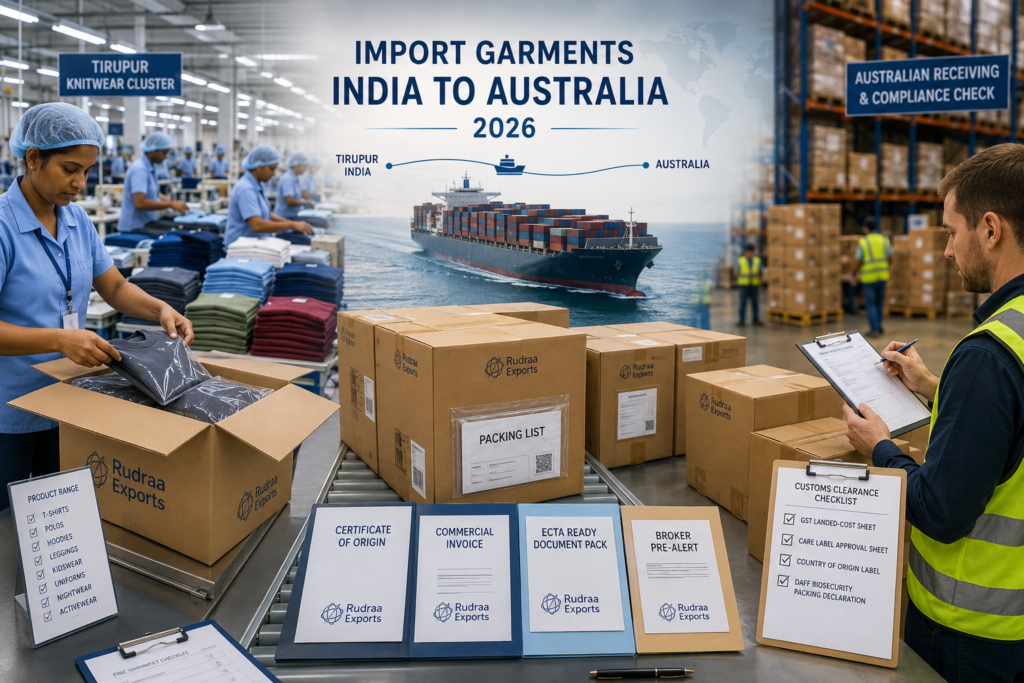
Importing garments from India to Australia can be a smart move for fashion brands, retailers, uniform buyers, activewear labels and private-label apparel businesses.
India is now a more attractive sourcing market for Australian buyers because of the Australia–India Economic Cooperation and Trade Agreement, known as ECTA.
ECTA can reduce or remove import duty on eligible Indian-origin garments when the HS code, origin proof, commercial documents and customs process are handled correctly.
But duty savings are not automatic.
Australian buyers still need to manage customs classification, GST, care labelling, country-of-origin marking, commercial invoices, packing lists, biosecurity checks, packing declarations and broker-ready documentation.
A low FOB price can become expensive if the shipment is held, misclassified, relabelled or denied preferential duty.
At Rudraa Exports, we help Australian brands import garments from Tirupur, India, with factory-direct production, ECTA-ready export documents, HS code coordination, commercial invoice preparation, packing lists, care label support, country-of-origin labels, QC inspection and shipment documentation.
Quick Answer
To import garments from India to Australia, buyers should confirm the HS code, check whether ECTA preferential duty applies, prepare a commercial invoice and packing list, approve care and country-of-origin labels, plan 10% GST on importation, provide origin documents where applicable, and ensure packing materials do not create DAFF biosecurity delays. Rudraa Exports supports Australian buyers with a direct-factory, compliance-first workflow that aligns production, labels, packing and export documents before shipment.
Planning to import garments from India to Australia? Contact Rudraa Exports to request an Australia-ready garment export plan.
Why Import Compliance Matters for Australian Brands
Importing garments is not only about production and freight.
It is also about compliance.
Australian buyers need to make sure that product details, customs classification, origin claims, labels, values and packing details are consistent across all documents.
If the invoice says one thing, the packing list says another and the garment label says something else, the shipment may face delays or extra questions.
The uploaded source explains that the cheapest ex-works quote can become the most expensive landed-cost outcome if classification, origin evidence, labelling or biosecurity preparation is weak.
Key Import Topics Australian Buyers Must Understand
| Topic | Why It Matters |
|---|---|
| HS code | Determines customs classification and duty |
| ECTA | May reduce duty for eligible Indian-origin garments |
| GST | Usually 10% on taxable importation value |
| Care labelling | Helps garments become retail-ready in Australia |
| Country of origin | Must match origin evidence |
| Commercial invoice | Supports customs value and classification |
| Packing list | Supports carton, quantity and SKU verification |
| Biosecurity | DAFF may check packaging cleanliness and contamination |
| Broker pre-alert | Helps reduce clearance delays |
Rudraa Direct Factory vs Trading Agent / Unknown Factory
The sourcing model affects import risk.
Comparison Table
| Criteria | Rudraa Direct Factory | Trading Agent / Unknown Factory |
|---|---|---|
| Product description | Style-level clarity with fibre, GSM and construction | Often generic descriptions |
| HS support | Better classification inputs for broker review | Limited classification support |
| ECTA origin proof | More controlled production and origin documentation | Origin trail may be unclear |
| Invoice consistency | Export documents aligned with actual goods | Document mismatch risk |
| GST planning | Clear values and Incoterms | Values may be bundled or unclear |
| Labelling | Labels approved before bulk | Labels may be handled late |
| Biosecurity | Packing controls and cleaner dispatch process | Higher repacking / contamination risk |
| Repeatability | Templates improve every shipment | Varies shipment to shipment |
The uploaded source compares Rudraa’s direct-factory model with trading agents or unknown factories and explains that direct sourcing gives better readiness for tariff classification, ECTA evidence, GST calculation, labelling, DAFF preparedness and ABF documentation.
Step 1: Confirm the Correct HS Code
HS code classification is the starting point.
Australian customs classification depends on:
- Garment type
- Fibre content
- Knit or woven construction
- Gender or age category
- End use
- Product design
- Sets or single garments
Common HS Chapters for Garments
| Chapter | Product Type |
|---|---|
| Chapter 61 | Knitted or crocheted apparel |
| Chapter 62 | Woven apparel |
Examples
| Garment | Likely HS Area |
|---|---|
| Cotton knitted T-shirt | Chapter 61 |
| Hoodie / sweatshirt | Chapter 61 |
| Knitted polo shirt | Chapter 61 |
| Woven shirt | Chapter 62 |
| Woven trousers | Chapter 62 |
| Babywear | Chapter depends on knit or woven |
| Activewear | Depends on construction and product type |
The uploaded source explains that HS Chapter 61 covers knits and HS Chapter 62 covers wovens, and that ABF Schedule 3 remains the baseline for classification and duty rates.
Step 2: Understand ECTA Duty Benefits
ECTA is the Australia–India Economic Cooperation and Trade Agreement.
It can reduce or remove duty on eligible Indian-origin garments.
But buyers must remember this:
ECTA duty benefit depends on product eligibility, HS code and rules-of-origin evidence.
ECTA Checklist
| Requirement | What to Confirm |
|---|---|
| HS code | Correct chapter and tariff line |
| Indian origin | Product qualifies under ECTA rules |
| Origin document | Certificate of Origin or approved evidence |
| Consistent documents | Invoice, packing list and product specs match |
| Broker review | Customs broker confirms claim pathway |
The uploaded source explains that ECTA lowered or eliminated Australian import duties on qualifying Indian-origin garments when classification, origin and documentation are handled correctly.
Step 3: Budget Duty and GST Correctly
Do not calculate landed cost only from FOB price.
Landed Cost Components
| Cost Item | Meaning |
|---|---|
| FOB value | Cost of goods from India |
| Freight | Sea or air freight to Australia |
| Insurance | If applicable |
| Duty | Depends on HS code and ECTA eligibility |
| GST | Usually 10% on taxable importation value |
| Broker fee | Customs clearance service |
| Port / terminal charges | Destination charges |
| Local delivery | Port to warehouse |
| Inspection / treatment | If customs or biosecurity selects shipment |
The uploaded source explains that GST on importation is 10% and that brands often estimate using a CIF-style base for planning before reconciling with the broker’s final import declaration calculation.
Simple GST Planning Example
Assume:
- Commercial value: AUD 100,000
- Freight and insurance: AUD 8,000
- Estimated CIF-style value: AUD 108,000
- GST planning rate: 10%
Estimated GST planning amount: AUD 10,800, plus any applicable duty and processing charges.
Buyer Tip
Ask your customs broker to calculate landed cost before the order is finalised.
Do not wait until goods are ready to ship.
Step 4: Prepare ECTA Origin Documentation
A “Made in India” label is not enough to claim ECTA duty preference.
Customs preference needs rules-of-origin support.
Origin Documents May Include
| Document | Purpose |
|---|---|
| Certificate of Origin | Supports preferential claim |
| Exporter details | Confirms supplier identity |
| Manufacturing records | Supports production origin |
| Fabric / material records | Supports origin evidence where needed |
| Commercial invoice | Matches product and value |
| Packing list | Matches shipment quantity |
| Product spec sheet | Supports classification and origin review |
The uploaded source explains that there is a difference between a consumer-facing “Made in India” origin statement and ECTA originating status for tariff preference.
Step 5: Get Care Labelling Right
Australian garments should be retail-ready before shipment.
Care labels should not be treated as a last-minute job.
Label Items to Confirm
| Label Item | Why It Matters |
|---|---|
| Fibre content | Must match actual fabric composition |
| Care instructions | Helps customers wash correctly |
| Country of origin | Must be truthful and consistent |
| Size label | Helps retail and warehouse handling |
| Brand label | Supports private-label presentation |
| Barcode / SKU label | Helps inventory tracking |
The uploaded source highlights AS/NZS 1957 as the care-labelling reference point for Australia and New Zealand markets.
Buyer Tip
Approve labels during sampling, not after bulk production.
If labels are wrong, relabelling in Australia can cost time and money.
Step 6: Prepare a Clean Commercial Invoice
The commercial invoice must support customs classification, valuation and duty calculation.
Commercial Invoice Should Include
| Field | Example |
|---|---|
| Exporter | Rudraa Exports |
| Buyer | Australian importer |
| Product description | Men’s knitted cotton T-shirts |
| Fibre content | 100% cotton |
| Construction | Knitted |
| Quantity | Pieces by style |
| Unit price | FOB or agreed Incoterm |
| Currency | USD / AUD / INR as agreed |
| HS code | Broker-reviewed |
| Country of origin | India |
| Incoterm | FOB, CIF, FCA, etc. |
| Invoice value | Total shipment value |
Avoid Vague Descriptions
Do not use only:
- Garments
- Clothes
- Fashion items
- Tops
- Assorted apparel
Use clear descriptions that match the product and HS code.
Step 7: Prepare a Detailed Packing List
The packing list should match the invoice and carton labels.
Packing List Should Include
- Carton number
- Style number
- SKU
- Colour
- Size
- Quantity per carton
- Total quantity
- Net weight
- Gross weight
- Carton dimensions
- Shipping marks
The uploaded source explains that Rudraa’s direct-factory model creates packing lists with SKU and carton traceability to reduce mismatch holds.
Step 8: Reduce DAFF Biosecurity Risk
DAFF biosecurity checks can delay shipments if packaging or cleanliness is a concern.
Garments themselves are usually low-risk compared with food or plant products, but packaging can create risk.
Biosecurity Areas to Check
| Area | What to Confirm |
|---|---|
| Cartons | Clean and dry |
| Wood packaging | Avoid or treat if used |
| Plant material | No straw, seed, leaf or soil contamination |
| Pallets | Must meet treatment requirements if used |
| Container | Clean and free from contamination |
| Packing record | Keep packing evidence and photos |
The uploaded source explains that packing SOPs can reduce DAFF inspection triggers such as plant matter contamination and dirty cartons.
Step 9: Send a Broker Pre-Alert Pack
A broker should receive documents before the goods arrive in Australia.
Broker Pre-Alert Pack
| Document | Purpose |
|---|---|
| Commercial invoice | Customs value and product description |
| Packing list | Carton and quantity details |
| Transport document | Bill of lading or airway bill |
| Certificate of Origin | ECTA support where applicable |
| Product spec summary | HS classification support |
| Packing declaration | Biosecurity support |
| Freight / insurance value | GST and landed-cost support |
| Label artwork | Retail compliance support if needed |
The uploaded source explains that Rudraa can issue a pre-alert pack to the broker so entries can be prepared without last-minute clarification.
Step 10: Keep Records for Repeat Imports
Import compliance improves when every shipment is documented.
Keep These Records
| Record | Why It Helps |
|---|---|
| HS code decision | Repeat classification consistency |
| Commercial invoice | Customs value history |
| Packing list | Quantity and carton traceability |
| Origin documents | ECTA claim support |
| Labels | Retail compliance proof |
| Packing photos | Biosecurity support |
| QC reports | Product quality proof |
| Broker declaration copy | Future audit support |
| Landed cost sheet | Pricing and margin planning |
A repeatable import process is more valuable than one lucky smooth shipment.
Common Import Mistakes to Avoid
| Mistake | Risk |
|---|---|
| Guessing HS code | Wrong duty and customs query |
| Claiming ECTA without origin proof | Preference denial |
| Vague invoice description | Broker cannot classify confidently |
| Fibre content mismatch | Label and customs issue |
| Late label approval | Relabel cost |
| Packing list mismatch | Clearance delay |
| Ignoring GST | Cashflow pressure |
| Dirty or risky packing | DAFF hold |
| No broker pre-alert | Last-minute clearance rush |
| No recordkeeping | Repeat shipment problems |
The uploaded source says ABF compliance communications highlight recurring issues around incorrect tariff classification and documentation errors that undermine correct duty assessment and preference claims.
How Rudraa Exports Supports India to Australia Imports
Rudraa Exports supports Australian brands with a compliance-first export workflow.
Rudraa Support Includes
- Factory-direct garment production
- Style-level product descriptions
- Fibre content confirmation
- Knit / woven construction clarity
- HS code inputs for broker review
- ECTA Certificate of Origin workflow support
- Commercial invoice preparation
- Packing list with SKU and carton mapping
- Care label approval support
- Country-of-origin label support
- Export carton packing
- Packing cleanliness controls
- QC inspection support
- Broker pre-alert document support
- Shipment coordination through Indian ports
Why Rudraa Exports
Rudraa Exports helps Australian buyers source and import garments from Tirupur, India, with factory-direct production and documentation-ready export support.
Product Categories Supported
- T-shirts
- Polo shirts
- Hoodies
- Sweatshirts
- Joggers
- Leggings
- Kidswear
- Babywear
- Nightwear
- Uniforms
- Corporate apparel
- Activewear
- Private-label knitwear
Manufacturing Strengths
- Tirupur-based factory-direct knitwear manufacturing
- 72,000+ units per month production capacity
- MOQ discussions starting from around 300 pieces for suitable programs
- AQL 2.5 inspection support
- Export-ready packing and documentation
- Multi-port shipping through Chennai, Tuticorin and Cochin
- Export support for Australia, USA, UK, Europe, Middle East and global buyers
Buyer Advantages
- Clearer landed-cost planning
- Better document consistency
- ECTA-ready export documentation support
- Reduced relabelling risk
- Better broker communication
- Better traceability from PO to carton
- Fewer trading-company layers
- Factory-direct pricing without middleman markups
- Up to 40% cost-saving positioning compared with indirect sourcing models
Ready to import garments from India to Australia? Speak with Rudraa Exports to share your product category, HS code if available, MOQ, fabric, delivery port, label requirements and shipment timeline.
India to Australia Import Checklist
| # | Checklist Item |
|---|---|
| 1 | Confirm product category |
| 2 | Confirm fibre content |
| 3 | Confirm knit or woven construction |
| 4 | Confirm HS chapter 61 or 62 |
| 5 | Review HS code with broker |
| 6 | Check ECTA eligibility |
| 7 | Prepare Certificate of Origin workflow |
| 8 | Approve care label |
| 9 | Approve country-of-origin label |
| 10 | Prepare commercial invoice |
| 11 | Prepare packing list |
| 12 | Confirm Incoterm |
| 13 | Confirm freight and insurance values |
| 14 | Estimate GST |
| 15 | Confirm packing cleanliness |
| 16 | Prepare packing declaration |
| 17 | Send pre-alert pack to broker |
| 18 | Track shipment |
| 19 | Keep import records |
| 20 | Review landed cost after delivery |
FAQ: Importing Garments from India to Australia
1. Can I import garments from India to Australia?
Yes. Australian businesses can import garments from India if the shipment has correct documents, HS classification, labels, packing details, origin proof where needed and broker support.
2. Are Indian garments duty-free in Australia?
Some Indian-origin garments may receive preferential duty treatment under ECTA if they meet the rules of origin and documentation requirements. Duty is not automatically removed for every shipment.
3. What HS chapters apply to garments?
Knitted or crocheted garments usually fall under Chapter 61. Woven garments usually fall under Chapter 62.
4. What is GST on imported garments in Australia?
GST on taxable importations is generally 10%. Buyers should calculate GST with a customs broker based on the final import declaration values.
5. What is ECTA?
ECTA is the Australia–India Economic Cooperation and Trade Agreement. It can reduce duty on eligible goods when origin rules are met.
6. Is a Made in India label enough for ECTA duty preference?
No. A Made in India label is not enough by itself. ECTA preference needs rules-of-origin evidence and correct documentation.
7. What documents are needed for importing garments?
Common documents include commercial invoice, packing list, bill of lading or airway bill, Certificate of Origin if applicable, packing declaration, product spec details and broker-requested documents.
8. What labels are needed for garments sold in Australia?
Garments usually need accurate care instructions, fibre content, size, brand label and country-of-origin information where applicable.
9. Can DAFF delay garment shipments?
Yes. DAFF may delay shipments if packaging or contamination risks are identified, especially with wood packaging, plant matter, soil or dirty cartons.
10. Should I use a customs broker?
Yes. A broker is strongly recommended for commercial garment imports because classification, GST, duty and ECTA claims can be complex.
11. Can Rudraa Exports support ECTA documentation?
Yes. Rudraa can support Certificate of Origin workflow, origin documentation coordination, product descriptions, packing lists and broker-ready export documents.
12. What should I send Rudraa for an Australia import quote?
Send your tech pack, product category, fabric composition, GSM, quantity, colours, labels, packaging needs, destination port, broker details if available and target shipment date.
Conclusion
Importing garments from India to Australia in 2026 is a strong opportunity for brands that manage compliance properly.
ECTA can improve duty outcomes for eligible Indian-origin garments, but only when HS code, origin proof and documentation are handled correctly.
Australian buyers must also plan for GST, care labelling, country-of-origin marking, commercial invoices, packing lists, DAFF biosecurity and broker-ready document packs.
Rudraa Exports helps Australian brands reduce import friction by connecting factory-direct production with compliance-ready export documentation, label control, packing traceability and broker support.
Visit rudraaexports.com or contact our team directly to share your India to Australia garment import requirement — and receive a compliance-first production and export plan from Rudraa Exports.
Related reading
The Real Landed Cost of Importing T-Shirts from India to Australia