
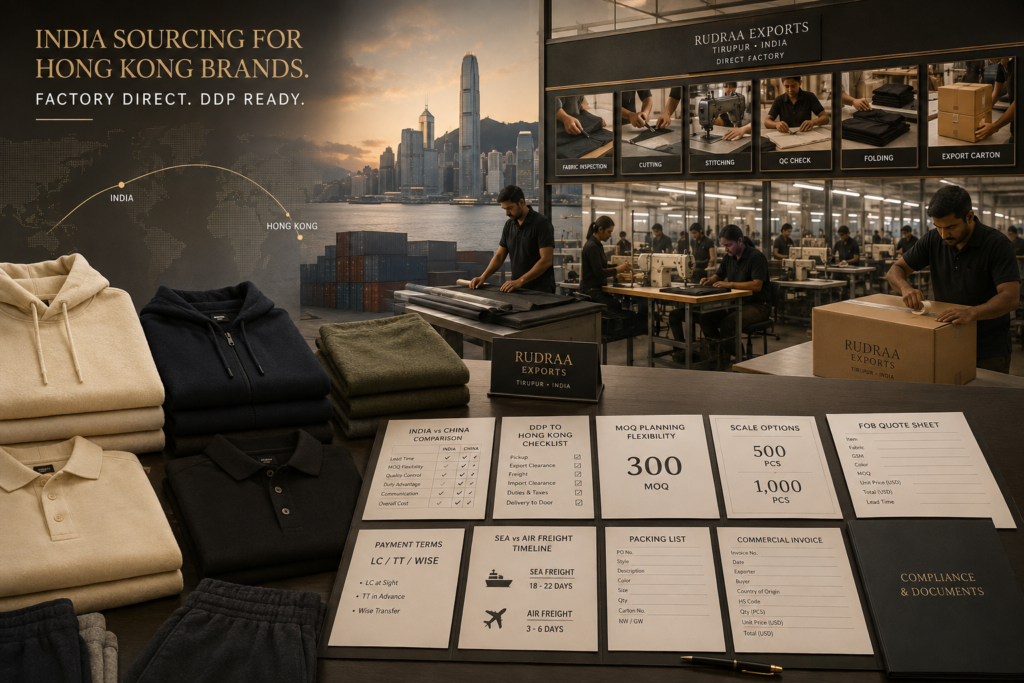
Hong Kong fashion brands are rethinking garment sourcing.
This does not mean China is no longer useful. China still has strong manufacturing depth, complex trim ecosystems and fast regional logistics.
But many Hong Kong brands are now looking for a China-plus-one sourcing base to reduce risk, protect margins and create more flexibility.
For knitwear basics, cotton-heavy programs, T-shirts, polos, fleece hoodies and loungewear, India is becoming a practical option.
Especially Tirupur in Tamil Nadu.
Tirupur is one of India’s strongest knitwear manufacturing ecosystems, with fabric sourcing, cutting, stitching, finishing, QC and export packing available within a mature production cluster.
At Rudraa Exports, we help Hong Kong brands source garments from India through a direct-factory model with 300-piece MOQ planning, factory communication, DDP discussion, payment flexibility, quality control and export-ready production.
Quick Answer
A garment manufacturer in India can be a strong fit for Hong Kong brands that need cotton knitwear, T-shirts, polos, fleece, loungewear and private-label basics. Rudraa Exports supports Hong Kong buyers with direct-factory sourcing from Tirupur, 300 pcs starting MOQ, 500 and 1,000 pcs scale pricing, FOB or DDP discussion, LC/TT/Wise payment options, QC checkpoints and export packing. Compared with agent buying, direct factory sourcing gives better visibility over cost, quality, timelines and documentation.
Why Hong Kong Brands Consider India
Hong Kong buyers usually understand overseas production well.
The challenge is not learning sourcing basics.
The challenge is choosing the right sourcing route.
Most Hong Kong brands compare three options:
- China factory sourcing
- Agent-based buying
- Direct-factory sourcing from India
The uploaded guide explains that Hong Kong brands are rebalancing sourcing because China-only supply chains can concentrate risk as wages, compliance demands and geopolitical volatility rise.
India helps because it gives brands another production base for core knitwear.
India vs China vs Agent Buying
| Route | Best For | Watch-Out |
|---|---|---|
| Rudraa Exports, Tirupur direct factory | Cotton knits, T-shirts, polos, fleece, repeat basics | Needs clear tech pack and 300+ pcs planning |
| China factory | Complex trims, automation, wide category depth | Can be higher cost for some basic knitwear |
| Agent-based buying | Convenience and multi-country coordination | Higher markup and weaker factory visibility |
The uploaded source compares Rudraa’s Tirupur direct-factory model, China factories and agent-based buying across product fit, MOQ, unit cost, labour, compliance, capacity, lead time, shipping, payment and control.
Why Tirupur Works for Hong Kong Brands
Tirupur is strong in cotton knitwear.
It is especially useful for:
- T-shirts
- Polo shirts
- Fleece hoodies
- Joggers
- Loungewear
- Uniform basics
- Private-label knitwear
- Repeat retail programs
The source highlights Tirupur as a practical China-plus-one hub with fabric proximity, scalable capacity and a mature export ecosystem.
For Hong Kong buyers, this matters because the supply chain is not spread across too many disconnected vendors.
A direct factory can coordinate fabric, samples, QC and export packing more clearly.
Rudraa MOQ for Hong Kong Buyers
Rudraa Exports’ MOQ starts from 300 pieces.
This MOQ is suitable for serious pilot production and practical first orders.
Quote Breaks to Request
- 300 pcs for controlled first production
- 500 pcs for better production efficiency
- 1,000 pcs for stronger scale economics
This helps Hong Kong buyers compare pilot cost, scale cost and repeat-order cost before committing larger volume.
A 300-piece MOQ also supports better fabric planning, size ratios, trims, QC structure and export carton planning.
Cost: Where Direct Factory Helps
The uploaded guide explains that Tirupur can show strong FOB advantages for basic cotton T-shirt programs when compared with some China sourcing routes. It also notes that agent-based buying can add cost and reduce transparency.
But buyers should not compare price blindly.
To compare India and China properly, normalize:
- Fabric GSM
- Yarn quality
- Stitch count
- Print method
- Finishing
- Packing
- AQL level
- Labels and trims
Without these details, a quote comparison becomes misleading.
A direct-factory quote from Rudraa can help Hong Kong buyers see what is actually included in the garment cost.
DDP to Hong Kong: What to Clarify
DDP can be useful for Hong Kong buyers because it simplifies landed-cost planning.
But DDP must be treated as a scope document, not just a selling word.
The uploaded source says buyers should confirm whether DDP includes Hong Kong local delivery, declaration charges and terminal handling.
DDP Checklist
Ask whether the quote includes:
- Export clearance in India
- Main freight
- Hong Kong arrival handling
- Import declaration support
- Local delivery
- Destination charges
- Insurance
- Carton and packing details
- Documentation
Hong Kong may be a free port for garments, but documentation and handling still matter.
Sea vs Air Freight
For Hong Kong garment imports, both sea and air can be used.
Sea Freight
Best for:
- Planned bulk orders
- Better margin control
- Repeat programs
- Larger carton volumes
Air Freight
Best for:
- Urgent top-ups
- Samples
- Time-sensitive launches
- Small priority shipments
The uploaded guide includes sea and air planning windows and stresses that end-to-end timelines must include production approvals, export handling and local delivery.
Payment Options
Hong Kong buyers often need flexible payment discussions.
The uploaded guide lists LC, TT and Wise as payment options.
Common options include:
- TT advance and balance
- LC for larger programs
- Wise for suitable smaller international payments
The right option depends on order size, buyer history, risk level and documentation requirements.
When Rudraa Is a Strong Fit
Rudraa is a strong fit when Hong Kong brands need:
- Cotton knitwear
- T-shirts and polos
- Fleece hoodies
- Repeat basics
- 300+ pcs MOQ planning
- Direct-factory communication
- DDP discussion
- FOB transparency
- Quality checkpoints
- Export documentation
- China-plus-one sourcing
When China or Agents May Still Fit
China may still be better for highly technical outerwear, specialized hardware, complex trims or ultra-short replenishment.
Agents may still help when the buyer needs heavy handholding, multiple countries, or lacks internal tech-pack discipline.
The uploaded source notes that some routes remain useful depending on product complexity, timeline and internal sourcing capability.
Transition Plan for Hong Kong Brands
Step 1: Choose a Pilot Basket
Pick 2–4 styles:
- One cotton T-shirt
- One polo
- One hoodie or jogger
- One repeat basic
Step 2: Lock Specs
Prepare:
- GSM
- Fabric composition
- Measurement chart
- Shrinkage target
- Colour standards
- Print method
- Packing ratio
- Label requirements
Step 3: Align Compliance
Request documents where applicable:
- OEKO-TEX
- GOTS
- ISO-related process documentation
- Fabric testing
- Care label details
The uploaded source recommends verifying certificate validity and scope during onboarding.
Step 4: Approve Samples
Use a controlled sequence:
- Proto sample
- Size set
- Pre-production sample
- PP approval
Step 5: Confirm Freight and DDP Scope
Before bulk production, confirm whether you want FOB, CIF or DDP.
For DDP, clearly define the included cost lines.
Step 6: Compare Performance
After the pilot, score:
- Cost vs China baseline
- On-time delivery
- AQL result
- Measurement accuracy
- Shade consistency
- Sampling rounds
- Documentation accuracy
- Freight variance
FAQ
1. Can Hong Kong brands source garments from India?
Yes. India is a strong option for Hong Kong brands sourcing cotton knitwear, T-shirts, polos, fleece, loungewear and private-label basics.
2. What is Rudraa Exports’ MOQ?
Rudraa Exports’ MOQ starts from 300 pieces, depending on product, fabric, colour, trims and complexity.
3. Does Rudraa offer DDP to Hong Kong?
Rudraa can discuss DDP to Hong Kong, but buyers should confirm the full scope, including freight, declaration handling, local delivery and destination charges.
4. Is India cheaper than China for garments?
For some basic cotton knitwear programs, India can be cost-competitive. Buyers should compare quotes only after matching GSM, fabric, stitching, finishing, packing and QC level.
5. Should Hong Kong brands still use China?
Yes, for some complex trims, technical products and fast replenishment programs, China can still be useful.
Conclusion
Hong Kong brands do not need to replace China completely.
But they should build a stronger sourcing portfolio.
For cotton knitwear, T-shirts, polos, fleece and repeat basics, Tirupur offers a practical India sourcing option.
Rudraa Exports helps Hong Kong buyers source garments through a direct-factory model with 300 pcs starting MOQ, 500 and 1,000 pcs scale pricing, sample approvals, QC checkpoints, DDP discussion, payment flexibility and export-ready production.
Visit rudraaexports.com or contact Rudraa Exports to request a quote for your next Hong Kong garment sourcing program.