
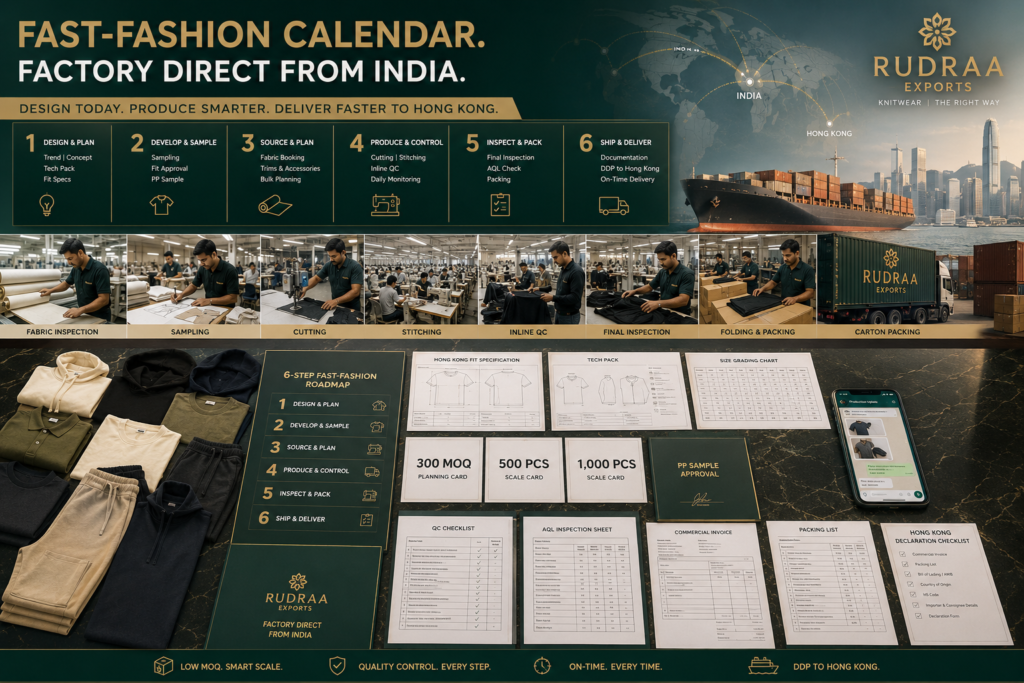
Hong Kong fashion brands work under serious calendar pressure.
Teams often need to move from design idea to shelf quickly while still protecting margin, quality and traceability.
That is difficult when sourcing is slow, communication is unclear, sampling takes too long or bulk production does not match the approved sample.
India can be a strong sourcing solution for Hong Kong brands, especially for knitwear, cotton basics, T-shirts, polos, hoodies, joggers and loungewear.
But the success depends on execution.
At Rudraa Exports, we help Hong Kong fashion teams source garments from India through a factory-direct model from Tirupur, with dedicated export communication, 300 pcs starting MOQ, sampling support, ISO-aligned quality systems, traceability, QC checkpoints and export-ready documentation.
Quick Answer
Hong Kong fashion brands can source garments from India without slowing their fast-fashion calendar by following a structured six-step roadmap: define specs, vet factories, manage sampling, run a 300 pcs trial order, monitor production with QC gates and prepare shipping documentation for Hong Kong. Rudraa Exports supports this process through direct-factory production, dedicated export coordination, WhatsApp updates, traceability, 72,000-unit monthly capacity and clear production planning.
Why Hong Kong Brands Look at India
Hong Kong brands are used to speed.
They need fast sampling, clear communication and production discipline.
India is attractive because it offers:
- Competitive garment manufacturing
- Strong knitwear capability
- Cotton and fabric access
- Export-ready production
- Scalable capacity
- Compliance alignment
- China-plus-one sourcing flexibility
The main risk is not whether India can make garments.
The risk is whether the process is structured enough for a Hong Kong calendar.
That is why buyers need a roadmap.
Step 1: Define Specs and Tech Pack
The first step is to remove ambiguity.
Your tech pack should include:
- Fabric composition
- GSM
- Measurement chart
- Size grading
- Tolerances
- Stitch details
- Shrinkage target
- Colour references
- Print or embroidery method
- Label and packing rules
- Carton requirements
Hong Kong customers can be fit-sensitive, so size grading must be clear.
Do not write “Asia fit” or “regular fit” without measurements.
For example, if you are sourcing a 280 GSM brushed fleece hoodie, define GSM tolerance, shrinkage expectation, colourfastness requirement, rib quality and wash-test method.
Rudraa’s factory-direct model helps because the export manager can review the tech pack, flag risk points and clarify details before sampling.
Step 2: Vet and Shortlist the Factory
Before placing a sample order, verify whether the factory can support your program.
Ask for:
- Factory profile
- Product categories
- Monthly capacity
- QC process
- Traceability method
- Compliance documentation
- Export experience
- Communication process
- Production timeline
Rudraa Exports supports Hong Kong buyers with ISO-aligned quality systems, traceability and stated capacity of 72,000 units per month.
This matters when you are running fast seasonal drops and need the factory to handle repeat production, not just one sample.
Agent sourcing can work, but factory identity and accountability may become unclear if the agent shifts production between vendors.
Step 3: Sampling and Negotiation
Sampling is where the calendar is won or lost.
A slow sample process can delay the entire launch.
To avoid this, sampling should be planned in stages:
- Fabric swatch
- Proto sample
- Size set
- Pre-production sample
- Final PP approval
Negotiate using a clear cost structure:
- Fabric
- Trims
- CMT
- Printing
- Washing
- Testing
- Labels
- Packing
- Freight
Rudraa’s direct-factory model reduces the “telephone game” because buyers communicate with the production source, not only through an intermediary.
This helps reduce sample clarification delays and gives better visibility into cost.
Step 4: Run a 300 pcs Trial Order
A trial order should not be treated as just small bulk.
It is a production rehearsal.
For Rudraa Exports, MOQ starts from 300 pieces.
A 300 pcs trial helps test:
- Fabric consistency
- Size grading
- Sewing quality
- Shade matching
- Shrinkage
- Label placement
- Packing format
- Carton marking
- QC discipline
- Communication speed
The trial should use the exact materials, labels, trims and packing planned for future production.
This helps Hong Kong teams understand whether the supplier can repeat the approved sample in bulk.
For scale planning, buyers can request price breaks at:
- 300 pcs
- 500 pcs
- 1,000 pcs
This helps compare trial cost, efficiency cost and scale cost.
Step 5: Production Monitoring and QC
The most common sourcing failure is quality drift.
The approved sample looks good, but bulk production changes.
To prevent this, define QC checkpoints before production starts.
Use:
- PP sample sealing
- Cutting approval
- First-off sewing check
- Inline inspection
- Measurement audit
- Midline review
- Final random inspection
- Packing check
Rudraa’s single-party factory accountability helps reduce confusion during corrections.
WhatsApp progress updates can also help Hong Kong teams move faster. Photos and videos of fabric receipt, cutting, inline QC and packed cartons reduce waiting time and improve decision speed.
Step 6: Shipping and Hong Kong Documentation
Hong Kong is a free port and apparel generally does not face customs tariff.
But documentation still matters.
The shipment file should include:
- Commercial invoice
- Packing list
- HS code
- Carton count
- Gross weight
- Net weight
- CBM
- Country of origin
- Buyer details
- Shipment mode
- Declaration support
Hong Kong trade declarations must be handled within the required timeline, so buyers should not leave paperwork to the last minute.
Factory-direct execution helps because the same accountable party controls production, packing and document preparation.
Best Fit for Rudraa
Rudraa is a strong fit for Hong Kong brands that:
- Run drop-based calendars
- Need cotton knitwear
- Source T-shirts, polos, hoodies or loungewear
- Need 300+ pcs trial production
- Want direct-factory communication
- Need traceability
- Want WhatsApp production updates
- Need QC checkpoints
- Plan repeat monthly drops
- Want China-plus-one sourcing
Not the Best Fit
Rudraa may not be the right fit if:
- You cannot prepare a proper tech pack
- You need ultra-tiny quantities below production MOQ
- You expect bulk to fix sample issues automatically
- You do not want to follow approval gates
- You need highly technical outerwear or hardware-heavy products
Migration Plan
Start with two SKUs and one fabric family.
For example:
- 180–220 GSM single jersey T-shirts
- 280 GSM fleece hoodie
- Cotton polo shirt
- Jogger or loungewear basic
Run a 300 pcs pilot with signed QC checkpoints.
Assign one Hong Kong owner and one Rudraa export contact.
Track updates at each milestone:
- Fabric received
- Cutting started
- First-off approved
- Inline QC complete
- Packing started
- Shipment documents prepared
After delivery, create a short lessons-learned report.
Review:
- Defects
- Measurement variance
- Sampling speed
- Documentation accuracy
- Delivery timeline
- Cost against plan
Then scale to 500 pcs or 1,000 pcs once trial KPIs are stable.
FAQ
1. Can Hong Kong brands source garments from India quickly?
Yes, if the process is structured with clear tech packs, sampling timelines, QC gates and direct-factory communication.
2. What is Rudraa Exports’ MOQ?
Rudraa Exports’ MOQ starts from 300 pieces, depending on product, fabric, colour, trims and complexity.
3. What products are best for Rudraa?
T-shirts, polos, fleece hoodies, joggers, loungewear and cotton knitwear basics are strong fits.
4. Why is tech pack clarity important?
Clear specs reduce sampling delays, prevent quality drift and help the factory match the approved sample in bulk.
5. Does Hong Kong have garment import duty?
Hong Kong generally operates as a free port, but shipment documentation and trade declarations still need to be handled correctly.
Conclusion
Hong Kong fashion brands can source from India without slowing their calendar if they use a disciplined roadmap.
The process must be clear: define specs, vet the factory, control sampling, run a 300 pcs trial, monitor QC and prepare shipment documents properly.
Rudraa Exports helps Hong Kong brands source garments from Tirupur, India through a factory-direct model with 300 pcs starting MOQ, 500 and 1,000 pcs scale planning, dedicated export communication, WhatsApp updates, ISO-aligned quality systems, traceability and export-ready production.
Visit rudraaexports.com or contact Rudraa Exports to request a quote for your next Hong Kong fashion sourcing program.