
Leggings look simple from the outside.
But from a manufacturing point of view, they are one of the most technical products in women’s activewear.
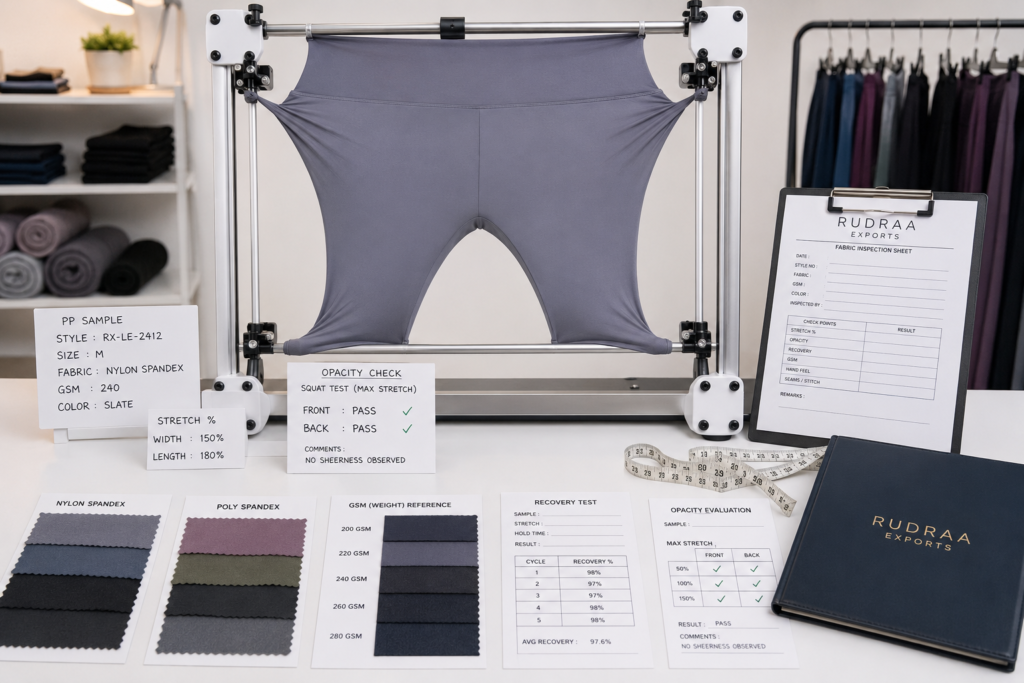
A good pair of leggings must stretch, recover, stay opaque, feel comfortable, hold shape, support movement, avoid pilling, survive washing and fit consistently across sizes.
That is why choosing the right leggings manufacturer matters.
India, especially Tirupur, has become a strong sourcing option for private-label leggings, women’s activewear, yoga wear, gym wear and performance knit programs.
The reason is simple.
Tirupur has an integrated knitwear ecosystem with fabric sourcing, dyeing, finishing, cutting, stitching, quality control and export packing support in one manufacturing cluster.
At Rudraa Exports, we help brands develop private-label leggings from India with fabric and GSM planning, compression tuning, tech-pack review, low-MOQ discussion, sampling, size-set development, quality checks and export-ready production.
Quick Answer
Leggings manufacturing in India is a strong option for brands that need private-label women’s activewear with flexible MOQs, performance fabrics, GSM control, squat-proof testing, stretch recovery and export-ready production. Tirupur is especially suitable for leggings because of its knitwear ecosystem, fabric processing base, activewear development capability and low-to-mid volume production flexibility. For most brands, the best starting point is one style, two or three colours, 300 pcs per colour where feasible, and a clear fabric brief with GSM, elastane percentage, compression target and testing requirements.
Looking for private-label leggings manufacturing? Contact Rudraa Exports and share your tech pack, target GSM, compression level, quantity and destination market.
Why India Works for Leggings Manufacturing
India’s knitwear sector has expanded from basic cotton products into performance knitwear and women’s activewear.
The uploaded guide explains that India’s knitwear sector has evolved into a competitive player in performance knit exports, with Tirupur playing a major role in knitwear exports and activewear-ready production.
Why Tirupur Is Important
Tirupur gives leggings buyers access to:
- Knitting
- Dyeing
- Processing
- Fabric finishing
- Cutting
- Stitching
- Activewear sampling
- Export packing
- Compliance-ready workflows
- Low-to-mid MOQ programs
- Repeat production systems
The uploaded source notes that Tirupur has a dense knitwear ecosystem with knitting units, dyeing and processing houses and export infrastructure that help reduce handoff friction.
India vs China vs Vietnam for Leggings
Buyers often compare India with China and Vietnam.
Each country can manufacture leggings, but they serve different sourcing needs.
Quick Comparison
| Criteria | India / Tirupur | China | Vietnam |
|---|---|---|---|
| Best for | Private label, low-to-mid volume, flexible drops | High-volume programs | Stable mid-to-high volume |
| MOQ | Often more flexible | Often higher for best price | Mid-range |
| Fabric ecosystem | Strong knitwear base | Very broad component base | Strong export apparel base |
| Cost | Competitive | Strong at very high volume | Competitive |
| Compliance | Strong export cluster options | Varies by supplier | Generally strong |
| Lead time | Good with planned fabric | Fast if materials ready | Stable but capacity-dependent |
| Best buyer | DTC activewear and growing brands | Large-scale brands | Stable wholesale programs |
The uploaded guide compares India, China and Vietnam across MOQ, FOB pricing, labour cost, cluster advantage, compliance, timelines, shipping and policy support.
When India Is Strongest
India is strongest when your brand needs:
- Private-label leggings
- Flexible colour drops
- 300 pcs per colour discussion
- Fabric development support
- Knitwear-focused production
- Compliance-ready supplier base
- Repeatable activewear quality
- Export shipping support
What Makes Leggings Technical?
Leggings are not just stitched tubes of stretch fabric.
They must perform under movement.
Leggings Must Control
- Stretch
- Recovery
- Opacity
- Compression
- Waistband hold
- Gusset comfort
- Seam strength
- Pilling
- Colourfastness
- Sweat exposure
- Washing stability
- Fit across sizes
Common Customer Complaints
- Fabric becomes see-through
- Knees bag out
- Waistband rolls down
- Seams pop
- Fabric pills quickly
- Colour fades
- Leggings shrink or grow after wash
- Fit changes after a few wears
A good leggings manufacturer must control fabric, pattern, stitching and testing together.
Best Fabrics for Leggings
Fabric choice decides the final performance.
1. Nylon-Spandex Interlock
Best for:
- Yoga leggings
- Premium activewear
- Soft compression leggings
- Lifestyle performance wear
Typical Direction
210–230 GSM
The uploaded guide identifies nylon-spandex interlock around 210–230 GSM as a common option for soft hand-feel and squat-proof stability.
Benefits
- Soft hand feel
- Good stretch
- Smooth surface
- Premium comfort
- Strong recovery when engineered correctly
- Suitable for yoga and studio wear
2. Polyester-Spandex Interlock
Best for:
- Gym leggings
- Printed leggings
- Running leggings
- Training tights
- High-abrasion use
Typical Direction
220–250 GSM
The uploaded source notes that polyester-spandex interlock is often used around 220–250 GSM for prints and abrasion resistance.
Benefits
- Better print compatibility
- Abrasion resistance
- Stronger colour options
- Durable activewear performance
- Useful for gym and running categories
3. Warp Knit Leggings Fabric
Best for:
- Supportive silhouettes
- Compression leggings
- Form-fitting activewear
- Performance tights
Typical Direction
200–300 GSM
The uploaded guide explains that warp knits are commonly used in 200–300 GSM ranges for controlled stretch and supportive fit.
Benefits
- Controlled stretch
- More structured support
- Better shape retention
- Good for performance and compression fits
4. Recycled Nylon-Spandex
Best for:
- Premium sustainable activewear
- High-end private label leggings
- Eco-positioned collections
- Yoga and lifestyle leggings
Example Direction
The uploaded guide references a premium recycled nylon example at 225 GSM with shape-retention and muscle-control positioning.
Buyer Checks
Before using recycled nylon, confirm:
- Recycled content documentation
- Stretch recovery
- Colourfastness
- Pilling resistance
- Hand feel
- Opacity
- Compression
- Certification support where required
GSM Guide for Leggings
GSM means grams per square metre.
For leggings, GSM affects opacity, compression, warmth, durability and feel.
Practical GSM Ranges
| Leggings Type | GSM Direction |
|---|---|
| Lightweight fashion leggings | 180–200 GSM |
| Yoga leggings | 210–230 GSM |
| Gym leggings | 220–250 GSM |
| Compression leggings | 240–280 GSM |
| Supportive warp-knit tights | 200–300 GSM |
| Premium recycled nylon leggings | Around 225 GSM and above depending on fabric |
GSM Rule
Higher GSM does not automatically mean better leggings.
The correct GSM depends on:
- Fabric blend
- Knit structure
- Elastane percentage
- Compression target
- Opacity requirement
- Climate
- End use
- Price point
Compression: How It Is Controlled
Compression can be tuned through fabric and construction.
Compression Depends On
- GSM
- Elastane percentage
- Knit structure
- Recovery
- Pattern reduction
- Waistband construction
- Seam placement
- Finishing process
The uploaded guide explains that compression can be adjusted by changing GSM, fabric structure, elastane percentage and recovery standards.
Compression Types
| Compression Level | Best For |
|---|---|
| Light compression | Yoga, lounge, daily wear |
| Medium compression | Gym, training, active lifestyle |
| Firm compression | Performance training and support |
| High compression | Specialised products requiring strong fit control |
Buyer Tip
Do not ask only for “high compression.”
Define:
- Fabric GSM
- Elastane percentage
- Stretch direction
- Recovery target
- Fit reduction
- Waistband pressure
- Sample size test
Squat-Proof Testing
Squat-proof performance is essential for leggings.
It checks whether the fabric becomes see-through during bending or stretching.
Squat-Proof Depends On
- GSM
- Fabric density
- Colour
- Stretch level
- Knit structure
- Print coverage
- Size selection
- Pattern reduction
Common Risk Areas
- Light colours
- Printed leggings
- Low GSM fabric
- Too much pattern reduction
- Poor recovery
- Thin polyester blends
Buyer Rule
Test squat-proof performance on-body, not only on a flat fabric swatch.
Waistband Construction
The waistband can make or break leggings.
Common Waistband Issues
- Rolling down
- Digging into waist
- Losing shape
- Twisting after wash
- Too much pressure
- Not enough support
Waistband Options
| Waistband Type | Best For |
|---|---|
| High-rise folded waistband | Yoga and lifestyle leggings |
| Elastic inserted waistband | Stronger hold |
| Contoured waistband | Better body shaping |
| Double-layer waistband | More support |
| Power mesh waistband | Higher compression styles |
Buyer Tip
Approve waistband fit during movement, not just standing photos.
Gusset and Seam Engineering
Leggings need proper gusset and seam construction.
Why Gusset Matters
A gusset improves:
- Movement
- Comfort
- Durability
- Fit
- Seam stress distribution
Seam Options
| Seam Type | Use |
|---|---|
| Flatlock seam | Comfort and activewear appearance |
| Overlock seam | Standard stretch construction |
| Coverstitch | Hem and waistband finish |
| Bonded seam | Specialised premium product, supplier-dependent |
Buyer Tip
For private-label leggings, define seam type in the tech pack.
Do not leave it to default factory choice.
Testing Required for Leggings
Leggings need more testing than basic T-shirts.
Recommended Tests
| Test | Why It Matters |
|---|---|
| GSM | Confirms fabric weight |
| Shrinkage | Protects fit after wash |
| Stretch and recovery | Prevents bagging |
| Colourfastness | Prevents fading and bleeding |
| Pilling | Protects surface appearance |
| Tensile strength | Checks durability |
| Seam strength | Prevents seam bursting |
| Opacity / squat-proof | Prevents transparency |
| Wash test | Checks real use performance |
The uploaded source highlights stretch recovery, ASTM D4964-style testing and tensile expectations as important when approving leggings fabric and performance.
Low MOQ for Private Label Leggings
Low MOQ is important for DTC activewear brands.
It allows brands to test colour, fit and demand without heavy inventory risk.
The uploaded guide states that India and Tirupur can support low-MOQ programs, often in the 300 pcs range, with 300 pcs per colour workable for agile programs.
Low MOQ Works Best When
- Fabric is already available
- Colour count is limited
- One base fabric is used
- Tech pack is clear
- Trims are simple
- Waistband is not overly complex
- Packaging is standardised
- Buyer approves samples quickly
Low MOQ Becomes Harder When
- Every colour is custom dyed
- Fabric is custom developed
- Compression target is highly specific
- Many prints are requested
- Trims are imported
- Pattern changes continue after sampling
- Size range is very wide
Better First Pilot
Instead of:
- 5 colours
- 6 sizes
- 3 fabrics
- Custom waistband for every style
Start with:
- 1 style
- 2–3 colours
- 1 core fabric
- Clear size curve
- Standard waistband
- 300 pcs per colour where feasible
Private Label Options for Leggings
Private-label leggings can include:
- Custom brand label
- Size label
- Care label
- Hangtag
- Barcode sticker
- Polybag
- Carton mark
- Printed logo
- Heat-transfer logo
- Reflective print
- Custom waistband
- Branded packaging
Private Label Checklist
| Item | Check |
|---|---|
| Main label | Placement and size |
| Care label | Fibre composition and care |
| Size label | Correct size standard |
| Logo | Print or heat transfer |
| Packaging | Fold, bag and barcode |
| Carton | Markings and packing ratio |
| Hangtag | Brand and product info |
Lead Times for Leggings Manufacturing in India
Lead time depends on fabric, sampling, dyeing, approvals and production capacity.
Practical Timeline Direction
| Stage | Timeline Direction |
|---|---|
| First sample | 2–3 weeks |
| Bulk production | 6–8 weeks |
| Repeat fabric production | 35–45 days |
| New fabric production | 50–60 days |
| Air shipping | 5–8 days |
| Sea shipping to EU | 18–22 days to key ports |
| Sea shipping to US | 28–35 days to New York |
The uploaded source provides these practical timing ranges for sampling, bulk, repeat fabric, new fabric and shipping.
Lead-Time Rule
Do not confuse sewing time with total lead time.
Total lead time includes:
- Fabric sourcing
- Lab dips
- Sample development
- Buyer comments
- PP approval
- Bulk fabric
- Cutting
- Stitching
- Finishing
- QC
- Packing
- Freight
Fit / Fit-Not Guide
India Is a Strong Fit If
- You need private-label leggings
- You want 300 pcs per colour discussion
- You need flexible drops
- You sell women’s activewear
- You need fabric and GSM options
- You want squat-proof development
- You need compression tuning
- You can work with tech packs
- You want compliance-ready sourcing
- You plan repeat production
The uploaded guide says India is a strong fit for brands needing low-MOQ private-label agility, fabric-driven performance and compliance-ready sourcing.
India May Not Be Best If
- You need ultra-low FOB at very high volume
- You need the fastest ocean lane outside South India routes
- Your product depends on specialised components
- You cannot approve samples quickly
- You do not have a leggings tech pack
- Your design changes after PP approval
The uploaded source notes that brands should proceed carefully when they need ultra-low FOB at very high volumes, extreme transit speed or proprietary components that the supplier ecosystem cannot source quickly.
Migration Plan: Adding India to Your Leggings Supply Chain
Phase 1: Audit
Before placing an order, review:
- Factory capability
- Knitting route
- Dyeing route
- Finishing process
- Compliance documents
- Fabric inspection system
- Shade band process
- In-line sewing checks
- Final inspection process
The uploaded guide recommends auditing factory capability, process routes, compliance pack and quality systems before moving leggings production.
Phase 2: Pilot Sampling
Run:
- Proto sample
- Fit sample
- PP sample
- Fabric test review
- Stretch recovery test
- Squat-proof check
- Wash test
- Size-set approval
Phase 3: Bulk Scale
After pilot approval:
- Lock core fabric
- Lock size curve
- Lock waistband construction
- Approve lab dips
- Plan bulk production
- Run inline QC
- Run final inspection
- Plan freight
- Review first delivery
- Scale colours after success
The uploaded source recommends an audit, pilot and scale approach to switch or add India to a leggings supply chain.
Leggings Manufacturing Checklist
| # | Checkpoint |
|---|---|
| 1 | Product type selected |
| 2 | Target customer defined |
| 3 | Fabric blend selected |
| 4 | GSM range defined |
| 5 | Compression level defined |
| 6 | Waistband type selected |
| 7 | Gusset confirmed |
| 8 | Seam type defined |
| 9 | Tech pack prepared |
| 10 | MOQ per colour planned |
| 11 | Fabric swatches requested |
| 12 | Lab dips planned |
| 13 | Stretch recovery test planned |
| 14 | Squat-proof check planned |
| 15 | Size set planned |
| 16 | PP sample required |
| 17 | AQL inspection planned |
| 18 | Private-label packaging defined |
| 19 | Freight mode planned |
| 20 | Reorder calendar prepared |
How Rudraa Exports Supports Leggings Manufacturing
Rudraa Exports supports leggings and women’s activewear production from Tirupur, India.
Rudraa Support Includes
- Product brief review
- Leggings tech-pack review
- Fabric sourcing
- GSM planning
- Nylon-spandex options
- Polyester-spandex options
- Recycled nylon discussion
- Compression planning
- Squat-proof development
- Waistband construction review
- Gusset and seam discussion
- Sample coordination
- Size-set support
- PP sample approval
- Stretch recovery testing discussion
- Pilling and colourfastness review
- AQL inspection support
- Private-label trims and packaging
- Export packing
- Repeat production planning
Products Supported
- Yoga leggings
- Gym leggings
- Running tights
- Compression leggings
- High-waist leggings
- Printed leggings
- Recycled nylon leggings
- Women’s activewear sets
- Sports bras where applicable
- Athleisure bottoms
- Private-label performance knits
Why Rudraa Fits Private-Label Leggings Brands
Rudraa is a good fit for brands that need:
- Low-to-mid MOQ planning
- Fabric-driven development
- GSM and compression control
- Activewear sourcing support
- Fit and sampling discipline
- Export-ready production
- Compliance-minded workflows
- Repeatable bulk quality
The uploaded guide positions Rudraa Exports for brands that want agility and control in private-label leggings manufacturing, with support for GSM, compression, fabric choice, sampling and bulk timelines.
Ready to develop private-label leggings from India? Speak with Rudraa Exports and share your tech pack, target GSM, fabric type, colour count, MOQ and destination.
FAQ: Leggings Manufacturing in India
1. Is India good for leggings manufacturing?
Yes. India, especially Tirupur, is a strong option for private-label leggings, activewear and performance knits because of its integrated knitwear ecosystem.
2. What is the best fabric for leggings?
Nylon-spandex interlock is popular for premium yoga leggings, while polyester-spandex interlock is useful for printed and gym leggings.
3. What GSM is good for leggings?
Yoga leggings often use around 210–230 GSM, gym leggings often use 220–250 GSM, and compression leggings may use higher GSM depending on the support level.
4. What MOQ can I expect for private-label leggings?
MOQ depends on fabric, colour and complexity, but 300 pcs per colour may be workable for some agile programs in Tirupur.
5. What does squat-proof mean?
Squat-proof means the leggings do not become see-through when stretched during bending, squatting or movement.
6. How do you control compression?
Compression is controlled through fabric GSM, elastane percentage, knit structure, recovery, pattern reduction and waistband design.
7. What tests are important for leggings?
Important tests include GSM, shrinkage, stretch recovery, colourfastness, pilling, tensile strength, seam strength and opacity checks.
8. How long does leggings production take in India?
First samples may take around 2–3 weeks, while bulk production often needs 6–8 weeks depending on fabric and approvals.
9. Can Rudraa Exports make private-label leggings?
Yes. Rudraa can support private-label leggings with fabric sourcing, GSM planning, sampling, size sets, PP samples, QC and packaging.
10. Can I use recycled nylon for leggings?
Yes, recycled nylon can be used for premium activewear, but documentation, recovery, opacity, pilling and colourfastness should be checked.
11. Should I start with many colours?
No. For a first pilot, start with one style and two or three colours using one core fabric to reduce risk.
12. What should I send Rudraa for a quote?
Send your tech pack, reference sample, fabric blend, GSM target, compression level, colour count, size range, MOQ and private-label requirements.
Conclusion
Leggings manufacturing in India can be a strong sourcing option for brands that need private-label women’s activewear with fabric flexibility, low-to-mid MOQs and export-ready production.
But leggings require more control than basic garments.
The fabric must be squat-proof. The GSM must match the use case. Stretch and recovery must be tested. The waistband must hold. The seams must survive movement. The product must keep its shape after washing and wearing.
Tirupur gives buyers a strong ecosystem for knitwear and activewear development, especially when the brand uses clear specs, structured sampling and measurable QC.
For the safest first step, start with one leggings style, one core fabric, two or three colours and a controlled MOQ. Approve fabric, fit, PP sample and performance checks before bulk.
Rudraa Exports helps activewear brands develop leggings from India with fabric sourcing, GSM planning, compression tuning, low-MOQ discussion, sampling, QC and private-label packaging support.
Visit rudraaexports.com or contact the Rudraa Exports team to request a custom quote for your leggings manufacturing program.
Related reading
Activewear Manufacturing in India for Australian Brands: Why Tirupur Works
Women’s Clothing Manufacturer in India: Leggings, Nightwear and Casual Wear Sourcing Guide
Nightwear Manufacturing in India: Fabric, MOQ and Private Label Guide for Brands