
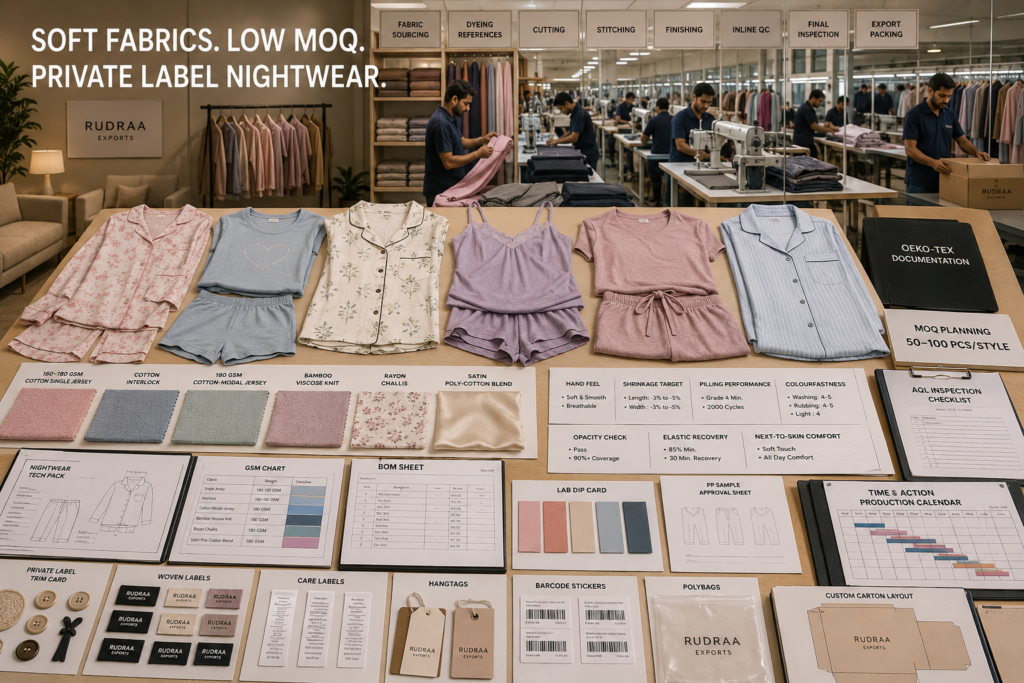
Nightwear is not just basic clothing.
It is worn for long hours, close to the skin, often while sleeping.
That means comfort, softness, breathability, shrinkage control, pilling resistance, colourfastness and safe materials matter more than many first-time buyers realise.
For brands developing sleepwear, loungewear, pajama sets, camisole sets or lounge co-ords, India has become a strong sourcing option.
India gives buyers access to cotton jersey, modal blends, bamboo viscose, interlock, rayon, satin blends, private-label trims, flexible MOQs and export-ready manufacturing systems.
Tirupur is especially useful for nightwear manufacturing because it has a dense knitwear ecosystem with fabric sourcing, dyeing, printing, garmenting, finishing and export packing in one cluster.
At Rudraa Exports, we help apparel brands develop private-label nightwear from India with fabric and GSM planning, sampling support, low-MOQ discussion, trims, labels, packaging, quality checks and export-ready production.
Quick Answer
Nightwear manufacturing in India is a strong option for brands that need soft fabrics, flexible MOQs, private-label packaging and export-quality production. Tirupur is especially suitable for cotton jersey pajama sets, modal sleepwear, bamboo viscose lounge sets, satin blend nightwear and multi-style drops. For a safe first order, brands should start with 1–2 hero styles, choose 1–2 fabrics, approve lab dips and samples, test shrinkage and colourfastness, and run a 300 pcs/style pilot where feasible before scaling.
Looking for a nightwear manufacturer in India? Contact Rudraa Exports and share your product type, fabric preference, GSM target, MOQ and destination market.
Why India Works for Nightwear Manufacturing
India has moved beyond being only a backup sourcing option.
For sleepwear and loungewear brands, India can now support:
- Fabric variety
- Flexible MOQs
- Private-label trims
- Export documentation
- Quality checks
- Soft cotton programs
- Premium modal and bamboo programs
- Scalable repeat production
The uploaded guide explains that India has shifted from a backup option to a primary sourcing hub for sleepwear and loungewear, especially for brands needing flexible MOQs, fabric variety and export-grade compliance.
Why Tirupur Is Important
Tirupur is a major knitwear production cluster.
For nightwear, this matters because many sleepwear products are made from knitted fabrics such as:
- Cotton single jersey
- Cotton interlock
- Cotton-modal jersey
- Bamboo viscose knit
- Stretch jersey
- Rib trims
- Soft lounge knits
The uploaded source highlights Tirupur’s knit supply chain and sustainability infrastructure as important advantages for nightwear and loungewear production.
India Direct Factory vs Agent Sourcing vs Other Regions
Brands usually compare three sourcing routes:
- India direct factory
- India through agent or trader
- Other high-volume regions
The uploaded guide compares these options across MOQ, cost structure, fabric ecosystem, quality control, compliance readiness, lead times, cluster advantages and private-label depth.
Quick Comparison
| Criteria | India Direct Factory | India via Agent | Other Regions |
|---|---|---|---|
| Best for | Control and agility | Done-for-you coordination | Very large standardised programs |
| MOQ | Flexible pilot discussion | Often bundled | Usually higher |
| Cost | Fewer middle layers | Agent margin added | Competitive at scale |
| Fabric access | Strong knits and blends | Depends on agent network | Strong but less flexible |
| Quality control | Direct QA | Filtered communication | Strong at top factories |
| Compliance | Easier documentation alignment | Fragmented documents possible | Varies |
| Communication | Direct with factory | Through middle layer | Varies |
| Private label | Strong trims and packaging options | Offered but diluted | Often requires higher volume |
Key Takeaway
If your brand depends on hand feel, fit, packaging and fast sampling corrections, direct factory sourcing is usually better than agent-led sourcing.
The uploaded source says direct nightwear manufacturing in India can reduce revision cycles compared with agent sourcing when fabric hand-feel, fit and packaging are important.
What Makes Nightwear Different from Basic Apparel?
Nightwear has a different quality expectation.
Customers want it to feel soft, breathable and comfortable for long wear.
Nightwear Must Control
- Hand feel
- Breathability
- Shrinkage
- Pilling
- Colourfastness
- Waistband comfort
- Seam softness
- Skin safety
- Drape
- Opacity
- Wash durability
- Label comfort
Common Customer Complaints
- Fabric feels rough
- Pajama set shrinks
- Waist elastic twists
- Fabric pills quickly
- Colour bleeds
- Seams feel scratchy
- Fabric becomes transparent
- Fit changes after washing
- Labels irritate skin
A good nightwear manufacturer must control fabric, sewing, finishing and testing together.
Best Fabrics for Nightwear Manufacturing in India
Fabric is the most important decision in nightwear.
The uploaded guide gives a practical nightwear fabric and GSM chart covering cotton single jersey, cotton interlock, cotton-modal, bamboo viscose, satin poly-cotton and rayon.
1. Cotton Single Jersey
Best for:
- Summer pajama sets
- Tee-and-short sets
- Breathable sleepwear basics
- Lightweight lounge tops
Typical GSM
160–180 GSM
The uploaded source identifies 160–180 GSM cotton single jersey as a common choice for breathable nightwear basics.
Benefits
- Breathable
- Soft
- Familiar to customers
- Cost-effective
- Good for daily sleepwear
- Easy to develop in multiple colours
2. Cotton Interlock
Best for:
- Winter pajama sets
- More opaque nightwear
- Smoother sleepwear tops
- Slightly warmer lounge sets
Typical GSM
150–250 GSM
The uploaded guide lists cotton interlock in the 150–250 GSM range for winter sets, opacity and smoother face.
Benefits
- Smoother hand feel
- More stable structure
- Better opacity
- Warmer than single jersey
- Suitable for premium basics
3. Cotton-Modal Jersey
Best for:
- Premium nightwear
- Soft lounge co-ords
- Drape sleepwear
- Women’s pajama sets
- Premium basics
Typical GSM
110–240 GSM, often around 180 GSM
The uploaded source notes that cotton-modal jersey is often used around 180 GSM for premium softness and drape.
Benefits
- Soft touch
- Better drape
- Premium feel
- Comfortable for long wear
- Good for upgrade capsules
Buyer Tip
Cotton-modal is useful when the brand wants a softer, more premium product without changing the basic silhouette.
4. Bamboo Viscose Knit
Best for:
- Premium soft sleepwear
- Moisture-wicking positioning
- Cool-touch lounge sets
- DTC premium nightwear brands
Typical Direction
Around 180 GSM is common depending on spec and finish.
The uploaded guide notes bamboo viscose knit around 180 GSM as a common premium option for soft and moisture-wicking positioning.
Buyer Checks
Before using bamboo viscose, confirm:
- Shrinkage
- Pilling
- Colourfastness
- Hand feel after wash
- Fabric stability
- Supplier documentation
- Claims support
5. Satin Poly-Cotton Blends
Best for:
- Silky-look sets
- Giftable nightwear
- Bridal sleepwear
- Premium presentation SKUs
- Lightweight lounge sets
GSM Direction
100–150 GSM for light satin
150–200 GSM for medium satin
The uploaded source lists satin poly-cotton blend GSM ranges for light and medium silky-look nightwear.
Buyer Checks
For satin programs, ask about:
- Snag resistance
- Seam slippage
- Stitching method
- Washing instructions
- Shine consistency
- Colourfastness
- Drape
6. Rayon Challis
Best for:
- Lightweight lounge sets
- Warm-weather nightwear
- Soft drape pieces
- Relaxed pajama pants
- Sleep shirts
Typical Direction
Around 155 GSM
The uploaded guide includes rayon options for lightweight drape and warm-weather lounge programs.
GSM Guide for Nightwear
GSM means grams per square metre.
For nightwear, GSM affects:
- Weight
- Breathability
- Opacity
- Warmth
- Drape
- Cost
- Drying time
Practical Nightwear GSM Table
| Product Type | Fabric Direction | GSM Direction |
|---|---|---|
| Summer tee-and-short set | Cotton single jersey | 160–180 GSM |
| Winter pajama set | Cotton interlock | 180–250 GSM |
| Premium soft set | Cotton-modal jersey | Around 180 GSM |
| Cool-touch lounge set | Bamboo viscose knit | Around 180 GSM |
| Silky-look set | Satin poly-cotton | 100–200 GSM |
| Lightweight lounge pant | Rayon challis | Around 155 GSM |
GSM Rule
Higher GSM does not always mean better nightwear.
Choose GSM based on:
- Climate
- Product type
- Drape
- Opacity
- Retail price
- Customer comfort
- Fabric composition
- Wash behaviour
Quality Specs to Lock Early
Nightwear quality should be defined before sampling.
Must-Have Quality Specs
| Spec | Why It Matters |
|---|---|
| GSM | Controls weight and feel |
| Shrinkage | Protects fit after washing |
| Pilling | Protects long-term appearance |
| Colourfastness | Prevents bleeding or fading |
| Elastic recovery | Prevents waistband failure |
| Seam softness | Improves comfort |
| Label placement | Avoids skin irritation |
| Fabric hand feel | Defines brand experience |
| Wash performance | Protects customer satisfaction |
The uploaded guide recommends locking shrinkage targets, pilling performance, colourfastness and elastic recovery early to avoid rework.
Compliance: Why OEKO-TEX Matters for Nightwear
Nightwear is worn close to skin for many hours.
That makes chemical safety important.
The uploaded guide explains that OEKO-TEX Standard 100 is one of the recognised textile product safety standards and is relevant for next-to-skin garments such as nightwear.
Why Brands Ask for OEKO-TEX
OEKO-TEX support can help with:
- Supplier onboarding
- Material approval
- Restricted substance checks
- Retail compliance reviews
- Customer trust
- Skin-safe product claims
Compliance Checklist
Ask suppliers for:
- OEKO-TEX documentation where required
- Restricted substance declaration
- Fabric composition proof
- Colourfastness records
- Shrinkage records
- Traceability by lot
- Subcontracting clarity
- Final inspection report
The uploaded source recommends putting OEKO-TEX or equivalent chemical compliance into the vendor checklist and requiring documentation before bulk.
MOQ for Private-Label Nightwear
MOQs depend on fabric, colour count, trims, printing, packaging and style complexity.
The uploaded guide notes that direct factory nightwear programs can often support 300 pcs/style pilot orders for startups, with scalability into larger quantities.
Low MOQ Works Best When
- Fabric is available
- Colour count is limited
- Trim choices are standardised
- Packaging is simple
- Tech pack is clear
- Buyer approves quickly
- Same fabric is used across styles
Low MOQ Becomes Harder When
- Every colour is custom dyed
- Fabric is custom developed
- Many prints are needed
- Labels are complex
- Packaging is fully customised
- Each style uses different trims
- Pattern changes continue after sampling
Better First Pilot
Instead of:
- 6 styles
- 5 colours each
- 4 fabrics
- Full custom packaging
Start with:
- 2 hero silhouettes
- 1–2 fabrics
- 2–3 colours
- Standardised trims
- 300 pcs/style where feasible
Private Label Options for Nightwear
Private-label nightwear can include:
- Main label
- Size label
- Care label
- Hangtag
- Barcode sticker
- Polybag
- Custom carton
- Tissue wrap
- Brand card
- Gift packaging
- Embroidery
- Elastic branding
- Drawcord branding
The uploaded guide highlights private-label depth such as labels, washes, hangtags, barcode stickers and custom packaging.
Private Label Checklist
| Item | Check |
|---|---|
| Main label | Material and placement |
| Size label | Size system |
| Care label | Fibre and washing instructions |
| Hangtag | Brand and product information |
| Barcode | SKU and retail system |
| Polybag | Size and warning text |
| Carton | Packing ratio and markings |
| Gift pack | Optional for premium lines |
Lead Times for Nightwear Manufacturing in India
Lead time depends on fabric, sampling, print, dyeing, trims, approvals and order size.
Practical Timeline
| Stage | Timeline Direction |
|---|---|
| Tech pack review and pattern | 3–7 days |
| Proto sample | 7–14 days |
| Fit revisions | 7–10 days per round |
| PP sample | 7–14 days |
| Bulk production | 30–60 days |
The uploaded source provides these typical nightwear development and production timing ranges.
Lead-Time Rule
Do not plan only from production start date.
Total lead time includes:
- Tech pack review
- Pattern
- Fabric sourcing
- Lab dips
- Proto sample
- Fit sample
- PP sample
- Buyer approval
- Bulk fabric
- Cutting
- Sewing
- Finishing
- QC
- Packing
- Shipping
How to Reduce Lead-Time Risk
Do This Early
- Approve lab dips before bulk
- Approve print strike-offs
- Standardise elastic widths
- Standardise label sizes
- Reuse trims across styles
- Reserve fabric in advance
- Build a T&A plan
- Keep two sample iterations in the calendar
The uploaded guide recommends pre-approving lab dips and print strike-offs, standardising trims and building a time-and-action plan tied to approvals.
Fit / Fit-Not Guide
India Direct Sourcing Is a Strong Fit If
- You run multi-style sleepwear drops
- You need low-MOQ pilots
- You want cotton, modal or bamboo fabric options
- You need private-label trims and packaging
- You value direct factory communication
- You want Tirupur knitwear expertise
- You need export-ready documentation
- You want to scale after pilot success
The uploaded source says India direct sourcing is a strong fit for multi-style drops, fabric hand-feel-focused brands, export-ready production and private-label packaging.
India May Not Be Ideal If
- You only buy one SKU at very high volume
- You need ultra-specialised proprietary synthetics
- Your team cannot manage approvals
- You need a fully managed sourcing office
- Your product needs extreme embellishment or handwork
The uploaded guide lists these fit-not scenarios where India direct sourcing may not be the best model.
Migration Plan: Moving to Direct-Factory Nightwear Production in India
Step 1: Define SKU Architecture
Choose 2–3 hero silhouettes.
Examples:
- Tee and short set
- Button top and pant set
- Cami set
- Sleep shirt
- Lounge co-ord
The uploaded guide recommends starting by defining SKU architecture with a few hero silhouettes before selecting fabric.
Step 2: Build a Fabric Matrix
Request:
- 160–180 GSM cotton single jersey
- Around 180 GSM cotton-modal jersey
- Around 180 GSM bamboo viscose
- 120–150 GSM satin blend
- Cotton interlock option
The uploaded source recommends a controlled fabric matrix using cotton jersey, cotton-modal, bamboo viscose and satin blend options.
Step 3: Run Sampling Sprint
Develop:
- Proto sample
- Fit sample
- PP sample
- Lab dip approval
- Print strike-off approval
- Fit comments
- Measurement review
Step 4: Lock Compliance and Packaging
Confirm:
- OEKO-TEX expectation where relevant
- Restricted substances requirements
- Care label content
- Barcode sticker
- Polybag
- Hangtag
- Carton layout
- DTC vs wholesale packaging needs
The uploaded guide recommends locking OEKO-TEX expectations, labels, care content, barcode stickers and packaging before pilot production.
Step 5: Pilot Order
Start with:
- 1–2 fabrics
- 2–3 colours
- 300 pcs/style where feasible
- Controlled size range
- Standard trims
Use the pilot to check:
- Fit
- Defect rate
- Shrinkage
- Pilling
- Colourfastness
- Wash performance
- Packaging
- Customer response
The uploaded guide recommends treating the pilot as a process audit, not a profit event.
Step 6: Scale With Repeatable Controls
After the pilot:
- Pre-book core fabrics
- Standardise trims
- Build reorder calendar
- Use T&A plan
- Track defect rate
- Track measurement tolerance
- Keep reference hanger swatches
- Plan bulk shade continuity
The uploaded source recommends scaling with repeatable controls, pre-booked fabrics, standard trims and a production calendar.
Nightwear Manufacturing Checklist
| # | Checkpoint |
|---|---|
| 1 | Product category selected |
| 2 | Hero silhouettes defined |
| 3 | Fabric type selected |
| 4 | GSM range defined |
| 5 | Shrinkage target set |
| 6 | Pilling requirement set |
| 7 | Colourfastness requirement set |
| 8 | Elastic recovery checked |
| 9 | Seam softness reviewed |
| 10 | Tech pack prepared |
| 11 | BOM prepared |
| 12 | MOQ per style planned |
| 13 | Lab dips planned |
| 14 | Print strike-offs planned |
| 15 | Proto sample planned |
| 16 | Fit sample planned |
| 17 | PP sample required |
| 18 | OEKO-TEX expectation checked |
| 19 | Private-label packaging defined |
| 20 | T&A plan prepared |
How Rudraa Exports Supports Nightwear Manufacturing
Rudraa Exports supports private-label nightwear and sleepwear production from Tirupur, India.
Rudraa Support Includes
- Product brief review
- Nightwear tech-pack review
- Fabric sourcing
- GSM planning
- Cotton single jersey options
- Cotton interlock options
- Cotton-modal jersey discussion
- Bamboo viscose discussion
- Satin blend discussion
- Rayon lounge fabric discussion
- Lab dip coordination
- Print strike-off coordination
- Sampling support
- Fit sample support
- PP sample approval
- Low-MOQ pilot discussion
- Private-label trims
- Labels and hangtags
- Barcode stickers
- Polybag and carton planning
- Shrinkage review
- Pilling review
- Colourfastness review
- AQL inspection support
- Export packing
- Repeat production planning
Products Supported
- Women’s pajama sets
- Men’s pajama sets
- Tee-and-short sets
- Button top-and-pant sets
- Cami sets
- Lounge co-ords
- Sleep shirts
- Night dresses
- Robes where applicable
- Cotton jersey sleepwear
- Modal sleepwear
- Bamboo viscose loungewear
- Satin-look nightwear
Why Rudraa Fits Private-Label Nightwear Brands
Rudraa is a strong fit for brands that need:
- Tirupur knitwear expertise
- Direct factory communication
- Low-MOQ pilot discussion
- Fabric and GSM options
- Private-label trims and packaging
- Export-ready documentation
- Traceability-driven production
- Repeat quality controls
- Scale after pilot success
The uploaded guide positions Rudraa Exports for brands seeking direct control, 72,000 units/month capacity, ISO-aligned systems, traceability-led execution and cost efficiency compared with layered sourcing.
Ready to develop private-label nightwear from India? Speak with Rudraa Exports and share your product type, fabric choice, GSM target, colour count, MOQ and destination.
FAQ: Nightwear Manufacturing in India
1. Is India good for nightwear manufacturing?
Yes. India is a strong option for nightwear manufacturing because of its fabric variety, flexible MOQs, knitwear ecosystem, private-label trims and export-ready production.
2. Why is Tirupur suitable for nightwear?
Tirupur has a strong knitwear supply chain with fabric sourcing, dyeing, stitching, finishing, QC and export packing support.
3. What fabrics are best for nightwear?
Common nightwear fabrics include cotton single jersey, cotton interlock, cotton-modal jersey, bamboo viscose knit, satin poly-cotton blends and rayon.
4. What GSM is good for nightwear?
Summer cotton jersey sets often use 160–180 GSM, while cotton-modal and bamboo viscose premium sets often use around 180 GSM.
5. What MOQ can I expect for private-label nightwear?
MOQ depends on fabric, colour and complexity, but 300 pcs/style may be workable for suitable pilot programs.
6. What should I test before bulk?
Test shrinkage, pilling, colourfastness, elastic recovery, wash performance and fabric hand feel before bulk production.
7. Why does OEKO-TEX matter for nightwear?
Nightwear is worn close to skin for long hours, so chemical safety documentation such as OEKO-TEX can support buyer and retailer confidence.
8. Can Rudraa Exports make private-label nightwear?
Yes. Rudraa can support private-label nightwear with fabric sourcing, sampling, labels, hangtags, packaging, QC and export packing.
9. How long does nightwear sampling take?
Sampling timelines vary, but tech pack review, proto, fit and PP stages should be planned with enough time for feedback and revision.
10. Should I start with many fabrics?
No. For a first pilot, start with one or two fabrics and two or three colours to reduce development and MOQ risk.
11. What private-label options are available?
Private-label options can include woven labels, care labels, hangtags, barcode stickers, polybags, custom cartons and gift packaging.
12. What should I send Rudraa for a quote?
Send your tech pack, reference images, fabric preference, GSM target, colour count, size range, MOQ, packaging needs and destination market.
Conclusion
Nightwear manufacturing in India is a practical option for brands that want fabric variety, soft hand feel, low-MOQ pilots and export-ready private-label production.
But nightwear needs careful development.
The fabric must feel soft on skin. The garment must not shrink badly after wash. Colours must not bleed. Waistbands must remain comfortable. Labels must not irritate. Packaging must match the brand experience.
Tirupur gives buyers a strong ecosystem for sleepwear and loungewear because fabric, dyeing, printing, garmenting, finishing and export packing sit close together.
For a safe first order, start with a few hero silhouettes, build a fabric matrix, run sampling properly, lock compliance and packaging, then launch a controlled pilot before scaling.
Rudraa Exports helps brands develop nightwear from India with fabric sourcing, GSM planning, private-label trims, low-MOQ discussion, sampling, QC and export packing support.
Visit rudraaexports.com or contact the Rudraa Exports team to request a custom quote for your private-label nightwear program.
Related reading
Women’s Clothing Manufacturer in India: Leggings, Nightwear and Casual Wear Sourcing Guide
Custom Activewear and Sportswear Manufacturing in India: Complete Buyer’s Guide
Leggings Manufacturing in India: Fabric, GSM, MOQ and Private Label Guide