
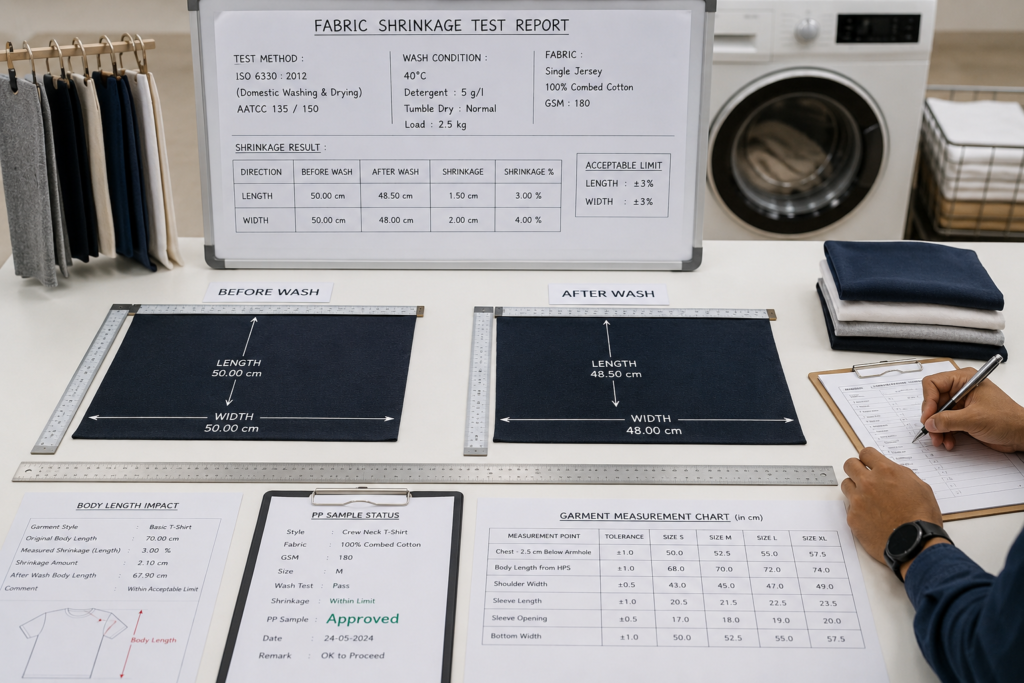
If you are building an apparel brand, you will eventually receive a fabric test report from a mill, factory or lab.
The report may look technical.
It may include numbers, percentages, grades, test methods, lot numbers and lab stamps.
But the real question is simple:
Can this fabric be approved for bulk production, or will it create returns, complaints and margin loss later?
Learning how to read a fabric test report helps you avoid poor fabric decisions before cutting starts.
A proper report can tell you whether the fabric weight is correct, whether the garment may shrink, whether the colour may fade or bleed, whether the surface may pill and whether the fabric is strong enough for the product category.
At Rudraa Exports, we help apparel brands review fabric reports, test core fabric performance, match results with bulk lots and make production decisions using clear quality-control systems instead of guesswork.
Quick Answer
To read a fabric test report, first verify the report identity, lab name, test method, sample ID, lot number and date. Then check the key performance results: GSM for fabric weight, shrinkage percentage for fit risk, colourfastness grades for fading or bleeding, pilling grade for surface durability and tensile or tear strength where durability matters. Do not approve bulk fabric if the report has no method, no lot reference, unclear wash conditions or perfect-looking results that cannot be traced to the actual production fabric.
Need help reviewing a fabric report before bulk? Contact Rudraa Exports and share your tech pack, target fabric, GSM, MOQ and report copy.
Why Fabric Test Reports Matter
A fabric may look good in a swatch.
It may feel soft in your hand.
It may even look perfect in a sample.
But after production, washing and customer use, hidden fabric issues can appear.
Common Fabric Problems
- T-shirt becomes too light
- Hoodie shrinks after washing
- Black fabric fades quickly
- Dark colour stains other garments
- Fabric pills after a few wears
- Activewear tears under stress
- Fit changes after laundering
- Bulk fabric differs from sample fabric
The uploaded guide explains that learning how to read fabric reports helps protect margins, prevent complaints and approve bulk production with confidence.
First: Check Whether the Report Is Real
Before interpreting the numbers, check whether the report itself is trustworthy.
A report with missing methods, unclear sample identity or suspicious formatting may not be reliable.
Fabric Report Authenticity Checklist
| What to Check | Reliable | Red Flag |
|---|---|---|
| Lab name | Clear and verifiable | No lab name |
| Lab competence | ISO/IEC 17025 or credible lab context | In-house lab shown like third-party |
| Test method | ISO, AATCC or ASTM method stated | Only pass/fail |
| Sample ID | Lot, batch, composition, colour and date | Generic “cotton fabric” |
| Result format | Units and grades included | Missing units |
| Wash conditions | Program and method shown | “Washed normally” |
| Signature/stamp | Clear and consistent | Cropped, pixelated or repeated |
| Dates | Test timing makes sense | Test date before fabric production |
The uploaded source says buyers should first verify report identity, method and sample ID before interpreting results.
Simple Rule
No method + no lot ID + no conditions = no approval.
The 4 Core Fabric Tests
Most apparel fabric reports include four key tests:
- GSM
- Shrinkage
- Colourfastness
- Pilling
These four tests can prevent many common quality complaints.
The uploaded guide focuses on these four common fabric tests and explains what each one means for brands.
1. GSM: Fabric Weight
GSM means grams per square metre.
It tells you the weight of the fabric.
Higher GSM usually means the fabric is heavier, but heavier does not always mean better.
GSM Affects
- Thickness
- Drape
- Opacity
- Warmth
- Durability
- Cost
- Fit
- Shipping weight
Typical GSM Ranges
| Product | Common GSM Direction |
|---|---|
| Lightweight T-shirt | 120–160 GSM |
| Standard T-shirt | 160–180 GSM |
| Premium T-shirt | 180–220 GSM |
| Activewear | 180–250 GSM |
| Hoodie / sweatshirt | 280–350 GSM |
| Denim | 300+ GSM |
The uploaded guide lists typical garment GSM ranges for T-shirts, activewear, hoodies, sweatshirts and denim.
How to Read GSM on a Report
Look for:
- Specified GSM
- Measured GSM
- Tolerance
- Sample lot
- Colour
- Conditioning notes
GSM Tolerance Example
If you ordered 180 GSM fabric and tolerance is ±5%, the acceptable range is approximately:
171 GSM to 189 GSM
The uploaded source explains that a practical industry tolerance is often around ±5% because yarn variation, moisture, dyeing and finishing can affect weight.
GSM Red Flags
- Measured GSM far below spec
- No target GSM listed
- No tolerance mentioned
- Same exact GSM across all colours and lots
- Report does not mention sample identity
- PP sample and bulk lot do not match
Production Tip
Do not approve fabric only because the GSM is close.
Also check:
- Shrinkage
- Hand feel
- Opacity
- Drape
- Fit sample
- Bulk lot reference
2. Shrinkage: Fit Risk After Washing
Shrinkage tells you how much fabric changes after washing and drying.
It is one of the most important tests for garment fit.
Shrinkage Is Usually Reported As
- Length shrinkage
- Width shrinkage
- Warp or weft shrinkage
- Wales or courses shrinkage
- Percentage change
Negative values usually mean shrinkage.
Positive values may mean growth.
Why Shrinkage Matters
A garment can fit perfectly before washing and become too short, too tight or distorted after washing.
Common Benchmarks
| Fabric Type | Practical Direction |
|---|---|
| Knits | Up to around 5% can be the upper edge |
| Wovens | Usually expected below around 3% |
The uploaded guide explains that knits may tolerate shrinkage up to around 5%, while wovens usually need tighter control.
Example
A T-shirt has a 70 cm body length.
If length shrinkage is 4.5%, the garment may shorten by around 3.1 cm after washing.
That is noticeable to the customer.
What to Check on a Shrinkage Report
- Wash method
- Drying method
- Number of wash cycles
- Length result
- Width result
- Fabric lot
- Colour
- Whether fabric was compacted
- Whether shrinkage was allowed in pattern
The uploaded source says shrinkage without wash and dry conditions is not meaningful because methods such as ISO 6330 and AATCC TM135 define the test conditions.
Shrinkage Red Flags
- Report says “0.00% shrinkage” everywhere
- No wash method stated
- No drying condition stated
- Bulk fabric not linked to tested lot
- Shrinkage result differs from fit sample behaviour
- High shrinkage but no pattern allowance
Production Tip
If shrinkage is close to 5%, treat it as a serious production decision.
Ask whether the fabric is compacted, sanforized where relevant, or relaxed before cutting.
3. Colourfastness: Fading, Bleeding and Staining Risk
Colourfastness tells you whether fabric colour will remain stable.
It checks whether colour may fade, bleed or transfer.
Colourfastness Can Test
- Washing
- Rubbing
- Perspiration
- Water
- Light
- Dry cleaning
- Migration
- Staining on other fabrics
How Colourfastness Is Graded
Most colourfastness tests use a 1 to 5 scale.
| Grade | Meaning |
|---|---|
| 5 | Excellent / no change |
| 4 | Good |
| 3 | Moderate |
| 2 | Poor |
| 1 | Very poor |
The uploaded guide explains that colourfastness grading commonly uses a 1–5 scale, where 5 is best and 1 is worst.
What to Check
A colourfastness report may show:
- Colour change
- Colour staining
- Staining on multifibre fabric
- Wash fastness
- Rubbing fastness
- Perspiration fastness
- Acid perspiration
- Alkali perspiration
Buyer Expectation
Many brands aim for grade 4 or higher for important colourfastness tests.
The uploaded source notes that brands often target grade 4 or above, especially for water-related colourfastness tests.
Example
Dark T-shirt wash fastness:
- Colour change: 3–4
- Staining: 4–5
This may be acceptable for some categories, but repeated fading may still affect black or navy essentials.
Activewear Warning
For activewear, perspiration and rubbing matter heavily because the garment is exposed to sweat and movement.
A perspiration staining grade of 3 may be risky.
Colourfastness Red Flags
- Only one general pass/fail result
- No exposure type shown
- No staining result
- No colour change result
- Activewear tested only for washing, not perspiration
- Dark colours with low rubbing fastness
- Report grades all 5 across every test without explanation
4. Pilling: Surface Durability
Pilling means small fuzz balls forming on the fabric surface.
It makes a garment look old quickly even if the garment is still wearable.
Pilling Affects
- Customer perception
- Repeat purchase
- Reviews
- Premium feel
- Return rate
- Long-term appearance
Pilling Grade Scale
| Grade | Meaning |
|---|---|
| 5 | No pilling |
| 4–5 | Strong performance |
| 3–4 | Often acceptable for some fashion items |
| 3 or below | Risk for essentials and premium products |
| 1 | Severe pilling |
The uploaded guide explains that pilling reports commonly use a 1–5 grade scale and that lower grades create perceived-quality risk.
Product Examples
Brushed Fleece Hoodie
Pilling grade: 3
This may be risky for a premium hoodie because brushed fleece can pill if yarn, brushing or finishing are not controlled.
Poly-Cotton Jersey Tee
Pilling grade: 4–5
This is usually safer for a core tee line when colourfastness and shrinkage are also acceptable.
Pilling Red Flags
- Grade 3 or below for premium essentials
- No method listed
- No test cycle details
- No fabric lot traceability
- Result does not match hand-feel after wear trial
Production Tip
For premium products, check pilling before bulk.
A garment that pills quickly can damage the brand even if stitching is correct.
Tensile Strength and Tear Resistance
Tensile and tear tests are especially useful for:
- Activewear
- Workwear
- Uniforms
- Denim
- Bottoms
- Performance clothing
- Kidswear
What Tensile Strength Means
Tensile strength tells you how much force fabric can take before breaking.
It is often reported in Newtons.
What Tear Resistance Means
Tear resistance tells you how well fabric stops a small tear from spreading.
What to Check
- Warp and weft values
- Wales and courses values
- Maximum force
- Elongation
- Directional imbalance
- Seam performance where relevant
The uploaded guide explains that tensile and tear results are relevant when durability issues could lead to seam bursts, rips and returns.
Example
If a woven active short fabric shows:
- Warp tensile: 700 N
- Weft tensile: 350 N
This is not automatically bad, but it shows the fabric is stronger in one direction than another.
Pattern placement and stress points must be considered.
How to Spot Fake or Manipulated Fabric Reports
A report can look official and still be unreliable.
Document Red Flags
- No lab name
- No test method
- No sample ID
- No lot number
- No colour code
- Missing page numbers
- Cropped stamp
- Pixelated logo
- Mismatched fonts
- Repeated signature image
- All perfect ratings
- Test date before fabric production date
- Lot number does not match invoice or roll label
The uploaded source lists missing methods, missing wash programs, perfect-looking results and lot mismatches as warning signs of unreliable reports.
Verification Steps
- Check the method names
- Match lot number to PO and roll label
- Confirm composition and colour code
- Ask whether the lab is independent
- Request original report if needed
- Compare sample receipt date and production date
- Check whether test conditions are stated
- Confirm results with PP sample behaviour
Test Methods You May See
A reliable report should show recognised method names.
Common Test Methods
| Test | Common Standards Mentioned |
|---|---|
| Shrinkage | ISO 6330, AATCC TM135 |
| Colourfastness | ISO 105 series, AATCC 61 |
| Pilling | ISO 12945, ASTM D3512 |
| Tensile strength | ISO 13934 |
| Tear resistance | ISO 13937 |
The uploaded guide says credible reports should clearly state method names such as ISO, AATCC or ASTM methods.
Why Method Matters
Without the method, you cannot compare results.
For example, “washed normally” is not enough.
You need to know:
- Wash temperature
- Drying method
- Number of cycles
- Test standard
- Evaluation scale
Certifications and Lab Competence
Certifications do not replace test results.
But they improve trust.
ISO/IEC 17025
ISO/IEC 17025 is used for testing laboratory competence.
A report from an ISO/IEC 17025-accredited lab is generally more trustworthy because the lab is assessed for technical competence and traceable results.
The uploaded guide identifies ISO/IEC 17025 lab competence as a key signal for credible fabric reports.
OEKO-TEX
OEKO-TEX is relevant for harmful-substance testing and chemical safety.
It helps with product safety confidence but does not replace performance testing.
ISO 9001
ISO 9001 relates to quality management systems.
It shows that the supplier has structured processes, but buyers should still request fabric performance reports.
Important Difference
| Area | What It Proves |
|---|---|
| GSM / shrinkage / pilling report | Fabric performance |
| OEKO-TEX | Chemical safety support |
| ISO 9001 | Quality management process |
| ISO/IEC 17025 | Lab competence |
The uploaded source recommends separating performance testing from chemical and safety compliance because they solve different problems.
Fabric Report Approval Checklist
Before approving bulk fabric, check:
| # | Checkpoint |
|---|---|
| 1 | Lab name present |
| 2 | Lab competence clear |
| 3 | Test method listed |
| 4 | Test conditions stated |
| 5 | Fabric composition shown |
| 6 | GSM target shown |
| 7 | Measured GSM within tolerance |
| 8 | Shrinkage acceptable |
| 9 | Wash method stated |
| 10 | Colourfastness exposure stated |
| 11 | Colour change grade acceptable |
| 12 | Staining grade acceptable |
| 13 | Pilling grade acceptable |
| 14 | Tensile / tear checked if needed |
| 15 | Lot number shown |
| 16 | Colour code shown |
| 17 | Report date makes sense |
| 18 | Stamp and signature look consistent |
| 19 | Report lot matches PP sample |
| 20 | Report lot matches bulk roll labels |
Migration Plan: From Unclear Reports to Tested Production
Step 1: Define Must-Hit Specs
For each product, define:
- GSM range
- Shrinkage cap
- Pilling minimum grade
- Colourfastness target
- Tensile or tear strength where needed
The uploaded guide recommends defining must-hit specs per product before testing, such as GSM range, shrinkage cap and pilling minimum grade.
Step 2: Align Test Methods
Choose test methods before sampling.
Examples:
- Shrinkage: ISO 6330 or AATCC TM135
- Colourfastness: ISO 105 or AATCC 61
- Pilling: ISO 12945 or ASTM D3512
Step 3: Test the Actual Bulk-Intended Lot
Do not approve bulk using an old reference report.
Test the fabric lot intended for production.
The uploaded source warns buyers not to approve based on a different season’s reference report.
Step 4: Set Acceptance Rules
Example acceptance rules:
- GSM within ±5%
- Knit shrinkage not above around 5%
- Colourfastness grade 4 or above for key exposures
- Pilling grade 4 or above for premium essentials
Step 5: Lock Traceability
Match:
- Report lot number
- PO
- Roll label
- Invoice
- PP sample
- Bulk fabric
The uploaded guide says lot numbers on the report should match PO, invoice and roll labels.
How Rudraa Exports Supports Fabric Testing
Rudraa Exports treats testing as a buyer decision tool, not a formality.
Rudraa Support Includes
- Fabric report review
- GSM verification
- Shrinkage review
- Colourfastness review
- Pilling review
- Tensile and tear discussion where needed
- Lot traceability
- PP sample alignment
- Bulk fabric verification
- Recognised method-based reporting
- ISO/IEC 17025 lab ecosystem support where relevant
- ISO 9001:2015 quality management system
- OEKO-TEX-aligned options where required
- Buyer-friendly report explanation
The uploaded source explains that Rudraa supports buyers with clear lab documentation for GSM, shrinkage, colourfastness and pilling using recognised methods where applicable.
What a Good Report Pack Should Include
- Fabric ID
- Composition
- Construction
- Lot number
- Colour
- Buyer spec
- Sample receipt date
- Test method
- Conditions
- Results
- Units or grades
- Acceptance reference
- Authorised sign-off
- Lab stamp
- Traceability details
Why This Helps Brands
A transparent report pack helps you:
- Approve fabric faster
- Avoid bulk surprises
- Reduce returns
- Reduce quality disputes
- Improve customer satisfaction
- Build repeat production consistency
Ready to test before you approve bulk? Speak with Rudraa Exports and share your product type, fabric spec, target GSM, MOQ and testing requirements.
FAQ: How to Read a Fabric Test Report
1. What is a fabric test report?
A fabric test report is a document that shows measured fabric performance results such as GSM, shrinkage, colourfastness, pilling, tensile strength and tear resistance.
2. What does GSM mean?
GSM means grams per square metre. It tells you the fabric weight and affects thickness, drape, opacity, warmth, durability and cost.
3. What GSM is good for T-shirts?
T-shirts often range from 120–180 GSM, while premium T-shirts may use 180–220 GSM depending on brand positioning.
4. What is acceptable GSM tolerance?
A practical tolerance is often around ±5%, but the exact tolerance should be agreed in the tech pack and PO.
5. What does shrinkage mean?
Shrinkage shows how much fabric changes after washing and drying. It is usually shown as a percentage in length and width directions.
6. What shrinkage is acceptable for knits?
Knits often need to stay under around 5% shrinkage, but premium or fitted garments may need stricter limits.
7. What is colourfastness?
Colourfastness measures whether fabric colour fades, bleeds or stains other materials during washing, rubbing, perspiration or other exposure.
8. What colourfastness grade is good?
Many brands target grade 4 or above for key colourfastness exposures, especially for water-related and dark-colour products.
9. What is pilling?
Pilling is the formation of small fuzz balls on the fabric surface due to abrasion. It affects the garment’s long-term appearance.
10. What pilling grade is good?
Grade 4–5 is strong. Grade 3 may be risky for premium essentials, especially if the garment is expected to last.
11. How can I spot a fake fabric report?
Watch for missing lab name, no test method, no lot number, no wash conditions, cropped stamps, mismatched fonts or all-perfect results across every test.
12. Can Rudraa Exports help review fabric reports?
Yes. Rudraa can help review fabric reports, verify lot references, interpret GSM, shrinkage, colourfastness and pilling results, and align testing with bulk production.
Conclusion
Learning how to read a fabric test report is one of the most useful skills for an apparel brand.
GSM tells you the fabric weight.
Shrinkage tells you the fit risk after washing.
Colourfastness tells you whether the colour may fade, bleed or stain.
Pilling tells you whether the garment may look old too quickly.
Tensile and tear strength help when durability matters.
But numbers alone are not enough.
A reliable report must have a lab name, test method, sample ID, lot number, test conditions, clear units, ratings and traceability to the actual fabric used in production.
Rudraa Exports helps brands review fabric testing, verify bulk fabric performance and approve production with confidence through structured QC, traceability and transparent documentation.
Visit rudraaexports.com or contact the Rudraa Exports team to request fabric testing support for your next bulk garment program.
Related reading
How to Avoid Apparel Production Nightmares: A Startup Guide for 2026
How to Get Samples from a Garment Manufacturer in India: Step-by-Step Buyer Guide
How to Handle a Failed Garment Shipment: Disputes, Claims and Resolution Guide