
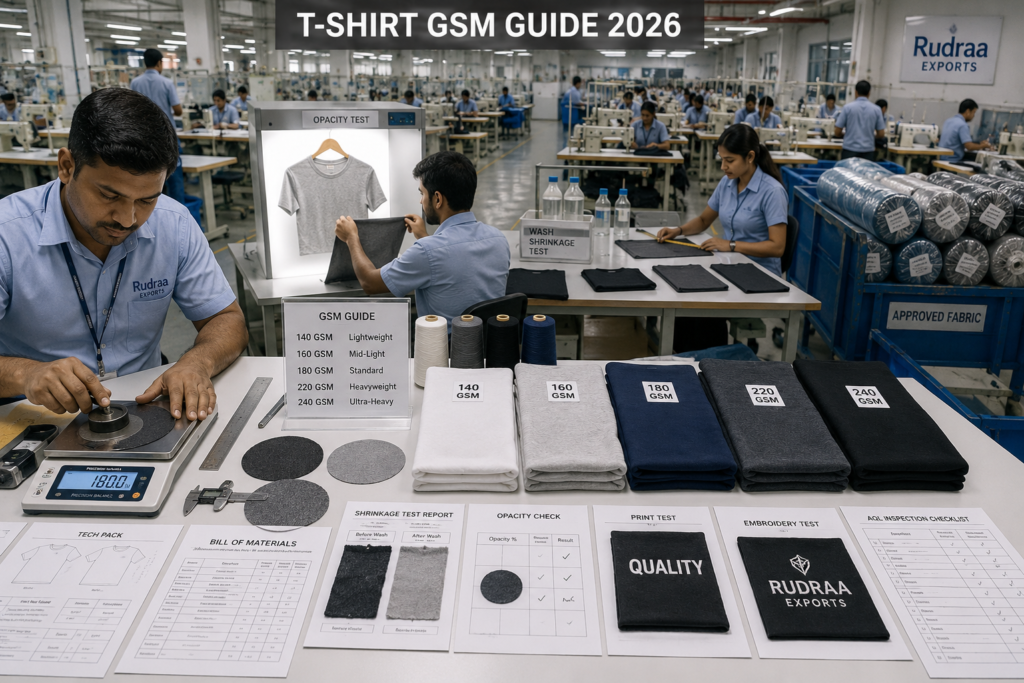
GSM is one of the most common terms you will hear when sourcing T-shirts.
But many buyers misunderstand it.
Some buyers think higher GSM always means better quality. Some think GSM means thickness. Some assume a 200 GSM T-shirt will automatically feel premium. But that is not always true.
GSM means grams per square metre. It tells you the weight of the fabric, not the full quality of the T-shirt.
A 180 GSM T-shirt can feel soft, stiff, thin, smooth, rough, premium, or average depending on the yarn, knit structure, finishing, dyeing, compacting, and fabric processing. That is why GSM should always be judged with fabric composition, handfeel, opacity, shrinkage, print method, and final use.
At Rudraa Exports, we help global buyers choose the right GSM for T-shirts, polos, uniforms, promotional apparel, corporate wear, streetwear, kidswear, and private-label knitwear from Tirupur, India.
Quick Answer
GSM in T-shirts means grams per square metre. It measures fabric weight, not quality by itself. Lightweight T-shirts usually fall around 120–150 GSM, mid-weight T-shirts around 150–180 GSM, heavyweight T-shirts around 180–220 GSM, and ultra-heavy streetwear T-shirts can go above 230 GSM. The best GSM depends on climate, use case, target price, fabric type, print method, opacity requirement, and brand positioning. Buyers should specify GSM with tolerance, fabric stage, and test method in the tech pack.
Planning to develop T-shirts with the right GSM? Contact Rudraa Exports to request GSM swatches and a T-shirt sourcing recommendation.
👉 Compare weights visually: Use our interactive T-Shirt GSM Guide & Comparison tool to feel the difference between 160, 180, 200 and 240 GSM and get a recommended GSM band for your program in seconds.
What Does GSM Mean in T-Shirts?
GSM stands for grams per square metre.
It measures how much one square metre of fabric weighs.
For example:
- 140 GSM means one square metre of fabric weighs 140 grams
- 180 GSM means one square metre of fabric weighs 180 grams
- 220 GSM means one square metre of fabric weighs 220 grams
Higher GSM usually means the fabric is heavier and denser, but it does not automatically mean the fabric is softer, better, or more premium.
Simple Explanation
| GSM | Meaning |
|---|---|
| Low GSM | Lighter fabric |
| Medium GSM | Balanced everyday fabric |
| High GSM | Heavier and more structured fabric |
GSM is one important specification, but it is not the whole story.
GSM Is Not the Same as Quality
This is the biggest mistake buyers make.
A higher GSM T-shirt can still feel bad if the yarn is poor, the knitting is uneven, or the finishing is harsh.
A lower GSM T-shirt can still feel premium if it uses high-quality combed cotton, good yarn, compact knitting, and soft finishing.
GSM vs Quality
| Factor | What It Affects |
| GSM | Fabric weight |
| Yarn quality | Softness and strength |
| Knit structure | Stretch, drape, and stability |
| Fibre composition | Breathability, shrinkage, and feel |
| Finishing | Smoothness, softness, and handfeel |
| Dyeing | Colour depth and shade consistency |
| Compacting | Shrinkage and dimensional stability |
So, do not ask only, “What GSM is this T-shirt?”
Ask, “What GSM, what yarn, what fabric construction, what finish, and what shrinkage control?”
Common T-Shirt GSM Ranges
Most T-shirts fall into four broad GSM categories.
Prefer to compare interactively? Try our T-Shirt GSM Guide & Comparison tool to see how 160, 180, 200 and 240 GSM feel side by side, weigh up cost and opacity, and get a recommended GSM band for your exact use case.
GSM Comparison Table
| GSM Band | Typical Range | Feel | Best For |
| Lightweight | 120–150 GSM | Airy, soft, lighter drape | Promo tees, summer wear, event T-shirts |
| Mid-weight | 150–180 GSM | Balanced, everyday feel | Retail basics, corporate tees, DTC brands |
| Heavyweight | 180–220 GSM | Dense, structured, premium feel | Workwear, premium basics, uniforms |
| Ultra-heavy | 230–260+ GSM | Very structured and boxy | Streetwear, winter capsules, statement basics |
The uploaded source groups common T-shirt jersey ranges into lightweight, core mid-weight, heavyweight, and ultra-heavy bands, with 150–180 GSM described as a strong everyday range.
Lightweight T-Shirts: 120–150 GSM
Lightweight T-shirts are soft, airy, and breathable.
They are good for hot climates, promotional campaigns, events, inner layers, and cost-sensitive orders.
Best Use Cases
- Summer T-shirts
- Event T-shirts
- Promotional T-shirts
- Giveaway apparel
- Inner-layer tees
- Budget retail basics
- Hot and humid markets
Advantages
- Lower fabric cost
- Lower shipping weight
- Comfortable in hot weather
- Good for high-volume promo programs
- Easier for one-day or short-term use cases
Limitations
- Can look transparent in white or light colours
- May feel too thin for premium buyers
- Less structured silhouette
- Embroidery may pucker if fabric is unstable
- Large prints may affect handfeel
Buyer Tip
Use lightweight GSM when price and breathability matter more than premium structure.
Mid-Weight T-Shirts: 150–180 GSM
Mid-weight T-shirts are the safest choice for many buyers.
They balance cost, comfort, opacity, durability, printability, and everyday wear.
Best Use Cases
- Retail basics
- DTC brand T-shirts
- Corporate T-shirts
- Promotional apparel with better quality
- Uniform T-shirts
- College and team T-shirts
- Private-label basics
Advantages
- Good everyday feel
- Better opacity than lightweight tees
- Works well for most climates
- Better print base
- Suitable for screen printing and DTG
- More durable than very light fabrics
- Good balance of cost and quality
Limitations
- Not as premium-looking as heavyweight streetwear
- May not feel thick enough for workwear
- Still needs good yarn and finishing to feel premium
Buyer Tip
If you are unsure, start with 160–180 GSM. It is one of the safest ranges for general-purpose T-shirts.
Heavyweight T-Shirts: 180–220 GSM
Heavyweight T-shirts feel denser and more structured.
They are suitable for brands that want a premium, durable, or uniform-ready T-shirt.
Best Use Cases
- Premium basics
- Workwear
- Corporate uniforms
- Streetwear
- Heavy cotton T-shirts
- Cooler climate markets
- High-quality branded merchandise
Advantages
- Better opacity
- Stronger structure
- Premium handfeel
- Better durability perception
- Strong base for prints
- Better stability for embroidery
- Good for boxy or oversized fits
Limitations
- Higher fabric cost
- Higher shipping weight
- Can feel warm in hot climates
- May not suit sportswear or outdoor summer use
Buyer Tip
Choose 180–220 GSM when the buyer wants premium feel, structure, opacity, and durability.
Ultra-Heavy T-Shirts: 230–260+ GSM
Ultra-heavy T-shirts are usually used for niche streetwear, luxury basics, oversized silhouettes, and winter capsules.
Best Use Cases
- Oversized streetwear
- Premium blank T-shirts
- Winter T-shirt capsules
- Fashion-forward statement basics
- Boxy fit garments
- Heavy embroidered branding
Advantages
- Very structured silhouette
- Very high opacity
- Premium streetwear feel
- Good embroidery support
- Strong perceived value
Limitations
- Highest fabric cost
- Higher freight weight
- May feel too warm
- Not ideal for all climates
- Needs proper pattern and fit development
Buyer Tip
Do not choose ultra-heavy GSM just because it sounds premium. Use it only when the brand positioning and customer climate support it.
Best GSM by Use Case
| Use Case | Recommended GSM |
| Promo T-shirts | 140–160 GSM |
| Summer T-shirts | 140–160 GSM |
| Retail basics | 160–180 GSM |
| Corporate T-shirts | 160–200 GSM |
| Uniform T-shirts | 180–220 GSM |
| Workwear T-shirts | 200–220 GSM |
| Streetwear oversized tees | 220–260 GSM |
| Kidswear T-shirts | 150–180 GSM |
| Premium blanks | 200–240 GSM |
| Gym T-shirts | Depends on fibre and construction |
Best GSM by Market and Climate
Climate should influence GSM selection.
Hot and Humid Markets
For hot markets, lighter GSM is usually more comfortable.
Recommended range:
- 140–160 GSM for summer or promo
- 160–180 GSM for better retail quality
Temperate Markets
For Europe, UK, and North America, mid-weight and heavyweight tees often work well.
Recommended range:
- 160–180 GSM for everyday basics
- 180–220 GSM for premium basics and uniforms
Cooler Markets
For cooler climates, heavyweight options can feel more suitable.
Recommended range:
- 200–220 GSM for premium and uniform programs
- 220–260 GSM for streetwear
GSM and Fabric Composition
GSM does not tell you what the fabric is made of.
Not sure which fabric to pick? Use our free fabric & knit selector — answer four quick questions about product type, end-use and climate, and get a recommended fabric, knit and GSM band for your program.
A 180 GSM cotton T-shirt and a 180 GSM polyester T-shirt will not feel the same.
Fabric Composition Comparison
| Composition | How It Feels |
| 100% cotton | Natural, breathable, soft depending on yarn |
| Combed cotton | Smoother and softer than regular cotton |
| Organic cotton | Natural feel with sustainability positioning |
| Cotton-poly blend | More durable, lower shrinkage, less natural feel |
| Polyester | Lightweight, quick drying, performance-oriented |
| Viscose blend | Softer drape, more fluid feel |
| Cotton elastane | Stretch comfort, useful for fitted styles |
A good T-shirt spec should include GSM plus composition.
Example:
180 GSM, 100% combed cotton, single jersey, compacted, enzyme washed
This is much clearer than simply saying “180 GSM cotton T-shirt.”
GSM and Knit Structure
Knit structure changes the feel and performance of the T-shirt.
Common T-Shirt Knit Types
| Knit Type | Common Use |
| Single jersey | Most common T-shirt fabric |
| Interlock | Smoother, thicker feel |
| Pique | Polo shirts |
| Rib | Neck, cuffs, fitted garments |
| French terry | Sweatshirts, joggers |
| Fleece | Hoodies and winterwear |
A 180 GSM single jersey and a 180 GSM interlock will not behave the same.
That is why GSM must be paired with knit type.
GSM and Printing
GSM affects printing performance.
Screen Printing
Mid-weight and heavyweight fabrics are usually easier to print because they provide better surface stability.
Best range:
- 160–220 GSM
DTG Printing
DTG can work on lighter fabrics, but fabric stability and pretreatment matter.
Best range:
- 160–200 GSM
Heat Transfer
Works across many GSM ranges, but buyer should test handfeel and wash durability.
Best range:
- 150–220 GSM
Large Back Prints
Large prints usually work better on mid-weight or heavyweight fabrics.
Best range:
- 180–220 GSM
GSM and Embroidery
Embroidery needs fabric stability.
Lightweight T-shirts can pucker if the embroidery is dense or if backing is not used correctly.
Embroidery GSM Guide
| Embroidery Type | Recommended GSM |
| Small chest logo | 160–180 GSM |
| Medium embroidery | 180–220 GSM |
| Heavy embroidery | 200–240 GSM |
| Patch embroidery | 200+ GSM |
If embroidery is a key branding element, avoid very light GSM unless the design is small and properly backed.
GSM and Cost
Higher GSM usually increases cost because it uses more fibre per garment.
It can also increase:
- Fabric cost
- Dyeing cost
- Finishing cost
- Carton weight
- Freight cost
- Landed cost
Cost Impact Example
If your T-shirt pattern uses around 0.75 square metres of fabric:
- 160 GSM uses around 120 grams of fabric
- 180 GSM uses around 135 grams of fabric
- 200 GSM uses around 150 grams of fabric
That means moving from 160 GSM to 200 GSM can increase material use significantly.
Buyer Tip
Do not upgrade GSM without checking FOB and landed cost.
A heavier T-shirt may sell better if your customer values premium feel, but it may reduce margin if the retail price stays the same.
GSM and Opacity
Opacity means how much the fabric shows through.
White and light-colour T-shirts need more attention.
Opacity Guide
| GSM | Opacity Risk |
| 120–140 GSM | Higher show-through risk |
| 150–160 GSM | Better but still depends on yarn and knit |
| 170–180 GSM | Good for most retail basics |
| 200+ GSM | Stronger opacity |
For white T-shirts, do not depend only on GSM. Always check the physical sample under light.
GSM and Shrinkage
GSM can change after washing or finishing.
A fabric may be knitted at one GSM, dyed and compacted to another GSM, and shrink differently after washing.
That is why buyers should specify the stage of GSM testing.
Better Tech Pack Language
Use this type of wording:
Fabric: 180 GSM ±5%, finished and compacted stage, 100% combed cotton single jersey, tested after conditioning.
This prevents confusion between greige fabric GSM and finished fabric GSM.
How to Specify GSM in a Tech Pack
A proper GSM specification should include more than a number.
GSM Tech Pack Checklist
| Item | Example |
| Target GSM | 180 GSM |
| Tolerance | ±5% |
| Fabric stage | Finished and compacted |
| Composition | 100% combed cotton |
| Knit type | Single jersey |
| Finish | Enzyme washed / compacted |
| Test method | ASTM D3776 or ISO 3801 where applicable |
| Colour | White, black, navy etc. |
| Shrinkage requirement | Example: below 5% |
| Print method | Screen print / DTG / embroidery |
| Approval sample | Physical swatch and garment sample |
The uploaded source recommends specifying target GSM, tolerance, fabric stage, and test method in the tech pack so the factory and buyer are aligned before bulk production.
Common GSM Mistakes Buyers Make
| Mistake | Better Approach |
| Thinking higher GSM always means better quality | Check yarn, knit, finishing, and handfeel |
| Comparing only GSM between suppliers | Compare full fabric specification |
| Not checking white fabric opacity | Review physical sample under light |
| Using heavy GSM for hot climates | Match GSM to climate and use |
| Not testing print or embroidery | Run decoration trial before bulk |
| Not specifying tolerance | Add GSM tolerance in tech pack |
| Not confirming fabric stage | Specify finished/compacted GSM |
| Ignoring landed cost | Recalculate freight and fabric cost |
| Approving by photo only | Approve physical swatches and samples |
Rudraa Exports T-Shirt GSM Options
Rudraa Exports supports T-shirt programs across common and custom GSM ranges.
Standard GSM Bands
| GSM Band | Rudraa Buyer Use Case |
| 120–150 GSM | Promo tees, summer tees, budget programs |
| 150–180 GSM | Retail basics, corporate T-shirts, private-label basics |
| 180–220 GSM | Premium basics, uniforms, workwear |
| 220–260 GSM | Streetwear, oversized T-shirts, premium blanks |
Product Categories
- Promotional T-shirts
- Corporate T-shirts
- Retail basics
- Oversized T-shirts
- Heavyweight T-shirts
- Organic cotton T-shirts
- Polo shirts
- Kidswear T-shirts
- Uniform T-shirts
- Private-label T-shirts
- Streetwear blanks
Buyer Support
Rudraa can help buyers compare:
- GSM swatches
- Fabric handfeel
- Opacity
- Shrinkage
- Print suitability
- Embroidery suitability
- FOB cost
- Landed cost
- MOQ by GSM and colour
How to Choose the Right GSM
Use this simple decision method.
Step 1: Define the Use
Is it for promo, retail, uniform, streetwear, or activewear?
Step 2: Define the Climate
Will customers wear it in hot, temperate, or cool climates?
Step 3: Define Brand Positioning
Is the product budget, mid-market, premium, or streetwear?
Step 4: Define Decoration
Will it have screen print, DTG, heat transfer, embroidery, or no decoration?
Step 5: Approve Physical Swatches
Do not choose GSM from a spreadsheet only. Feel the fabric.
Step 6: Test Before Bulk
Run wash, shrinkage, print, and embroidery tests before confirming bulk production.
T-Shirt GSM Buyer Checklist
| # | Checklist Item |
| 1 | Confirm product use case |
| 2 | Choose GSM band |
| 3 | Confirm fabric composition |
| 4 | Confirm knit structure |
| 5 | Confirm finish |
| 6 | Add GSM tolerance |
| 7 | Specify finished-stage GSM |
| 8 | Request physical swatches |
| 9 | Check opacity |
| 10 | Test shrinkage |
| 11 | Run print / embroidery trial |
| 12 | Confirm FOB cost |
| 13 | Confirm freight weight impact |
| 14 | Approve pre-production sample |
| 15 | Include GSM in tech pack and BOM |
Why Rudraa Exports
Rudraa Exports helps global buyers source T-shirts from Tirupur with the right fabric weight, quality, and production plan.
Manufacturing Capabilities
- Factory-direct Tirupur T-shirt manufacturing
- 72,000+ units per month production capacity
- Lightweight, mid-weight, heavyweight, and custom GSM T-shirts
- Promotional T-shirts, corporate T-shirts, retail basics, oversized T-shirts, uniforms, and private-label apparel
- MOQ discussions starting from around 300 pieces for suitable programs
- Sampling and GSM swatch support
- Bulk production planning for repeat programs
Quality Support
- GSM swatch comparison
- Fabric composition guidance
- Knit structure guidance
- Shrinkage control
- Shade consistency support
- Print and embroidery testing
- AQL 2.5 inspection standards
- Fabric and finished garment checking
- Export packing and documentation support
Buyer Advantages
- Factory-direct pricing without trading-company markups
- Up to 40% cost-saving positioning compared with indirect sourcing models
- Clearer technical communication
- Better fabric selection support
- Export support for USA, UK, EU, Australia, Middle East, and global buyers
- Multi-port shipping through Chennai, Tuticorin, and Cochin
Ready to choose the right GSM for your next T-shirt program? Speak with Rudraa Exports to request GSM swatches, sample development, and a factory-direct quote.
FAQ: What GSM Means in T-Shirts
1. What does GSM mean in T-shirts?
GSM means grams per square metre. It measures the weight of the fabric used to make the T-shirt.
2. Is higher GSM always better?
No. Higher GSM means heavier fabric, but quality also depends on yarn, knit structure, finishing, dyeing, shrinkage control, and stitching.
3. What is the best GSM for T-shirts?
For general retail and corporate T-shirts, 160–180 GSM is often a safe range. For premium or uniform T-shirts, 180–220 GSM may be better.
4. What GSM is best for summer T-shirts?
For summer T-shirts, 140–160 GSM is usually more breathable and comfortable, especially in hot climates.
5. What GSM is best for premium T-shirts?
Premium T-shirts often use 180–220 GSM. Streetwear and oversized T-shirts may use 220–260 GSM depending on the desired structure.
6. What GSM is best for corporate T-shirts?
Corporate T-shirts usually work well between 160–200 GSM, depending on budget, climate, and expected wash frequency.
7. What GSM is best for printing?
Screen printing and DTG usually work well on 160–220 GSM fabrics. Large prints often perform better on mid-weight or heavyweight fabric.
8. What GSM is best for embroidery?
Embroidery works better on more stable fabrics. Small logos can work on 160–180 GSM, while heavier embroidery may need 200 GSM or more.
9. Can two 180 GSM T-shirts feel different?
Yes. Two T-shirts with the same GSM can feel different depending on cotton quality, yarn count, knit structure, finishing, dyeing, and compacting.
10. How should GSM be mentioned in a tech pack?
Mention target GSM, tolerance, fabric stage, composition, knit type, finish, and test method. For example: 180 GSM ±5%, finished compacted, 100% combed cotton single jersey.
11. Does GSM affect cost?
Yes. Higher GSM uses more fabric weight per garment and can increase fabric cost, dyeing cost, shipping weight, and landed cost.
12. Can Rudraa Exports provide different GSM T-shirt options?
Yes. Rudraa supports lightweight, mid-weight, heavyweight, and custom GSM T-shirt programs for promotional, corporate, retail, uniform, and private-label buyers.
Conclusion
GSM is one of the most important specifications in T-shirt sourcing, but it should never be judged alone.
GSM tells you fabric weight. It does not tell you the full quality of the garment.
To choose the right GSM, buyers must consider use case, climate, fabric composition, knit structure, finishing, print method, embroidery needs, opacity, shrinkage, price point, and landed cost.
For most buyers, 150–180 GSM is a safe all-round range. For premium basics, uniforms, and workwear, 180–220 GSM may be better. For streetwear and oversized T-shirts, 220 GSM and above can create a structured premium feel.
The best way to choose is simple: request swatches, test handfeel, check opacity, run wash trials, test decoration, and put the final GSM specification clearly into the tech pack.
Visit rudraaexports.com or contact our team directly to share your target market, GSM preference, T-shirt type, decoration method, and quantity — and receive a factory-direct T-shirt GSM recommendation from Rudraa Exports.
Related reading
How to Choose a Men’s Round-Neck T-Shirt Manufacturer: Proof-Led Framework 2026
How to Source T-Shirts and Knitwear from Tirupur Manufacturers: Complete 2026 Buyer’s Guide
GSM Fraud in Indian Garment Factories: 3 Factory Practices Every Brand Must Verify