
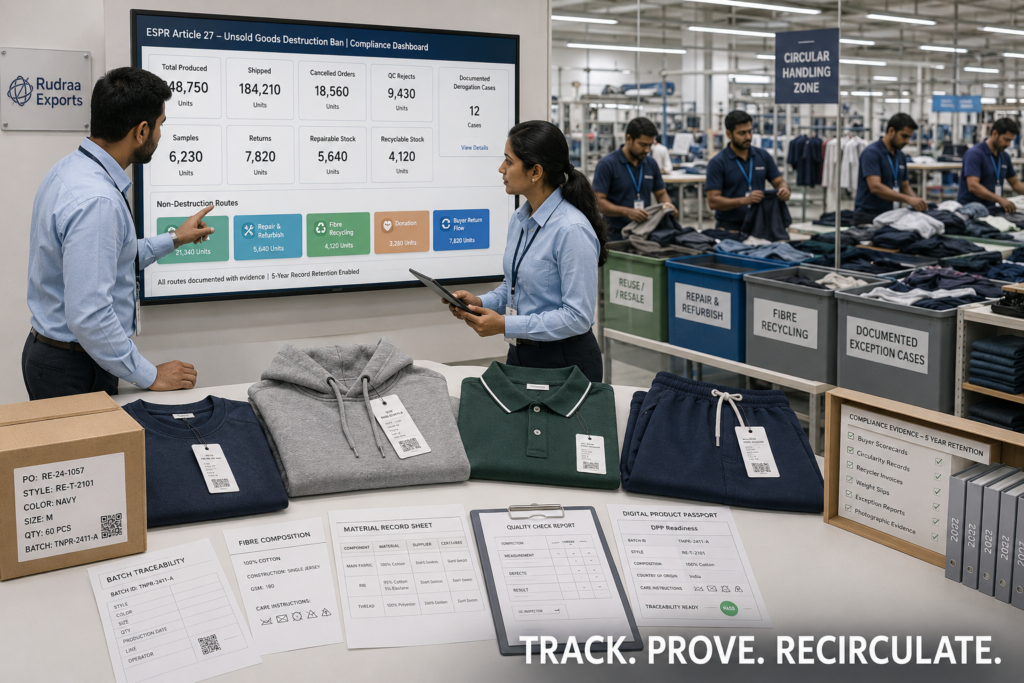
The European Union is changing how fashion brands and apparel suppliers handle unsold products.
Under the Ecodesign for Sustainable Products Regulation, commonly called ESPR, the destruction of unsold apparel and footwear is being restricted for companies selling into the EU market.
For Indian apparel exporters, this is not only an EU brand problem.
Even when the exporter is based in India, EU buyers may push these requirements into:
- Purchase orders
- Vendor scorecards
- Audit checklists
- Product data requests
- Sustainability declarations
- Return and cancellation policies
- Digital Product Passport preparation
The uploaded source explains that the ESPR unsold goods ban applies to large enterprises selling into the EU from 19 July 2026, and that EU buyers are likely to push related obligations upstream to exporters through documentation and audit requirements.
At Rudraa Exports, we help international apparel buyers and export programs build stronger production visibility, batch traceability, quality records, material documentation, export packing and repeatable compliance support from Tirupur, India.
Quick Answer
Indian apparel exporters supplying EU brands should prepare for the ESPR unsold goods ban by tracking cancelled orders, rejected goods, samples, returns and leftover inventory; documenting whether each item is reused, repaired, resold, recycled or handled under an allowed exemption; and maintaining evidence such as batch IDs, weight records, recycler confirmations, buyer approvals and quality reports. Exporters should also begin capturing product-level data for future textile Digital Product Passport requirements.
Supplying EU apparel buyers? Contact Rudraa Exports to discuss traceability-ready garment manufacturing and export documentation support.
What Is the EU ESPR Unsold Goods Ban?
ESPR stands for Ecodesign for Sustainable Products Regulation.
It is part of the EU’s broader shift toward circular products, reduced waste and better product transparency.
For apparel and footwear, one major change is the ban on destroying unsold consumer products.
This means companies selling into the EU must move away from uncontrolled destruction and toward documented circular handling.
What the Rule Targets
The rule focuses on unsold consumer products such as:
- Apparel
- Clothing accessories
- Footwear
- Related textile products
What It Changes
Instead of simply destroying unsold stock, businesses must be able to show:
- What became unsold
- Why it became unsold
- Where it went
- How it was handled
- Whether it was reused, repaired, resold or recycled
- Whether any exemption was justified
- What evidence supports the decision
The uploaded source notes that Article 27 is not just a “do not burn stock” rule. It requires a new operating model for tracking unsold goods, proving treatment routes and documenting exemptions.
Why Indian Apparel Exporters Should Care
Many Indian exporters do not sell directly to consumers in the EU.
But they supply EU brands and retailers.
Those buyers may require exporters to provide upstream evidence.
EU Buyers May Ask For
- Production quantity records
- Shipment reconciliation
- Cancelled order records
- QC rejection records
- Sample inventory records
- Repair or recycling routes
- Material traceability
- Chemical compliance evidence
- Batch-level documentation
- Digital Product Passport data fields
Why This Matters
An exporter that cannot provide evidence may face:
- Buyer audit failures
- Vendor rating downgrade
- Shipment delays
- Chargebacks
- Reduced repeat orders
- Loss of EU buyer confidence
- Exclusion from future sourcing programs
The uploaded guide explains that EU buyers may convert ESPR obligations into supplier requirements, scorecards and audit requests.
The Three Compliance Paths
Indian exporters can respond in three different ways.
1. Do Nothing
This means continuing existing production, rejection and liquidation practices without building records.
Risks
- No evidence trail
- Poor buyer confidence
- Rushed documentation later
- Weak recycling proof
- High audit failure risk
- Loss of EU programs
2. Minimal Compliance Patch
This means adding basic tracking and disposal records without fully integrating compliance into production.
Benefits
- Faster to start
- Lower initial system change
- Useful for small EU exposure
Risks
- Manual reporting burden
- Incomplete records
- Weak downstream proof
- Harder DPP readiness
- Audit gaps under deeper buyer review
3. Compliance-Ready Manufacturing Partner
This means working with a supplier that can support traceability, quality records, controlled materials and documentation from the production stage.
Benefits
- Stronger buyer confidence
- Better audit readiness
- Easier batch tracking
- Cleaner material records
- Better circular route documentation
- Stronger DPP foundation
The uploaded source compares “do nothing,” a minimal compliance patch and partnering with a compliance-ready manufacturer, noting that the strongest route builds traceability, controlled materials and documented circular routes into the workflow.
Compliance Path Comparison
| Area | Do Nothing | Minimal Patch | Compliance-Ready Partner |
|---|---|---|---|
| Initial cost | Low | Medium | Medium |
| Hidden risk | High | Medium | Lower |
| Audit readiness | Poor | Partial | Stronger |
| Buyer confidence | Weak | Moderate | Strong |
| DPP readiness | Poor | Partial | Stronger |
| Documentation | Reactive | Manual | System-based |
| Circular handling | Unclear | Basic | Planned |
| Long-term EU fit | Weak | Transitional | Strong |
What Counts as Unsold Inventory?
Exporters should not wait for buyers to define every category.
Start mapping all stock that could become unsold, rejected or diverted.
Unsold or Risk Inventory Categories
| Category | Example |
|---|---|
| Cancelled orders | Buyer cancels before shipment |
| QC rejects | Goods fail buyer inspection |
| Size-set leftovers | Development garments remain unused |
| Samples | Proto, fit, PP and showroom samples |
| Overproduction | Extra units made beyond order |
| Returns | Buyer or consumer return flow |
| End-of-season stock | Retailer unsold inventory |
| Damaged stock | Goods damaged in transit or storage |
| IP-sensitive goods | Branded goods not suitable for open resale |
| Contaminated goods | Unsafe or unsuitable for reuse |
The uploaded source recommends mapping cancellations, size-set leftovers, QC rejects, samples, returns and end-of-season stock as measurable unsold flows.
Why Documentation Is the Real Compliance Challenge
The regulation does not only ask companies to avoid destruction.
It creates pressure to prove what happened.
Evidence Exporters May Need
- Purchase order number
- Style number
- Batch number
- Quantity produced
- Quantity shipped
- Quantity rejected
- Quantity returned
- Reason code
- Quality inspection report
- Buyer approval
- Repair route
- Recycling route
- Weight slip
- Recycler invoice
- Donation record
- Disposal exemption file
- Date of action
- Person responsible
Simple Example
A buyer cancels 1,000 hoodies after production.
A weak system says:
“Stock handled locally.”
A compliance-ready system says:
- PO 1048
- Style HD-320
- Batch REX-2026-08
- 1,000 units produced
- 850 units resold with buyer approval
- 100 units repaired and relabelled
- 40 units sent to textile recycler
- 10 units documented as contaminated or damaged
- Weight slips, photos and approvals retained
This is the difference between an explanation and an evidence trail.
Digital Product Passport Readiness
The Digital Product Passport, or DPP, is expected to become important for textiles.
Even if final DPP requirements evolve, exporters should start preparing core product data now.
Useful DPP-Ready Fields
| Data Field | Why It Matters |
|---|---|
| Fibre composition | Product transparency |
| Fabric source | Supply-chain mapping |
| Dyeing or processing location | Production traceability |
| Chemical compliance records | Safety and restricted-substance evidence |
| Batch ID | Stock and recall control |
| Style code | Product identification |
| Care instructions | Longer product life |
| Repair guidance | Circular use |
| Recycling guidance | End-of-life route |
| Packaging material | Sustainability data |
The uploaded source explains that textile DPP expectations from 2027 will increase upstream data requests for materials, chemicals, processes and traceability.
5-Step ESPR Readiness Roadmap
Step 1: Define Unsold Goods Flows
Start by categorising every product flow that could become unsold.
Suggested Taxonomy
| Category | Meaning |
|---|---|
| Saleable | Can be sold as intended |
| Repairable | Can be fixed and sold |
| Reworkable | Needs correction before release |
| Recyclable | Suitable for material recovery |
| Donatable | Suitable for approved donation |
| IP-sensitive | Requires buyer-approved handling |
| Contaminated | Not suitable for reuse |
| Disposal-exception case | Requires documented justification |
The uploaded source recommends creating a simple taxonomy such as saleable, repairable, recyclable, hazardous-contaminated and IP-sensitive.
Step 2: Build Batch-Level Inventory Tracking
At minimum, link every garment batch to:
- Buyer
- Purchase order
- Style
- Colour
- Size
- Fabric lot
- Production batch
- Carton number
- Shipment
- Disposition route
Step 3: Set Up Circular Handling Routes
Develop approved pathways for unsold or rejected goods.
Circular Routes
| Route | Suitable For |
|---|---|
| Resale | Saleable unbranded or approved goods |
| Repair | Minor defects |
| Rework | Correctable production issues |
| Donation | Approved usable goods |
| Fibre recycling | Damaged but recyclable textiles |
| Downcycling | Lower-grade textile recovery |
| Documented exception | Safety, contamination or IP-sensitive cases |
The uploaded guide recommends setting up resale, donation, repair, fibre-to-fibre recycling or downcycling routes instead of relying on destruction.
Step 4: Prepare Derogation Documentation
A derogation means an exception.
Some products may be unsuitable for reuse or recycling.
But the reason must be documented.
Possible Exception Reasons
- Safety risk
- Contamination
- Legal restriction
- IP or brand protection
- Product cannot be repaired
- Product cannot be recycled through available route
Derogation File Should Include
- Product details
- Batch ID
- Quantity
- Reason code
- Photos
- QA report
- Buyer approval
- Lab report where needed
- Responsible person
- Final treatment record
- Date
- Supporting documents
The uploaded source explains that destruction may be allowed only under specific derogations and must be justified with evidence.
Step 5: Capture DPP-Ready Product Data
Do not wait until every DPP field is final.
Start with information that will almost certainly matter:
- Fibre content
- Fabric source
- Dyeing route
- Chemical compliance
- Production location
- Batch ID
- Care instruction
- Repair guidance
- Recycling route
What EU Buyers May Add to Purchase Orders
EU brands and retailers may update supplier contracts to include:
- No-destruction clauses
- Unsold goods reporting
- Return-handling rules
- Rework and repair requirements
- Recycler approval requirements
- Documentation retention obligations
- DPP data responsibilities
- Material compliance records
- Chemical compliance declarations
- Audit access rights
- Evidence of circular treatment
Buyer Question Examples
Expect questions such as:
- What happens to cancelled goods?
- How are QC rejects recorded?
- Can you segregate saleable and unsaleable stock?
- Can you prove recycling?
- Can you provide batch-level material data?
- Can you support Digital Product Passport fields?
- Can you document why any product was destroyed?
- How long do you keep evidence?
Practical Records Exporters Should Maintain
| Record | Purpose |
|---|---|
| Production reconciliation | Produced vs shipped vs leftover |
| QC rejection log | Why goods were rejected |
| Repair log | What was repaired |
| Rework log | What was corrected |
| Recycling invoice | Proof of route |
| Weight slip | Quantity evidence |
| Buyer approval | Commercial permission |
| Photo evidence | Visual support |
| Batch traceability | Links product to source |
| Material compliance file | Product safety data |
| DPP data sheet | Future reporting readiness |
The uploaded source notes that evidence may include downstream partners, weights, invoices, reasons for write-off and treatment documentation.
How ESPR Affects Indian Apparel Clusters
Indian exporters serving EU buyers may need stronger internal controls in areas such as:
- Inventory coding
- Returns segregation
- Stock reconciliation
- QC reject handling
- Material records
- Chemical compliance
- Recycler relationships
- Buyer reporting
- DPP data preparation
This is especially important for export clusters that produce high volumes of:
- T-shirts
- Polos
- Hoodies
- Sweatshirts
- Knitwear
- Footwear-related textiles
- Kidswear
- Fashion basics
The uploaded guide gives examples of Indian apparel exporters needing better inventory reconciliation and formal handling routes for unsold, returned and defective goods.
Role of ISO 9001 and OEKO-TEX-Aligned Material Control
Certifications do not automatically make a company ESPR-compliant.
However, they can support stronger systems.
ISO 9001 Can Help With
- Document control
- Process discipline
- Corrective action
- Traceability habits
- Quality inspection records
- Supplier control
- Continuous improvement
OEKO-TEX-Aligned Material Control Can Help With
- Chemical safety expectations
- Restricted-substance awareness
- Material compliance documentation
- Buyer confidence
- Safer product data collection
The uploaded source explains that ISO 9001 and OEKO-TEX-aligned material compliance can reduce compliance risk, but they do not solve unsold goods handling by themselves.
Important Limitation
A certificate is not a circularity system.
Exporters still need:
- Inventory tracking
- Unsold stock records
- Circular handling routes
- Buyer-approved disposition
- Evidence retention
- DPP data readiness
Minimal Compliance Patch: When It Works
A minimal patch may work temporarily when:
- EU exposure is low
- SKU count is simple
- Cancellations are rare
- Returns are limited
- Buyer requests are basic
- Recycling partners are already formal
- Manual reporting is manageable
Minimal Patch Components
- Unsold inventory spreadsheet
- Reason codes
- Batch IDs
- Basic recycler agreements
- Weight records
- Buyer approval folder
- Monthly reconciliation
- Documentation owner
Risk
Manual systems often break when:
- SKU count increases
- Buyer audits deepen
- Returns grow
- Multiple factories are involved
- DPP data requests begin
Compliance-Ready Manufacturing: When It Is Better
A compliance-ready manufacturing partner is better when:
- EU buyers are important
- The brand expects DPP data
- Product volume is growing
- Returns and rejected stock must be tracked
- Buyer scorecards are strict
- Sustainability claims are used
- Material compliance matters
- Long-term supplier approval is the goal
What to Ask a Manufacturer
| Question | Why It Matters |
|---|---|
| Can you track batch IDs? | Supports reconciliation |
| Can you record fabric lots? | Supports product data |
| Can you separate QC rejects? | Supports unsold flow tracking |
| Can you document rework? | Supports circular handling |
| Can you provide material compliance data? | Supports buyer audits |
| Can you support DPP fields? | Supports future reporting |
| Can you coordinate recycling partners? | Supports non-destruction routes |
| Can you retain records? | Supports audit evidence |
30–120 Day Action Plan
Week 1–2: Map Unsold Flows
Identify:
- Samples
- Leftover stock
- QC rejects
- Cancelled orders
- Returns
- Damaged goods
- End-of-season stock
Week 2–6: Add Batch Tracking
Create:
- Batch ID
- PO link
- Style code
- Fabric lot
- Quantity produced
- Quantity shipped
- Quantity leftover
- Disposition route
Week 4–10: Confirm Circular Partners
Identify and document:
- Repair partners
- Sorters
- Recyclers
- Donation partners
- Buyer-approved resale routes
Week 6–12: Create Derogation Packs
Prepare:
- Reason code
- Evidence folder
- Approval workflow
- Retention process
Week 8–16: Build DPP Data Sheet
Capture:
- Fibre composition
- Material source
- Chemical compliance
- Processing location
- Batch ID
- Care and repair guidance
- Recycling guidance
ESPR Readiness Checklist for Apparel Exporters
| # | Action |
|---|---|
| 1 | Identify EU buyer exposure |
| 2 | Map unsold inventory flows |
| 3 | Define reason codes |
| 4 | Create batch IDs |
| 5 | Link batches to POs |
| 6 | Link batches to fabric lots |
| 7 | Record produced quantity |
| 8 | Record shipped quantity |
| 9 | Record leftover quantity |
| 10 | Segregate QC rejects |
| 11 | Define resale route |
| 12 | Define repair route |
| 13 | Define recycling route |
| 14 | Approve donation route |
| 15 | Create derogation file template |
| 16 | Collect weight slips |
| 17 | Collect recycler invoices |
| 18 | Retain buyer approvals |
| 19 | Capture DPP-ready fields |
| 20 | Review system quarterly |
How Rudraa Exports Supports ESPR-Ready Apparel Programs
Rudraa Exports supports international buyers and export-oriented apparel programs from Tirupur, India.
Documentation and Production Support
- Product brief review
- Fabric and material records
- Batch-level tracking support
- Style and PO mapping
- QC inspection records
- AQL inspection support
- Rework visibility
- Production reconciliation
- Export packing records
- Carton and shipment documentation
- Material compliance coordination
- DPP-ready data preparation support
Products Supported
- T-shirts
- Polo shirts
- Hoodies
- Sweatshirts
- Joggers
- Activewear
- Kidswear
- Babywear
- Nightwear
- Corporate apparel
- School uniforms
- Private-label knitwear
Why Factory-Direct Helps
A factory-direct model can support ESPR readiness because it improves access to:
- Product records
- Fabric lots
- Production batches
- QC rejects
- Rework details
- Packing data
- Corrective action records
- Shipment documentation
Ready to strengthen EU buyer readiness? Speak with Rudraa Exports and share your product category, target EU buyer requirements, MOQ and compliance documentation needs.
FAQ: EU ESPR Unsold Goods Ban for Apparel Exporters
1. What is the EU ESPR unsold goods ban?
It is part of the EU Ecodesign for Sustainable Products Regulation and restricts the destruction of unsold consumer products such as apparel and footwear.
2. Does ESPR affect Indian apparel exporters?
Yes, indirectly. EU buyers may require Indian exporters to provide upstream inventory, product data, circular handling and compliance documentation.
3. What products are affected?
Apparel, clothing accessories, footwear and textile-related consumer products are key affected categories.
4. What does “unsold goods” include?
It may include cancelled stock, returns, QC rejects, samples, end-of-season stock, damaged goods and leftover production.
5. Can unsold garments be destroyed?
Destruction may be restricted and, where exceptions apply, the reason must be documented with evidence.
6. What is a derogation?
A derogation is an allowed exception. For example, certain goods may be unsuitable for reuse because of safety, contamination or IP-sensitive reasons.
7. What records should exporters keep?
Keep batch IDs, PO links, production quantities, shipped quantities, leftover records, treatment routes, weight slips, invoices, photos and buyer approvals.
8. What is the Digital Product Passport?
The Digital Product Passport is a product data system expected to increase transparency around materials, production, chemicals, repair and recycling information.
9. Does ISO 9001 make a factory ESPR-compliant?
No. ISO 9001 can support document control and process discipline, but ESPR readiness also requires unsold goods tracking and circular handling evidence.
10. Does OEKO-TEX solve ESPR compliance?
No. OEKO-TEX-aligned material controls can support chemical safety and buyer confidence, but unsold goods handling still needs separate tracking and documentation.
11. How can Rudraa Exports help EU-facing buyers?
Rudraa can support traceability-ready production records, batch tracking, material data, QC documentation, export packing records and DPP-ready data preparation.
12. What should I send Rudraa Exports?
Send your product type, EU buyer requirements, tech pack, material compliance needs, MOQ, expected destination and reporting expectations.
Conclusion
The EU ESPR unsold goods ban is not only a waste rule.
It is a documentation, traceability and circularity challenge.
Indian apparel exporters supplying EU buyers should prepare now by mapping unsold flows, tracking inventory by batch, documenting circular handling routes, preparing derogation files and capturing product data needed for future DPP expectations.
The exporters that wait will face rushed paperwork, buyer pressure and higher audit risk.
The exporters that prepare will be easier to approve, easier to trust and easier to scale with.
Rudraa Exports helps export-focused buyers build stronger production visibility through factory-direct communication, material records, batch traceability, QC documentation, export packing and DPP-ready data support from Tirupur, India.
Visit rudraaexports.com or contact the Rudraa Exports team to discuss ESPR-ready apparel manufacturing support.
Related reading
EU Sustainability Compliance for Garments Made in India: Practical Guide for European Apparel Brands
How to Use Deadstock Fabric in Your Clothing Brand: Sustainable Sourcing Guide
India vs Poland Garment Manufacturing: Cost, Quality and Lead Time Comparison