
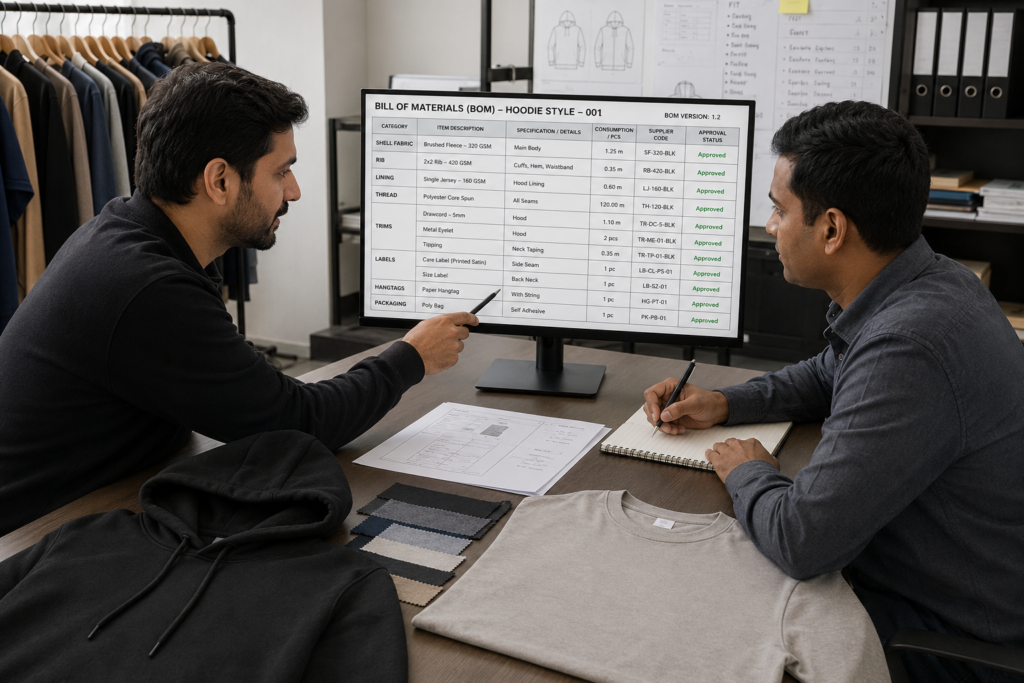
Launching your first garment production run is exciting.
But one missing detail can become an expensive bulk mistake.
The wrong fabric weight, wrong zipper, wrong thread, wrong label, wrong hangtag string or wrong polybag size can delay sampling, increase cost or make the bulk order different from the approved sample.
Most of these problems happen for one reason:
The factory did not have one clear, approved list of exactly what to buy and how to buy it.
That list is called the BOM.
In garment manufacturing, a Bill of Materials is the garment’s recipe and shopping list. It tells the factory what fabric, trims, labels, packaging and components are needed to make one style correctly.
The uploaded guide explains that a BOM links design to sourcing, costing, quality and compliance, and becomes the source of truth from sampling through bulk production.
At Rudraa Exports, we help apparel brands prepare production-ready BOMs so sampling, costing, sourcing, quality checks and bulk production are aligned from day one.
Quick Answer
A Bill of Materials in garment manufacturing is a detailed list of every material needed to make a garment, including fabric, trims, thread, labels, hangtags, packaging, embellishments and quantity per garment. A strong BOM helps the factory source correctly, quote accurately, maintain sample-to-bulk consistency, control quality, manage compliance and prevent bulk production mistakes. It should be prepared before sampling and frozen before pre-production approval.
Need a production-ready BOM for your first order? Contact Rudraa Exports and share your product type, design reference, fabric requirement, MOQ and destination.
What Is a BOM in Clothing Manufacturing?
BOM stands for Bill of Materials.
In simple words, it is the complete list of materials required to make a garment.
It tells the factory:
- What to buy
- How much to buy
- Which colour to use
- Which size to use
- Which supplier or code to follow
- Which material is approved
- Which version is final
The uploaded source describes the BOM as a master list of raw materials, trims, components and packaging elements needed to manufacture one SKU.
Simple Example
For a hoodie, the BOM may include:
- Main fleece fabric
- Rib fabric
- Hood lining
- Drawcord
- Eyelets
- Thread
- Main label
- Size label
- Care label
- Hangtag
- Polybag
- Carton
- Barcode sticker
Without a BOM, these details may live across WhatsApp messages, emails, sample notes and supplier memory.
That is risky.
Why a BOM Matters
A BOM prevents confusion between the brand, merchandiser, sourcing team, factory and quality team.
A Good BOM Helps With
- Accurate costing
- Better sourcing
- Faster sampling
- Correct trim buying
- Clear label planning
- Packaging control
- Sample-to-bulk consistency
- Quality testing
- Compliance support
- Bulk production accuracy
- Reorder consistency
The uploaded guide explains that a BOM helps with costing, vendor negotiation, quality, testing, compliance, purchase readiness and sample-to-bulk consistency.
Clear BOM vs Incomplete BOM
| Area | Clear BOM | Incomplete BOM |
|---|---|---|
| Costing | Line-by-line cost visibility | Hidden assumptions |
| Sourcing | Purchase-ready specs | Back-and-forth |
| Sampling | Correct materials used | Sample may differ from bulk |
| Bulk production | Same approved inputs | Wrong materials may arrive |
| Quality | Test references included | Testing may happen too late |
| Compliance | Label and material rules clear | Mislabeling risk |
| Communication | One shared source of truth | Details lost in chats |
| Change control | Versioned revisions | Outdated info followed |
| Packaging | Planned early | Carton and packing problems |
The uploaded guide compares a clear, detailed BOM with an incomplete or missing BOM and shows how missing BOM details can lead to wrong purchasing, inconsistent bulk and compliance risk.
BOM Is Not Only Fabric
Many first-time founders think BOM means fabric list.
That is wrong.
A BOM includes every material and component needed to complete the garment.
Main BOM Categories
| Category | Examples |
|---|---|
| Shell fabric | Jersey, fleece, twill, interlock |
| Lining | Pocketing, body lining, hood lining |
| Rib | Neck rib, cuff rib, waistband rib |
| Interlining | Fusible, collar fusing, waistband fusing |
| Thread | Sewing thread, embroidery thread |
| Closures | Zipper, buttons, snaps, hooks |
| Elastics | Waist elastic, cuff elastic |
| Drawcords | Hoodie cord, jogger cord |
| Labels | Main label, size label, care label |
| Heat seals | Logo, neck print, size print |
| Embellishments | Screen print, embroidery, patch |
| Packaging | Polybag, carton, tissue, barcode |
| Inserts | Hangtag, brand card, warning card |
The uploaded guide recommends building the BOM by component category and not forgetting invisible items such as thread, packaging and interlining.
What a Strong BOM Should Include
Each BOM line should be specific enough for the factory to purchase without guessing.
Important BOM Fields
| BOM Field | Example |
|---|---|
| Component category | Shell fabric |
| Component name | Cotton fleece |
| Placement | Body |
| Composition | 100% cotton |
| Construction | Brushed fleece |
| GSM | 320 GSM |
| Width | 180 cm usable width |
| Colour | Pantone Black |
| Supplier code | Fabric supplier code |
| Unit of measure | Metres, pieces, rolls etc. |
| Quantity | Consumption per garment |
| Tolerance | GSM or shrinkage tolerance |
| Test reference | GSM, shrinkage etc. |
| Approval status | Approved / pending |
| Version | BOM v3 frozen |
The uploaded source explains that each BOM line needs a clear specification and unit of measure, including GSM, dimensions, thread size, shrinkage allowances and other measurable details.
Example: Weak BOM vs Strong BOM
Weak Fabric Line
Cotton fleece
This is too vague.
The supplier may choose different fabric weight, finish, width or composition.
Strong Fabric Line
Shell fabric: 100% cotton brushed fleece, 320 GSM, usable width 180 cm, colour Pantone Black, shrinkage max 5%, approved supplier code REX-FL-320-BLK.
This is clearer and purchase-ready.
The uploaded guide gives a similar example showing how “cotton fleece” is too vague, while a defined fleece with GSM, width and test reference creates better pricing and sourcing clarity.
Example: Weak Trim Line vs Strong Trim Line
Weak Trim Line
Zipper: black
This is not enough.
Strong Trim Line
#5 coil zipper, 55 cm, polyester tape, nylon teeth, matte gunmetal puller, colour Pantone Black, approved sample required.
The uploaded guide explains that a simple “YKK zipper” or generic zipper note is not enough; length, tape, teeth, puller, colour and finish should be defined.
BOM vs Tech Pack
A BOM and tech pack are connected, but they are not the same.
BOM
The BOM tells the factory what materials to buy.
It answers:
- What fabric?
- What trim?
- What label?
- What packaging?
- What quantity?
- What colour?
- What supplier code?
Tech Pack
The tech pack tells the factory how to make the garment.
It includes:
- Technical sketches
- Construction details
- Measurements
- Grading
- Seam types
- Stitch details
- Artwork placement
- Tolerance rules
- BOM section
The uploaded source explains that the tech pack is the complete blueprint, while the BOM is one major section inside it.
Simple Example
BOM says:
Rib: 2×2 rib knit, 380 GSM
Tech pack says:
Attach rib at neckline using specified seam type with measurement tolerance and stitch requirement.
Both are needed.
Why First-Time Founders Need a BOM
Some founders think a BOM is only needed for big brands.
Actually, small first runs need BOM discipline even more.
Why?
Because when the quantity is small, each mistake costs more per piece.
The uploaded guide says the fewer units you make, the more each mistake costs per piece.
BOM Helps First-Time Founders Avoid
- Wrong fabric
- Wrong GSM
- Wrong hand feel
- Wrong thread
- Wrong zipper
- Wrong label
- Wrong hangtag
- Wrong packaging
- Wrong carton size
- Extra sampling rounds
- Bulk delays
- Cost surprises
When BOM Shortcuts Backfire
Example 1: Wrong GSM in Bulk
A founder approves a sample made with 300 GSM fleece.
But the BOM only says “fleece.”
The factory sources 260 GSM fleece for bulk.
Result:
- Garment feels thinner
- Fit changes
- Customer value perception drops
- Brand may need discounting
The uploaded guide gives this type of example where unclear BOM lines can cause sample and bulk fabric to differ.
Example 2: Wrong Hangtag String
A brand wants a sustainable look.
The sample uses cotton string.
But the BOM only says “string.”
Bulk arrives with polyester string.
Result:
- Sustainability claim becomes weaker
- Brand presentation changes
- Rework may be needed
Example 3: Wrong Care Label
The care label is not locked in the BOM.
Bulk arrives with incomplete fibre content.
Result:
- Compliance risk
- Relabelling cost
- Shipment delay
- Retailer rejection risk
Minimum Viable BOM
If your product is simple and you are not ready for a full advanced BOM, start with a minimum viable BOM.
Minimum BOM Should Include
- Shell fabric
- Lining or pocketing if used
- Rib if used
- Thread
- Closure
- Elastic or drawcord
- Main label
- Size label
- Care label
- Print or embroidery
- Hangtag
- Polybag
- Carton
The uploaded source recommends a minimum viable BOM covering shell fabric, lining or pocketing, closures, labels, thread, embellishments and packaging if a buyer is tempted to skip the BOM.
How to Create a Garment Bill of Materials
Step 1: Use a Garment BOM Template
Start with a spreadsheet or PLM-style template.
Your BOM should be easy to update, share and approve.
Step 2: Assign One BOM Owner
One person should own BOM accuracy.
This may be:
- Founder
- Sourcing manager
- Technical designer
- Merchandiser
The uploaded guide says BOM ownership should remain on the brand side, even when the factory helps with data entry.
Step 3: Add Component Categories
Build the BOM section by section:
- Fabric
- Trims
- Thread
- Labels
- Prints
- Packaging
Step 4: Specify Every Line Clearly
Each line should include:
- Name
- Material
- Size
- Colour
- Finish
- Supplier code
- Quantity
- Unit of measure
- Approval status
Step 5: Connect BOM to Costing
A BOM should help you calculate:
- Fabric cost
- Trim cost
- Label cost
- Packaging cost
- Wastage
- Consumption
- Total material cost
- Margin impact
Step 6: Link BOM to Testing
Add test requirements where needed:
- GSM
- Shrinkage
- Colourfastness
- Pilling
- Stretch recovery
- Chemical safety support
The uploaded guide explains that BOMs can link material decisions with testing and restricted-substance expectations, especially for export programs.
Step 7: Freeze BOM Before Bulk
The BOM can change during development.
But before bulk production, it must be frozen.
The uploaded source explains that BOMs evolve through prototype and costing stages, then are frozen before pre-production to protect bulk consistency.
What Is BOM Freeze?
BOM freeze means the approved material list is locked before production.
After BOM freeze, no material should change without written approval.
BOM Freeze Should Confirm
- Final fabric
- Final GSM
- Final trim
- Final thread
- Final labels
- Final packaging
- Final supplier codes
- Final colour references
- Final test requirements
- Final approval status
Why BOM Freeze Matters
It prevents:
- Old versions being followed
- Supplier substitutions
- Bulk mismatch
- Mixed trims
- Cost disputes
- Approval confusion
The uploaded guide gives an example where an untracked zipper puller change after PP approval caused mixed bulk trim results, showing why revision logs and BOM freeze are important.
BOM Version Control
Every BOM should have a revision log.
Revision Log Should Include
| Field | Example |
|---|---|
| Version | BOM v3 |
| Date | 30 July 2026 |
| Change | Zipper puller changed |
| Changed by | Brand owner |
| Approved by | Buyer and factory |
| Impact | Cost + delivery |
| Status | Approved / pending |
Important Rule
If the BOM changes, the costing, sample and PO may also need to change.
Garment BOM Template Structure
Here is a practical BOM structure for brands.
Style Information
| Field | Example |
|---|---|
| Brand | Brand name |
| Style code | HD-001 |
| Style name | Oversized Hoodie |
| Season | AW26 |
| Category | Hoodie |
| Size range | XS–XXL |
| Colourways | Black, Grey, Navy |
| BOM version | v3 frozen |
Fabric Section
| Component | Placement | Spec | Colour | UOM | Consumption |
|---|---|---|---|---|---|
| Brushed fleece | Body | 320 GSM cotton fleece | Black | metres | 1.45 |
| Rib | Cuff/hem | 2×2 rib, 380 GSM | Black | metres | 0.20 |
| Hood lining | Hood | Single jersey 180 GSM | Black | metres | 0.30 |
Trims Section
| Component | Spec | Colour | UOM | Quantity |
|---|---|---|---|---|
| Drawcord | Cotton flat cord, 12 mm | Black | pcs | 1 |
| Eyelet | Metal eyelet, matte black | Black | pcs | 2 |
| Thread | Core-spun poly thread | DTM | cones | As required |
Label and Packaging Section
| Component | Spec | Placement | Quantity |
|---|---|---|---|
| Main label | Woven damask label | Back neck | 1 |
| Size label | Woven size pip | Back neck | 1 |
| Care label | Satin printed label | Left side seam | 1 |
| Hangtag | 350 GSM card | Neck loop | 1 |
| Polybag | Recyclable bag, barcode sticker | Individual pack | 1 |
| Carton | Export carton | 24 pcs/carton | As required |
BOM Checklist Before Sampling
| # | Checkpoint |
|---|---|
| 1 | Style code added |
| 2 | Fabric composition defined |
| 3 | GSM defined |
| 4 | Usable width defined |
| 5 | Colour references added |
| 6 | Trim specs added |
| 7 | Thread specified |
| 8 | Labels specified |
| 9 | Print or embroidery defined |
| 10 | Packaging specified |
| 11 | Consumption added |
| 12 | Unit of measure added |
| 13 | Supplier codes added where possible |
| 14 | Testing requirements added |
| 15 | Compliance requirements added |
| 16 | Approval status added |
| 17 | Costing linked |
| 18 | Version number added |
| 19 | Owner assigned |
| 20 | Factory reviewed |
How Rudraa Exports Uses BOM for Accurate Samples
Rudraa Exports uses the BOM as a production-control document.
It is not just paperwork.
It helps align:
- Buyer
- Merchandiser
- Sourcing team
- Sampling team
- Factory
- QC team
- Packaging team
The uploaded guide explains that when working directly with a factory, the BOM becomes a shared operational document rather than a summary passed through middle layers.
Rudraa Support Includes
- BOM review
- Garment BOM template support
- Fabric specification review
- GSM planning
- Trim selection
- Label planning
- Packaging planning
- Costing support
- Supplier code tracking
- Testing requirement alignment
- Revision control
- BOM freeze before production
- Sample-to-bulk consistency checks
- Factory-direct communication
- Traceability mindset
- ISO 9001:2015 process discipline
Why This Helps
A strong BOM helps Rudraa produce samples that are:
- Closer to the buyer’s expectation
- Easier to cost
- Easier to test
- Easier to repeat
- Easier to scale
- Easier to approve for bulk
Ready to build your first production BOM? Speak with Rudraa Exports and request a garment BOM template for your next style.
FAQ: Bill of Materials in Garment Manufacturing
1. What is a Bill of Materials in garment manufacturing?
A Bill of Materials is a detailed list of all materials required to make a garment, including fabric, trims, labels, thread, embellishments and packaging.
2. Why is a BOM important?
A BOM helps control costing, sourcing, sampling, quality, compliance, packaging and sample-to-bulk consistency.
3. Is a BOM the same as a tech pack?
No. A BOM lists what materials to buy. A tech pack explains how the garment should be made and measured. The BOM is usually one section inside the tech pack.
4. What should be included in a garment BOM?
A BOM should include shell fabric, lining, rib, thread, closures, elastics, drawcords, labels, hangtags, prints, embroidery, polybags and cartons.
5. Who should own the BOM?
The brand should own the BOM, even if the factory helps fill in technical details. One person should manage approvals and revisions.
6. What is BOM freeze?
BOM freeze means the final material list is locked before bulk production. Any change after that should be versioned and approved.
7. What happens if a BOM is incomplete?
An incomplete BOM can cause wrong fabric, wrong trims, cost surprises, sample-to-bulk mismatch, delays and compliance issues.
8. What is a minimum viable BOM?
A minimum viable BOM includes the most important materials: fabric, trims, thread, labels, print or embroidery and packaging.
9. Should packaging be part of the BOM?
Yes. Packaging should be included because polybags, cartons, barcode labels and packing ratios affect cost, shipping and buyer compliance.
10. Should testing requirements be included in the BOM?
Yes. GSM, shrinkage, colourfastness, pilling, stretch recovery and chemical safety expectations should be included where relevant.
11. Can Rudraa Exports provide a garment BOM template?
Yes. Rudraa can support buyers with a garment BOM template, BOM review, sourcing alignment and production-ready BOM planning.
12. What should I send Rudraa to prepare a BOM?
Send your product reference, tech pack if available, fabric requirement, trims, labels, packaging needs, MOQ, colourways and target price.
Conclusion
A Bill of Materials in garment manufacturing is more than a document.
It is the control system behind sourcing, costing, sampling, testing, packaging and bulk production.
When the BOM is clear, the factory knows exactly what to buy and how to prepare for production.
When the BOM is vague, the factory guesses.
That is when small details become expensive mistakes.
For first-time founders, a strong BOM protects the first production run. For growing brands, it protects repeat orders and margins.
Rudraa Exports helps apparel brands create production-ready BOMs with factory-direct communication, fabric and trim planning, costing support, revision control, BOM freeze and sample-to-bulk consistency checks.
Visit rudraaexports.com or contact the Rudraa Exports team to request a garment BOM template and prepare your next production order with fewer surprises.
Related reading
Seasonal Production Planning for Apparel Brands: How to Book Factory Capacity in India
How to Reduce Garment Production Lead Times: 7 Proven Strategies for Apparel Buyers
Where Clothing Brand Founders Waste the Most Money: A Factory-Side Guide