
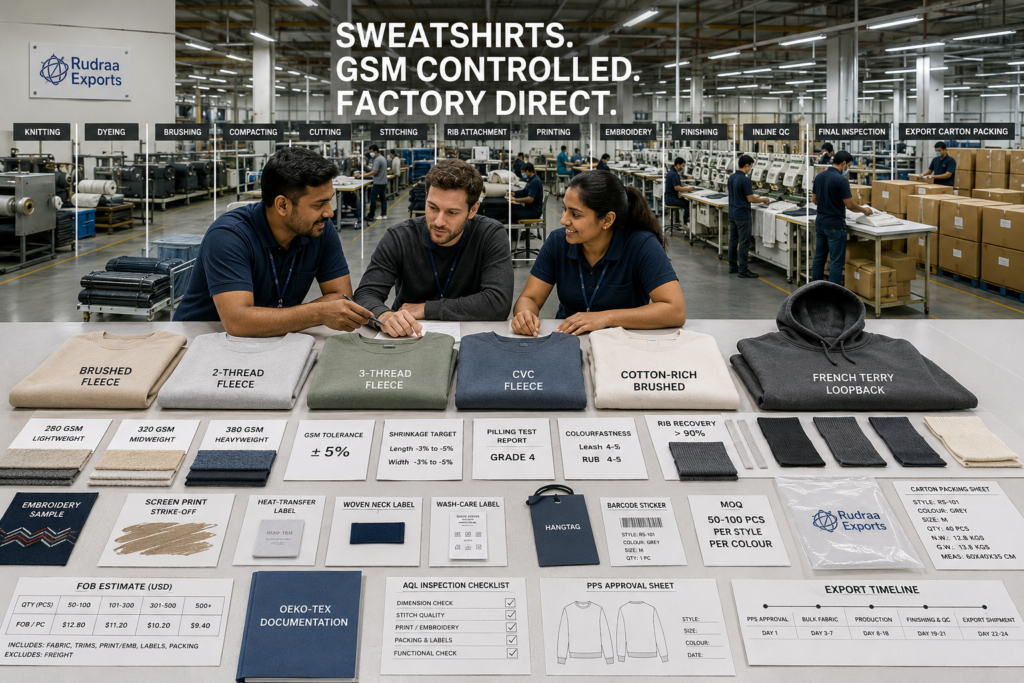
Sweatshirts look simple from the outside.
But for a brand, the difference between a weak sweatshirt and a premium sweatshirt comes down to fabric, GSM, shrinkage, pilling, rib quality, stitching, finishing and repeatability.
A good sweatshirt must feel warm enough, hold shape after washing, avoid excessive pilling, keep the correct size, support print or embroidery, and match the approved sample in bulk.
That is why choosing the right sweatshirt manufacturer matters.
India, especially Tirupur, is a strong sourcing base for sweatshirt manufacturing because it offers cotton knit depth, fleece and French terry options, export-ready workflows, compliance support and factory-direct communication.
At Rudraa Exports, we help international buyers develop private-label sweatshirts from India with fabric selection, GSM planning, low-MOQ discussion, sampling, private-label trims, QC checks, export packing and FOB or DDP planning.
Quick Answer
Sweatshirt manufacturing in India is a strong option for brands that need fleece, French terry, GSM control, private-label trims, lower MOQ flexibility and export-ready production. Tirupur is especially suitable for cotton-rich sweatshirts, crewnecks, hoodies, loopback French terry and brushed fleece programs. For most buyers, 280 GSM works for mild climates, 320 GSM is a balanced export midweight, and 380 GSM works for premium winter or heavyweight streetwear. A safe first order starts with one proven sweatshirt block, one fabric platform, clear GSM tolerance, shrinkage target, pilling expectations and a 300 pcs per style per colour MOQ discussion where feasible.
Looking for sweatshirt manufacturing in India? Contact Rudraa Exports and share your tech pack, target GSM, fabric type, MOQ, decoration method and destination.
Why India Works for Sweatshirt Manufacturing
India has a strong knitwear manufacturing base.
For sweatshirts, this matters because fabric quality and finishing decide the final product experience.
The uploaded guide explains that international buyers exploring sweatshirt manufacturing in India usually care about consistent knit quality, predictable FOB pricing, compliance and private-label flexibility without massive volume commitments.
India Is Useful For
- Crewneck sweatshirts
- Hoodies
- Brushed fleece sweatshirts
- French terry sweatshirts
- Loopback sweatshirts
- Cotton-rich fleece
- CVC sweatshirts
- Streetwear blanks
- Private-label sweatshirts
- Corporate sweatshirts
- Wholesale sweatshirts
- Export-ready knitwear programs
Why Tirupur Is Important
Tirupur gives buyers access to:
- Cotton knit fabric sourcing
- Fleece knitting
- French terry options
- Dyeing and finishing
- Brushing and compacting
- Cutting and stitching
- Rib trims
- Printing and embroidery
- Quality control
- Export packing
The uploaded source describes Tirupur as a major cotton knitwear export cluster with an integrated ecosystem of knitting, dyeing, finishing and garmenting units.
India Direct Factory vs Agent vs Other Countries
Buyers do not only compare countries.
They compare sourcing models.
The uploaded guide compares India direct factory sourcing, India via agent, Bangladesh and China across cost transparency, MOQ flexibility, knit fabric access, compliance, private-label control and lead-time predictability.
Quick Comparison
| Criteria | India Direct Factory | India via Agent | Bangladesh | China |
|---|---|---|---|---|
| Cost transparency | High | Medium to low | Strong for volume | Medium |
| MOQ flexibility | Good for development-friendly factories | Often higher | Best at very high volume | Flexible but price-sensitive |
| Fleece/French terry access | Strong in Tirupur | Depends on agent network | Strong for bulk basics | Very broad |
| Compliance support | Strong with right factory | Varies | Strong in large units | Strong but supplier-dependent |
| Private label control | High | Medium | Medium | High but can add cost |
| Best for | Controlled private-label programs | Buyers needing coordination | Large basic programs | Speed and variety |
Key Takeaway
India works best when you work directly with the factory and define the product clearly.
Factory-direct sourcing helps protect:
- GSM
- Fabric composition
- Shrinkage control
- Pilling performance
- Rib quality
- Decoration quality
- Private-label trims
- Packing standards
Best Fabrics for Sweatshirts
Fabric choice controls hand feel, warmth, drape, durability and final price.
The uploaded guide identifies brushed fleece, French terry or loopback, and brushed cotton or cotton-rich options as common sweatshirt fabric choices in India.
1. Brushed Fleece
Brushed fleece is one of the most common sweatshirt fabrics.
It has a soft brushed inside surface that feels warm and comfortable.
Best For
- Winter sweatshirts
- Hoodies
- Crewnecks
- Streetwear
- College sweatshirts
- Premium casualwear
- Cold-weather merchandise
Common Directions
- 2-thread fleece
- 3-thread fleece
- Cotton-rich fleece
- CVC fleece such as cotton/poly blends
- Inside-brushed fleece
The uploaded source mentions brushed fleece, 2-thread/3-thread construction and CVC blends such as 60% cotton / 40% polyester for sweatshirt programs.
Benefits
- Warm feel
- Soft inner surface
- Good structure
- Works well for hoodies and crewnecks
- Strong casualwear appeal
Watch-Out
Brushing and finishing must be controlled.
Poor finishing can increase pilling or shrinkage risk.
2. French Terry / Loopback
French terry has a smooth face and looped inside.
It is more breathable than brushed fleece.
Best For
- Year-round sweatshirts
- Lightweight hoodies
- Premium lounge sweatshirts
- Spring/fall drops
- All-season streetwear
- Warmer climates
The uploaded guide explains that French terry or loopback has a smooth face with internal loops and is more breathable than brushed fleece.
Benefits
- Breathable
- Comfortable for layering
- Less hot than brushed fleece
- Good for all-season products
- Premium casualwear feel
Watch-Out
French terry may feel less warm than brushed fleece, so it must match the buyer’s target market and climate.
3. Brushed Cotton and Cotton-Rich Sweatshirt Fabric
Cotton-rich options are chosen when brands want a natural hand feel.
Best For
- Cotton-forward brands
- Premium basics
- Lifestyle labels
- Soft casualwear
- Export programs with natural fibre positioning
Buyer Checks
Confirm:
- Cotton percentage
- Polyester percentage if blended
- GSM
- Shrinkage
- Pilling
- Brushing finish
- Colourfastness
- Hand feel after wash
Sweatshirt GSM Guide
GSM is one of the most important sweatshirt decisions.
It affects:
- Warmth
- Weight
- Hand feel
- Structure
- Cost
- Freight weight
- Drying time
- Perceived value
The uploaded guide explains that GSM selection is a major commercial lever because it changes perceived quality and FOB cost.
Practical Sweatshirt GSM Chart
| GSM | Best For | Buyer Feel | Common Risk |
|---|---|---|---|
| 280 GSM | Mild climates, spring/fall drops | Lightweight, easy layering | May feel thin for heavyweight markets |
| 320 GSM | Most export midweight programs | Balanced warmth and structure | GSM drift if not tested |
| 380 GSM | Premium winter and heavyweight streetwear | Heavy, luxury blank feel | Higher freight cost and pilling risk if finishing is rushed |
The uploaded source gives this same practical 280/320/380 GSM positioning for sweatshirts.
Simple Rule
Use 280 GSM for lighter sweatshirts and mild climates.
Use 320 GSM for balanced export programs.
Use 380 GSM for premium winter, heavyweight and streetwear products.
GSM Tolerance and Testing
A buyer should not only write “320 GSM.”
The factory should confirm tolerance.
Practical Spec Example
320 GSM brushed fleece ±10 GSM, shrinkage target agreed, pilling requirement agreed, colourfastness checked before bulk.
The uploaded guide recommends sending a tech pack with fabric type, GSM tolerance, shrinkage target, print or embroidery method and compliance requirement before requesting quotes.
Testing Before Cutting
Before cutting bulk fabric, check:
- Roll-wise GSM
- Fabric width
- Shade band
- Shrinkage
- Pilling
- Colourfastness
- Hand feel
- Brushing consistency
The uploaded source recommends fabric GSM testing before cutting and again after washing where possible.
FOB Pricing for Sweatshirt Manufacturing in India
FOB price depends on:
- Fabric type
- GSM
- Composition
- Quantity
- Trims
- Rib quality
- Print or embroidery
- Labels
- Packaging
- Testing
- Compliance requirements
The uploaded guide gives a realistic planning range of US$8–US$18 per piece for export-quality private-label standard crewneck sweatshirts, depending on specification and order volume.
Price Direction
| Sweatshirt Type | FOB Direction |
|---|---|
| Lightweight 280 GSM sweatshirt | Lower range |
| Midweight 320 GSM brushed fleece | Mid range |
| Heavyweight 380 GSM sweatshirt | Higher range |
| French terry premium loopback | Spec-dependent |
| Printed or embroidered sweatshirt | Add decoration cost |
| Private-label packed sweatshirt | Add trims and packaging |
Buyer Tip
Be careful with unrealistically low FOB quotes.
They may hide compromises in:
- GSM
- Yarn quality
- Shrinkage control
- Pilling performance
- Rib recovery
- Finishing quality
- Compliance documentation
The uploaded source warns that unrealistically low FOB can signal compromises in GSM consistency, colourfastness or compliance documentation.
MOQ for Sweatshirt Manufacturing in India
MOQ depends on fabric availability, colour, GSM, printing, embroidery and private-label trims.
The uploaded guide says 300 pcs per style per colour can be achievable with development-friendly Tirupur factories when the right fabric and program structure are used.
Practical MOQ Direction
| Quantity | Best For |
|---|---|
| 300 pcs per colour | Small capsule, test run |
| 300 pcs per colour | DTC pilot |
| 300 pcs per colour | Safer private-label starter |
| 300 pcs total | First proof-of-factory run |
| 500+ pcs | Better production efficiency |
| 1,000+ pcs | Stronger wholesale pricing |
Low MOQ Works Best When
- Fabric is stock-supported
- One base sweatshirt block is used
- Colour count is limited
- Rib specs are standardised
- Decoration is simple
- Packaging is practical
- Buyer approves samples quickly
Low MOQ Becomes Harder When
- Every colour is custom dyed
- Fabric is custom knitted
- GSM is unusual
- Multiple fits are requested
- Trims are imported
- Prints are complex
- Embroidery is large
- Packaging is fully custom
Private Label Options for Sweatshirts
Private-label sweatshirts can include:
- Neck label
- Size label
- Wash-care label
- Hangtag
- Barcode sticker
- Polybag
- Carton marking
- Drawcord branding
- Embroidery
- Screen print
- Puff print
- Sleeve print
- Woven patch
- Heat-transfer neck print
The uploaded guide recommends asking factories whether they can support neck labels, size pips, wash-care labels, hangtags, barcode stickers and polybag warnings.
Private Label Checklist
| Item | Check |
|---|---|
| Main label | Woven, printed or heat-transfer |
| Size label | Neck or side seam |
| Wash-care label | Fibre and care information |
| Hangtag | Brand and SKU details |
| Barcode sticker | Retail or warehouse needs |
| Polybag | Size, warning text and barcode |
| Carton | Packing ratio and shipping marks |
| Placement and durability | |
| Embroidery | Stitch count and clarity |
Decoration Options
Sweatshirts can be decorated using:
- Screen print
- Embroidery
- Puff print
- Heat transfer
- Appliqué patch
- Sleeve print
- Chest print
- Back print
Best Use
| Decoration | Best For |
|---|---|
| Screen print | Bulk logos and graphics |
| Embroidery | Premium chest logos |
| Puff print | Streetwear |
| Heat transfer | Neck labels or small marks |
| Woven patch | Premium branding |
| Back print | Merch and streetwear drops |
Buyer Tip
Approve a strike-off or sew-out before bulk.
A design that looks good on a mockup may not behave the same on fleece.
Quality Risks in Sweatshirt Production
Sweatshirts have specific quality risks.
Common Risks
- GSM drift
- Shrinkage after wash
- Pilling on brushed surface
- Rib losing recovery
- Shade variation
- Print cracking
- Embroidery puckering
- Neck stretch
- Sleeve length change
- Poor brushing consistency
- Inside fleece shedding
The uploaded guide highlights GSM drift, shrinkage, pilling, rib recovery and claim rates as key risks buyers should control.
Buyer Controls
To reduce risk:
- Set GSM tolerance
- Approve PPS
- Test shrinkage
- Check pilling
- Check rib recovery
- Approve shade bands
- Check print durability
- Run inline QC
- Run final inspection
Sampling Flow for Sweatshirts
A good sweatshirt program should not go straight from quote to bulk.
Recommended Sampling Stages
- Proto sample
- Size set
- PPS / pre-production sample
The uploaded guide recommends a three-stage sampling flow: proto sample, size set and PPS to prevent bulk surprises.
What Each Stage Checks
| Stage | What It Checks |
|---|---|
| Proto sample | Fit and construction |
| Size set | Grading and measurement |
| PPS | Bulk reality before production |
PPS Checklist
Before bulk, confirm:
- Actual fabric
- Actual GSM
- Brushing finish
- Shrinkage
- Rib quality
- Print or embroidery
- Labels
- Packaging
- Measurement tolerance
Compliance and Chemical Safety
Export buyers often ask for compliance documentation.
For sweatshirts, this may include:
- OEKO-TEX expectation
- Restricted substance statement
- Fabric test reports
- Print chemical safety
- Dye documentation
- Lot traceability
- Factory profile
- Quality system documents
The uploaded guide explains that buyers often require chemical safety assurances aligned with OEKO-TEX standards and recommends attaching test reports to bulk lots.
Important Rule
Even when full certification is not required, buyers should ask for restricted-substance alignment for fabric and prints.
Fit / Fit-Not Guide
India Is a Strong Fit If
- You need private-label sweatshirts
- You want 300 pcs per style per colour discussion
- You need cotton-rich fleece
- You need French terry
- You want GSM control
- You need export documentation
- You value compliance support
- You plan repeat programs
- You can work with a tech pack
- You need factory-direct communication
The uploaded guide says India is a strong fit for private-label brands, wholesale importers and cotton-forward brands that benefit from Tirupur’s knit specialization.
India May Not Be Best If
- You need 2–3 week end-to-end micro-drops
- Your only KPI is lowest CM cost
- Your product uses complex bonded materials
- You need highly specialised laminations
- You cannot approve samples properly
- Your design keeps changing after PPS
The uploaded source says India may not be best for ultra-fast micro-drops, extremely price-led commodity buying or complex multi-material builds.
Migration Plan: Switching to a Tirupur Direct Factory
Step 1: Start With One Proven Block and One Fabric
Choose one sweatshirt silhouette.
Examples:
- Crewneck sweatshirt
- Hoodie
- Oversized sweatshirt
- Cropped sweatshirt
- Zip hoodie
Choose one fabric platform.
Examples:
- 320 GSM brushed fleece
- French terry loopback
- 280 GSM lightweight fleece
- 380 GSM heavyweight fleece
The uploaded source recommends starting with one proven block and one fabric platform when moving to a Tirupur direct factory.
Step 2: Freeze Non-Negotiables
Freeze:
- GSM
- Composition
- Shrinkage target
- Pilling expectation
- Rib specification
- Fit block
- Size tolerance
Step 3: Run Sampling Properly
Run:
- Proto sample
- Size set
- PPS
The uploaded guide says the PPS should include the intended finishing route, especially for brushed fleece because brushing can affect hand feel and dimensional stability.
Step 4: Set Compliance Expectations
Confirm:
- OEKO-TEX expectation if needed
- Restricted substance alignment
- Fabric documentation
- Print documentation
- Lot traceability
Step 5: Place a Pilot Bulk Order
Start with:
- 100–300 pcs
- 2–3 colours
- One fabric base
- One sweatshirt block
- Defined QC checks
The uploaded guide recommends using a 100–300 pcs pilot bulk order as a proof-of-factory run before scaling.
Step 6: Track Quality Data
Track:
- Shade banding
- GSM variance
- Shrinkage
- Pilling
- Print defects
- Embroidery defects
- Rib recovery
- Seam strength
The uploaded source recommends tracking shade banding, GSM variance, print/embroidery defect rate and related quality points during the pilot.
Sweatshirt Manufacturing Checklist
| # | Checkpoint |
|---|---|
| 1 | Sweatshirt type selected |
| 2 | Fabric type selected |
| 3 | GSM target selected |
| 4 | GSM tolerance defined |
| 5 | Composition confirmed |
| 6 | Shrinkage target defined |
| 7 | Pilling requirement defined |
| 8 | Rib spec confirmed |
| 9 | Decoration method selected |
| 10 | Tech pack prepared |
| 11 | MOQ per colour planned |
| 12 | Proto sample planned |
| 13 | Size set planned |
| 14 | PPS required |
| 15 | OEKO-TEX expectation checked |
| 16 | Restricted substance statement requested |
| 17 | Private-label trims defined |
| 18 | Packaging plan confirmed |
| 19 | Inline QC planned |
| 20 | Final inspection planned |
How Rudraa Exports Supports Sweatshirt Manufacturing
Rudraa Exports supports sweatshirt and hoodie production from Tirupur, India.
Rudraa Support Includes
- Product brief review
- Sweatshirt tech-pack review
- Fabric sourcing
- Brushed fleece options
- French terry loopback options
- Cotton-rich sweatshirt fabric
- CVC fleece discussion
- 280/320/380 GSM planning
- GSM tolerance discussion
- Shrinkage review
- Pilling review
- Rib recovery review
- Proto sample coordination
- Size-set support
- PPS approval
- Screen print coordination
- Embroidery coordination
- Puff print discussion
- Private-label trims
- Neck labels
- Wash-care labels
- Hangtags
- Barcode stickers
- Polybag and carton planning
- AQL inspection support
- Export packing
- FOB quote discussion
- Repeat production planning
Products Supported
- Crewneck sweatshirts
- Hoodies
- Zip hoodies
- Oversized sweatshirts
- Cropped sweatshirts
- Streetwear blanks
- Brushed fleece sweatshirts
- French terry sweatshirts
- Loopback sweatshirts
- Corporate sweatshirts
- Private-label sweatshirts
- Wholesale sweatshirts
Why Rudraa Fits Sweatshirt Buyers
Rudraa is a strong fit for buyers who need:
- Factory-direct accountability
- Tirupur knitwear capability
- Fabric and GSM control
- Low-MOQ discussion
- Private-label flexibility
- Export-ready quality systems
- Compliance-first production habits
- Predictable sampling-to-bulk execution
The uploaded guide positions Rudraa Exports as a direct factory model for sweatshirt buyers who need fabric selection, GSM control, private labelling and export-oriented process discipline.
Ready to develop sweatshirts from India? Speak with Rudraa Exports and share your target fabric, GSM, composition, MOQ, artwork, labelling, packaging and compliance requirements.
FAQ: Sweatshirt Manufacturing in India
1. Is India good for sweatshirt manufacturing?
Yes. India, especially Tirupur, is a strong option for sweatshirt manufacturing because of its cotton knitwear ecosystem, fleece options, French terry availability and export-ready workflows.
2. What fabrics are used for sweatshirts?
Common sweatshirt fabrics include brushed fleece, 2-thread fleece, 3-thread fleece, CVC fleece, cotton-rich fleece and French terry loopback.
3. What GSM is best for sweatshirts?
280 GSM works for lightweight sweatshirts, 320 GSM is a balanced midweight option, and 380 GSM is suitable for premium winter or heavyweight streetwear.
4. What MOQ can I expect?
MOQ depends on fabric, colour and decoration, but 300 pcs per style per colour may be achievable with the right development-friendly factory.
5. What is French terry?
French terry is a sweatshirt fabric with a smooth outer face and looped inner surface. It is more breathable than brushed fleece.
6. What is brushed fleece?
Brushed fleece has a soft brushed inside surface that gives warmth and comfort, making it common for hoodies and winter sweatshirts.
7. What tests are important for sweatshirts?
Important checks include GSM, shrinkage, pilling, colourfastness, rib recovery, seam strength and print or embroidery durability.
8. Can Rudraa Exports make private-label sweatshirts?
Yes. Rudraa can support private-label sweatshirts with neck labels, wash-care labels, hangtags, barcode stickers, packaging and export cartons.
9. Should I approve a PPS before bulk?
Yes. A PPS should be approved before bulk because it confirms fabric, GSM, finishing, decoration, fit and packing before production starts.
10. Can I use embroidery on sweatshirts?
Yes. Embroidery is suitable for premium chest logos, streetwear marks, corporate sweatshirts and private-label branding.
11. What should I send Rudraa for a quote?
Send your tech pack, reference sample, fabric type, GSM target, quantity, colour count, print or embroidery details, label needs and destination.
12. Is India suitable for ultra-fast micro-drops?
India may not be ideal for 2–3 week end-to-end micro-drops unless stock fabric and rush capacity are available. It works better for planned, controlled production.
Conclusion
Sweatshirt manufacturing in India is a strong option for brands that need fleece, French terry, GSM control, private-label trims and export-ready production.
But sweatshirts need technical control.
The fabric must match the promised weight. The sweatshirt must not shrink badly. The brushed surface should not pill quickly. The rib should recover well. The print or embroidery should hold. The bulk should match the approved PPS.
Tirupur gives buyers a strong cotton knitwear ecosystem for sweatshirts because fabric sourcing, dyeing, finishing, stitching, decoration, QC and export packing are connected.
For a safe first order, start with one sweatshirt block, one fabric platform and a controlled pilot. Define GSM, shrinkage, pilling and compliance expectations before production.
Rudraa Exports helps brands develop sweatshirts from India with brushed fleece, French terry, 280/320/380 GSM planning, low-MOQ discussion, sampling, private-label trims, QC and export support.
Visit rudraaexports.com or contact the Rudraa Exports team to request a quote for your sweatshirt manufacturing program.
Related reading
Hoodie Manufacturing in India: GSM, Fabric Types, MOQ and Pricing Guide for Brands
3 Factory Practices You Must Verify Before Placing a Heavyweight Knitwear Order