
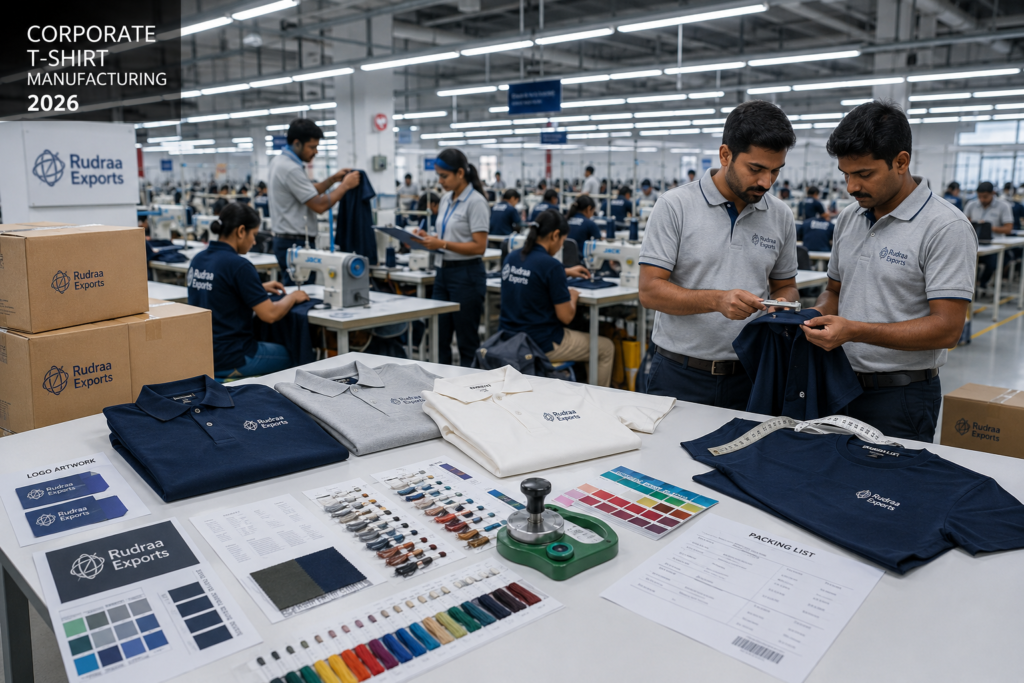
Corporate T-shirt manufacturing in Tirupur has become a serious procurement category for HR, admin, brand, event, and compliance teams. Companies are no longer buying “some printed T-shirts” casually. They need consistent fabric quality, brand-color accuracy, logo durability, size reliability, ethical sourcing, product safety, export documentation, and repeat supply across offices, events, onboarding kits, and multi-branch uniform programs.
Tirupur is a strong sourcing base for corporate T-shirts because the cluster keeps knitting, dyeing, printing, stitching, finishing, and packing within one geographic zone. That reduces handoff risk and helps buyers control timelines better than scattered multi-vendor sourcing. The uploaded research notes that Tirupur knitwear exports reached ₹40,000 crore in FY 2024–25, up around 20% from ₹33,400 crore in FY 2023–24, and that the region has roughly 20,000 units across the value chain with around 600,000 workers supporting production depth.
At Rudraa Exports, we support corporate buyers looking for factory-direct Tirupur T-shirt and knitwear manufacturing with controlled sampling, quality systems, bulk production, branding support, export documentation, and repeat-order consistency.
Quick Answer
Tirupur is one of the strongest locations for corporate T-shirt manufacturing in 2026 because it has deep knitwear infrastructure, skilled labor, fabric sourcing, dyeing, printing, stitching, packing, and export support within one cluster. Corporate buyers should choose suppliers based on ISO 9001 quality systems, OEKO-TEX product safety readiness, fabric GSM transparency, logo-printing control, MOQ flexibility, lead-time discipline, export documentation, and traceability. Rudraa Exports fits buyers that need factory-direct corporate T-shirts, branded polos, onboarding kits, event uniforms, and repeat supply programs with clear quality and procurement workflows.
Planning a corporate T-shirt or uniform program? Contact Rudraa Exports to share your logo artwork, target GSM, quantity, size ratio, delivery market, and required certifications.
Why Corporate T-Shirt Procurement Needs More Discipline in 2026
Corporate T-shirts may look simple, but bulk programs fail for predictable reasons:
- Logo colour mismatch
- Fabric shade variation across lots
- Wrong size ratios
- Poor print durability
- Neck rib stretching
- Shrinkage after washing
- Delayed event delivery
- Inconsistent packing by branch or department
- Missing labels, carton marks, or documentation
- Weak supplier communication during peak timelines
For HR and procurement teams, these failures are visible. If an annual event uniform arrives late, the supplier issue becomes an internal embarrassment. If onboarding kits have inconsistent branding, it affects employee experience. If corporate polos shrink or fade quickly, the company’s brand looks cheap.
That is why procurement teams need to treat corporate T-shirts like a controlled sourcing project, not like a casual merchandise purchase.
Why Tirupur Is Strong for Corporate T-Shirts
Tirupur’s advantage is not only low-cost manufacturing. Its real advantage is knitwear specialization.
Corporate T-shirts and polos usually depend on cotton jersey, pique, interlock, blends, rib, compacted fabric, printing, embroidery, finishing, and packing. Tirupur has a mature ecosystem around these exact categories.
The uploaded research states that Tirupur accounts for approximately 55% of India’s knitwear exports and as much as 90% of cotton knitwear exports in some estimates. That matters because cotton T-shirts and polos are core corporate apparel categories.
Tirupur Advantage for Corporate Buyers
| Tirupur Strength | Procurement Benefit |
|---|---|
| Knitwear specialization | Better fit for T-shirts, polos, uniforms, and onboarding kits |
| Dense supplier ecosystem | Faster coordination between fabric, dyeing, printing, stitching, and packing |
| Export experience | Better documentation support for global buyers |
| Skilled labor base | Better repeatability for bulk and replenishment orders |
| Multi-process cluster | Lower handoff risk compared with scattered sourcing |
| Sustainability infrastructure | Useful for ESG-focused corporate procurement |
| Factory-direct options | Better pricing transparency and accountability |
For corporate buyers, the key benefit is repeatability. You do not want one good sample and a messy bulk order. You want the same shade, same logo placement, same GSM, same fit, and same packing discipline across every batch.
What Corporate Buyers Should Ask Before Choosing a Supplier
A corporate buyer should not start with “What is your lowest price?” That is a weak question.
Start with procurement-safe questions:
✅ Can you handle our required quantity within the event timeline?
✅ What is your monthly production capacity?
✅ Can you support our fabric GSM and colour standards?
✅ Do you provide lab dips and pre-production samples?
✅ Can you match Pantone logo colours?
✅ Is printing or embroidery done in-house or outsourced?
✅ What QC checks happen before shipment?
✅ Do you follow AQL inspection standards?
✅ Can you provide ISO 9001 or compliance documentation?
✅ Can you pack by branch, department, size, or employee kit?
✅ Can you support repeat orders with shade continuity?
✅ Can you provide export documents if required?
If a supplier gives vague answers, move on. Corporate programs need clarity.
Corporate T-Shirt Supplier Evaluation Table
Use this table when comparing suppliers.
| Evaluation Area | What to Check | Why It Matters |
|---|---|---|
| Factory ownership | Manufacturer vs trader | Direct control reduces confusion |
| Capacity | Monthly output and line availability | Prevents event delivery failure |
| Fabric options | GSM, cotton, blends, pique, jersey | Controls comfort and durability |
| Sampling process | Lab dip, proto, PPS, size set | Prevents bulk mismatch |
| Logo method | Screen print, embroidery, heat transfer, DTF | Affects branding quality |
| QC system | Inline, end-line, final inspection | Reduces defects |
| Certifications | ISO 9001, OEKO-TEX, BSCI, WRAP, SMETA | Supports procurement compliance |
| MOQ flexibility | Per style, colour, and size | Helps corporate programs scale |
| Packing control | Branch-wise, size-wise, kit-wise | Reduces distribution errors |
| Export documents | Invoice, packing list, HS code, COO | Required for global shipment |
| Traceability | Fabric lot, production batch, packing records | Helps repeat orders and issue resolution |
Fabric and GSM Options for Corporate T-Shirts
Fabric choice determines how employees experience the garment. A cheap, thin T-shirt may save money upfront but damages the brand when it shrinks, fades, or feels uncomfortable.
Common Corporate T-Shirt Fabric Options
| Product Type | Common Fabric | GSM Range | Best Use |
|---|---|---|---|
| Event T-shirt | Cotton single jersey | 160–180 GSM | One-time events, campaigns |
| Premium corporate tee | Combed cotton jersey | 180–220 GSM | Onboarding kits, employee gifting |
| Corporate polo | Cotton pique / blend pique | 200–260 GSM | Staff uniforms, sales teams |
| Performance tee | Polyester / cotton-poly blend | 140–180 GSM | Sports events, outdoor teams |
| Heavyweight tee | Compact cotton jersey | 220+ GSM | Premium merchandise, leadership kits |
The uploaded research mentions core corporate specs such as 160–220 GSM single jersey and 200–260 GSM pique for polos.
The practical rule is simple: do not choose GSM blindly. Choose based on climate, usage, wash frequency, budget, and brand perception.
Printing and Embroidery: Where Corporate Orders Often Fail
For corporate T-shirts, the logo is not decoration. It is the brand.
Poor logo execution makes the entire order look cheap. Common problems include cracking prints, wrong Pantone shade, uneven placement, embroidery puckering, and inconsistent logo size across sizes.
Logo Application Comparison
| Method | Best For | Risk to Control |
|---|---|---|
| Screen printing | Large-volume event tees | Ink curing, cracking, shade matching |
| Embroidery | Premium polos and uniforms | Puckering, density, thread shade |
| Heat transfer | Small runs and detailed logos | Peeling, wash durability |
| DTF | Multi-colour logos and lower MOQs | Handfeel, wash performance |
| DTG | Short-run full-colour prints | Fabric compatibility and fading |
Buyers should approve:
- Logo size
- Logo placement
- Pantone colour
- Print method
- Wash-test result
- Embroidery thread shade
- Placement tolerance
- First-off production sample
Do not approve bulk printing based only on a digital mockup. That is lazy procurement.
ISO 9001 and OEKO-TEX: What They Mean for Corporate Buyers
Certifications help procurement and compliance teams reduce supplier risk, but they should be understood correctly.
ISO 9001
ISO 9001 is a quality management system standard. It does not automatically mean every T-shirt will be perfect. It means the factory has documented processes, internal audits, corrective actions, and a system for consistent quality.
The uploaded research correctly explains that ISO 9001 should be used as a governance signal, but buyers should still require their own fabric, print, and inspection approvals.
OEKO-TEX STANDARD 100
OEKO-TEX STANDARD 100 relates to harmful substance testing in textile products. For corporate T-shirts worn for long hours, this can be useful, especially for companies with employee safety and ESG screening requirements.
OEKO-TEX STeP
OEKO-TEX STeP is facility-focused and evaluates broader responsible production areas such as environmental performance, chemical management, health and safety, social responsibility, and compliance.
Certification Comparison for Corporate T-Shirts
| Certification | Helps With | Does Not Replace |
|---|---|---|
| ISO 9001 | Process reliability and quality systems | Product-specific inspection |
| OEKO-TEX STANDARD 100 | Harmful substance assurance | Fit, stitching, shrinkage checks |
| OEKO-TEX STeP | Facility responsibility | Product-specific test reports |
| BSCI / SMETA / WRAP | Social compliance | Fabric and print performance |
| GOTS | Organic textile claims | Corporate logo durability |
| GRS | Recycled material claims | Measurement consistency |
The right approach is not “certificate or no certificate.” The right approach is certificate + sample approval + testing + AQL inspection + packing control.
Manufacturing Process for Corporate T-Shirts
A good corporate T-shirt supplier should explain the production flow clearly.
Typical Corporate T-Shirt Manufacturing Flow
| Stage | What Happens | Buyer Control Point |
|---|---|---|
| Requirement brief | Product, logo, quantity, size ratio, market | Written RFQ |
| Fabric selection | GSM, composition, colour, finish | Fabric swatch approval |
| Lab dip | Colour matching | Shade approval |
| Sample development | Proto or pre-production sample | Fit and logo approval |
| Bulk fabric | Knitting, dyeing, compacting | Shade band control |
| Cutting | Fabric cut by size ratio | Marker and ratio check |
| Stitching | Sewing lines produce garments | Inline inspection |
| Printing / embroidery | Logo application | First-off approval |
| Finishing | Trimming, pressing, checking | End-line QC |
| Packing | Size-wise, branch-wise, carton-wise | Packing list approval |
| Final inspection | AQL-based quality check | Shipment release |
| Export dispatch | Documents and logistics | Invoice, packing list, B/L |
The uploaded research highlights common failure points such as PPS gaps, fabric and dye variation, print and embroidery inconsistency, and packing errors.
This table helps procurement teams ask the right questions at each stage.
MOQ and Lead Time for Corporate T-Shirt Orders
Corporate programs vary widely. A leadership offsite may need 300 T-shirts. A national sales meet may need 3,000. A multi-branch uniform program may need 20,000 or more.
So MOQ must be discussed by:
- Style
- Colour
- Size ratio
- Fabric
- Print method
- Packing method
- Reorder plan
Corporate Order Size Planning
| Order Type | Typical Requirement | Supplier Planning Need |
|---|---|---|
| Small event | 100–500 pcs | Fast sampling, low MOQ |
| Company event | 500–3,000 pcs | Colour and logo consistency |
| Annual uniform program | 3,000–20,000 pcs | Capacity booking and size planning |
| Multi-branch program | 20,000+ pcs | Batch control, branch-wise packing |
| Repeat onboarding kit | Monthly/quarterly replenishment | Long-term shade and inventory planning |
Lead time depends on fabric availability, dyeing, printing, approval speed, packing complexity, and shipment mode. Corporate buyers should never accept a vague “we can do fast” answer. Ask for a dated critical path.
Corporate Packing Requirements
Packing is where many corporate orders fall apart.
A normal garment supplier may pack by size and carton. But corporate buyers may need packing by:
- Branch
- Department
- Event location
- Employee kit
- Size ratio
- Gender fit
- Region
- Campaign batch
- Store or office code
Packing Control Checklist
✅ Size-wise bundle plan
✅ Carton-wise packing list
✅ Branch-wise allocation
✅ Barcode or sticker requirement
✅ Carton marking format
✅ Spare quantity rules
✅ Damage replacement buffer
✅ Final carton count check
✅ Destination-wise dispatch plan
If packing is wrong, the product may be good but the program still fails.
Direct Factory vs Agent Sourcing for Corporate T-Shirts
Corporate buyers often use agents because it feels convenient. But convenience can create cost and visibility problems.
| Area | Direct Factory | Agent / Trader |
|---|---|---|
| Pricing | More transparent | Margin may be hidden |
| Communication | Direct with production team | Buyer → agent → factory |
| Sampling feedback | Faster | Slower due to handoffs |
| Logo control | Easier to correct | Depends on agent coordination |
| Compliance proof | Directly requested | Depends on factory access |
| Packing control | More accountable | Can become fragmented |
| Best for | Repeat programs and brand control | One-off convenience sourcing |
A direct-factory model can reduce confusion, but only if the buyer provides proper specs and approvals. Direct sourcing does not fix poor procurement discipline.
12-Point Factory Evaluation Checklist for Corporate Buyers
Use this checklist before awarding your corporate T-shirt order.
| # | Evaluation Point | Evidence Required |
|---|---|---|
| 1 | Company profile and years in operation | Factory profile, registration |
| 2 | Monthly capacity and peak-load plan | Capacity sheet, line plan |
| 3 | MOQ and price-break transparency | Quote grid |
| 4 | Fabric menu and GSM options | Swatches and test reports |
| 5 | Shade control process | Lab dip and shade band |
| 6 | Printing and embroidery control | Samples, first-off approval process |
| 7 | Sampling workflow | Proto, PPS, size set timeline |
| 8 | Quality system evidence | ISO 9001 and QC records |
| 9 | Product safety assurance | OEKO-TEX or testing documentation |
| 10 | Social/environmental responsibility | BSCI, SMETA, WRAP, STeP or equivalent |
| 11 | Export documentation readiness | Invoice, packing list, HS code, COO |
| 12 | Traceability and after-sales support | Lot records, defect handling policy |
The uploaded research recommends scoring each supplier from 1–5 and requiring evidence for scores above 3. That is a smart procurement method because it stops teams from choosing suppliers based on vague confidence.
Why Rudraa Exports
Rudraa Exports fits corporate buyers that need factory-direct Tirupur production with practical support for branded T-shirts, polos, uniforms, onboarding kits, and event apparel.
Manufacturing Capabilities
- Factory-direct Tirupur T-shirt and knitwear manufacturing
- 72,000+ units per month production capacity
- Corporate T-shirts, branded polos, onboarding kits, event uniforms, promotional tees, and private-label knitwear
- MOQs starting from around 300 pieces per style, depending on fabric, colour, and customization
- Fabric sourcing, sampling, cutting, stitching, printing, embroidery coordination, finishing, packing, and export documentation support
Quality and Compliance
- ISO 9001:2015 certified manufacturing approach
- AQL 2.5 inspection standards
- Support for buyer-defined GSM, shade, logo placement, print durability, and packing controls
- Certification-aligned sourcing support for OEKO-TEX, GOTS, GRS, BSCI, SMETA, WRAP, and related buyer standards where applicable
- Traceability support across fabric lots, production batches, inspection records, and packing lists
International Buyer Advantages
- Factory-direct pricing without trading-company markups
- Up to 40% cost-saving positioning compared with indirect sourcing models
- English-language communication for HR, procurement, admin, and brand teams
- Export support for EU, USA, Australia, and Middle East markets
- Multi-port shipping through Tuticorin VOC, Chennai, and Cochin
- FTA-eligible documentation support for relevant destination markets
Ready to source corporate T-shirts without agent confusion? Speak with Rudraa Exports for a quote based on your logo artwork, fabric GSM, quantity, packing plan, and delivery timeline.
FAQ: Corporate T-Shirt Manufacturing in Tirupur
1. Why is Tirupur a good place to source corporate T-shirts?
Tirupur is strong for corporate T-shirts because it has a dense knitwear ecosystem covering fabric, dyeing, printing, stitching, finishing, packing, and export support. The uploaded research highlights Tirupur’s ₹40,000 crore FY 2024–25 knitwear exports and around 20,000 units across the value chain.
2. What fabric is best for corporate T-shirts?
For standard corporate T-shirts, 160–220 GSM cotton single jersey is common. For corporate polos, 200–260 GSM pique is often used. The right fabric depends on climate, budget, usage, wash frequency, and brand positioning.
3. What is the difference between corporate T-shirts and event T-shirts?
Event T-shirts are often short-term promotional garments, while corporate T-shirts or polos may be used repeatedly as uniforms, onboarding kit items, or brand apparel. Corporate programs usually need better shade control, logo durability, packing discipline, and repeat-order consistency.
4. What certifications should a corporate T-shirt manufacturer have?
Useful certifications and compliance signals include ISO 9001, OEKO-TEX STANDARD 100, BSCI, SMETA, WRAP, GOTS, GRS, and related buyer-specific standards. ISO 9001 supports quality systems, while OEKO-TEX supports harmful substance assurance.
5. Is ISO 9001 enough to guarantee quality?
No. ISO 9001 is a quality management system standard, not a guarantee that every garment will be perfect. Buyers should still require approved samples, fabric tests, logo approval, inline checks, and AQL final inspection.
6. What printing method is best for corporate T-shirts?
Screen printing is usually best for large-volume event tees, embroidery is better for premium polos, DTF can work for multi-colour smaller runs, and heat transfer may suit certain short-run requirements. The best method depends on logo complexity, quantity, fabric, and wash expectations.
7. How do I prevent logo colour mismatch?
Use Pantone references, approved artwork files, print strike-offs, first-off production approval, and shade/placement tolerance. Do not approve bulk printing based only on a digital mockup.
8. What MOQ should I expect for corporate T-shirts?
MOQ depends on fabric, colour, print method, and packing complexity. Small events may need hundreds of pieces, while multi-branch programs may need thousands. Ask for MOQ per style, colour, and size ratio.
9. How should corporate T-shirts be packed?
Corporate T-shirts can be packed size-wise, branch-wise, department-wise, employee-kit-wise, or location-wise. The packing method must be finalized before production because it affects labeling, carton planning, and dispatch accuracy.
10. What documents are needed for corporate T-shirt exports?
Common export documents include commercial invoice, packing list, Bill of Lading or Air Waybill, certificate of origin where required, HS code details, inspection reports, and buyer-specific compliance documents.
11. Is factory-direct sourcing better than using an agent?
Factory-direct sourcing can improve price transparency, communication, sampling feedback, and accountability. But it works best when the buyer provides clear specs, approval timelines, and inspection requirements.
12. Why choose Rudraa Exports for corporate T-shirts?
Rudraa Exports is suitable for corporate buyers that need factory-direct Tirupur manufacturing, controlled sampling, GSM and logo consistency, AQL-based inspection, export documentation, and repeat-order support without unnecessary trading-company layers.
Conclusion
Corporate T-shirt manufacturing in 2026 requires more than a cheap quote. Procurement teams need a supplier that can manage fabric, GSM, colour, logo placement, print durability, size ratios, packing, compliance documents, export timelines, and repeat-order consistency. Tirupur gives corporate buyers a strong production base because of its knitwear depth, export infrastructure, skilled workforce, and integrated supplier ecosystem.
Visit rudraaexports.com or contact our team directly to share your corporate T-shirt requirement, logo artwork, target GSM, quantity, packing plan, and delivery market — and receive a transparent factory-direct quote built for serious corporate buyers in 2026.
Related reading
Case study: corporate uniforms for a 1,200-employee Singapore tech company
What Printing Techniques Are Best for Custom T-Shirts in 2026? Complete Buyer’s Guide
What Is the MOQ for Corporate T-Shirts from Tirupur Manufacturers in 2026?
T-Shirts with Logo from India: Custom Branding Options for Corporate and Brand Orders