
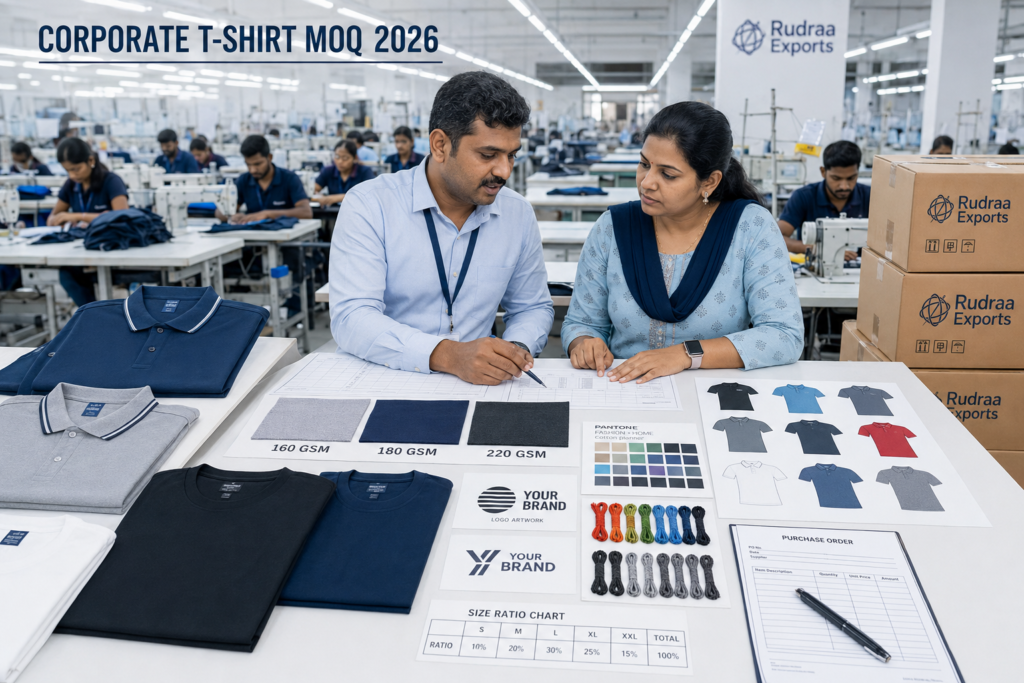
The MOQ for corporate T-shirts from Tirupur manufacturers depends on one thing most buyers underestimate: production efficiency. A factory is not only calculating how many T-shirts you want. It is calculating fabric sourcing, dyeing batches, cutting efficiency, logo setup, stitching line planning, finishing, packing, and dispatch control.
For custom corporate T-shirts, most Tirupur manufacturers work best in the 300 pieces per design or colour range because this is where knitting, dyeing, cutting, printing or embroidery, and finishing become efficient. But Tirupur is not a one-size-fits-all market. Smaller runs such as 50–100 pieces are also possible through smaller units, stock fabrics, and digital decoration workflows, but they usually come with higher per-piece pricing, fewer colour options, or tighter specification limits.
At Rudraa Exports, we help corporate buyers structure MOQ properly instead of over-ordering blindly. The goal is not just to hit the lowest number. The goal is to balance MOQ, price, fabric quality, logo method, lead time, and repeat-order planning.
Quick Answer
For corporate T-shirts from Tirupur manufacturers in 2026, buyers should expect a practical MOQ of 300 pieces per design or colour for factory-efficient custom production. Low MOQs such as 50–300 pieces may be possible for simple designs, stock fabrics, standard GSMs, and digital print workflows, but unit cost is usually higher. Bulk advantages usually improve from 1,000–3,000 pieces, while 5,000+ pieces can unlock stronger price breaks because fabric sourcing, dyeing, printing, and stitching lines run more efficiently.
Need help planning MOQ for a corporate T-shirt order? Contact Rudraa Exports to share your quantity, logo method, GSM, colour count, size ratio, and delivery deadline.
What MOQ Really Means in Corporate T-Shirt Manufacturing
MOQ means Minimum Order Quantity. But in corporate T-shirt manufacturing, MOQ is not just a random factory rule. It is the minimum quantity where production becomes practical without wasting too much setup time, fabric, dyeing effort, cutting efficiency, logo preparation, and packing labor.
A buyer may ask:
“Can you make 100 corporate T-shirts?”
The honest answer is:
“Yes, maybe — but not at the same price, colour flexibility, or production efficiency as 1,000 pieces.”
That is the key difference between available MOQ and efficient MOQ.
Standard MOQ vs Available MOQ
Corporate buyers must understand this distinction clearly.
| MOQ Type | Typical Quantity | What It Means |
|---|---|---|
| Available low MOQ | 50–100 pcs | Possible for simple specs, stock fabrics, or digital decoration |
| Startup-friendly MOQ | 100–300 pcs | Useful for small events, pilot runs, or team orders |
| Factory-efficient MOQ | 300 pcs per design/colour | Best starting range for corporate programs |
| Scale MOQ | 1,000–3,000 pcs | Better pricing and stronger process control |
| Volume MOQ | 5,000+ pcs | Best unit economics and stronger negotiation leverage |
The uploaded research states that most Tirupur manufacturers work with 300 pieces per design or colour for custom corporate programs, while lower MOQ options like 50–100 pieces are possible through smaller units and digital workflows.
This means buyers should not ask only, “What is your MOQ?” They should ask:
“What MOQ gives me the best balance of price, quality, lead time, and customization?”
Why MOQ Is Usually Per Design or Colour
Most buyers think MOQ is based on total order quantity. That is not always true.
In T-shirt manufacturing, MOQ is often linked to:
- Per design
- Per colour
- Per fabric
- Per GSM
- Per logo method
- Per size ratio
- Per packing type
For example, 1,000 corporate T-shirts in one colour is far easier than 1,000 T-shirts split across five colours. Why? Because each colour may need separate dyeing, shade approval, cutting segregation, printing setup, and packing control.
MOQ Example
| Order Plan | Factory View |
|---|---|
| 1,000 pcs, one colour, one logo | Efficient |
| 1,000 pcs, five colours, one logo | 300 pcs per colour; less efficient |
| 1,000 pcs, one colour, five logo variations | More logo setup and segregation |
| 1,000 pcs, five colours, five logos | Complex and costlier |
| 5,000 pcs, two colours, one logo | Stronger efficiency and better pricing |
If your order is small, reduce complexity. That is the simplest MOQ hack.
What Drives MOQ in Tirupur Corporate T-Shirt Manufacturing?
MOQ is driven by production setup. Here are the main factors.
1. Fabric Type and GSM
Corporate T-shirts commonly use cotton single jersey, combed cotton, compact cotton, poly-cotton blends, pique fabric for polos, or performance blends.
The uploaded research notes that corporate tees commonly use GSM ranges around 160–220 GSM, depending on use case and desired opacity or drape.
| Fabric Type | Common Use | MOQ Impact |
|---|---|---|
| Stock cotton jersey | Event tees, onboarding kits | Lower MOQ possible |
| Custom dyed cotton jersey | Brand-specific corporate colour | Higher MOQ |
| Pique fabric | Corporate polos | Higher than basic round neck |
| Organic cotton | ESG-focused programs | Higher documentation and sourcing requirement |
| Performance fabric | Sports events, outdoor teams | Depends on fabric availability |
| Custom GSM | Premium corporate merchandise | Higher MOQ if not standard |
If you choose standard fabric and GSM, MOQ is easier. If you demand custom yarn, custom dyeing, or unusual GSM, MOQ goes up.
2. Colour Count
Colour is one of the biggest MOQ drivers.
MOQ is often calculated per colour because dyeing is batch-based. If your brand requires exact corporate Pantone colours, the factory may need lab dips and dedicated dyeing. That adds time and minimums.
| Colour Strategy | MOQ Impact |
|---|---|
| One standard colour | Lowest complexity |
| Two colours | Manageable |
| Multiple department colours | Higher planning complexity |
| Exact Pantone corporate shade | Lab dip and dyeing control needed |
| Custom seasonal shades | Higher MOQ and longer lead time |
For smaller corporate orders, use fewer colours and differentiate teams through logo variation, neck labels, sleeve print, or packaging.
3. Logo Method
Logo application affects setup cost.
| Logo Method | Best For | MOQ Impact |
|---|---|---|
| Screen printing | Medium to large runs | Efficient at scale |
| Embroidery | Premium polos and uniforms | Higher setup and machine time |
| DTF | Small to mid-sized multi-colour logos | More flexible for low MOQ |
| DTG | Short runs and detailed artwork | Low MOQ friendly but fabric-dependent |
| Heat transfer | Event or special-use apparel | Flexible but must test wash durability |
The uploaded guide notes that digital decoration routes such as DTF and DTG can support smaller, faster runs compared with traditional setups.
If your order is below 300 pieces, digital printing may be more practical than screen printing.
4. Product Type: Round Neck vs Polo
Round-neck T-shirts are usually easier than polos.
Polos require collars, plackets, buttons, sometimes tipping, pockets, and more stitching operations. That increases production complexity and can increase MOQ.
| Product Type | MOQ Complexity |
|---|---|
| Basic round-neck T-shirt | Lower |
| Round-neck with one print | Low to medium |
| Round-neck with multiple prints | Medium |
| Polo with embroidery | Medium to high |
| Polo with collar tipping and pocket | Higher |
| Multi-location uniform pack | Higher |
For small corporate orders, start with a simple round-neck T-shirt. Move to polos when quantity and budget justify it.
MOQ and Pricing: How Quantity Changes Cost
MOQ is closely linked to pricing. Lower MOQ usually means higher unit cost because setup costs are spread across fewer pieces.
The uploaded research gives market sanity references: domestic listings show plain round-neck tees across broad price ranges depending on fabric and quantity, and export-oriented bulk marketplace references often vary heavily by MOQ and specification.
Practical MOQ Pricing Logic
| Quantity Tier | Pricing Expectation | Buyer Use Case |
|---|---|---|
| 50–100 pcs | Highest per-piece cost | Small team, urgent event, test run |
| 100–300 pcs | Higher but manageable | Startup, pilot, department order |
| 500–1,000 pcs | More efficient pricing | Standard corporate program |
| 1,000–3,000 pcs | Better negotiation room | Company-wide uniform or event |
| 5,000+ pcs | Stronger price breaks | National campaigns, multi-branch rollout |
The biggest unit-cost improvement often happens when the order crosses from small-batch to factory-efficient production. A 100-piece order and a 1,000-piece order do not behave the same in production costing.
Why 5,000+ Pieces Usually Gets Better Pricing
At 5,000+ pieces, the factory can plan longer production runs, buy fabric more efficiently, reduce setup cost per piece, optimize cutting, and spread logo setup across higher volume.
The uploaded research points out that 5,000+ pieces can create meaningful unit-cost drops because fabric procurement, dyeing utilization, and line balancing improve.
Why 5,000+ Helps
✅ Better fabric purchase efficiency
✅ Lower setup cost per piece
✅ Longer uninterrupted sewing run
✅ Better dyeing batch economics
✅ Stronger negotiation leverage
✅ More packaging customization options
✅ Better QC planning
✅ Easier dedicated production scheduling
If you have repeat events, onboarding kits, or multi-location employee programs, consider combining demand into one production run and dispatching in phases.
Lead Time for Corporate T-Shirts from Tirupur
The uploaded research says 15–30 days is a realistic planning range for corporate bulk T-shirts from Tirupur once artwork, fabric, and sampling are approved.
But this timeline depends on your complexity.
Typical Timeline
| Stage | Timeline |
|---|---|
| Tech pack + RFQ | 1–3 days |
| Lab dip / shade approval | 3–7 days |
| Pre-production sample | 5–10 days |
| Bulk production | 7–15 days |
| Final QC + packing + dispatch | 2–5 days |
This assumes approvals move fast. If your team takes one week to approve a logo strike-off, the factory cannot magically recover that lost time.
Sampling Before Bulk Production
Sampling is not optional. It protects your MOQ investment.
For corporate T-shirts, sampling should confirm:
- Fabric GSM
- Fabric handfeel
- Colour shade
- Logo placement
- Print size
- Print colour
- Embroidery quality
- Measurement tolerance
- Wash performance
- Packing format
Sampling Checklist
| Sample Type | Purpose |
|---|---|
| Fabric swatch | Confirms GSM and handfeel |
| Lab dip | Confirms colour |
| Logo strike-off | Confirms print/embroidery quality |
| Fit sample | Confirms measurement and fit |
| Pre-production sample | Final approval before bulk |
| TOP sample | First output from production line |
The uploaded research says sampling is the gate that makes MOQ manageable because it prevents expensive bulk mistakes. That is correct.
How to Lower MOQ Without Destroying Quality
If you need fewer than 500 pieces, do not just pressure the factory. Redesign the order.
MOQ Reduction Tactics
| Tactic | How It Helps |
|---|---|
| Reduce colour count | Improves dyeing and cutting efficiency |
| Use stock fabric | Avoids fresh knitting/dyeing minimums |
| Use standard GSM | Keeps sourcing simple |
| Choose digital print | Better for small runs |
| Keep one logo placement | Reduces setup cost |
| Consolidate orders | Combines event, onboarding, and uniform demand |
| Split delivery, not production | Keeps production efficient while managing inventory |
| Plan repeat orders | Gives factory confidence to support lower first MOQ |
The uploaded research gives similar tactics, including reducing colour count, standardizing fabric across events, using digital decoration for small batches, and splitting delivery rather than production.
MOQ Planning Examples
Example 1: 600-Piece Employee Onboarding Kit
A company needs 600 round-neck T-shirts for two office locations. They choose one GSM, one colour, and one chest logo.
This fits well into the 500–1,000-piece factory-efficient range. The factory can run the order cleanly, maintain colour consistency, and simplify packing.
Example 2: 240-Piece Event T-Shirt Order
An event team needs 240 T-shirts across two colours with a multi-colour front design.
This is below the standard efficient MOQ, so the better route may be digital decoration such as DTF or DTG. Unit cost will be higher, but the buyer avoids unnecessary inventory.
Example 3: 7,500-Piece National Corporate Campaign
A corporate brand needs 7,500 polos with embroidery and retail-style packing.
At this volume, the buyer can negotiate better pricing, stronger QC, better packaging options, and more stable production planning.
The uploaded research includes similar practical examples for 600-piece, 240-piece, and 7,500-piece corporate programs.
10-Point MOQ and Order Planning Checklist
Use this before asking for a quote.
- Define the use case: uniform, event, promo, onboarding kit, or paid merch
- Choose product type: round neck, polo, oversized tee, performance tee
- Lock fabric spec: cotton, blend, GSM, finish
- Decide colour count and quantity per colour
- Confirm logo method: screen print, embroidery, DTF, DTG, heat transfer
- Finalize size curve and size ratio
- Confirm sample needs: swatch, lab dip, logo strike-off, PPS
- Decide target dispatch date and buffer time
- Define QC checkpoints and acceptance criteria
- Confirm price tiers, packing, shipment, and repeat-order plan
This checklist will save you from asking vague questions and getting useless quotes.
Why Rudraa Exports
Rudraa Exports helps corporate buyers structure MOQ based on product reality instead of guesswork.
Manufacturing Capabilities
- Factory-direct Tirupur T-shirt and knitwear manufacturing
- 72,000+ units per month production capacity
- Corporate round-neck T-shirts, polos, onboarding kits, event tees, uniforms, and promotional knitwear
- MOQs starting from around 300 pieces per style, depending on fabric, colour, logo method, and customization
- Fabric sourcing, sampling, cutting, stitching, printing/embroidery coordination, finishing, packing, and export documentation support
Quality and Compliance
- ISO 9001:2015 certified manufacturing approach
- AQL 2.5 inspection standards
- Support for buyer-defined GSM, shade, logo placement, measurement tolerance, and packing controls
- Certification-aligned sourcing support for OEKO-TEX, GOTS, GRS, BSCI, SMETA, WRAP, and related buyer standards where applicable
- Traceability support across fabric lots, production batches, inspection records, and packing lists
International Buyer Advantages
- Factory-direct pricing without trading-company markups
- Up to 40% cost-saving positioning compared with indirect sourcing models
- English-language communication for procurement, HR, admin, and brand teams
- Export support for EU, USA, Australia, and Middle East markets
- Multi-port shipping through Tuticorin VOC, Chennai, and Cochin
- FTA-eligible documentation support for relevant destination markets
Ready to plan the right MOQ instead of over-ordering? Speak with Rudraa Exports for a custom MOQ strategy based on your GSM, colour count, logo method, size ratio, and delivery deadline.
FAQ: Corporate T-Shirt MOQ from Tirupur
1. What is the usual MOQ for corporate T-shirts from Tirupur?
For custom corporate T-shirts, the practical MOQ is usually 300 pieces per design or colour for factory-efficient production. Smaller quantities may be possible, but they often come with higher per-piece pricing or specification limits.
2. Can Tirupur manufacturers make only 50–100 corporate T-shirts?
Yes, some Tirupur suppliers can support 50–100 pieces, especially with stock fabrics and digital printing. But buyers should expect higher unit cost, fewer fabric options, and less flexibility in colour matching.
3. Is MOQ calculated per design, colour, or size?
MOQ is commonly calculated per design or colour because dyeing, cutting, printing, and batching depend heavily on colour and artwork. Sizes are usually mixed within the run, but extreme size ratios can affect cutting efficiency.
4. Why does MOQ increase for custom colours?
Custom colours require lab dips, dyeing batches, shade control, and sometimes fresh fabric processing. This creates minimums at the dyeing and fabric level, which increases MOQ.
5. What is the best MOQ for better pricing?
The 500–1,000-piece range is usually more efficient than very small orders. Stronger pricing often starts from 1,000–3,000 pieces, while 5,000+ pieces can unlock better volume discounts.
6. How long does bulk corporate T-shirt production take in Tirupur?
The uploaded research gives 15–30 days as a realistic planning range after artwork, fabric, and sampling approvals. Timeline depends on fabric availability, colour count, logo method, and packing complexity.
7. How can I lower MOQ without reducing quality?
Use stock fabric, reduce colour count, choose standard GSM, keep logo placement simple, use digital printing for small runs, consolidate multiple events into one production plan, and split delivery instead of splitting production.
8. Is screen printing good for low MOQ corporate T-shirts?
Screen printing is usually more efficient at medium to large quantities because screen setup costs are spread across more pieces. For low MOQ or multi-colour artwork, DTF or DTG may be more practical.
9. Are polos higher MOQ than round-neck T-shirts?
Often yes. Polos require collars, plackets, buttons, sometimes tipping or pockets, and more stitching operations. This increases complexity compared with basic round-neck T-shirts.
10. Should I order more than I need to get a lower price?
Not always. Over-ordering creates inventory waste. A smarter option is to consolidate future needs into one production plan or negotiate phased dispatch while keeping production efficient.
11. What details should I send to get an accurate MOQ quote?
Send product type, fabric composition, GSM, colour count, logo artwork, print method, size ratio, total quantity, packing requirement, target delivery date, and destination market.
12. Why choose Rudraa Exports for corporate T-shirt MOQ planning?
Rudraa Exports helps buyers structure corporate T-shirt orders around realistic MOQ, fabric availability, logo method, production efficiency, quality checks, and export timelines without unnecessary trading-company layers.
Conclusion
The MOQ for corporate T-shirts from Tirupur manufacturers in 2026 depends on design, colour, fabric, GSM, logo method, size ratio, packing, and repeat-order potential. The realistic factory-efficient range is usually 300 pieces per design or colour, while low MOQs such as 50–300 pieces may be possible for simpler orders using stock fabrics and digital decoration. Buyers get stronger pricing and process control when they plan around 1,000+ pieces, and 5,000+ pieces often unlock better volume economics.
Visit rudraaexports.com or contact our team directly to share your corporate T-shirt requirement, target MOQ, GSM, colour count, logo method, size ratio, and delivery market — and receive a transparent factory-direct MOQ and pricing plan for 2026.
Related reading
Case study: corporate uniforms for a 1,200-employee Singapore tech company
What Does It Actually Cost to Produce Custom T-Shirts in 2026? Factory-Direct Cost Breakdown
Corporate T-Shirt Customization Guide for Brand Managers in 2026
Custom T-Shirts for Events and Tours: How to Order in Bulk from India