
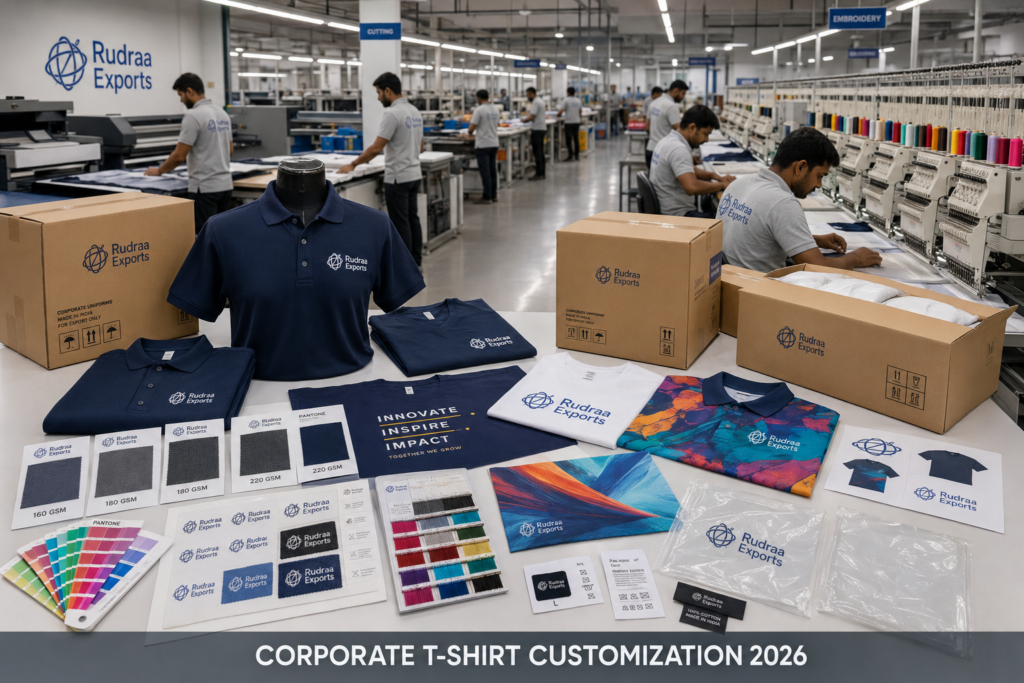
Corporate T-shirt customization in 2026 is no longer just about adding a company logo to a plain tee. For brand managers, HR teams, procurement teams, and event planners, a corporate T-shirt has to carry brand identity, employee comfort, campaign purpose, budget control, and delivery reliability at the same time.
A customized T-shirt may be used for onboarding kits, trade shows, retail staff uniforms, dealer meets, CSR runs, sports days, executive gifting, or internal culture programs. Each use case needs a different decision: cotton or polyester, screen print or embroidery, 160 GSM or 220 GSM, standard fit or women’s fit, Pantone match or stock colour, individual packing or bulk carton packing.
The uploaded customization research explains that Tirupur stands out for knitwear specialization and end-to-end capabilities in knitting, dyeing, cutting, sewing, printing, embroidery, and packaging. It also highlights that buyers can start with a small 300-piece pilot and later scale to 2,000–20,000 units for multi-location uniform programs if specifications are locked early.
At Rudraa Exports, we help corporate buyers choose the right customization path based on fabric, GSM, logo method, quantity, budget, wash-life expectations, packing needs, and delivery timelines.
Quick Answer
Corporate T-shirt customization should be planned around the use case, quantity, fabric, logo method, colour accuracy, fit, labels, packaging, and repeat-order needs. Screen printing works best for larger runs and spot-colour logos, DTG is useful for small batches and detailed artwork, sublimation is ideal for polyester performance tees, heat transfer works for fast personalization, and embroidery is best for premium polos and long-lasting corporate uniforms. Tirupur manufacturers can support these options, but buyers must approve swatches, strike-offs, lab dips, samples, and packing details before bulk production.
Need help choosing the right customization method? Contact Rudraa Exports to share your logo, quantity, GSM target, fabric preference, and delivery timeline.
Why Corporate T-Shirt Customization Matters
A corporate T-shirt is not just apparel. It is a walking brand asset.
When employees wear it at an event, when sales teams wear it at a dealer meet, or when customers receive it as merchandise, the T-shirt speaks for the brand. If the fabric feels cheap, the logo cracks, the colour looks wrong, or the fit is uncomfortable, the brand looks careless.
Good customization solves four things:
| Customization Goal | Why It Matters |
|---|---|
| Brand consistency | Logo, colour, and placement must match brand standards |
| Employee comfort | Fabric and fit affect actual usage |
| Durability | Print, embroidery, and fabric must survive washing |
| Operational control | Labels, packing, and dispatch must match the campaign plan |
Corporate buyers should not ask, “Can you print our logo?” They should ask, “Which customization method gives the best result for our use case, quantity, wash expectation, and budget?”
Corporate T-Shirt Customization Options at a Glance
| Customization Method | Best For | Quantity Fit | Key Risk |
|---|---|---|---|
| Screen printing | Bulk corporate tees, events, uniforms | Medium to high volume | Cracking if curing is poor |
| DTG printing | Detailed artwork, small batches, photo prints | Low to medium volume | Colour variation and pretreatment issues |
| Sublimation | Polyester sports tees, all-over prints | Medium to high volume | Works best on light polyester |
| Heat transfer / vinyl | Fast personalization, names, numbers | Low volume | Peeling or edge lift |
| Embroidery | Corporate polos, premium uniforms | Low to high volume | Puckering or unreadable small text |
| Custom fabric | Premium programs, uniforms | Medium to high volume | Higher MOQ and lead time |
| Pantone dyeing | Brand-colour accuracy | Medium to high volume | Shade variation across dye lots |
| Private labels | Brand ownership and retail finish | Any planned program | Delays if labels are not approved |
| Custom packaging | Onboarding kits, gifting, multi-site dispatch | Any planned program | Packing errors if not specified |
A good factory should not push one method for every order. The right method depends on the buyer’s goal.
1. Screen Printing for Corporate T-Shirts
Screen printing is one of the most common customization methods for corporate T-shirts. It works especially well for bold logos, spot colours, large event orders, and repeat uniform programs.
The uploaded research says screen printing remains a workhorse for corporate tees because it is cost-efficient at volume and stable for brand consistency. It also notes that high-quality screen prints can commonly hold up for many wash cycles when curing and care are handled properly.
When Screen Printing Works Best
| Use Case | Why Screen Printing Fits |
|---|---|
| Annual company event | Cost-effective for medium and large quantities |
| Dealer meet T-shirts | Strong logo visibility |
| Retail staff uniforms | Repeatable print placement |
| Promotional campaign tees | Efficient for bold artwork |
| Large onboarding kits | Consistent branding across batches |
Buyer Checklist for Screen Printing
✅ Provide vector logo files
✅ Define Pantone colours
✅ Confirm print size and placement
✅ Ask for strike-off approval
✅ Confirm ink type
✅ Ask about curing controls
✅ Run wash-test approval for repeat-use garments
✅ Approve first production print before full run
Screen printing is excellent when done correctly. But poor curing can create cracking, fading, or peeling. So the approval process matters.
2. DTG Printing for Small and Detailed Corporate Runs
DTG, or Direct-to-Garment printing, prints artwork directly onto the garment. It is useful when the design has gradients, photographic artwork, multiple colours, or small-batch personalization.
The uploaded guide explains that DTG is favored for high-resolution or multi-colour artwork without screen setup complexity and is useful for short runs or tight deadlines.
When DTG Works Best
| Use Case | Why DTG Fits |
|---|---|
| 50–200 piece leadership offsite | No screen setup needed |
| Product launch artwork | Handles detailed graphics |
| Location-specific event tees | Good for variable artwork |
| Startup merchandise drops | Lower commitment than bulk screen printing |
| Personalization | Easier for changing names or graphics |
DTG Risk Controls
- Print on the actual fabric colour before approval
- Confirm pretreatment process
- Avoid expecting exact Pantone matching
- Approve a physical sample, not only a digital mockup
- Check wash durability expectations
DTG is flexible, but it is not always the cheapest option at scale. For thousands of pieces, screen printing may become more economical.
3. Sublimation for Corporate Sports and Performance T-Shirts
Sublimation works differently from surface printing. It dyes the fabric, usually polyester, so the print becomes part of the garment. This gives strong colour vibrancy and a smooth handfeel because there is no thick print layer on top.
The uploaded research positions sublimation as ideal for polyester, sportswear, all-over prints, and designs that need strong wash durability and colour retention.
When Sublimation Works Best
| Use Case | Why Sublimation Fits |
|---|---|
| Corporate marathon tees | Lightweight, breathable, vibrant |
| Sports day uniforms | Durable prints, strong colour |
| Sponsor-heavy event tees | Good for multiple logos |
| Dealer meet sports apparel | All-over branding possible |
| Performance workwear | Good for quick-dry polyester |
Sublimation Buyer Notes
✅ Works best on polyester
✅ Best on white or light base fabric
✅ Ideal for all-over patterns
✅ Strong for sports and outdoor use
✅ Not suitable for classic cotton T-shirts
✅ Test colours under different lighting conditions
If the buyer wants a premium cotton corporate tee, sublimation is usually not the right method. If the buyer wants a sports event performance tee, sublimation may be the best option.
4. Heat Transfer and Vinyl for Fast Personalization
Heat transfer applies a printed or cut design using heat and pressure. It is useful for small batches, names, numbers, and urgent event requirements.
The uploaded source explains that heat transfer is popular for short runs and personalization, but long-term wear can include cracking or edge lift depending on vinyl type, application parameters, and wash conditions.
When Heat Transfer Works Best
| Use Case | Why It Fits |
|---|---|
| Last-minute event tees | Fast turnaround |
| Crew T-shirts | Names, roles, and numbers |
| Security or volunteer apparel | Simple text customization |
| Department-specific orders | Easy artwork variation |
| One-time campaign apparel | Practical for short-use garments |
Heat Transfer Risk Controls
- Confirm vinyl or transfer type
- Ask for PVC-free options if required
- Approve peel and adhesion checks
- Confirm washing care instructions
- Avoid using low-quality transfers for long-term uniforms
Heat transfer is useful, but it should not be treated as the best method for every corporate program.
5. Embroidery for Corporate Polos and Premium Uniforms
Embroidery is the premium choice for corporate polos, uniforms, and executive gifting. It gives a more formal look than print and often lasts longer because the branding is created with thread.
The uploaded research notes that embroidery is often considered one of the most durable branding methods and is especially suitable for corporate polos and premium uniforms.
Best Embroidery Placements
| Placement | Best Use |
|---|---|
| Left chest | Standard corporate logo |
| Sleeve | Partner logo, department mark, event year |
| Back neck | Premium subtle branding |
| Pocket area | Uniform styling |
| Cap or accessory | Extended merchandise set |
Embroidery Buyer Checklist
✅ Provide vector logo
✅ Avoid tiny text
✅ Confirm minimum letter height
✅ Ask for digitized embroidery proof
✅ Approve actual stitched sample
✅ Confirm thread colours
✅ Confirm backing type
✅ Check puckering on lightweight fabrics
Embroidery is durable, but it is not suitable for every design. Very small text, gradients, or complex photographic logos may not stitch cleanly.
Printing vs Embroidery: Which Is Better?
| Factor | Printing | Embroidery |
|---|---|---|
| Best product | T-shirts | Polos, uniforms |
| Best artwork | Bold or detailed graphics | Simple logos |
| Premium feel | Medium | High |
| Durability | Depends on method | Usually high |
| Cost driver | Colours, placement, setup | Stitch count |
| Small text | Better in print | Risky in embroidery |
| Large artwork | Easier | Expensive and heavy |
| Best for events | Yes | Sometimes |
| Best for executive gifting | Sometimes | Yes |
For corporate polos, embroidery usually looks better. For event T-shirts, printing is usually more practical.
6. Fabric and Fit Customization
The base garment matters more than many buyers realize. A great logo on a bad T-shirt is still a bad corporate product.
Common Fabric Options
| Fabric | Best For | Buyer Notes |
|---|---|---|
| 100% combed cotton | Office events, casual wear, premium tees | Comfortable and print-friendly |
| Cotton-poly blend | Uniforms and repeated washing | Better shape retention |
| Micro polyester | Sports, outdoor, performance use | Best for sublimation and quick dry |
| Organic cotton | ESG campaigns and premium gifting | Higher cost and documentation needs |
| Bamboo viscose | Soft premium gifting | Needs careful handling and testing |
The uploaded research explains that 100% combed cotton is a common baseline for corporate programs, blends support durability and stability, polyester is useful for moisture management and sublimation, and sustainable options such as organic cotton or bamboo viscose can support premium storytelling.
GSM Selection Guide
| GSM Range | Best Use |
|---|---|
| 140–160 GSM | Lightweight event or sports tees |
| 160–180 GSM | Standard corporate T-shirts |
| 180–220 GSM | Premium corporate tees |
| 200–260 GSM | Corporate polos |
| 220+ GSM | Heavyweight merchandise or premium gifting |
Fit Options
Corporate buyers should specify fit clearly:
- Unisex regular fit
- Men’s regular fit
- Women’s shaped fit
- Modern slim fit
- Oversized fit
- Polo fit
- Performance fit
Do not leave fit to “factory standard.” Factory standard may not match your employee profile or market expectation.
7. Pantone Matching and Brand Colour Accuracy
Corporate T-shirt customization often fails because of colour.
The logo may be correct, but the base garment colour may be wrong. Or the approved shade may look different under office light, daylight, and event lighting.
The uploaded guide explains that Pantone matching is a chain: lab dip, bulk dyeing, batch approval, and shade continuity.
Pantone Matching Process
| Step | Buyer Action |
|---|---|
| Share Pantone code | Provide brand colour reference |
| Provide physical reference | Helps avoid screen colour mismatch |
| Request lab dips | Ask for 2–3 options |
| Approve under proper lighting | Daylight and office light check |
| Set shade tolerance | Define acceptable variation |
| Track dye lot | Important for repeat orders |
| Keep approved shade standard | Helps future reorders |
For repeat corporate uniforms, shade continuity is critical. A second order should not look different from the first order.
8. Private Labels and Packaging
Customization does not end with print or embroidery. Labels and packaging can make the product feel professional and easier to distribute.
Label Options
| Label Type | Best Use |
|---|---|
| Woven main label | Premium private-label look |
| Printed neck label | Comfortable, no scratchiness |
| Care label | Fiber and wash information |
| Size label | Easy distribution |
| Side seam label | Subtle brand detail |
| Heat-transfer label | Clean finish for tees |
Packaging Options
| Packaging Type | Best Use |
|---|---|
| Individual polybag | Size-wise distribution |
| Size sticker | Easy sorting |
| Paper belly band | Premium onboarding kits |
| Welcome insert | Employee gifting |
| Carton marking | Multi-location delivery |
| Department-wise packing | Internal distribution |
| Branch-wise packing | Multi-city rollouts |
The uploaded research rightly notes that many delays happen when garments are ready but labels, sticker wording, or carton markings are not approved.
So add a packaging page to your tech pack.
9. OEM and ODM Support
For corporate T-shirts, OEM and ODM support can reduce risk.
OEM means the factory manufactures according to your exact specification.
ODM means the factory helps develop or suggest product options based on your use case.
OEM Works Best When
- You already have a tech pack
- You know the fabric, GSM, fit, and logo method
- You need repeatable production
- You want brand-owned specifications
ODM Works Best When
- You need supplier suggestions
- You are choosing between fabric options
- You want help selecting fit and construction
- You need a cost-optimized or premium route
The uploaded research recommends asking Rudraa Exports practical questions about sampling workflow, quality systems, in-house versus partnered processes, scalability, and testing support.
Corporate T-Shirt Customization Decision Table
| Buyer Need | Best Customization Route |
|---|---|
| 5,000+ event tees with simple logo | Screen printing |
| 50–200 tees with complex artwork | DTG |
| Corporate sports day T-shirts | Sublimation on polyester |
| Premium corporate polos | Embroidery |
| Urgent crew shirts with names | Heat transfer |
| ESG gifting campaign | Organic cotton + minimal print |
| Multi-branch uniforms | Standard fabric + controlled logo + branch-wise packing |
| Executive gifts | Premium cotton or polo + embroidery + custom packaging |
Corporate T-Shirt Customization Checklist
Use this checklist before requesting a quote.
- Program type: uniform, event, gifting, sports, onboarding, promo
- Total quantity and size ratio
- Men’s, women’s, or unisex fit
- Fabric type and GSM
- Colour and Pantone requirements
- Logo method: screen print, DTG, sublimation, heat transfer, embroidery
- Logo placement and dimensions
- Artwork format and colour references
- Label requirement
- Packaging and carton marking
- Sample requirement
- Wash-test expectation
- Delivery deadline
- Destination market
- Repeat-order possibility
This checklist will help the factory give a meaningful quote instead of a vague estimate.
Why Rudraa Exports
Rudraa Exports supports corporate buyers who need factory-direct Tirupur T-shirt customization with practical guidance across fabric, fit, print, embroidery, labels, packing, and export delivery.
Manufacturing Capabilities
- Factory-direct Tirupur T-shirt and knitwear manufacturing
- 72,000+ units per month production capacity
- Corporate T-shirts, polos, event tees, onboarding kits, uniforms, sportswear, and private-label knitwear
- MOQs starting from around 300 pieces per style, depending on fabric, colour, logo method, and customization
- Fabric sourcing, sampling, cutting, stitching, printing and embroidery coordination, finishing, packing, and export documentation support
Quality and Compliance
- ISO 9001:2015 certified manufacturing approach
- AQL 2.5 inspection standards
- Buyer-defined GSM, colour, logo placement, print durability, embroidery quality, label, and packing controls
- Certification-aligned sourcing support for OEKO-TEX, GOTS, GRS, BSCI, SMETA, WRAP, and related buyer standards where applicable
- Traceability support across fabric lots, production batches, samples, inspection records, and packing lists
International Buyer Advantages
- Factory-direct pricing without trading-company markups
- Up to 40% cost-saving positioning compared with indirect sourcing models
- English-language communication for procurement, HR, admin, and brand teams
- Export support for EU, USA, Australia, and Middle East markets
- Multi-port shipping through Tuticorin VOC, Chennai, and Cochin
- FTA-eligible documentation support for relevant destination markets
Ready to customize corporate T-shirts with the right fabric, logo method, and packing plan? Speak with Rudraa Exports for a quote based on your brand artwork, quantity, GSM, and delivery timeline.
FAQ: Corporate T-Shirt Customization
1. What is the best customization method for corporate T-shirts?
The best method depends on quantity, artwork, fabric, and use case. Screen printing is best for large runs, DTG for small detailed batches, sublimation for polyester sports tees, heat transfer for quick personalization, and embroidery for premium polos.
2. Is screen printing good for corporate T-shirts?
Yes. Screen printing is one of the best methods for medium and large corporate T-shirt orders because it is cost-efficient, repeatable, and suitable for bold logos and campaign artwork.
3. Is embroidery better than printing?
Embroidery is better for premium polos, executive uniforms, and long-lasting corporate apparel. Printing is usually better for large artwork, event tees, multi-colour graphics, and lower-cost campaign apparel.
4. What fabric is best for corporate T-shirts?
Combed cotton is best for comfort and everyday wear, cotton-poly blends are useful for uniforms, polyester is best for sports and sublimation, and organic cotton works well for ESG-focused gifting programs.
5. What GSM is best for corporate T-shirts?
For standard corporate T-shirts, 160–180 GSM is common. For premium tees, 180–220 GSM is better. For polos, 200–260 GSM is often preferred depending on fabric and construction.
6. Can corporate T-shirts be Pantone matched?
Yes, but Pantone matching requires lab dips, physical approval, shade tolerance, and dye lot control. Buyers should approve physical fabric samples instead of relying only on digital colour previews.
7. What is a logo strike-off?
A logo strike-off is a sample print or embroidery of the logo on fabric or garment before bulk production. It helps confirm colour, size, placement, texture, and durability.
8. Can I customize labels and packaging?
Yes. Corporate buyers can customize main labels, neck labels, care labels, size labels, polybags, stickers, belly bands, inserts, carton markings, and branch-wise packing.
9. What is better for small corporate orders: DTG or screen printing?
DTG is usually better for small orders with detailed or multi-colour artwork because it does not require screen setup. Screen printing becomes more cost-effective as quantity increases.
10. Is sublimation suitable for corporate uniforms?
Sublimation is suitable for polyester performance T-shirts, sports events, marathons, and all-over print designs. It is not suitable for classic 100% cotton corporate T-shirts.
11. How do I avoid print cracking or fading?
Choose the right print method, approve strike-offs, confirm curing or pretreatment process, run wash tests, and define acceptable durability expectations before bulk production.
12. Why choose Rudraa Exports for corporate T-shirt customization?
Rudraa Exports is suitable for corporate buyers who need factory-direct Tirupur manufacturing, fabric selection, print and embroidery support, Pantone control, labeling, packaging, AQL inspection, and export-ready documentation.
Conclusion
Corporate T-shirt customization in 2026 should be planned like a brand and procurement project, not a simple logo-printing task. Buyers need to choose the right fabric, GSM, fit, logo method, Pantone process, labels, packaging, sample approvals, and quality checks before bulk production. Screen printing, DTG, sublimation, heat transfer, and embroidery each have a role, but the best choice depends on quantity, budget, artwork, durability, and use case.
Visit rudraaexports.com or contact our team directly to share your corporate T-shirt customization requirement, logo artwork, target GSM, quantity, packaging needs, and delivery market — and receive a transparent factory-direct quote built for serious corporate buyers in 2026.
Related reading
Corporate T-Shirt Manufacturing in Tirupur: 2026 Procurement Guide
What Printing Techniques Are Best for Custom T-Shirts in 2026? Complete Buyer’s Guide
Premium Embroidery Manufacturing in India for Australian Apparel Start-Ups