
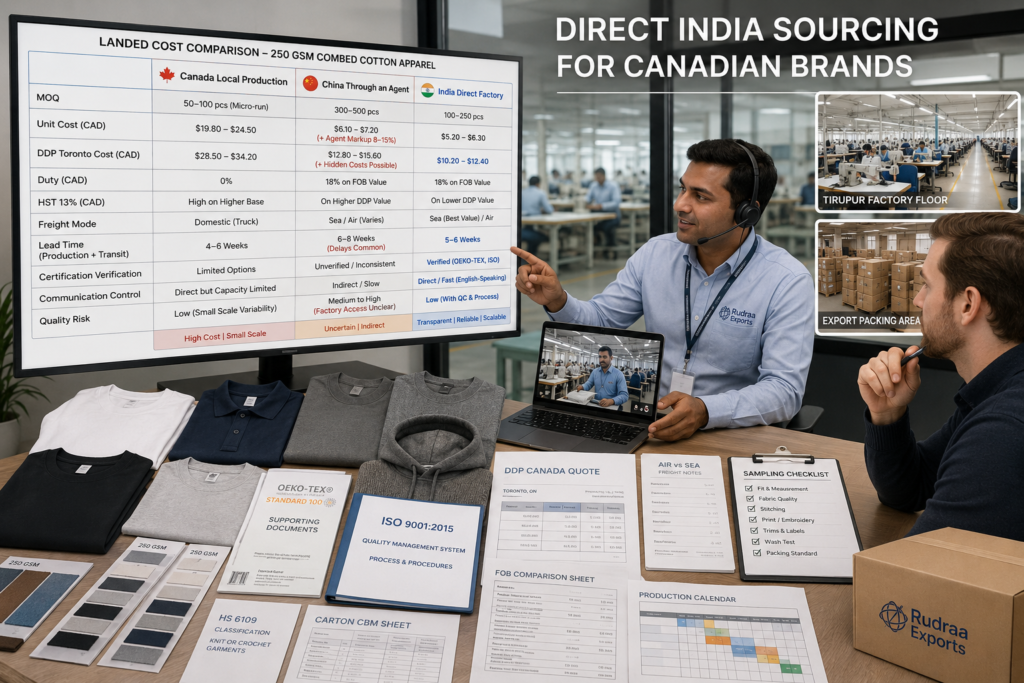
Canadian apparel founders often reach the same sourcing problem.
Local production is easier to manage, but the unit cost can become too high when the brand tries to scale.
China offers strong manufacturing capacity, but many startups end up working through agents, which can reduce visibility and add hidden markups.
India offers a strong middle path when the buyer works directly with the factory.
For Canadian brands, direct sourcing from India can unlock better margins, low-MOQ testing, cotton knitwear expertise, English communication, OEKO-TEX-aligned product safety support and DDP delivery planning to Canada.
But offshore sourcing only works when the process is controlled.
You need tech packs, sampling discipline, landed-cost calculation, duty and HST planning, quality checkpoints and transparent communication before bulk production begins.
At Rudraa Exports, we help Canadian startups and growing apparel brands source directly from India with low-MOQ garment manufacturing, factory-direct communication, sampling support, QC planning, export packing and DDP Canada shipment discussion.
Quick Answer
Canadian brands can source clothing from India safely by working directly with a certified factory, starting with a 50–100 pcs pilot, preparing a factory-ready tech pack, approving samples, verifying OEKO-TEX or compliance documents, comparing FOB and DDP landed costs, and using sea freight for scalable reorders. India is especially suitable for cotton T-shirts, polos, sweatshirts, hoodies and knitwear programs where direct communication and landed-cost control matter.
Looking for a clothing manufacturer for Canadian brands? Contact Rudraa Exports and share your tech pack, target MOQ, product category and Canadian delivery city.
Why Canadian Brands Look Offshore
Many Canadian founders start with local production because it feels safer.
That can be a good choice for early prototypes or very small runs.
But as soon as the brand needs margin, repeat orders or wholesale pricing, local production can become difficult.
Common Local Production Challenges
- Higher labour cost
- Higher fabric cost
- Limited capacity for scaling
- Higher unit cost on small runs
- Limited textile ecosystem
- Slower margin growth
- Difficulty competing with imported brands
The uploaded source explains that offshore sourcing can unlock margin, but only when quality, compliance and landed cost are controlled.
Canada vs China Agent vs India Direct Factory
Canadian brands usually compare three sourcing options:
- Canada local production
- China via agent or intermediary
- India direct factory sourcing
The uploaded guide compares these three sourcing routes across MOQ, unit cost, certifications, communication, quality control, freight, landed-cost transparency and risk profile.
Quick Comparison
| Criteria | Canada Local Production | China via Agent | India Direct Factory |
|---|---|---|---|
| MOQ | Low but expensive | Often higher or bundled | Low-MOQ discussion possible |
| Unit cost | Higher | Competitive but may include agent margin | Competitive with direct visibility |
| Communication | Easy | Agent-mediated | Direct English communication |
| Factory access | Easy locally | Often limited | Direct factory relationship |
| Compliance proof | Varies | Can be opaque | Easier to verify directly |
| QC control | Easier visits | Filtered through agent | Direct sampling and QC gates |
| Freight | Domestic | Import required | Import required |
| Landed cost | Clear | Medium transparency | FOB/DDP clarity possible |
| Best for | Prototypes and micro-runs | Scale with agent support | Founder-friendly cotton programs |
Why Direct India Sourcing Can Work for Canadian Brands
India can be a strong sourcing base for Canadian apparel brands because of:
- Cotton textile ecosystem
- Knitwear manufacturing capability
- T-shirt and sweatshirt production
- English communication
- Private-label experience
- Low-MOQ pilot options
- Compliance-document culture
- Direct factory access
- DDP shipping discussion
- Scalable reorder planning
The uploaded source positions India as especially useful for cotton programs, direct communication and certified export-ready production when compared with agent-led sourcing routes.
What Canadian Brands Should Compare First
Before asking for prices, compare suppliers using objective criteria.
Sourcing Scorecard
| Criteria | What to Check |
|---|---|
| MOQ | Can they support 50–100 pcs pilot? |
| Product fit | Have they made similar garments? |
| Fabric | Can they support GSM and composition needs? |
| Certifications | Can they provide valid documents? |
| Communication | Can you talk directly with production team? |
| Sampling | Is the sampling process clear? |
| QC | Are checkpoints defined? |
| Shipping | Can they quote FOB and DDP? |
| Landed cost | Are duty, tax and freight assumptions visible? |
| Scalability | Can they support reorders after pilot? |
The uploaded guide says the goal should be the best blend of margin, reliability and compliance, not simply the cheapest quote.
Landed Cost: Do Not Compare FOB to Local All-In Price
One of the biggest mistakes Canadian founders make is comparing:
Canadian delivered price vs Indian FOB price
That is not a fair comparison.
You need to compare landed cost.
Landed Cost Includes
- Factory price
- Fabric and trims
- Labels and packaging
- Freight
- Duty
- Brokerage
- HST
- Delivery to Canada
- Inspection cost
- Currency buffer
The uploaded source explains that Canadian brands should calculate DDP landed cost, including freight, duty, brokerage and HST, instead of comparing local all-in price with offshore FOB price.
Duty and HST Planning for Canada
For Canada, import costs depend on:
- HS code
- Product type
- Fibre composition
- Country of origin
- Freight mode
- Province
- Import structure
The uploaded guide gives an example for cotton T-shirts under HS 6109.10.00 using 18% duty and Ontario HST at 13%, showing why landed-cost modelling matters.
Planning Example Structure
| Cost Line | What to Include |
|---|---|
| Product value | Factory or FOB value |
| Freight | Air or sea |
| Duty | Based on HS code |
| Brokerage | Customs clearance cost |
| HST | Based on duty-paid value |
| Final delivery | Port or airport to destination |
Important Rule
Always confirm exact duty and tax treatment with a Canadian customs broker before setting retail prices.
Low MOQ: Why 50–100 pcs Helps Startups
Canadian startups often do not want to order thousands of units before testing demand.
A 50–100 pcs pilot can help validate:
- Fit
- Fabric
- Shrinkage
- Print quality
- Customer response
- Size curve
- Packaging
- Delivery process
The uploaded source positions 50–100 pcs as a startup-friendly MOQ range for testing before scaling.
Low-MOQ Works Best When
- Styles are simple
- Colour count is limited
- Fabric is available
- Trims are standard
- Packaging is not over-customised
- Tech pack is clear
- Buyer approves samples quickly
Low-MOQ Becomes Hard When
- Many colours are requested
- Fabric is custom dyed
- Trims are complex
- Artwork has many versions
- Size range is too wide
- Product changes after sampling
Why Air Freight Is Not Always the Best for Small Orders
Small test lots often move by air because speed matters.
But air freight can make offshore landed cost look high.
The uploaded source explains that at 100 pcs by air, offshore can look worse because air freight dominates, while sea freight becomes more attractive at scale.
Use Air Freight For
- Samples
- First pilot order
- Influencer drops
- Urgent stock
- Launch-critical pieces
Use Sea Freight For
- Reorders
- Bulk programs
- Stable SKUs
- Seasonal inventory
- Larger quantities
Freight Rule
Use air to learn.
Use sea to scale.
Why India Can Beat China for Some Canadian Startups
China can be faster and highly scalable.
But for many Canadian startups, India can be more suitable when the product is cotton-forward and communication matters.
India Advantages for Canadian Startups
- Cotton knitwear strength
- Direct English communication
- Low-MOQ discussion
- Factory access
- Founder-friendly development
- OEKO-TEX and certification support
- Private-label cotton basics
- DDP landed-cost clarity
The uploaded guide explains that China can win on speed, but India can be more founder-friendly for cotton programs with direct communication and certified export-ready production.
China May Be Better When
- Speed is the main priority
- Product is very complex and China has a specialised ecosystem
- You already have a trusted agent
- You have high volume
- You need very mature multi-category infrastructure
India May Be Better When
- You make T-shirts, polos, sweats or hoodies
- You want direct factory access
- You want low-MOQ pilot support
- You need English communication
- You want cotton ecosystem strength
- You want transparent DDP pricing
Certification: Proof Beats Promises
Words like “ethical,” “premium” and “safe” are not enough.
Canadian brands should ask for evidence.
Documents to Request
- OEKO-TEX certificate where applicable
- ISO process documentation where available
- Factory profile
- Product testing support
- Fabric composition record
- Restricted substance support
- QC report template
- Export documentation sample
The uploaded source highlights OEKO-TEX as a practical baseline for textile chemical safety and recommends asking for certificate numbers, scope and validity dates.
Certificate Verification Checklist
| Check | Question |
|---|---|
| Certificate number | Is it real and traceable? |
| Validity | Is it current? |
| Scope | Does it cover the product type? |
| Facility | Does it match the production site? |
| Product class | Is it suitable for your use case? |
| Renewal | Is it still active? |
Important Rule
Expired certification should be treated as not certified.
Communication: Avoid the Agent Tax
An agent can help with sourcing, but it can also create a communication layer.
The uploaded guide describes the “agent tax” as hidden margin, slower clarification cycles and less leverage when production problems occur.
Why Direct Factory Communication Helps
- Faster sample corrections
- Clearer fabric decisions
- Better measurement clarification
- Direct QC updates
- Faster issue resolution
- Better accountability
- Less hidden markup
- Stronger reorder consistency
Direct Communication Is Important For
- Shrinkage
- GSM
- Lab dips
- Stitching
- Print placement
- Size tolerance
- Packing
- QC defects
- Shipping data
What to Look for in an Indian Manufacturer
When searching for a garment manufacturer in India for Canadian brands, check these points before placing an order.
1. Product Fit
Ask whether the factory has experience with your product category.
Rudraa is especially relevant for:
- T-shirts
- Polo shirts
- Sweatshirts
- Hoodies
- Joggers
- Cotton knits
- Jersey programs
- Private-label basics
2. Sampling Discipline
A good factory should support:
- Fabric swatch approval
- Proto sample
- Size set
- Pre-production sample
- Shrinkage review
- Wash testing where needed
The uploaded guide recommends at least one proto sample and one size set or pre-production sample before bulk.
3. Lead-Time Clarity
Ask for a calendar covering:
- Sampling
- Fabric sourcing
- Knitting or dyeing
- Cutting
- Sewing
- Finishing
- QC
- Packing
- Freight
4. QC Checkpoints
Ask how the factory manages:
- Inline QC
- Measurement checks
- Final inspection
- Rework
- Defect reporting
5. DDP Shipping to Canada
Ask for a quote that shows:
- Product value
- Freight
- Duty
- Brokerage
- HST
- Delivery city
- Transit mode
- Assumptions
The uploaded source recommends DDP shipping for first-time importers because it reduces duty and brokerage surprises.
Step-by-Step Sourcing Process
Stage 1: Define Your Product
Prepare:
- Product category
- Measurements
- Tolerance
- Fabric GSM
- Composition
- Trims
- Labels
- Packaging
- Test MOQ
The uploaded guide recommends building a basic tech pack with measurements, tolerance, fabric spec, trims, labels and packing before sourcing.
Stage 2: Validate the Supplier
Request:
- Factory profile
- Product experience
- OEKO-TEX or ISO documents
- Export experience
- QC process
- Rework process
- Communication contact
Stage 3: Sampling and Costing
Approve:
- Fabric swatches
- Lab dips
- Proto sample
- Size set
- PP sample
- DDP landed-cost assumptions
Stage 4: Bulk Production
Before bulk, lock:
- BOM
- Fabric
- Embroidery
- Labels
- Packaging
- PP sample
- QC plan
Stage 5: Logistics and Delivery
Decide:
- Air or sea
- FOB or DDP
- Duty assumptions
- HST assumptions
- Brokerage
- Final Canadian delivery location
The uploaded guide presents a five-stage sourcing process from product definition to supplier validation, sampling, bulk production and logistics to Canada.
Migration Plan: From Canada or Agents to Direct India
Step 1: Start With One Hero SKU
Do not move your entire collection first.
Start with one product such as:
- 250 GSM T-shirt
- Hoodie
- Polo shirt
- Sweatshirt
- Jogger
The uploaded source recommends starting with one hero cotton knit SKU so the brand can learn quickly with fewer variables.
Step 2: Build a Factory-Ready Tech Pack
Include:
- Measurements
- Tolerance
- Stitch types
- Fabric
- GSM
- Labels
- Packaging
- Test requirements
Step 3: Run a 50–100 pcs DDP Pilot
Use the pilot to validate:
- Fit
- Fabric
- Shrinkage
- Stitching
- Print quality
- Packing
- Delivery process
Step 4: Plan Reorders by Sea Freight
Once quality and fit are stable, move from air to sea freight for better margin.
The uploaded guide notes that sea freight is usually the margin-maker for reorders, while air is best for samples and emergencies.
Step 5: Scale Colours, Then Styles
Scale in order:
- Same style, same fabric, more quantity
- Same style, more colours
- Similar styles using same fabric
- New product categories
This protects quality and cash flow.
Clothing Manufacturer Checklist for Canadian Brands
| # | Checkpoint |
|---|---|
| 1 | Product category selected |
| 2 | Hero SKU chosen |
| 3 | Tech pack prepared |
| 4 | Fabric GSM defined |
| 5 | MOQ target confirmed |
| 6 | Certificate proof requested |
| 7 | Factory profile reviewed |
| 8 | Sampling process agreed |
| 9 | PP sample required |
| 10 | QC checkpoints defined |
| 11 | HS code reviewed |
| 12 | Duty assumptions checked |
| 13 | HST assumptions checked |
| 14 | FOB quote requested |
| 15 | DDP quote requested |
| 16 | Air vs sea freight compared |
| 17 | Carton CBM collected |
| 18 | Delivery city confirmed |
| 19 | Payment terms written |
| 20 | Reorder calendar planned |
How Rudraa Exports Supports Canadian Brands
Rudraa Exports supports Canadian startups and apparel brands with factory-direct garment manufacturing from India.
Rudraa Support Includes
- Low-MOQ discussion
- Product brief review
- Tech-pack review
- Fabric and GSM planning
- Cotton knitwear development
- Sample coordination
- Size-set support
- PP sample approval
- Shrinkage review
- Inline QC
- Final inspection coordination
- OEKO-TEX supporting documentation where applicable
- ISO process support where available
- Export packing
- Carton CBM and weight data
- FOB and DDP quote discussion
- Canada delivery planning
Products Supported
- T-shirts
- 250 GSM premium tees
- Polo shirts
- Sweatshirts
- Hoodies
- Joggers
- Cotton knitwear
- Jersey programs
- Elevated basics
- Private-label apparel
- Corporate apparel
- School uniforms
- Kidswear
- Babywear
Why Rudraa Fits Canadian Startups
Rudraa is a strong fit when brands need:
- Direct factory relationship
- Low MOQ 300 pcs discussion
- English communication
- Cotton expertise
- OEKO-TEX support
- Transparent landed-cost planning
- DDP Canada discussion
- Sampling discipline
- QC checkpoints
- Scalable repeat production
The uploaded guide positions Rudraa Exports as a direct factory partner for Canadian startups needing low MOQs, English-speaking coordination, OEKO-TEX-certified processes and DDP delivery to Canada.
Ready to source from India without agents? Speak with Rudraa Exports and share your tech pack, target MOQ, fabric GSM, quantity and Canadian delivery city.
FAQ: Clothing Manufacturer for Canadian Brands
1. Can Canadian brands source garments from India?
Yes. Canadian brands can source garments from India when they manage tech packs, sampling, quality control, landed cost and import planning properly.
2. What products are best for India sourcing?
India is strong for cotton T-shirts, polos, sweatshirts, hoodies, joggers, jersey programs and private-label basics.
3. What MOQ can Canadian startups expect?
MOQ depends on fabric, colour count and product complexity, but 300 pcs per style can be discussed for suitable pilot programs.
4. Is India cheaper than Canada for apparel production?
India can be more cost-effective at scale, especially when sea freight is used and the buyer calculates landed cost correctly.
5. Is local Canadian production still useful?
Yes. Local production can be useful for prototypes, very small runs and quick testing before moving proven styles offshore.
6. Is China faster than India?
China can be faster on some routes and categories, but India may be better for cotton programs, English communication and direct-factory sourcing.
7. Why avoid agents?
Agents can be useful, but they may add hidden margin, slow communication and reduce direct factory visibility.
8. What does DDP to Canada mean?
DDP means Delivered Duty Paid. It can simplify importing because freight, duties, brokerage and delivery are handled in the agreed quote structure.
9. Should I ship by air or sea?
Use air for samples and urgent pilots. Use sea for reorders and bulk shipments because it usually protects margin better.
10. What documents should I verify?
Check certificate proof, factory profile, product specs, HS classification, QC reports, export documents and DDP quote assumptions.
11. Can Rudraa Exports support Canadian startups?
Yes. Rudraa supports Canadian startups with low-MOQ discussions, sampling, cotton knitwear production, QC checkpoints and Canada delivery planning.
12. What should I send Rudraa for a quote?
Send your tech pack, reference images, product category, fabric GSM, quantity, colour count, labels, packaging needs and Canadian delivery city.
Conclusion
Canadian apparel founders do not need to choose between expensive local production and risky offshore sourcing.
The safer route is direct factory sourcing with a clear process.
Canada is useful for prototypes and micro-runs. China can be strong for speed and scale. India can be a strong fit for cotton knitwear, low-MOQ pilots, direct English communication, OEKO-TEX-aligned safety support and transparent DDP landed-cost planning.
The key is to avoid vague sourcing.
Start with one hero SKU. Build a proper tech pack. Validate the factory. Approve samples. Check certifications. Compare FOB and DDP. Use air for learning and sea for scaling.
Rudraa Exports helps Canadian startups and apparel brands source garments from India without agents through factory-direct communication, low-MOQ planning, cotton knitwear development, sampling, QC support, export packing and DDP Canada discussion.
Visit rudraaexports.com or contact the Rudraa Exports team to request a custom DDP quote for your next Canada-focused apparel order.
Related reading
India vs China T-Shirt Manufacturing 2026: Which Is Better for Your Brand?
How to Export Garments from India to the USA: HS Codes, Duties and Compliance Guide
Clothing Manufacturer for South African Brands: How to Source from India