
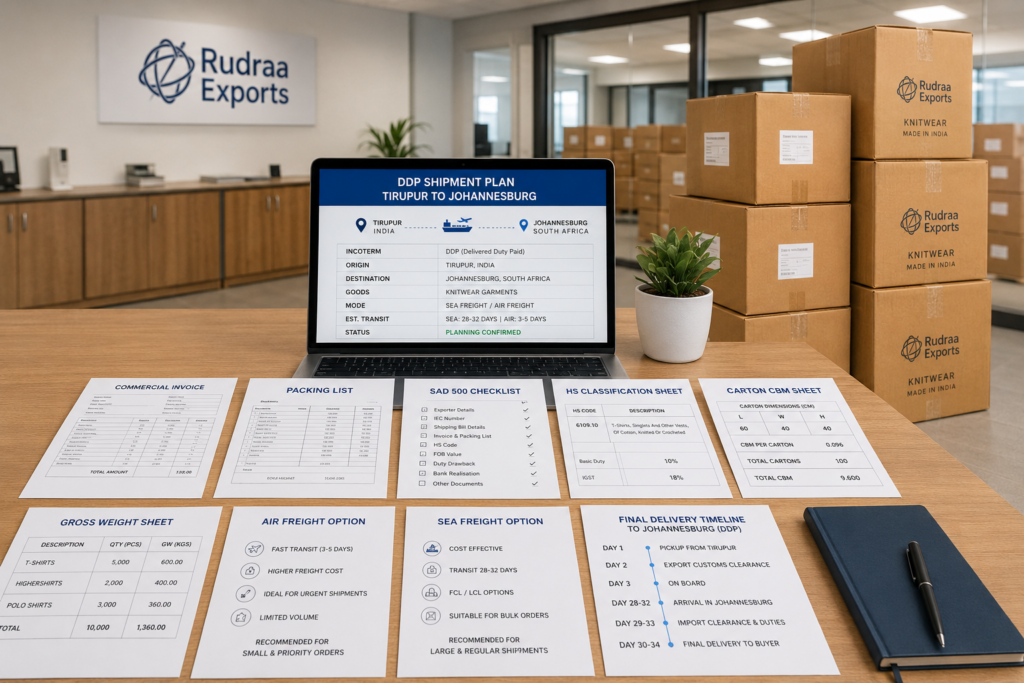
South African fashion founders often face a difficult sourcing decision.
Local production gives speed and hands-on control, but cut-make-trim costs can rise quickly.
China offers large-scale production, but many smaller brands face higher MOQs, agent layers and less direct visibility.
India, especially Tirupur, can offer a strong middle path for South African brands that need knitwear production, better cost-to-quality balance, structured quality control and DDP delivery into Johannesburg or Cape Town.
But India works best when the process is controlled.
You need a clear spec pack, confirmed HS classification, SARS duty planning, VAT modelling, sealed samples, quality checkpoints, shipment buffers and DDP documentation support before scaling.
At Rudraa Exports, we help South African apparel brands source from India with factory-direct knitwear manufacturing, sampling support, QC planning, export packing, carton data, DDP shipping discussion and South Africa-ready documentation.
Quick Answer
South African brands can source garments from India successfully by working with a direct factory, starting with a controlled pilot, preparing a clear spec pack, verifying HS codes, modelling SARS customs duty and 15% VAT, approving sealed samples, using QC checkpoints and choosing DDP shipping into Johannesburg or Cape Town for a more predictable first import. India is especially suitable for knitwear such as T-shirts, hoodies, fleece, joggers, uniforms and schoolwear basics.
Planning a South Africa-focused garment order? Contact Rudraa Exports and share your product category, fabric GSM, quantity, HS code if available, and delivery city.
Why South African Brands Look at India
South African fashion founders are under pressure from:
- Rising local production costs
- Inconsistent local capacity
- Cashflow pressure
- Long overseas lead times
- Duty and VAT exposure
- Quality variation
- Need for better margins
The uploaded guide explains that many South African founders look to India because local cut-make-trim costs, capacity issues and cashflow pressure make a structured offshore model attractive.
Why India Can Work
India can support South African brands with:
- Strong knitwear production
- Cotton T-shirts
- Hoodies
- Fleece sweatshirts
- Joggers
- Schoolwear basics
- Uniforms
- Fabric sourcing
- Printing and embroidery
- Export packing
- DDP shipping discussion
- Repeat production planning
Local South Africa vs China vs India
South African brands usually compare three sourcing routes:
- Local South Africa production
- China sourcing
- India direct factory sourcing
The uploaded source compares these routes across unit cost, cost-to-quality, lead time, MOQ, best categories, logistics, customs duty exposure and compliance burden.
Quick Comparison
| Criteria | Local South Africa | China | India Direct Factory |
|---|---|---|---|
| Unit cost | Medium to high | Medium | Low to medium |
| MOQ | Low | Medium to high | Low to medium |
| Best categories | Quick repeats, local control | Technical/high-volume programs | Knitwear and uniforms |
| Logistics | Simple local delivery | Import required | Import required |
| Duty exposure | None | MFN duties | MFN duties |
| QC control | Easy visits | Requires strong process | Strong with direct factory workflow |
| Best fit | Urgent local runs | Mature sourcing teams | Brands wanting savings with process |
Key Takeaway
India is not just a cheap supplier option.
India works when it is treated as a full system:
factory + spec pack + QC + HS classification + DDP import + reorder rhythm
The uploaded guide says India wins when brands treat sourcing as a system, not as a cheap supplier hunt.
Total Landed Cost: The Number That Matters
The factory quote is only one part of cost.
For South Africa, landed cost must include customs duty, VAT, freight and clearing charges.
Basic Landed Cost Formula
FOB / Ex-works price + freight + insurance + SARS customs duty + 15% VAT + port / clearing / inland charges = landed cost
The uploaded guide defines landed cost into South Africa as ex-works or FOB price plus freight, insurance where applicable, SARS customs duty, 15% VAT and port, clearing or inland charges.
Cost Items to Include
| Cost Item | Why It Matters |
|---|---|
| Factory price | Base garment cost |
| Fabric and trims | Major cost driver |
| Freight | Sea or air |
| Insurance | Where applicable |
| Customs duty | Depends on HS code |
| VAT | 15% import VAT |
| Clearing fees | Customs handling |
| Inland delivery | Port or airport to warehouse |
| FX buffer | Currency movement |
| QC cost | Inspection and rework prevention |
SARS Duty and VAT: What Brands Must Know
For South African importers, duty can be high on apparel.
The uploaded guide states that India is charged at MFN rates in 2026 because the India–SACU Preferential Trade Agreement is not yet active.
Example Duty References from the Source
| Product Type | HS Reference | Duty Mentioned |
|---|---|---|
| Cotton T-shirts | 6109.10 | 45% |
| Cotton hoodies / sweatshirts | 6110.20 | 45% |
| Knitted cotton schoolwear items | 6103.42 / 6104.52 | 40% |
| Import VAT | South Africa | 15% |
The uploaded guide highlights these SARS duty references and explains that brands must confirm classification before committing.
Important Rule
Do not assume one duty rate for all garments.
A cotton T-shirt, hoodie, school skirt, jogger and woven uniform item may have different HS classifications.
Why India Can Still Win Despite High Duty
Duty is high.
But India can still be commercially attractive when:
- Factory pricing is competitive
- Quality is consistent
- Rework is reduced
- Fabric sourcing is efficient
- Production is repeatable
- Logistics are predictable
- DDP reduces import friction
- Reorders are planned properly
The uploaded guide explains that India’s factory pricing and consistent quality can still outperform local South Africa and often compete with China at the same quality tier, even after MFN duty.
When India Becomes Stronger
India becomes more attractive when the brand is producing:
- Repeat T-shirts
- Core hoodies
- Schoolwear basics
- Uniform programs
- Fleece sets
- Joggers
- Knitwear collections
- Seasonal repeat styles
Freight from Tirupur to South Africa
For Tirupur production, garments usually move by road to Chennai and then ship by sea or air.
The uploaded source explains that South India production commonly routes through Chennai for ocean or air movement to South Africa.
Main Freight Options
| Freight Mode | Best For |
|---|---|
| Sea freight | Main bulk shipments |
| Air freight | Samples, urgent stock and launch-critical pieces |
| Split shipping | Air for urgent pieces, sea for the rest |
| DDP shipping | First imports and predictable delivered cost |
Shipping Planning Direction
The uploaded guide mentions ocean routing from Chennai to Durban and air routing from Chennai to Johannesburg, with DDP and split-shipping options used to reduce risk.
Why DDP Helps South African Brands
DDP means Delivered Duty Paid.
For many South African founders, DDP can make the first import easier because duties, taxes, clearance and final delivery are coordinated through the logistics structure.
DDP Can Help With
- Export paperwork
- International freight
- Import clearance
- SARS duty payment
- VAT handling
- Final-mile delivery
- Fewer customs surprises
- More predictable landed cost
The uploaded guide explains that DDP turns unknown port costs into a planned landed number and reduces clearance mistakes through repeatable customs processes.
DDP Checklist
Before accepting a DDP quote, confirm:
- Product description
- HS code
- FOB value
- Duty included
- VAT included
- Clearing included
- Final delivery city
- Carton count
- CBM
- Gross weight
- Net weight
- Shipment mode
- Importer of record structure
- Delivery timeline
Important Rule
DDP is helpful, but it is not magic.
The product description, composition, values and HS classification still must be correct.
The uploaded source warns that DDP simplifies the process but still requires correct product descriptions, composition and values for SAD 500 declarations.
SAD 500: The Customs Document Brands Should Know
SAD 500 is a key customs declaration document in South Africa.
The uploaded guide states that South African customs entry is typically made on SAD 500 and requires accurate tariff classification, customs value, origin and procedure codes.
Why It Matters
Errors can cause:
- Customs delays
- Penalties
- Storage charges
- Launch delays
- Cashflow stress
SAD 500 Data Should Match
- Commercial invoice
- Packing list
- HS code
- Product description
- Customs value
- Country of origin
- Carton data
- Freight documents
HS Classification: The Most Expensive Small Mistake
HS classification decides the duty rate.
A wrong HS code can create duty shocks and SARS penalty exposure.
The uploaded guide identifies HS misclassification as a major risk and recommends verifying HS codes before production starts, not when goods are already on the water.
Classification Should Consider
- Knit or woven construction
- Fibre composition
- Gender category
- Age category
- Product use
- Garment type
- Trims or special features
Example
A hoodie and a cotton T-shirt should not automatically share the same classification.
A schoolwear item may need different treatment from a casual fashion garment.
Buyer Rule
Verify HS codes before placing the PO.
Fit / Fit-Not Guide
India Is a Strong Fit If
- You are a knitwear-driven brand
- You produce T-shirts, hoodies, fleece or joggers
- You are scaling 300 units per style
- You can work with spec packs
- You need consistent repeat production
- You want DDP shipping to Johannesburg or Cape Town
- You can model duty and VAT
- You need a direct factory partner
The uploaded source says India is a strong fit for knitwear-driven brands, especially those scaling 300 units per style with spec packs and QC checklists.
India May Not Be Ideal If
- You need replenishment inside 7–10 days
- You need 300 pcs per colour with many changes
- You have no landed-cost model
- You cannot manage duty and VAT cashflow
- You are still changing the product every week
- You need only hands-on local sampling
The uploaded guide recommends considering local or hybrid sourcing when brands need ultra-fast replenishment, tiny MOQs or frequent design changes.
Migration Plan: Moving Production from South Africa or China to India
Step 1: Build a Landed-Cost Model in ZAR
Before requesting quotes, calculate your target landed cost.
Include:
- Factory price
- Freight
- Insurance
- SARS duty
- 15% VAT
- Clearing charges
- Inland delivery
- Currency buffer
The uploaded guide recommends building a ZAR landed-cost model before requesting quotes, especially because duty and VAT are non-negotiable.
Step 2: Choose the Sourcing Model
South African brands commonly compare:
- Agent-led FOB
- Direct factory FOB or CIF
- Direct factory + DDP shipping
The uploaded guide recommends direct factory plus DDP shipping as the simplest operational route for many founders switching from China or local production.
Step 3: Lock the Spec Pack
A proper spec pack should include:
- Fabric GSM
- GSM tolerance
- Shrinkage limit
- Seam type
- Stitch density
- Print method
- Colour reference
- Label rules
- Measurement chart
- Grading
- Packaging
- QC checklist
The uploaded guide says brands should lock specifications with fabric GSM tolerance, shrinkage limits, seam type, stitch density, print method, colour references, labelling rules, measurement charts and packaging.
Step 4: Approve Samples Before Bulk
Approve:
- Lab dip
- Size set
- Sealed golden sample
- Measurement tolerance sheet
- QC checklist
Step 5: Start With a Pilot Order
Do not move the full season first.
Start with:
- One or two core SKUs
- Manageable quantity
- Clear fabric
- Clear size curve
- Controlled delivery plan
Step 6: Use Staged Shipping
The uploaded guide recommends split shipping, using air for urgent size-set top-ups or launch-critical quantities and sea for the main bulk.
Step 7: Build a Reorder Rhythm
After quality is stable, use:
- Monthly reorder rhythm
- Six-week reorder cycle
- Rolling POs
- Reorder triggers
- Shared production calendar
The uploaded source explains that India becomes powerful when brands stop treating every PO as a new project and move into repeat PO structure.
Common Mistakes South African Brands Should Avoid
Mistake 1: Buying Only on Price
A cheaper quote without QC gates can become expensive through shrinkage, rework, shade variation or late delivery.
Mistake 2: Skipping HS Verification
Misclassification can create duty shocks and penalties.
Mistake 3: No Sealed Sample
Bulk production can drift without a sealed sample and tolerance sheet.
Mistake 4: No Timeline Buffer
Shipping disruptions can add time, so brands should plan buffers and consider split shipping.
Mistake 5: Underestimating Cashflow
Duty and VAT create real working-capital pressure.
Mistake 6: Treating DDP as Magic
DDP simplifies importing but still depends on accurate product data and documentation.
The uploaded source lists these exact common mistakes and explains why they create cost, timeline and customs risk.
South Africa Sourcing Readiness Checklist
| # | Checkpoint |
|---|---|
| 1 | Product category selected |
| 2 | Knit or woven confirmed |
| 3 | Fibre composition confirmed |
| 4 | HS code reviewed |
| 5 | Duty estimate calculated |
| 6 | 15% VAT calculated |
| 7 | ZAR landed-cost model created |
| 8 | Spec pack prepared |
| 9 | GSM tolerance defined |
| 10 | Shrinkage limit defined |
| 11 | Measurement tolerance set |
| 12 | Lab dip approval planned |
| 13 | Size set planned |
| 14 | Golden sample required |
| 15 | QC checklist prepared |
| 16 | DDP quote requested |
| 17 | SAD 500 data reviewed |
| 18 | Carton CBM collected |
| 19 | Air/sea shipping plan decided |
| 20 | Reorder rhythm planned |
How Rudraa Exports Supports South African Brands
Rudraa Exports supports South African brands with structured garment manufacturing and export planning from Tirupur, India.
Rudraa Support Includes
- Product brief review
- Spec pack review
- Fabric and GSM planning
- Knitwear manufacturing
- T-shirt production
- Hoodie and fleece production
- Jogger production
- Schoolwear basics
- Uniform programs
- Lab dip coordination
- Size-set support
- Golden sample approval
- QC checklist support
- Export packing
- Carton CBM and weight data
- HS-ready product descriptions
- DDP shipping discussion
- Johannesburg and Cape Town delivery planning
Products Supported
- T-shirts
- Polo shirts
- Hoodies
- Fleece sweatshirts
- Joggers
- Schoolwear basics
- Uniforms
- Corporate apparel
- Kidswear
- Babywear
- Nightwear
- Private-label knitwear
Why Rudraa Fits South African Brands
Rudraa is a strong fit when brands need:
- Direct factory communication
- Knitwear expertise
- Spec-driven production
- Repeat quality
- Low-to-medium MOQ planning
- DDP-friendly execution
- Export documentation support
- QC checkpoints
- Reorder planning
The uploaded guide positions Rudraa Exports as a direct-factory partner with knitwear focus, DDP-friendly execution, HS discipline, documentation readiness and repeat PO structure for South African brands.
Ready to source from India with a controlled first shipment? Speak with Rudraa Exports and share your product category, spec pack, target quantity, delivery city and target landed cost.
FAQ: Clothing Manufacturer for South African Brands
1. Can South African brands source garments from India?
Yes. South African brands can source garments from India when they manage landed cost, HS codes, duty, VAT, QC and logistics properly.
2. What products are best for India sourcing?
India is strong for knitwear such as T-shirts, hoodies, fleece sweatshirts, joggers, uniforms, schoolwear basics, kidswear and private-label apparel.
3. What duties apply when importing garments into South Africa?
Duty depends on the HS code. The uploaded guide references 45% duty for cotton T-shirts and cotton hoodies or sweatshirts, and 40% for some knitted cotton schoolwear items, plus 15% VAT. Confirm exact classification before ordering.
4. What is DDP shipping?
DDP means Delivered Duty Paid. The service provider handles export, international freight, import clearance, duty and tax payment, then delivers to your door under the agreed structure.
5. Is DDP good for South African brands?
DDP can be useful for first shipments because it reduces customs friction and turns unknown import costs into a more predictable delivered number.
6. What is SAD 500?
SAD 500 is a key South African customs declaration form. It requires accurate tariff classification, customs value, origin and procedure details.
7. Should I verify HS codes before production?
Yes. HS codes should be reviewed before production starts because classification affects duty and customs risk.
8. Is local South African production still useful?
Yes. Local production is useful for urgent replenishment, hands-on sampling, very small batches and styles that change frequently.
9. Is China better than India?
China can be better for some technical categories and high-volume programs. India can be better for knitwear, direct communication, cost-to-quality balance and structured DDP sourcing.
10. What should a spec pack include?
A spec pack should include fabric GSM, shrinkage limits, seam type, stitch density, print method, colour references, labels, measurements, grading and packaging.
11. Can Rudraa Exports support DDP to South Africa?
Rudraa can discuss DDP-friendly execution through logistics partners depending on product, order size, delivery city and shipment requirements.
12. What should I send Rudraa for a quote?
Send your spec pack, product category, fabric GSM, quantity, colour count, size range, HS code if known, target delivery city and landed-cost target.
Conclusion
South African fashion brands can improve margin and consistency by sourcing from India, but only when the process is structured.
India is not the right answer for every situation.
Local production is still better for ultra-fast replenishment, hands-on sampling and very tiny runs. China can work well for high-volume or technical categories. India is strongest for knitwear, uniforms, T-shirts, hoodies, fleece, joggers and repeat programs where factory pricing, quality and DDP planning can create a better total landed cost.
The real sourcing decision is not only FOB price.
It is landed cost, duty, VAT, HS classification, QC discipline, DDP execution and repeatability.
Rudraa Exports helps South African brands source from India with direct factory communication, knitwear manufacturing, spec-pack review, QC checkpoints, export packing, carton data, documentation support and DDP shipping discussion into Johannesburg or Cape Town.
Visit rudraaexports.com or contact the Rudraa Exports team to request a quote for your South Africa garment sourcing pilot.
Related reading
U.S. vs Tirupur Apparel Manufacturing: A Reality Check for Western Startup Founders in 2026
Garment Export Documentation Requirements Guide 2026
Clothing Manufacturer for Canadian Brands: Source from India Direct With No Agents