
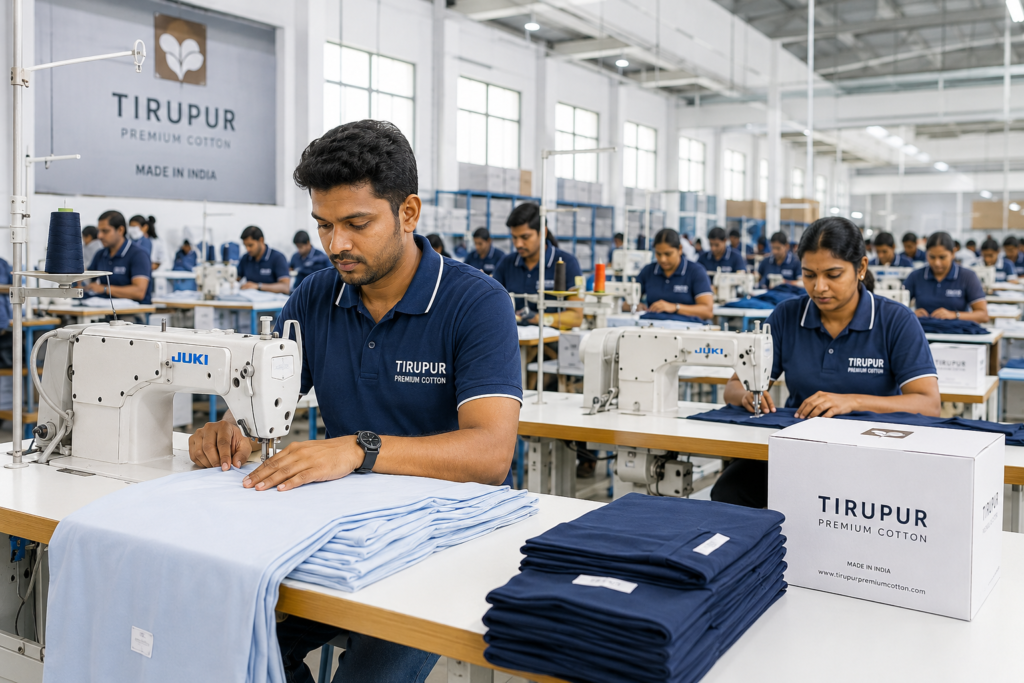
India vs China T-Shirt Manufacturing 2026: Which Is Better for Your Brand?
Sourcing basic cotton T-shirts in 2026 comes down to one big question for most international buyers: manufacture in India or China? Specifically, should your brand work with Tirupur in Tamil Nadu, India, or with mainstream Chinese hubs in Guangdong and Zhejiang?
This guide compares both origins across the seven decisions that actually move your P&L — FOB pricing, minimum order quantity (MOQ), lead times, production capacity, certifications, supply-chain risk, and tariffs — for men’s basic cotton T-shirts in the 160–180 GSM range. At the end, you’ll see exactly where Rudraa Exports fits and why we’re built specifically for international buyers sourcing from Tirupur.
Quick Answer: Should You Manufacture T-Shirts in India or China in 2026?
For basic men’s cotton T-shirts at 160–180 GSM, India’s Tirupur cluster is the better choice for most international buyers in 2026. Tirupur offers minimum order quantities as low as 50 pieces (versus 500 in mainstream Chinese factories), FOB pricing around US$2.32 per unit (versus US$3.40–US$4.10 in China), comparable lead times, and additional tariff advantages through India’s expanding free trade agreement network. China still wins for very large mass-production orders where MOQ is irrelevant. For everyone else — startups, DTC brands, private-label retailers, and importers running China-plus-one strategies — Tirupur delivers better economics and better flexibility.
What This Guide Covers
Product baseline: Men’s basic crewneck or round-neck T-shirts in single-jersey cotton, 160–180 GSM. Printing, embroidery, and washes are treated as separate cost and lead-time variables.
Origins compared:
- India (Tirupur): Tamil Nadu’s knitwear cluster, India’s primary export-focused cotton knit hub
- China (mainstream): Coastal hubs in Guangdong (Shenzhen, Guangzhou, Dongguan) and Zhejiang (Ningbo, Hangzhou)
How we built this comparison: Published industry data, supplier quote samples, academic research on Tirupur lead times, and global shipping reliability reports. Where evidence has gaps, we say so openly — because honest sourcing decisions need honest data.
1. FOB Pricing: What Cotton T-Shirts Actually Cost from India vs China
Tirupur (India) FOB Pricing
Indian T-shirt pricing varies significantly by sales channel, fabric specification, and order size:
- Premium Tirupur wholesale (160 GSM ring-spun cotton): ₹310–₹380 per piece at 6–100 piece quantities — this is micro-MOQ pricing, not bulk FOB
- Standard 160 GSM cotton round-neck (manufacturer listing): ₹115 per piece at MOQ 300
- Industry-wide FOB trend: Made-in-India T-shirt FOB prices declined from US$2.75 in 2017 to US$2.32 in 2024 — a 15.71% drop over seven years
China (Mainstream) FOB Pricing
Concrete supplier quotes for the same 160 GSM ring-spun cotton basic crewneck specification from Chinese coastal hubs show:
- US$3.40 to US$4.10 per unit at MOQ 300 pieces
The Honest Pricing Verdict
For 160–180 GSM cotton T-shirts at moderate volumes with matched specifications, India delivers roughly 25–40% pricing advantage over mainstream Chinese exporters. The exact margin depends on order size, customization complexity, and compliance requirements.
How Rudraa Exports fits: Operating inside Tirupur’s competitive cost structure, we offer FOB pricing aligned with India’s structural advantage while maintaining export quality standards required by buyers in the EU, US, Australia, and Middle East.
2. Minimum Order Quantity (MOQ): The Biggest Difference
If you remember one thing from this guide, remember this: MOQ is where Tirupur decisively beats mainstream China for modern apparel brands.
MOQ in Tirupur, India
- Wholesale and online channels start at 6 to 10 pieces for select spec variants
- Manufacturer listings commonly accept MOQ 300 pieces per design for export production
- Full custom export orders typically run 300 pieces per design
MOQ in Mainstream China
- Cited 160 GSM ring-spun cotton crewneck quotes specify MOQ 300 pieces per design
- Larger Chinese factories frequently require 1,000+ pieces for custom specifications
What This Means in Dollars
Imagine launching a brand with 5 designs:
| Scenario | Total Pieces | Trial Cost |
|---|---|---|
| Tirupur (50 MOQ × 5 designs) | 250 pieces | US$700–US$1,200 |
| China (500 MOQ × 5 designs) | 2,500 pieces | US$8,500–US$10,250 |
That’s an 8–10x difference in upfront commitment for the same number of designs.
Lower MOQs deliver reduced inventory risk for unproven designs, faster trend response without legacy stock liquidation, more SKU experimentation within fixed budgets, better cash flow management, and lower trial cost when validating new markets.
Why this matters for Rudraa Exports clients: We operate inside Tirupur’s structurally lower-MOQ ecosystem. DTC brands, private-label retailers, corporate uniform programs, and emerging fashion businesses access production economics that mainstream Chinese sourcing simply cannot match.
3. Lead Time: Production and Delivery in 2026
Production Lead Time (Purchase Order to FOB-Ready)
India (Tirupur): Academic research on Tirupur lead-time management points to typical timelines of 50 to 90 days from confirmed purchase order to FOB-ready goods.
China (mainstream): Production lead times generally fall in similar ranges. The big exception is Chinese New Year (late January through early February), which creates a 4–6 week disruption window every year.
Ocean Freight Transit Times
Indian export ports serving Tirupur:
- Tuticorin (VOC Port) — closest to Tirupur, reported strong dwell-time performance
- Chennai Port — larger vessel capacity, major route flexibility
- Cochin Port — West Coast and Middle East flexibility
Chinese export ports:
- Shenzhen (Yantian) — historically subject to disruption events
- Ningbo — major Zhejiang export gateway
- Shanghai — largest container port globally
The Schedule Reliability Reality Check
The single most important shipping fact for 2026 planning: global liner schedule reliability ran at approximately 50–55% throughout 2024, per Sea-Intelligence data. Roughly half of all promised vessel arrivals slipped from schedule. Build a 10–20% time buffer regardless of origin.
Door-to-Door Lead Time Estimates from Tirupur
| Destination | Estimated Range |
|---|---|
| Europe (Hamburg, Rotterdam, Antwerp) | 80–135 days |
| US East Coast (New York, Savannah) | 85–140 days |
| US West Coast (Los Angeles) | 75–125 days |
| Australia (Sydney, Melbourne) | 75–130 days |
| Middle East (Dubai, Jeddah) | 65–115 days |
The Rudraa Exports logistics edge: We use multi-port flexibility (Tuticorin, Chennai, Cochin) and maintain relationships with major shipping lines to optimize transit cost and time across global destinations.
4. Production Capacity and Scalability
Tirupur’s Cluster Model
Tirupur operates as a horizontally integrated cluster with thousands of specialized small and medium manufacturers concentrated in one geographic area. Independent specialists handle every stage — yarn supply, knitting, dyeing, printing, embroidery, cutting, stitching, finishing, packaging, and export documentation.
This model scales through network expansion rather than fixed factory capacity, drives specialization at every stage, and supports lower minimum order economics with flexible design variation.
China’s Vertical Integration Model
Mainstream Chinese garment manufacturing favors larger vertically integrated facilities with knitting, dyeing, cutting, and stitching consolidated under single ownership. Strengths include predictable economics at very high volumes and tight internal control. Weaknesses include higher MOQ requirements, less design flexibility, and slower changeover between styles.
Why Rudraa Exports benefits from the cluster model: We tap the full Tirupur ecosystem to scale orders from sample volumes to bulk production runs — without changing supplier relationships, fabric quality, or production standards. Start with 300 pieces, validate the market, and scale to 50,000+ without switching partners.
5. Quality and International Certifications
Certifications That Actually Matter
Top exporters in both India and China maintain certifications relevant to international compliance:
- OEKO-TEX Standard 100 — Chemical safety of finished textiles
- GOTS (Global Organic Textile Standard) — Organic fiber and processing
- WRAP (Worldwide Responsible Accredited Production) — Ethical labor practices
- BSCI (Business Social Compliance Initiative) — Independent social compliance auditing
- ISO 9001 — Quality management systems
- GRS (Global Recycled Standard) — Recycled content verification
Every buyer should verify certifications through each issuing body’s official online database — not through supplier-published claims alone.
Tirupur’s ESG Reporting Has Matured
Top Tirupur exporters now publish structured sustainability documentation, including Science Based Targets initiative (SBTi) alignment for climate measurement. This has become a baseline expectation for European retailers and US public companies sourcing internationally.
The Rudraa Exports compliance approach: Our production processes align with international compliance requirements. Buyers should request specific certification documentation at the inquiry stage to match end-market regulatory needs.
6. Real Cost Drivers Beyond the FOB Price
Headline FOB pricing is only one input. Your true landed cost includes material costs (yarn, fabric, trims), labor and compliance overhead (audits, certification renewal, environmental compliance), and hidden costs most brands miss — sample development at US$50–US$300 per iteration, third-party inspection at US$200–US$400 per shipment, communication overhead, rework rates, and destination tariffs.
What the evidence supports: India shows downward FOB pricing pressure (–15.71% from 2017 to 2024), Chinese quotes for matched specifications consistently price higher per unit at export-standard MOQs, and true cost comparison requires matched specs and full landed-cost modeling.
7. Supply-Chain Resilience: Why China-Plus-One Is Now Standard
A China-exclusive strategy concentrates exposure to currency volatility, geopolitical tensions affecting tariffs, single-country regulatory shifts, trade policy changes, and port-specific disruption events (like Yantian in 2021).
The China-plus-one strategy spreads this risk by establishing a second-country supplier. India and Tirupur have emerged as the most credible alternative for cotton knitwear, thanks to manufacturing maturity, English-language workforce, democratic governance, and expanding free trade agreement coverage.
Where Rudraa Exports fits: We serve as the strategic India-side supplier for international brands diversifying away from China-concentrated sourcing while maintaining quality and delivery standards.
8. Sustainability and Labor Rights
Tirupur has invested heavily over the past decade in Zero Liquid Discharge (ZLD) dyeing infrastructure — the cluster pioneered ZLD at scale in apparel — plus water recycling, effluent treatment, solar power integration, cotton traceability programs, and structured climate reporting.
Buyers requiring documented ESG performance should request from any supplier: recent factory audit reports (BSCI, SMETA, WRAP), certification body verification links, water and energy intensity data, worker grievance mechanism documentation, and wage payment records.
9. Tariffs and Import Duties: Where India Has a Hidden Advantage
For destination-specific tariff calculations, use official tools — TARIC for EU, HTS for US, ABF for Australia, and GCC common external tariff for Middle East.
HS 610910 is the standard tariff classification for T-shirts, singlets, and other vests of cotton, knitted or crocheted.
India’s Free Trade Agreement Advantage
India’s expanding FTA network creates tariff advantages for buyers sourcing from Indian manufacturers:
- United Kingdom (India-UK FTA)
- Australia (India-Australia ECTA)
- UAE (India-UAE CEPA)
- EFTA countries (India-EFTA TEPA)
- Ongoing negotiations with EU and other major markets
For buyers in FTA-covered markets, Indian-origin T-shirts receive preferential tariff treatment compared to Chinese goods facing standard MFN rates. This is a structural advantage Tirupur exporters leverage with proper certificate-of-origin documentation.
Decision Framework: When to Choose India vs China
Choose Tirupur (India) When:
✅ Your order sizes are 300 pieces per design ✅ You’re launching a brand or testing new designs ✅ You need design flexibility and fast trend response ✅ You’re executing a China-plus-one diversification strategy ✅ You sell into markets covered by India FTAs (UK, Australia, UAE) ✅ You value English-language communication ✅ You want lower trial costs to validate concepts
Choose Mainstream China When:
✅ Your order sizes consistently exceed 300 pieces per design ✅ You need extreme product complexity (technical synthetics, hardware-heavy items) ✅ You have established factory relationships you don’t want to disrupt
For most apparel brands in 2026, the answer is Tirupur.
Frequently Asked Questions
Is it cheaper to manufacture T-shirts in India or China in 2026? India is significantly cheaper for basic 160–180 GSM cotton T-shirts. Indian FOB prices averaged US$2.32 per unit in 2024, while mainstream Chinese quotes for comparable specifications range from US$3.40 to US$4.10 per unit.
What is the minimum order quantity for T-shirts in Tirupur? Tirupur manufacturers, including Rudraa Exports, typically accept MOQs starting from 300 pieces per design for export production. Some wholesale channels begin at 6–10 pieces. This is dramatically lower than the 500-piece minimums common in mainstream Chinese exports.
How long does it take to manufacture and ship T-shirts from Tirupur to Europe? Total door-to-door timing is typically 80–135 days, combining 50–90 days for production, 18–30 days for ocean transit, and 3–10 days for destination clearance and inland delivery.
How long does shipping from India to the United States take? Ocean transit from Indian ports to the US East Coast takes 25–35 days, while West Coast routes via the Pacific run 18–28 days. Total door-to-door including production is 75–140 days.
Which certifications should I require from a Tirupur T-shirt manufacturer? Standard certifications include OEKO-TEX Standard 100, GOTS (organic textiles), WRAP or BSCI (labor practices), ISO 9001 (quality systems), and GRS (recycled content). Always verify certificates through each issuing body’s official database.
Can Tirupur manufacturers handle private label and custom branding? Yes. Tirupur’s cluster model is built for customization, including custom fabric sourcing, brand-specific dyeing, custom prints and embroidery, branded labels and hangtags, and tailored packaging. Rudraa Exports provides complete private-label manufacturing services.
What is the best port for shipping garments from Tirupur? Tuticorin (VOC Port) is the primary export port for Tirupur with strong dwell-time performance. Chennai Port handles larger vessels for major global routes. Cochin Port adds flexibility for West Coast and Middle East destinations.
Why are global brands shifting from China to India for garment sourcing? The China-plus-one strategy reduces concentration risk in geopolitics, currency exposure, and regulatory shifts. India offers cost-competitive pricing, lower MOQs, an expanding FTA network, English-language workforce, and a mature cotton supply chain.
What are standard payment terms for Indian garment exporters? Common terms include 30% advance with purchase order confirmation and 70% against shipping documents, or Letter of Credit (LC) arrangements for larger orders.
What is HS code 610910? HS code 610910 covers T-shirts, singlets, and other vests, of cotton, knitted or crocheted. This is the standard tariff classification for basic cotton T-shirts in international trade.
How does India’s free trade agreement network help T-shirt importers? India has active or expanding FTAs with the UK, Australia, UAE, EFTA countries, and is negotiating with the EU. Buyers in FTA-covered markets receive preferential tariff treatment on Indian-origin goods, providing structural cost advantages over Chinese alternatives that face standard MFN rates.
How do I evaluate a Tirupur garment manufacturer before placing an order? Request verifiable certifications, recent factory audit reports, sample production for quality assessment, references from current international clients, transparent FOB pricing with detailed specification breakdown, clear lead time commitments, and documented payment terms.
Why Rudraa Exports for Your Tirupur T-Shirt Manufacturing Partner
Rudraa Exports is built specifically for international buyers sourcing cotton knitwear from Tirupur. Our advantages include:
- Flexible MOQ structure that supports both emerging brands and established retailers
- Vertical network access to knitting, dyeing, printing, embroidery, and finishing specialists across Tirupur’s cluster
- Mature export documentation and customs compliance discipline
- Strategic multi-port access through Tuticorin, Chennai, and Cochin
- Transparent English-language communication across all time zones
- Quality assurance integrated throughout production — not just at final inspection
- FTA-eligible documentation for buyers in covered markets
- Complete private-label services for brand-specific manufacturing requirements
Rudraa Exports works particularly well for fashion startups testing first runs, established brands diversifying sourcing away from China, importers serving regulated markets in Europe and North America, corporate uniform programs, and private-label retailers across the Middle East and Australia.
Final Verdict: India Wins the 2026 T-Shirt Sourcing Decision
For basic men’s cotton T-shirts at 160–180 GSM, India’s Tirupur cluster offers structural advantages in MOQ flexibility, FOB pricing, supply-chain diversification value, and tariff treatment over mainstream Chinese hubs. Lead times and quality are comparable when buyers select established exporters with mature export operations.
For international buyers planning sourcing strategy through 2030, partnering with a verified Tirupur exporter is not just a tactical cost decision — it’s a strategic positioning move that aligns with China-plus-one diversification, India’s expanding FTA network, and modern apparel’s demand for low-MOQ flexibility.
Related guides: our roundup of the best garment manufacturers in Tirupur, the direct-vs-agent cost breakdown, and why Tirupur is India’s knitwear capital.
Ready to source cotton T-shirts from a trusted Tirupur manufacturer? Visit rudraaexports.com to share your specifications, request a transparent FOB quote, and start a sourcing partnership built for international buyers in 2026 and beyond.