
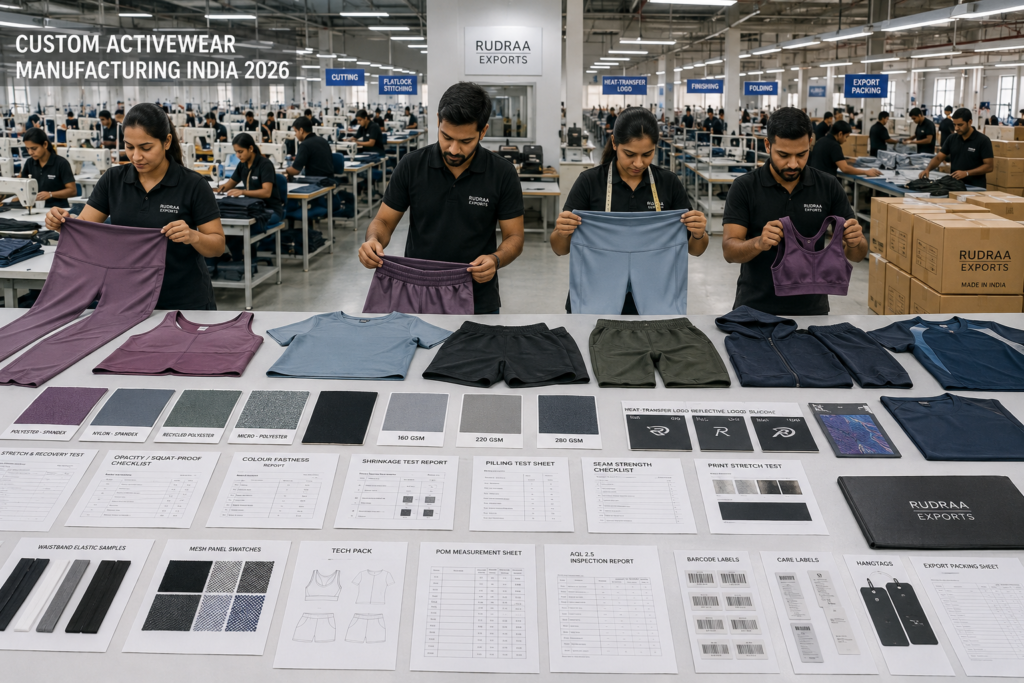
Activewear is no longer only gym clothing.
Today, brands use activewear for fitness, athleisure, yoga, running, teamwear, gym merchandise, school sportswear, corporate wellness programs, travel apparel, and private-label lifestyle collections.
But activewear manufacturing is more technical than basic T-shirt manufacturing.
A good activewear product must control stretch, recovery, opacity, sweat performance, seam strength, GSM, compression, colour fastness, print durability, fit, grading, and wash performance.
This is why choosing the right manufacturing partner matters.
India has become a strong sourcing option for activewear and sportswear, especially for knitwear-based products. Tirupur, Tamil Nadu, is particularly relevant because it has a deep ecosystem for knitting, dyeing, processing, printing, embroidery, sewing, finishing, QC, and export packing.
At Rudraa Exports, we help global buyers manufacture custom activewear, sportswear, performance T-shirts, leggings, joggers, hoodies, gym wear, teamwear, kids sportswear, uniforms, and private-label knitwear from Tirupur, India.
Quick Answer
Custom activewear manufacturing in India involves fabric selection, GSM planning, fit development, stretch and recovery testing, sampling, print or embroidery approval, bulk production, quality inspection, packing, and export documentation. Common activewear fabrics include polyester-spandex, nylon-spandex, recycled polyester blends, cotton-poly blends, micro-polyester, French terry, and performance knits. Buyers should evaluate manufacturers by fabric capability, MOQ, pricing transparency, certifications, QC testing, lead time, customization, and export readiness.
Planning to manufacture activewear or sportswear in India? Contact Rudraa Exports to request a custom activewear production plan.
Why India Is Growing in Activewear Manufacturing
India’s apparel export base is moving beyond basic knits into more technical and performance-led garments.
The uploaded source highlights that India’s sports and activewear exports grew from USD 417M in FY 2021–22 to USD 546M in FY 2022–23, with further growth projected for FY 2023–24.
This matters for buyers because India is becoming more capable in:
- Performance knits
- Synthetic blends
- Recycled polyester blends
- Stretch garments
- Technical finishing
- Sportswear customization
- Activewear printing
- Private-label production
- Export-ready documentation
Why Tirupur Is Strong for Activewear and Sportswear
Tirupur is best known for knitwear, but its ecosystem also supports activewear and performance-knit programs.
Tirupur Advantages
| Tirupur Strength | Buyer Benefit |
|---|---|
| Knitwear specialization | Strong fit for T-shirts, leggings, joggers, hoodies |
| Fabric sourcing | Cotton, blends, synthetics and performance knits |
| Dyeing and processing | Better control over shade and finishing |
| Printing capacity | Useful for gym, teamwear and brand logos |
| Embroidery capacity | Useful for patches, logos and uniforms |
| Export experience | Supports USA, UK, Europe, Australia and Middle East buyers |
| Cluster density | Fewer handoffs and faster coordination |
| Direct factory models | Better cost and communication control |
The uploaded source notes that Tirupur has a strong knitwear and synthetic-activewear ecosystem, including dyeing, processing, printing, embroidery, and testing infrastructure.
Activewear Product Categories
A strong activewear manufacturer should understand category-specific construction.
Common Activewear Products
| Product | Key Manufacturing Focus |
|---|---|
| Leggings | Opacity, stretch recovery, waistband hold |
| Sports bras | Compression, support, elastic, lining |
| Performance T-shirts | Moisture management, lightweight GSM |
| Running shorts | Lightweight fabric and movement |
| Gym shorts | Durability and stretch |
| Joggers | Waistband, drawcord, comfort |
| Hoodies | GSM, rib recovery, warmth |
| Sweatshirts | Fit, fleece or terry structure |
| Tank tops | Armhole, stretch and fabric drape |
| Teamwear | Logo placement and colour consistency |
| Kids sportswear | Comfort, safety and durability |
| Corporate activewear | Branding and reorder consistency |
Activewear Fabric Options
Fabric is the foundation of activewear.
The wrong fabric can create poor stretch, low recovery, sheerness, sweat discomfort, pilling, or shrinkage.
Common Activewear Fabrics
| Fabric | Best For |
|---|---|
| Polyester-spandex | Leggings, gym wear, sports bras |
| Nylon-spandex | Premium leggings and compression wear |
| Recycled polyester-spandex | Sustainable activewear programs |
| Micro-polyester | Performance T-shirts and running tops |
| Cotton-poly blends | Athleisure and casual sportswear |
| Cotton-elastane | Stretch T-shirts and leggings |
| French terry | Joggers, sweatshirts, light hoodies |
| Fleece | Winter sportswear and hoodies |
| Mesh | Panels, ventilation and teamwear |
| Pique | Polo sportswear and uniforms |
Activewear GSM Guide
GSM affects performance, opacity, compression, drape, warmth, and price.
Indicative GSM by Product
| Product | Common GSM Range | Notes |
|---|---|---|
| Performance T-shirt | 140–180 GSM | Lightweight and breathable |
| Micro-poly tee | 160–180 GSM | Common for sports and gym tees |
| Sports bra | 220–260 GSM | Support and coverage |
| Leggings | 250–320 GSM | Opacity and compression |
| Running shorts | 120–180 GSM | Lightweight movement |
| Gym shorts | 180–240 GSM | Durability and comfort |
| Joggers | 240–320 GSM | French terry or fleece |
| Hoodies | 280–420 GSM | Depends on warmth and structure |
| Sweatshirts | 240–350 GSM | Casual or performance use |
The uploaded source gives activewear GSM benchmarks such as 160–180 GSM for micro-poly tees, 220–240 GSM for sports bras, and 250–300 GSM for leggings.
How to Choose the Right Activewear Fabric
Fabric Decision Table
| Requirement | Better Fabric Direction |
|---|---|
| Squat-proof leggings | Higher GSM polyester-spandex or nylon-spandex |
| Premium compression | Nylon-spandex blend |
| Lower cost gym wear | Polyester-spandex |
| Running T-shirts | Micro-polyester |
| Athleisure joggers | French terry |
| Winter gym hoodies | Fleece |
| Sustainable positioning | Recycled polyester blends |
| Casual stretch tees | Cotton-elastane |
| Teamwear | Polyester or micro-poly blends |
Buyer Tip
Do not choose activewear fabric only by handfeel.
Also test:
- Stretch
- Recovery
- Opacity
- Shrinkage
- Pilling
- Colour fastness
- Wash durability
- Print compatibility
MOQ for Activewear Manufacturing in India
MOQ depends on product, fabric, colour count, GSM, trims, print, embroidery, labels, packaging, and certification needs.
Activewear MOQ Drivers
| MOQ Driver | Why It Matters |
|---|---|
| Fabric type | Technical fabrics may need sourcing minimums |
| Colour count | More colours split production |
| GSM | Special GSM may need planned fabric |
| Spandex blend | Fabric sourcing may require minimum quantity |
| Prints | Setup cost affects smaller orders |
| Elastic | Sports bras and waistbands need trim planning |
| Labels | Private label programs need MOQ |
| Packaging | Custom packaging adds minimums |
| Testing | Performance testing adds cost and time |
Buyer Tip
Always ask MOQ by:
- Style
- Colour
- Fabric
- Size range
- Print method
- Trim package
One MOQ number is not enough.
Activewear Pricing in India
Activewear pricing depends heavily on fabric and construction.
A simple performance T-shirt is not priced like a compression legging or sports bra.
Activewear Cost Components
| Cost Component | Examples |
|---|---|
| Fabric | Polyester-spandex, nylon-spandex, micro-poly |
| Dyeing and finishing | Shade, handfeel, performance finish |
| CMT | Cutting, stitching, finishing |
| Elastic and trims | Waistband, bra elastic, drawcord, zipper |
| Printing | Reflective logo, silicone print, screen print |
| Embroidery | Logo, patch, team badge |
| Testing | Stretch, colour fastness, pilling, wash |
| Labels | Neck, size, care, fibre content |
| Packing | Polybag, barcode, carton, hangtag |
Indicative FOB Planning Framework
| Product | Lower Complexity | Higher Complexity |
|---|---|---|
| Performance T-shirt | Lower FOB range | Higher with print and performance finish |
| Sports bra | Medium range | Higher with lining, elastic and support |
| Leggings | Medium to higher range | Higher with premium fabric and compression |
| Joggers | Medium range | Higher with trims and fabric weight |
| Hoodies | Medium to higher range | Higher with heavy GSM and branding |
The uploaded source provides reference-level activewear pricing logic and tiered FOB ranges for leggings, sports bras, and performance tees based on order quantity and specification.
Direct Factory vs Agent vs Trader for Activewear
Activewear has more technical risk than basic apparel.
So the sourcing model matters.
Sourcing Model Comparison
| Area | Direct Factory | Agent / Trader | Vendor Consolidator |
|---|---|---|---|
| Cost visibility | Better | Lower transparency | Medium |
| Fabric control | Stronger | Depends on supplier | Medium |
| Testing control | Easier to coordinate | May be indirect | Structured but layered |
| Communication | Direct | Through middle layer | Managed through office |
| MOQ discussion | More practical | May be bundled | Depends on network |
| QC accountability | Clearer | Can be unclear | Structured but not factory-owned |
| Scaling | Easier if factory fits | May move factories | Good for multi-country |
| Best for | Repeatable activewear programs | Simple buying support | Large multi-source buyers |
The uploaded source compares Rudraa Exports’ direct-factory model with agents, trading houses, and vendor consolidators, highlighting differences in cost transparency, lead-time control, customization, and QC accountability.
Why Direct Factory Sourcing Helps Activewear Buyers
Direct factory communication helps because activewear decisions are technical.
Direct Factory Advantages
- Clearer fabric discussion
- Better GSM control
- Faster sample feedback
- Direct print and trim coordination
- Better QC visibility
- Easier performance testing
- Stronger production accountability
- Fewer communication handoffs
- Better repeat production consistency
For leggings, sports bras, and performance tops, direct control over fabric, fit, seams, and testing is especially important.
Activewear Customization Options
Activewear buyers usually need both functional and branding customization.
Customization Options
| Area | Options |
|---|---|
| Fabric | Polyester-spandex, nylon-spandex, recycled blends |
| Fit | Compression, relaxed, athletic, oversized |
| Waistband | High waist, mid waist, elastic, drawcord |
| Seams | Flatlock, overlock, coverstitch |
| Panels | Mesh, contrast, ventilation |
| Logos | Silicone, reflective, heat transfer, embroidery |
| Prints | Screen, digital, sublimation, all-over print |
| Trims | Zippers, drawcords, toggles, eyelets |
| Labels | Heat transfer, woven, printed |
| Packing | Barcode, hangtag, polybag, carton marks |
The uploaded source highlights Tirupur’s activewear customization strength through printing, digital printing, embroidery, and brand-detail execution.
Activewear Quality Control Checklist
Activewear needs special QC checks because the garments stretch, move, sweat, and wash frequently.
QC Checkpoints
| QC Area | What to Check |
|---|---|
| Fabric GSM | Matches approved spec |
| Stretch | Width and length stretch |
| Recovery | Shape after stretch |
| Opacity | Squat-proof or coverage test |
| Shrinkage | After wash |
| Colour fastness | Wash, rub, perspiration |
| Pilling | Especially for leggings and brushed fabrics |
| Seam strength | Stretch seam durability |
| Needle damage | Holes near seams |
| Print durability | Stretch and wash performance |
| Measurements | Within tolerance |
| Waistband | Hold and comfort |
| Bra elastic | Support and pressure |
| Packing | Size, barcode and carton accuracy |
The uploaded source identifies activewear failure risks such as stretch recovery drift, colour fastness issues, heat-transfer cracking, and measurement tolerance creep across sizes.
Product-Specific QC Checks
Leggings
Check:
- Squat opacity
- Waistband hold
- Inseam twisting
- Stretch recovery
- Seam popping
- Gusset comfort
- Fabric pilling
- Size grading
Sports Bras
Check:
- Support level
- Elastic quality
- Lining comfort
- Strap strength
- Compression
- Armhole comfort
- Label irritation
- Wash performance
Performance T-Shirts
Check:
- Breathability
- GSM
- Shoulder fit
- Print durability
- Sweat comfort
- Neck rib recovery
- Shrinkage
- Colour fastness
Shorts
Check:
- Inseam
- Movement comfort
- Waistband
- Drawcord
- Pocket strength
- Hem shape
- Inner brief if applicable
Activewear Testing Plan
A good activewear program should include a fabric and garment test plan.
Common Tests
| Test | Why It Matters |
|---|---|
| GSM test | Confirms fabric weight |
| Stretch and recovery | Checks performance fit |
| Shrinkage test | Prevents size change |
| Colour fastness to wash | Prevents fading |
| Colour fastness to rubbing | Prevents colour transfer |
| Colour fastness to perspiration | Important for gym wear |
| Pilling test | Checks surface durability |
| Seam strength | Prevents seam failure |
| Print wash test | Checks logo durability |
| Opacity test | Important for leggings |
Activewear Sampling Process
Sampling should not be rushed.
Sample Stages
| Sample | Purpose |
|---|---|
| Fabric swatch | Checks fabric and handfeel |
| Lab dip | Confirms colour |
| Proto sample | First physical version |
| Fit sample | Checks shape and comfort |
| Size set | Checks grading |
| Print strike-off | Checks logo and stretch |
| Wash test sample | Checks after wash behaviour |
| PP sample | Final approval before bulk |
| TOP sample | Checks first production output |
Buyer Tip
For leggings and sports bras, always test movement before approval.
Static fit is not enough.
Activewear Lead Time in India
Lead time depends on fabric availability, GSM, trims, sampling, print, testing, order quantity, and export packing.
Typical Planning Timeline
| Stage | Planning Time |
|---|---|
| Tech pack review | 1–3 days |
| Fabric sourcing | 1–3 weeks |
| Lab dip / colour approval | 1–2 weeks |
| Sampling | 2–4 weeks |
| Print / trim approval | 1–2 weeks |
| Bulk production | 3–6 weeks |
| QC and packing | 1 week |
| Export freight | Depends on destination |
The uploaded source gives typical planning logic for activewear including fabric booking, sewing, and freight windows, with route-dependent export timing.
Certifications for Activewear Buyers
Certifications depend on the buyer’s market and product claims.
Common Certifications and Standards
| Certification / Standard | Why It Matters |
|---|---|
| ISO 9001:2015 | Quality management system |
| OEKO-TEX Standard 100 | Chemical safety |
| GOTS | Organic textile processing |
| GRS | Recycled material claims |
| RCS | Recycled content verification |
| BSCI | Social compliance |
| SEDEX / SMETA | Ethical trade monitoring |
| AQL inspection | Quality acceptance method |
Buyer Tip
If you are selling recycled polyester activewear, confirm the certification scope and transaction documentation before making recycled claims.
How to Move Activewear Production to India
Changing suppliers should be done carefully.
Step 1: Lock Non-Negotiables
Define:
- Fabric composition
- GSM
- Stretch and recovery requirement
- Opacity requirement
- Fit tolerance
- Print method
- Label requirement
- Packaging rules
Step 2: Run Sampling Properly
Approve:
- Proto sample
- Size set
- Bulk-intent fabric
- Print or heat-transfer sample
- Wash test
- PP sample
Step 3: Set QC Gates
Use:
- Fabric inspection
- Inline inspection
- Midline measurement audit
- Final inspection
- AQL report
- CAPA for repeat defects
Step 4: Plan Lead Time and Logistics
Confirm:
- Fabric booking
- Production window
- Testing time
- Packing time
- Freight mode
- Destination market
- Export documentation
The uploaded source recommends a structured migration plan covering locked specs, sampling, QC gates, AQL alignment, lead-time planning, and logistics.
Why Rudraa Exports
Rudraa Exports supports custom activewear and sportswear manufacturing from Tirupur, India, with factory-direct production and export-ready systems.
Activewear Products Supported
- Leggings
- Sports bras
- Performance T-shirts
- Gym T-shirts
- Running shorts
- Training shorts
- Joggers
- Hoodies
- Sweatshirts
- Tank tops
- Kids sportswear
- School sports uniforms
- Corporate activewear
- Teamwear
- Private-label activewear
Buyer Support
- Activewear tech pack review
- Fabric and GSM guidance
- Stretch fabric sourcing support
- Sampling and fit development
- Size set coordination
- Print and logo approval
- Trim and label planning
- QC and testing coordination
- AQL 2.5 inspection standards
- Export packing and documentation support
Manufacturing Strengths
- Factory-direct Tirupur knitwear manufacturing
- 72,000+ units per month production capacity
- MOQ discussions starting from around 300 pieces for suitable programs
- Performance knitwear and athleisure production support
- Multi-port shipping through Chennai, Tuticorin, and Cochin
- Export support for USA, UK, Europe, Australia, Middle East, and global buyers
Buyer Advantages
- Factory-direct pricing without trading-company markups
- Up to 40% cost-saving positioning compared with indirect sourcing models
- Better visibility over fabric, trims, sampling, and QC
- Stronger control for stretch and performance garments
- Better communication from development to dispatch
- Suitable for small-batch activewear launches and scalable repeat programs
Ready to manufacture custom activewear in India? Speak with Rudraa Exports to share your tech pack, target fabric, GSM, quantity, colour count, logo requirement, and destination market.
Activewear Manufacturer Checklist for Buyers
| # | Checklist Item |
|---|---|
| 1 | Define product category |
| 2 | Confirm target market |
| 3 | Confirm fabric composition |
| 4 | Confirm GSM |
| 5 | Confirm stretch requirement |
| 6 | Confirm opacity requirement |
| 7 | Confirm fit tolerance |
| 8 | Confirm MOQ by style and colour |
| 9 | Request fabric swatches |
| 10 | Approve lab dips |
| 11 | Approve fit sample |
| 12 | Approve size set |
| 13 | Approve print or logo test |
| 14 | Run wash test |
| 15 | Confirm QC checkpoints |
| 16 | Confirm testing requirements |
| 17 | Confirm labels and packaging |
| 18 | Request tiered pricing |
| 19 | Confirm export documents |
| 20 | Approve PP sample before bulk |
FAQ: Custom Activewear Manufacturing in India
1. Is India good for activewear manufacturing?
Yes. India is becoming stronger in activewear and sportswear manufacturing, especially knit-based products such as leggings, performance T-shirts, joggers, hoodies, teamwear, and gym apparel.
2. Which city is best for activewear manufacturing in India?
Tirupur is one of the strongest cities for knitwear-based activewear because it has fabric sourcing, dyeing, printing, embroidery, sewing, finishing, QC, and export support within the cluster.
3. What fabrics are used for activewear?
Common activewear fabrics include polyester-spandex, nylon-spandex, recycled polyester blends, micro-polyester, cotton-poly blends, French terry, fleece, mesh, and cotton-elastane.
4. What GSM is best for leggings?
Leggings commonly use around 250–320 GSM depending on opacity, compression, stretch, and brand positioning.
5. What GSM is best for performance T-shirts?
Performance T-shirts commonly use around 140–180 GSM, with micro-polyester options often around 160–180 GSM.
6. Can Rudraa Exports manufacture private-label activewear?
Yes. Rudraa can support private-label activewear with custom labels, care labels, heat transfers, prints, embroidery, hangtags, barcode stickers, packaging, and export cartons.
7. What is the MOQ for activewear manufacturing in India?
MOQ depends on fabric, GSM, colour, size range, trims, prints, labels, packaging, and testing requirements. Suitable programs may start lower, while technical fabrics and custom colours may require higher quantities.
8. How do I compare activewear manufacturer quotes?
Compare quotes using the same fabric composition, GSM, quantity, colour count, trim package, print method, testing requirement, packing, and Incoterm.
9. What QC tests are important for activewear?
Important checks include stretch recovery, opacity, shrinkage, colour fastness, pilling, seam strength, print durability, measurement tolerance, waistband hold, and wash performance.
10. Can India manufacture recycled polyester activewear?
Yes. Recycled polyester activewear can be manufactured if suitable fabric sourcing, certification scope, MOQ, and documentation are aligned.
11. Can Rudraa Exports export activewear to USA, UK, EU, and Australia?
Yes. Rudraa supports activewear and sportswear export production for USA, UK, Europe, Australia, Middle East, and other global markets.
12. What should I send to get an activewear quote?
Send product type, tech pack, fabric composition, GSM, target quantity, size range, colours, logo method, trims, packaging, destination market, and testing or certification needs.
Conclusion
Custom activewear and sportswear manufacturing requires more control than basic apparel production.
The right manufacturer must understand performance fabrics, GSM, stretch recovery, opacity, seam strength, print durability, fit, size grading, QC, testing, packing, and export documentation.
India is becoming a stronger activewear sourcing destination, and Tirupur is especially useful for knitwear-based performance products because of its dense manufacturing ecosystem.
For buyers, the safest approach is to choose a direct-factory partner that can support fabric selection, sampling, testing, QC, customization, and scalable production.
Rudraa Exports helps global buyers manufacture leggings, sports bras, performance T-shirts, joggers, hoodies, teamwear, kids sportswear, corporate activewear, and private-label sportswear from Tirupur with factory-direct coordination and export-ready systems.
Visit rudraaexports.com or contact our team directly to share your activewear product requirement, fabric, GSM, MOQ, colour count, customization needs, and destination market — and receive a factory-direct activewear manufacturing plan from Rudraa Exports.
Related reading
Activewear Manufacturing in India for Australian Brands: Why Tirupur Works
How to Source Fabric in India for Your Clothing Brand: Mills, MOQs and Quality Guide
How to Reduce Garment Production Lead Times: 7 Proven Strategies for Apparel Buyers
Leggings Manufacturing in India: Fabric, GSM, MOQ and Private Label Guide