
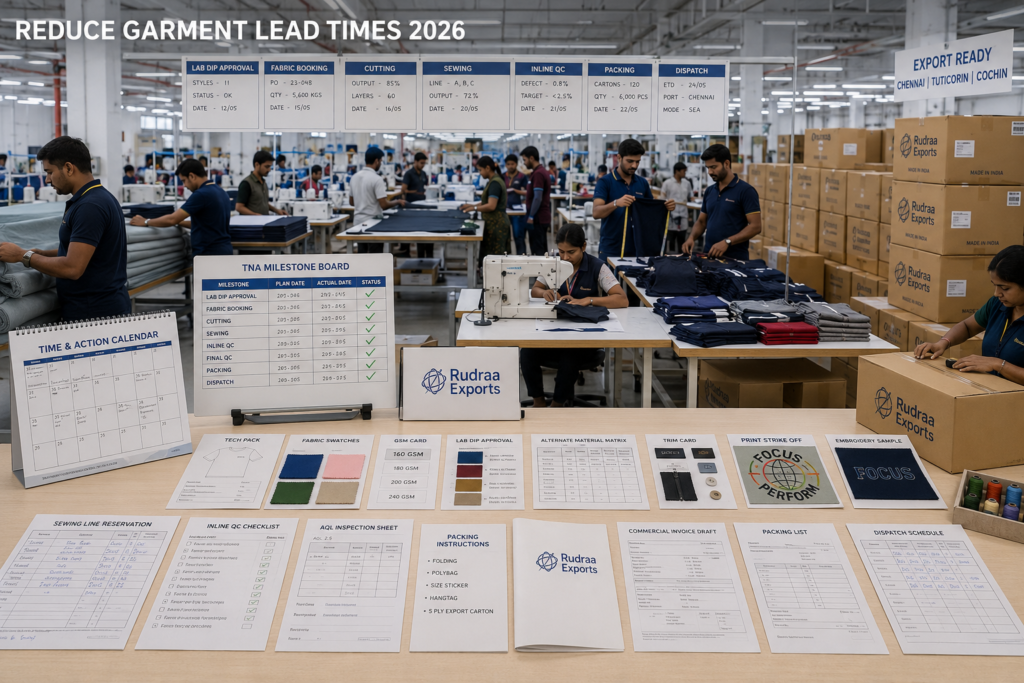
Garment production lead time is not just an operations metric.
It directly affects sales, cash flow, launch dates, markdown risk, buyer trust, and reorder planning.
When production runs late, brands may miss seasonal selling windows, spend more on air freight, delay website launches, lose retail placement, or face buyer chargebacks. For fast-moving apparel categories like T-shirts, polos, hoodies, kidswear, uniforms, and private-label basics, even a one-week delay can affect margin.
The good news is that lead time can be reduced when the buyer and factory manage approvals, materials, sampling, production, QC, packing, and logistics in a disciplined way.
Tirupur, India’s knitwear hub, is especially strong for faster knitwear programs because many processes are located within the same ecosystem: yarn, knitting, dyeing, printing, embroidery, stitching, finishing, packing, and export coordination.
At Rudraa Exports, we help global buyers reduce production delays through factory-direct planning, Time & Action calendars, material readiness, sampling control, inline QC, and export-ready shipment workflows from Tirupur.
Quick Answer
To reduce garment production lead times, buyers should finalise the tech pack early, use a Time & Action calendar, pre-book fabric and production capacity, reduce SKU and trim complexity, approve alternate materials in advance, minimise sampling rounds, run inline quality checks, and plan logistics before production ends. In Tirupur, standard knitwear programs can often run faster when approvals, fabric, trims, dyeing, printing, sewing, QC, and packing are coordinated through a direct-factory workflow.
Planning a faster garment production program? Contact Rudraa Exports to request a lead-time review for your product, MOQ, fabric, and target shipment date.
Why Garment Production Lead Time Matters
Lead time is the total time needed to move from confirmed order to finished shipment.
It includes:
- Tech pack review
- Fabric sourcing
- Lab dips
- Trim approval
- Sampling
- Pattern and grading
- Cutting
- Stitching
- Printing or embroidery
- Washing or finishing
- Quality inspection
- Packing
- Documentation
- Dispatch
If any stage is delayed, the full order timeline gets affected.
Common Reasons Garment Orders Get Delayed
Most delays are preventable.
Lead-Time Delay Factors
| Delay Cause | What Happens |
|---|---|
| Incomplete tech pack | Factory asks repeated questions |
| Late lab dip approval | Dyeing cannot start |
| Fabric not booked early | Production waits for raw material |
| Too many colourways | Dyeing and cutting become slower |
| Trim delays | Stitching or packing stops |
| Too many sample revisions | Bulk production starts late |
| No TNA calendar | Nobody owns deadlines |
| End-line QC failure | Rework delays shipment |
| Late packing details | Cartons cannot be completed |
| Documentation mismatch | Dispatch gets delayed |
A faster production system starts before the PO is placed.
Lead-Time Optimized vs Traditional Production
| Area | Traditional Approach | Lead-Time Optimized Approach |
|---|---|---|
| Approvals | Informal and slow | Deadline-based with named owners |
| Fabric | Ordered after PO | Pre-approved and pre-booked |
| Sampling | Multiple unclear rounds | Structured sample plan |
| Capacity | Requested late | Reserved in advance |
| QC | Checked at the end | Checked inline |
| Logistics | Planned after packing | Planned before production ends |
| Communication | Email chains | Single TNA tracker |
| Responsibility | Spread across many parties | Direct-factory accountability |
The uploaded source explains that fewer handoffs, tighter control, and direct-factory coordination help reduce idle days and improve production reliability.
Typical Garment Production Timeline in Tirupur
Timelines vary by product, GSM, fabric availability, colour count, trims, decoration, order size, and approval speed.
Standard Knitwear Timeline
| Stage | Typical Time |
|---|---|
| Tech pack review | 1–3 days |
| Lab dips / shade approval | 5–10 days |
| Yarn or fabric sourcing | 5–7 days |
| Knitting | 2–4 days |
| Dyeing and finishing | 7–10 days |
| Fabric inspection | 1–2 days |
| Pattern, grading, marker | 2–4 days |
| Cutting | 1–2 days |
| Sewing | 10–20 days |
| Printing / embroidery | 3–7 days |
| Final QC and packing | 2–4 days |
| Documentation and dispatch | 1–3 days |
Rush Program Timeline
Rush programs are possible only when prerequisites are ready.
| Requirement | Needed for Rush Production |
|---|---|
| Approved tech pack | No open construction questions |
| Approved fabric | No new development delay |
| Approved trims | Labels, zips, drawcords ready |
| Approved lab dips | No shade waiting |
| Reserved capacity | Sewing and dyeing slots booked |
| Fast buyer approvals | 24–48 hour feedback |
| Inline QC | No end-stage surprise failures |
| Clear logistics plan | Dispatch ready before packing ends |
The uploaded source notes that standard Tirupur programs may often fall around 45–60 days, while rush programs can be compressed when inputs and approvals are tightly controlled.
Strategy 1: Use a Time & Action Calendar
A Time & Action calendar, also called a TNA calendar, is the most important lead-time control tool.
It lists every milestone, due date, owner, and approval deadline.
TNA Calendar Should Include
| Milestone | Owner |
|---|---|
| Tech pack received | Buyer / factory |
| Fabric sourced | Factory |
| Lab dip submitted | Factory |
| Lab dip approved | Buyer |
| Trim card approved | Buyer |
| Sample completed | Factory |
| Fit feedback received | Buyer |
| PP sample approved | Buyer |
| Fabric production started | Factory |
| Cutting started | Factory |
| Sewing started | Factory |
| Inline QC completed | Factory |
| Final inspection | QC team |
| Packing completed | Factory |
| Documents prepared | Export team |
| Dispatch completed | Logistics team |
Buyer Tip
Every approval should have a deadline.
For example:
Lab dip approval must be completed within 48 hours of receipt.
If approvals are open-ended, lead time becomes unpredictable.
Strategy 2: Pre-Book Fabric and Production Capacity
Many buyers lose time because they confirm capacity too late.
Even if the factory is ready, fabric mills, dyeing units, printing units, embroidery teams, and sewing lines may already be booked.
What to Pre-Book
- Yarn
- Fabric
- Dyeing slot
- Printing slot
- Embroidery slot
- Sewing line
- Finishing team
- Packing team
- Export dispatch window
Why It Matters
| Without Pre-Booking | With Pre-Booking |
|---|---|
| Order waits in queue | Production slot is protected |
| Dyeing may be delayed | Wet processing is planned |
| Trims may arrive late | Materials are aligned early |
| Sewing starts late | Line allocation is clear |
| Shipment date slips | Dispatch plan is realistic |
Pre-booking is especially important during peak season.
Strategy 3: Reduce SKU and Trim Complexity
Every extra style, colour, trim, print, label, and packing variation adds time.
A collection with 3 colours is easier and faster than a collection with 12 colours.
Complexity Drivers
| Complexity | How It Adds Delay |
|---|---|
| Many colourways | More lab dips and dye lots |
| Many GSMs | More fabric sourcing |
| Many trims | More vendor coordination |
| Many labels | More packing risk |
| Many print placements | More strike-offs |
| Many size ratios | More cutting and packing complexity |
| Custom zippers | More sourcing delay |
| Custom packaging | More approval time |
Better Approach
For first production or rush orders, keep the program simple.
Example:
- 1 fabric
- 1 GSM
- 2–3 colours
- 1 label set
- 1 print method
- Standard packing
This can reduce decision delays and production risk.
Strategy 4: Approve Alternate Materials Early
A production plan can stop if one fabric, yarn, rib, zipper, label, or drawcord is not available.
To avoid this, approve alternates before production begins.
Alternate Material Matrix
| Item | Primary Option | Approved Alternate |
|---|---|---|
| Main fabric | 180 GSM cotton jersey | 185 GSM cotton jersey |
| Rib | 1×1 cotton rib | 1×1 cotton-elastane rib |
| Thread | Tonal cotton thread | Tonal poly thread |
| Drawcord | Flat cotton cord | Round cotton cord |
| Label | Woven label | Printed neck label |
| Polybag | Recyclable clear bag | Standard clear bag |
Buyer Tip
Alternates should be approved in the tech pack.
If alternates are discussed only after a shortage happens, you lose time.
Strategy 5: Reduce Sampling Rounds
Sampling is important, but uncontrolled sampling can delay production.
Many delays happen because the buyer changes design details after every sample.
How to Reduce Sampling Time
| Problem | Better Method |
|---|---|
| Vague fit comments | Give measurement-based feedback |
| Too many design changes | Lock design before sample |
| Old files used | Keep one latest tech pack |
| No revision log | Track every change |
| No sample purpose | Define proto, fit, PP sample clearly |
| Late feedback | Set approval SLA |
Sample Control Rule
Each sample round should answer a clear question.
- Proto sample: Does the design work?
- Fit sample: Does it fit correctly?
- Size set: Does grading work?
- PP sample: Is it ready for bulk?
Do not keep changing the design after PP approval.
Strategy 6: Build Quality Control Into the Line
End-line QC alone is risky.
If defects are found only after production is complete, rework can delay shipment.
Inline QC helps catch problems early.
Inline QC Checkpoints
| Stage | What to Check |
|---|---|
| Fabric inspection | GSM, shade, holes, shrinkage |
| Cutting | Marker accuracy, panel count |
| First piece | Construction and measurement |
| Sewing line | Stitching, seams, alignment |
| Print / embroidery | Placement and quality |
| Midline inspection | Measurement consistency |
| Final inspection | AQL and packing readiness |
Product-Specific QC Examples
| Product | Critical QC Points |
|---|---|
| T-shirt | Neck rib, sleeve length, body length |
| Polo | Collar shape, placket, button alignment |
| Hoodie | Hood symmetry, rib recovery, pocket placement |
| Jogger | Waistband, drawcord, inseam, cuff |
| Kidswear | Safety, labels, trims, stitching |
| Uniform | Colour consistency, logo placement |
The fastest order is the one that does not need rework.
Strategy 7: Plan Logistics Before Production Ends
Logistics should not start after packing is finished.
It should be planned while production is still running.
Logistics Planning Checklist
| Item | Confirm Early |
|---|---|
| Incoterm | FOB, CIF, DAP, etc. |
| Export port | Chennai, Tuticorin, Cochin |
| Destination port | USA, UK, EU, Australia, Middle East |
| Freight mode | Sea, air, or hybrid |
| Carton dimensions | Needed for booking |
| Gross weight | Needed for freight |
| Buyer warehouse rules | Carton marks and labels |
| Documents | Invoice, packing list, COO |
| Cut-off date | Vessel or air booking deadline |
Hybrid Logistics Option
For urgent launches, buyers can split shipment:
- First critical quantity by air
- Remaining bulk by sea
This protects launch dates without air-freighting the full order.
7 Proven Lead-Time Reduction Strategies: Summary Table
| # | Strategy | Main Benefit |
|---|---|---|
| 1 | Use TNA calendar | Controls approvals and milestones |
| 2 | Pre-book capacity | Avoids production queue delays |
| 3 | Reduce SKU complexity | Fewer approvals and fewer dye lots |
| 4 | Approve alternates | Prevents material stoppage |
| 5 | Reduce sampling rounds | Speeds pre-production |
| 6 | Use inline QC | Avoids rework delays |
| 7 | Plan logistics early | Prevents dispatch surprises |
Red Flags That Will Delay Your Order
Watch for these early warning signs:
- Tech pack is incomplete
- Fabric is not approved
- Lab dips are pending
- Buyer feedback is slow
- Too many colours are open
- Trim approval is pending
- Capacity is not reserved
- Sample changes are not documented
- QC plan is not agreed
- Packing instructions are missing
- Export documents are not ready
If these are not fixed early, the order will likely run late.
Pre-Order Checklist for Faster Production
| # | Checklist Item |
|---|---|
| 1 | Final tech pack approved |
| 2 | Fabric spec approved |
| 3 | GSM confirmed |
| 4 | Lab dips approved |
| 5 | Trim card approved |
| 6 | Artwork files approved |
| 7 | Print / embroidery placement approved |
| 8 | Measurement tolerance confirmed |
| 9 | Size set plan confirmed |
| 10 | PP sample approval timeline agreed |
| 11 | Alternate materials approved |
| 12 | TNA calendar created |
| 13 | Buyer approval owner assigned |
| 14 | Fabric and dyeing capacity reserved |
| 15 | Sewing line reserved |
| 16 | Inline QC checkpoints agreed |
| 17 | Packing instructions confirmed |
| 18 | Export documents listed |
| 19 | Freight mode selected |
| 20 | Dispatch deadline confirmed |
Why Tirupur Helps Reduce Lead Times
Tirupur’s biggest advantage is cluster density.
Many processes are available close together, which reduces handoffs and coordination delays.
Tirupur Lead-Time Advantages
| Advantage | How It Helps |
|---|---|
| Knitwear specialization | Faster product understanding |
| Local fabric ecosystem | Faster sourcing |
| Dyeing and finishing support | Faster wet processing coordination |
| Printing and embroidery options | Faster decoration approvals |
| Export packing experience | Faster shipment readiness |
| Factory-direct workflow | Fewer communication layers |
| MOQ flexibility | Better pilot and reorder planning |
| Repeat production support | Faster reorders over time |
For knitwear programs, Tirupur can be faster when the buyer and factory are aligned from the beginning.
Why Rudraa Exports
Rudraa Exports supports global buyers with factory-direct knitwear production from Tirupur, India.
Manufacturing Capabilities
- Factory-direct Tirupur knitwear manufacturing
- 72,000+ units per month production capacity
- T-shirts, polos, sweatshirts, hoodies, joggers, leggings, kidswear, babywear, uniforms, activewear, corporate apparel, and private-label knitwear
- MOQ discussions starting from around 300 pieces for suitable programs
- Sampling support for new and growing brands
- Bulk production planning for repeat programs
Lead-Time Reduction Support
- TNA calendar planning
- Fabric and GSM pre-approval
- Material alternate planning
- Sampling workflow control
- Lab dip coordination
- Print and embroidery approval support
- Sewing line planning
- Inline QC checkpoints
- AQL 2.5 inspection standards
- Export packing support
- Documentation and dispatch coordination
Buyer Advantages
- Factory-direct communication without agent delays
- Better visibility from sampling to dispatch
- Reduced handoffs inside Tirupur’s knitwear ecosystem
- Faster decision-making through structured approvals
- Better control over rework and QC
- Export support for USA, UK, Europe, Australia, Middle East, and global buyers
- Multi-port shipping through Chennai, Tuticorin, and Cochin
Ready to reduce garment production lead times? Speak with Rudraa Exports to share your product type, tech pack, MOQ, target dispatch date, and destination market.
FAQ: How to Reduce Garment Production Lead Times
1. What is garment production lead time?
Garment production lead time is the time needed to complete a garment order from confirmed order or approved sample to finished goods dispatch.
2. What causes garment production delays?
Common causes include incomplete tech packs, late approvals, fabric delays, trim shortages, too many sampling rounds, capacity queues, QC failures, and late packing or documentation details.
3. How can I reduce garment production lead time?
Use a TNA calendar, approve materials early, reduce SKU complexity, pre-book capacity, control sampling rounds, run inline QC, and plan logistics before production ends.
4. What is a TNA calendar in apparel?
A TNA calendar is a Time & Action plan that lists every production milestone, owner, due date, and approval deadline.
5. Why does sampling delay production?
Sampling delays production when feedback is unclear, design changes continue after approval, old files are used, or the buyer takes too long to approve fit, lab dips, strike-offs, or PP samples.
6. How does inline QC reduce lead time?
Inline QC catches defects while production is running. This prevents large-scale rework at the end of the order.
7. Can Tirupur produce garments faster?
Tirupur can support faster knitwear production because many processes such as knitting, dyeing, printing, embroidery, stitching, finishing, and packing are available within the cluster.
8. What products can Rudraa Exports manufacture with lead-time planning?
Rudraa manufactures T-shirts, polos, hoodies, sweatshirts, joggers, leggings, kidswear, babywear, uniforms, activewear, corporate apparel, and private-label knitwear.
9. Can rush garment production be done safely?
Yes, but only when the tech pack, fabric, trims, lab dips, samples, capacity, QC plan, and logistics are ready. Rushing without preparation increases quality risk.
10. What is the best way to avoid production delays?
The best way is to prepare before the PO: final tech pack, approved materials, confirmed capacity, clear TNA, defined QC checkpoints, and logistics plan.
11. Can Rudraa Exports help with faster garment production?
Yes. Rudraa supports lead-time planning through TNA calendars, material readiness, sampling control, inline QC, packing, and export coordination.
12. Does reducing lead time mean reducing quality?
No. Good lead-time reduction comes from better planning, fewer handoffs, faster approvals, and inline QC — not from skipping quality steps.
Conclusion
Garment production lead time can be reduced, but not by simply pressuring the factory to go faster.
The real solution is better planning.
A complete tech pack, early material approval, TNA calendar, capacity booking, SKU simplification, alternate material planning, controlled sampling, inline QC, and early logistics planning can remove weeks from the production calendar.
For knitwear buyers, Tirupur offers a strong ecosystem because many processes are located close together. With the right direct-factory partner, brands can reduce handoffs, avoid rework, improve visibility, and hit launch windows more reliably.
Rudraa Exports helps global buyers manufacture T-shirts, polos, hoodies, sweatshirts, joggers, kidswear, babywear, uniforms, and private-label knitwear from Tirupur with a lead-time-focused production workflow.
Visit rudraaexports.com or contact our team directly to share your target dispatch date, tech pack, product category, MOQ, and destination market — and receive a practical lead-time reduction plan from Rudraa Exports.
Related reading
Seasonal Production Planning for Apparel Brands: How to Book Factory Capacity in India
How to Build a Consistent Production System for Your Growing Australian Clothing Brand