
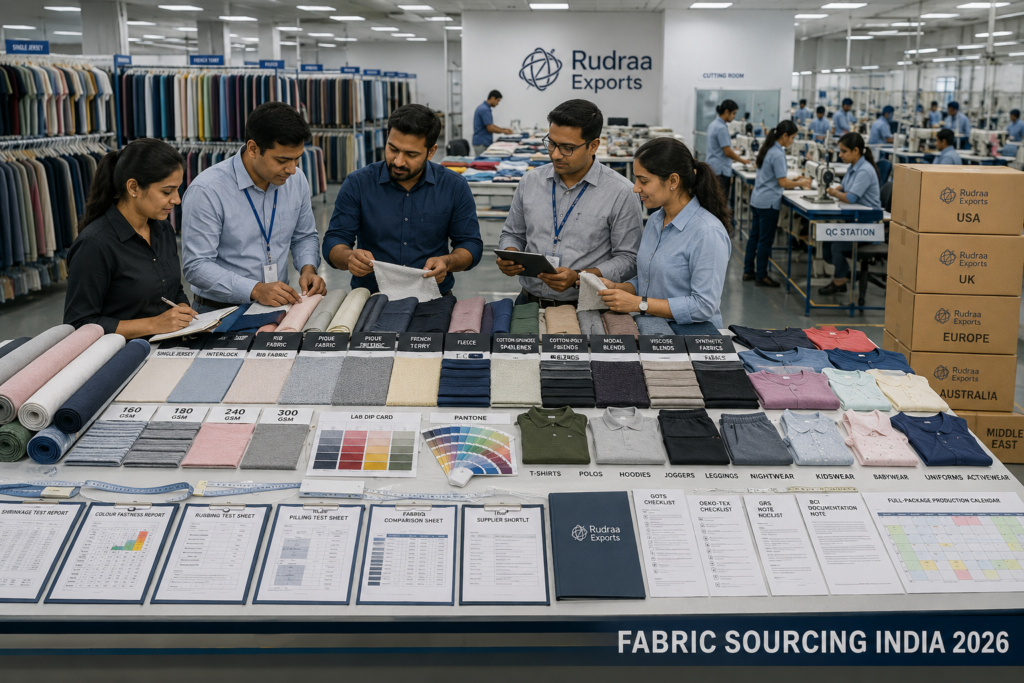
Fabric sourcing is one of the most important decisions in clothing manufacturing.
The right fabric can make your product feel premium, fit better, wash better, and sell better.
The wrong fabric can create shrinkage, shade mismatch, pilling, poor drape, weak recovery, high wastage, delays, and customer returns.
India is a strong fabric sourcing destination because it has multiple textile clusters with different strengths. Tirupur is strong for cotton knits and garment manufacturing. Surat is strong for synthetic and printed fabrics. Erode is known for greige cotton and woven base fabrics. Ludhiana is known for wool, acrylic, and winter knits.
But sourcing fabric in India can become difficult if the buyer does not understand mills, MOQs, GSM, shade approval, testing, certifications, and logistics.
At Rudraa Exports, we help global clothing brands source suitable fabrics, approve lab dips, manage quality checks, develop samples, and manufacture export-ready apparel through a full-package production model from Tirupur, India.
Quick Answer
To source fabric in India, first choose the right textile region based on fabric type, then define your fabric specification, confirm MOQ, request swatches or lab dips, test GSM, shrinkage, colour fastness, rubbing, and pilling, verify certifications if required, and align fabric sourcing with garment production. Clothing brands can either buy fabric themselves or work with a full-package manufacturer who manages fabric, trims, testing, sampling, production, packing, and export documentation.
Need help sourcing fabric and manufacturing garments in India? Contact Rudraa Exports to request a fabric sourcing and full-package production plan.
Why Fabric Sourcing Matters
Fabric is not just a raw material.
It controls the garment’s:
- Comfort
- Fit
- Drape
- Weight
- Stretch
- Recovery
- Shrinkage
- Colour
- Print result
- Wash durability
- Retail price
- Customer satisfaction
A garment factory can stitch well, but if the fabric is wrong, the product can still fail.
India’s Fabric Sourcing Advantage
India has a wide textile base, including cotton, knits, synthetics, wovens, blends, recycled yarns, printed fabrics, and winter knits.
The uploaded source explains that India exports large volumes of textiles, fabric, and garments, and that its fabric sourcing advantage depends heavily on how the supply chain is structured.
India Is Strong For
| Fabric / Product Area | Common Region |
|---|---|
| Cotton knit fabric | Tirupur |
| Single jersey | Tirupur |
| Interlock | Tirupur |
| Rib fabric | Tirupur |
| Fleece and French terry | Tirupur |
| Polyester and MMF fabrics | Surat |
| Digital printed fabrics | Surat |
| Greige cotton | Erode |
| Woven base fabrics | Erode |
| Wool and acrylic knits | Ludhiana |
| Winter knitwear | Ludhiana |
Fabric Sourcing Regions in India
1. Tirupur: Cotton Knits and Garment Ecosystem
Tirupur is one of India’s strongest knitwear hubs.
It is especially useful for brands sourcing fabrics for:
- T-shirts
- Polo shirts
- Hoodies
- Sweatshirts
- Joggers
- Leggings
- Kidswear
- Babywear
- Nightwear
- Loungewear
- Uniforms
- Private-label basics
Tirupur Fabric Strengths
| Fabric Type | Best For |
|---|---|
| Cotton single jersey | T-shirts and casual tops |
| Cotton interlock | Babywear and premium basics |
| Rib fabric | Necklines, cuffs, tank tops, leggings |
| French terry | Joggers, sweatshirts, lounge sets |
| Fleece | Hoodies and winter casualwear |
| Cotton-spandex | Leggings and stretch basics |
| Cotton-poly blends | Durable casualwear and uniforms |
The uploaded source identifies Tirupur as a key region for cotton single jersey, interlock, rib knits, tees, polos, and repeat knitwear programs.
2. Surat: Synthetic, MMF and Printed Fabrics
Surat is known for man-made fibre fabrics, polyester, synthetics, blends, and printed fabrics.
Surat Fabric Strengths
| Fabric Type | Best For |
|---|---|
| Polyester | Dresses, activewear, fashion tops |
| Poly-spandex | Activewear and leggings |
| Digital printed fabric | Printed capsules and fashion drops |
| Sublimation fabric | Sportswear and teamwear |
| Georgette / chiffon style fabrics | Fashionwear and womenswear |
| Synthetic blends | Fast-moving fashion collections |
Surat can be useful for brands that need synthetic fabrics, prints, or performance-oriented fabric options.
3. Erode: Greige Cotton and Woven Base Fabrics
Erode is known for cotton textile supply and greige fabric.
Erode Fabric Strengths
| Fabric Type | Best For |
|---|---|
| Greige cotton | Shirts, lining, conversion programs |
| Woven cotton | Casualwear and utility garments |
| Powerloom fabrics | Large-volume base fabric programs |
| Dyed woven fabrics | Shirts, uniforms, casualwear |
Erode may be useful when the buyer needs woven base fabrics before dyeing, printing, or garment conversion.
4. Ludhiana: Wool, Acrylic and Winter Knits
Ludhiana is useful for winter and cold-weather categories.
Ludhiana Fabric Strengths
| Fabric Type | Best For |
|---|---|
| Wool blends | Sweaters and winter wear |
| Acrylic knits | Sweaters and budget winterwear |
| Brushed knits | Winter loungewear |
| Thermal knits | Cold-weather basics |
For knitwear-heavy summer and everyday apparel, Tirupur is usually more relevant. For sweaters and winter knits, Ludhiana may be considered.
DIY Fabric Sourcing vs Full-Package Manufacturing
Clothing brands usually have two options.
They can buy fabric themselves, or they can let a full-package manufacturer manage fabric sourcing and production.
Comparison Table
| Criteria | DIY Fabric Buying | Full-Package Manufacturing |
|---|---|---|
| Fabric control | Highest direct control | High control through approvals |
| Vendor management | Buyer manages mills | Factory manages sourcing |
| Speed | Slower for new buyers | Faster through one workflow |
| MOQ handling | Buyer handles mill MOQ | Factory may consolidate better |
| Testing | Buyer must arrange | Factory can coordinate |
| Quality risk | Higher if buyer is new | Lower with QA gates |
| Logistics | Multiple pickups and invoices | One production workflow |
| Best for | Fabric experts | Scaling brands and export buyers |
The uploaded source compares DIY fabric buying with full-package manufacturing and explains that full-package can reduce coordination, quality, and documentation risk for growing brands.
When DIY Fabric Buying Works
DIY fabric sourcing can work if you have textile knowledge and time.
DIY Is a Fit If You
- Have an in-house sourcing manager
- Understand fabric construction
- Can evaluate mills
- Can manage lab dips
- Can arrange quality testing
- Can handle multiple invoices
- Can manage fabric logistics
- Need very specific niche fabrics
- Want direct mill negotiation
DIY Risks
| Risk | What Can Go Wrong |
|---|---|
| Wrong GSM | Garment feels too light or heavy |
| Shrinkage surprise | Finished garment changes after wash |
| Shade mismatch | Bulk colour differs from approval |
| Poor colour fastness | Dye bleeds or fades |
| MOQ overbuy | Extra fabric becomes dead stock |
| Mill delay | Garment production starts late |
| Certification gap | Claims cannot be supported |
| Logistics confusion | Fabric reaches factory late |
When Full-Package Manufacturing Works Better
Full-package manufacturing is often better when the brand needs one accountable partner.
Full-Package Is a Fit If You
- Want one partner for fabric and production
- Need predictable timelines
- Want fewer coordination tasks
- Need sampling and bulk aligned
- Want fabric testing built into approvals
- Need export packing and documentation
- Are scaling beyond small-batch chaos
- Want to reduce dead stock from fabric MOQ
Full-Package Buyer Advantage
A full-package manufacturer can align:
- Fabric sourcing
- Trim sourcing
- Lab dips
- Testing
- Sampling
- Production
- QC
- Packing
- Export documents
This reduces the risk of fabric arriving late or failing after cutting.
Understanding Fabric MOQ in India
MOQ means Minimum Order Quantity.
Fabric MOQ depends on whether the fabric is stock, custom dyed, custom knitted, printed, or certified.
Common MOQ Drivers
| MOQ Driver | Why It Matters |
|---|---|
| Stock fabric | Usually lower MOQ |
| Custom colour | Dye lot minimum applies |
| Custom knitting | Machine setup and yarn planning |
| Fabric width | Loom or knitting setup |
| Printing method | Screen setup or digital route |
| Certification | Certified chain needs minimums |
| Finish | Special process may need batch minimum |
| Fabric supplier | Each mill has its own rules |
The uploaded source gives practical MOQ examples across Indian clusters, including Tirupur cotton knits, Erode greige fabric, Surat digital prints, and Bhilwara suiting.
Example: How Fabric MOQ Creates Dead Stock
Fabric MOQ can create extra cost.
Scenario
You need fabric for 1,000 T-shirts.
Assume:
- Fabric consumption: 0.35 kg per T-shirt
- Fabric needed: 350 kg
- Mill MOQ: 300 kg per colour
- You want 2 colours
You may need to buy 600 kg even though you only need 350 kg.
That leaves 250 kg extra fabric.
Why Full-Package Can Help
A full-package partner may help by:
- Reducing colour count
- Using approved stock fabric
- Consolidating fabric across styles
- Planning repeat orders
- Adjusting size ratios
- Matching fabric to production quantity
The uploaded source includes a similar cost-savings calculation showing how full-package planning can reduce excess fabric and dead stock risk.
Fabric Specification Checklist
Before asking for fabric prices, prepare a clear fabric specification.
Fabric Spec Should Include
| Specification | Example |
|---|---|
| End use | Summer T-shirt, leggings, hoodie |
| Composition | 100% cotton, 95/5 cotton-elastane |
| Construction | Single jersey, rib, fleece, woven |
| GSM | 180 GSM ±5% |
| Width | Open width or tubular width |
| Yarn count | If relevant |
| Finish | Bio-wash, enzyme, brushed, anti-pilling |
| Colour | Pantone or TCX reference |
| Shrinkage limit | Example: within buyer tolerance |
| Colour fastness | Wash, rub, perspiration |
| Certification | GOTS, OEKO-TEX, GRS, BCI if needed |
| Testing plan | ASTM / ISO / buyer method |
A good fabric spec prevents price confusion and quality disputes.
5 Fabric Quality Tests Before Bulk Cutting
Never cut bulk fabric before basic testing.
1. GSM Verification
GSM confirms fabric weight.
If GSM is wrong, the garment may feel too light, too heavy, too transparent, or more expensive than planned.
2. Shrinkage Test
Shrinkage testing checks how much the fabric changes after washing.
This is critical for T-shirts, leggings, kidswear, nightwear, and hoodies.
3. Colour Fastness to Washing
This test checks whether the colour remains stable after washing.
It helps avoid fading and bleeding.
4. Colour Fastness to Rubbing
This test checks whether dye transfers when rubbed dry or wet.
It is especially important for dark colours.
5. Pilling Resistance
Pilling testing checks whether the fabric surface forms small balls after use.
This is important for fleece, brushed fabrics, synthetics, and premium basics.
The uploaded source recommends five key tests before bulk cutting: GSM verification, shrinkage, colour fastness to washing, rubbing/crocking, and pilling resistance.
Certification Guide for Fabric Sourcing
Certifications matter when the buyer wants to make organic, recycled, chemical safety, or responsible sourcing claims.
Common Fabric Certifications
| Certification | What It Supports |
|---|---|
| GOTS | Organic textile processing and traceability |
| OEKO-TEX Standard 100 | Harmful substance testing |
| GRS | Recycled content and chain of custody |
| RCS | Recycled content verification |
| BCI / Better Cotton | Better cotton sourcing claims |
| ISO 9001 | Quality management system |
| BSCI / SEDEX | Social compliance visibility |
Buyer Tip
Do not only ask for a logo.
Ask for:
- Certificate copy
- Certificate number
- Validity date
- Scope
- Product class
- Material coverage
- Transaction certificate process if needed
The uploaded source explains that fabric certifications are useful only when scope, validity, and transaction documentation are correct.
Fabric Sourcing Workflow for Clothing Brands
Step 1: Define the Product
Start with the garment.
Example:
- T-shirt
- Polo shirt
- Hoodie
- Legging
- Nightwear set
- Babywear
- Uniform
- Activewear
Step 2: Choose Fabric Direction
Choose based on product performance.
| Product | Fabric Direction |
|---|---|
| T-shirt | Cotton single jersey |
| Polo shirt | Pique |
| Hoodie | Fleece or French terry |
| Jogger | French terry or fleece |
| Legging | Cotton-spandex or poly-spandex |
| Nightwear | Cotton-modal or viscose blend |
| Babywear | Cotton interlock |
| Uniform | Cotton-poly or pique |
| Activewear | Polyester-spandex or micro-poly |
Step 3: Identify the Right Region
Match the fabric to the region.
- Tirupur for cotton knits
- Surat for synthetic and printed fabrics
- Erode for greige cotton and woven base fabrics
- Ludhiana for winter knits
Step 4: Request Swatches or Lab Dips
Review:
- Handfeel
- GSM
- Colour
- Drape
- Stretch
- Recovery
- Opacity
Step 5: Test Before Bulk
Run basic fabric tests before cutting.
Step 6: Approve Fabric and Start Sampling
Use approved fabric for sampling whenever possible.
Step 7: Confirm Bulk Fabric and Production
Do not start cutting until fabric, colour, shrinkage, and quality are approved.
How Rudraa Exports Supports Fabric Sourcing
Rudraa Exports supports fabric sourcing and full-package garment production from Tirupur.
Fabric Support
- Cotton single jersey
- Interlock
- Rib
- Pique
- French terry
- Fleece
- Cotton-spandex
- Cotton-poly blends
- Modal blends
- Viscose blends
- Activewear fabric discussions
- Organic cotton fabric discussions
- Recycled fabric discussions where feasible
Full-Package Support
- Fabric feasibility review
- Fabric and GSM guidance
- Lab dip coordination
- Shrinkage and colourfastness coordination
- Trim sourcing
- Sampling
- Pattern and fit support
- Bulk production
- QC inspection
- AQL 2.5 inspection standards
- Export packing
- Documentation support
Why Rudraa Exports
Rudraa Exports helps clothing brands reduce sourcing complexity by connecting fabric sourcing, sampling, production, QC, packing, and export documentation in one workflow.
Manufacturing Strengths
- Factory-direct Tirupur knitwear manufacturing
- 72,000+ units per month production capacity
- MOQ discussions starting from around 300 pieces for suitable programs
- T-shirts, polos, sweatshirts, hoodies, joggers, leggings, kidswear, babywear, uniforms, activewear, corporate apparel, and private-label knitwear
- Multi-port shipping through Chennai, Tuticorin, and Cochin
- Export support for USA, UK, Europe, Australia, Middle East, and global buyers
Buyer Advantages
- One accountable partner for fabric and production
- Better control over fabric approval
- Fewer delays from multiple vendors
- Lower risk of wrong GSM or shade
- Better support for shrinkage and fastness testing
- Factory-direct pricing without trading-company markups
- Up to 40% cost-saving positioning compared with indirect sourcing models
- Stronger support for repeat programs
Ready to source fabric and manufacture garments in India? Speak with Rudraa Exports to share your product category, target fabric, GSM, MOQ, colours, and destination market.
Fabric Sourcing Checklist for Clothing Brands
| # | Checklist Item |
|---|---|
| 1 | Define product category |
| 2 | Define target market |
| 3 | Choose fabric type |
| 4 | Choose fabric region |
| 5 | Confirm composition |
| 6 | Confirm GSM |
| 7 | Confirm width |
| 8 | Confirm colour reference |
| 9 | Confirm MOQ |
| 10 | Request swatches |
| 11 | Approve lab dips |
| 12 | Test GSM |
| 13 | Test shrinkage |
| 14 | Test colour fastness |
| 15 | Test rubbing |
| 16 | Test pilling |
| 17 | Verify certifications |
| 18 | Confirm usable quantity |
| 19 | Approve sample |
| 20 | Release bulk cutting only after approval |
FAQ: How to Source Fabric in India
1. Is India good for fabric sourcing?
Yes. India is strong for cotton, knits, synthetics, woven fabrics, blends, printed fabrics, recycled yarns, and garment-ready textile supply.
2. Which city is best for cotton knit fabric in India?
Tirupur is one of the strongest regions for cotton knit fabric and knitwear manufacturing, including single jersey, rib, interlock, pique, fleece, and French terry.
3. Which city is best for synthetic fabric in India?
Surat is known for synthetic, polyester, MMF, blended, digital printed, and fashion fabrics.
4. What is fabric MOQ in India?
Fabric MOQ depends on region, fabric type, stock availability, custom dyeing, printing, width, certification, and supplier. Stock fabrics may have lower MOQs, while custom fabrics usually require higher minimums.
5. Should I buy fabric myself or use a full-package manufacturer?
DIY fabric buying gives more direct control but increases coordination and quality risk. Full-package manufacturing gives one accountable partner for fabric, trims, testing, sampling, production, QC, packing, and export.
6. What tests should I run before cutting fabric?
Run GSM verification, shrinkage test, colour fastness to washing, colour fastness to rubbing, pilling resistance, and any product-specific tests such as stretch recovery or opacity.
7. What fabric is best for T-shirts?
Cotton single jersey, combed cotton jersey, organic cotton jersey, cotton-poly blends, and interlock are commonly used for T-shirts depending on price and positioning.
8. What fabric is best for hoodies?
French terry and fleece are common for hoodies. The right choice depends on warmth, GSM, structure, climate, and target price.
9. What fabric is best for leggings?
Cotton-spandex, cotton-elastane, polyester-spandex, and nylon-spandex are common choices depending on comfort, stretch, opacity, and recovery.
10. What certifications should I check for fabric?
Check GOTS for organic, OEKO-TEX for harmful substances, GRS or RCS for recycled content, BCI for Better Cotton claims, and social or quality certifications where needed.
11. Can Rudraa Exports help source fabric and manufacture garments?
Yes. Rudraa can help with fabric feasibility, GSM guidance, lab dips, testing coordination, sampling, bulk garment production, QC, packing, and export documentation.
12. What should I send to get a fabric sourcing plan?
Send product type, fabric composition, GSM, colour count, target quantity, target price, size range, destination market, certification needs, and launch timeline.
Conclusion
Fabric sourcing in India can be a major advantage when it is handled properly.
India offers strong textile clusters for cotton knits, synthetics, wovens, blends, printed fabrics, and winter knits. But buyers must understand regional strengths, MOQs, GSM, testing, certification scope, and production compatibility.
DIY fabric buying gives control, but it also creates coordination risk. A full-package manufacturer can reduce complexity by managing fabric sourcing, trims, testing, sampling, production, QC, packing, and export documentation in one workflow.
For brands sourcing knitwear from India, Tirupur is a strong base because fabric and garment manufacturing are closely connected.
Rudraa Exports helps global buyers move from fabric selection to finished garment export with factory-direct support, fabric approval workflows, AQL inspection, and export-ready production.
Visit rudraaexports.com or contact our team directly to share your fabric requirement, product category, GSM, quantity, colour count, and destination market — and receive a fabric sourcing and full-package production plan from Rudraa Exports.
Related reading
How to Use Deadstock Fabric in Your Clothing Brand: Sustainable Sourcing Guide
How to Choose the Right Fabric for Custom T-Shirts: Complete Bulk Buyer Guide 2026
How to Perfect Garment Patterns for a Flawless Fit: Guide for Clothing Brands