
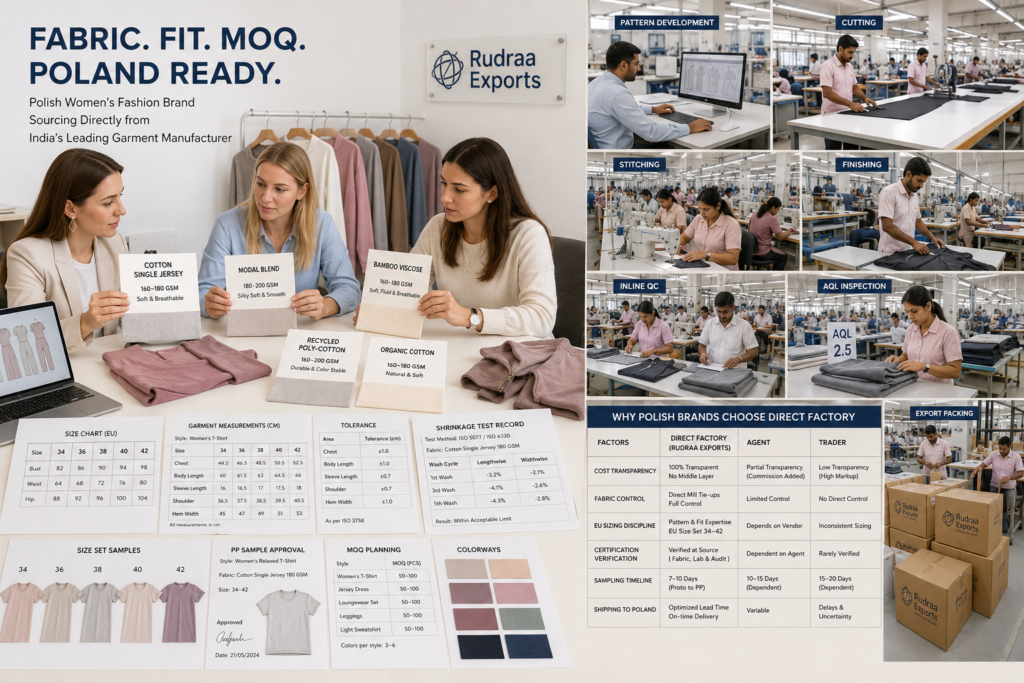
Polish women’s fashion brands need suppliers who can balance design quality with commercial reality.
The product must feel right. The fit must match EU customer expectations. The fabric must support the brand promise. The MOQ must be realistic. The price must leave enough margin after shipping, duties, VAT, packaging and marketing.
This is why many Polish brands explore women’s clothing manufacturing in India.
India can offer strong fabric access, competitive production costs and scalable capacity, especially when buyers work with a direct factory rather than relying only on agents or traders.
But India works best when the sourcing process is structured.
You need clear fabric specifications, EU measurement rules, low-MOQ planning, sample approvals, certification checks and a real shipping timeline to Poland.
At Rudraa Exports, we support Polish and EU-facing brands with women’s apparel manufacturing from Tirupur, India, including fabric sourcing, GSM planning, tech-pack review, EU size-set support, sampling, low-MOQ discussion, quality inspection and export documentation.
Quick Answer
A women’s clothing manufacturer in India can be a good fit for Polish brands when the buyer needs fabric flexibility, competitive pricing, low-to-medium MOQs, EU sizing discipline and scalable production. The safest route is to work directly with a factory, request fabric swatches with GSM and composition, approve EU size sets, verify certificates, compare FOB and DDP quotes and confirm sampling, bulk production and shipping timelines before placing the order.
Looking for a women’s clothing manufacturer for Poland? Contact Rudraa Exports and share your product category, fabric, GSM, MOQ, EU size range and destination.
Why Polish Women’s Fashion Brands Source from India
Polish fashion brands usually explore India for four practical reasons:
- Better fabric access
- Competitive production costs
- Flexible manufacturing capacity
- Scalable export production
The uploaded source explains that Polish women’s fashion brands often turn to India because the right manufacturing model can balance design ambition with pricing, fabric access and capacity.
India Can Support Products Such As
- Women’s T-shirts
- Jersey dresses
- Loungewear sets
- Leggings
- Tank tops
- Oversized tops
- Lightweight sweatshirts
- Co-ord sets
- Sleepwear
- Casual knit dresses
- Private-label basics
- Athleisure pieces
The Three Main Sourcing Models
Polish brands usually compare three options:
- Direct factory sourcing
- Agent sourcing
- Trader or aggregator sourcing
Each model has a different level of control, convenience and risk.
The uploaded guide compares direct factory, agent sourcing and trader or aggregator models across MOQ, fabric control, EU sizing, certifications, sampling, quality accountability and logistics.
Direct Factory vs Agent vs Trader
| Criteria | Direct Factory | Agent Sourcing | Trader / Aggregator |
|---|---|---|---|
| Fabric control | High | Medium | Low to medium |
| MOQ clarity | More transparent | Depends on network | Often flexible but marked up |
| EU sizing control | Stronger with spec review | Depends on agent accuracy | Often standard-size based |
| Quality accountability | Clearer | Split accountability | Harder to trace |
| Certification verification | Easier to verify directly | Must verify through agent | Often partial |
| Sampling feedback | Faster technical loop | Slower due to middle layer | Fast for ready styles |
| Pricing transparency | Higher | Commission added | Markup embedded |
| Best for | Custom women’s apparel | First-time buyers needing support | Simple ready basics |
Option 1: Direct Factory Manufacturing
Direct factory sourcing means the Polish brand works with the manufacturer producing the garments.
This model gives the buyer more control over:
- Fabric
- GSM
- Fit
- Measurements
- Grading
- Shrinkage
- Labels
- Packaging
- Sampling
- QC
- Timeline
Benefits of Direct Factory Sourcing
- Better fabric transparency
- Better cost visibility
- Faster technical clarification
- Stronger EU sizing control
- Easier sample correction
- Direct accountability
- Better traceability
- Better repeat-order consistency
The uploaded source positions Rudraa’s direct factory model as stronger for brands that need fabric precision, EU sizing discipline and clear production accountability.
Best Fit
Direct factory sourcing is best when your brand promise depends on:
- Fabric quality
- Fit consistency
- Sustainability claims
- Custom styling
- EU size accuracy
- Repeat production
- Private-label control
Option 2: Agent Sourcing
An agent helps the brand find and manage suppliers.
This can be useful for first-time buyers.
Benefits
- More hand-holding
- Supplier search support
- Communication help
- Sampling coordination
- Logistics coordination
Risks
- Extra communication layer
- Commission or service fee
- Slower technical updates
- Less factory visibility
- Possible sizing translation mistakes
- Quality accountability may be split
The uploaded guide explains that agents can be useful when a brand is new to India, but communication latency and translation errors can affect fit and sampling.
Best Fit
Agent sourcing may suit you if:
- You have no sourcing experience
- You do not have a tech pack
- You need supplier discovery
- You want someone to coordinate multiple vendors
- You accept paying for convenience
Option 3: Trader or Aggregator
A trader or aggregator sells products sourced from different factories.
This can be convenient for standard styles.
Benefits
- Quick access to ready styles
- Sometimes lower apparent MOQ
- Faster for simple repeat basics
- Less development responsibility
Risks
- Limited fabric control
- Limited factory visibility
- Harder certification verification
- Less custom sizing support
- Markup hidden in price
- Quality traceability can be weak
The uploaded source warns that traders can be convenient for ready patterns but may limit fabric traceability and certification clarity.
Best Fit
Trader sourcing may suit you when:
- You need off-the-shelf basics
- Custom fabric is not important
- EU sizing is not a major risk
- Sustainability claims are limited
- Fast availability matters more than control
Fabric Guide for Women’s Apparel
Fabric selection is one of the most important decisions in women’s clothing.
It affects:
- Drape
- Fit
- Opacity
- Comfort
- Shrinkage
- Stretch
- Premium feel
- Retail price
- Return rate
The uploaded guide gives practical GSM ranges for cotton single jersey, modal blends, bamboo viscose and recycled blends used in women’s apparel.
Cotton Single Jersey
Best for:
- T-shirts
- Casual tops
- Jersey dresses
- Everyday basics
Practical GSM Direction
| Use | GSM Direction |
|---|---|
| Light top | 140–160 GSM |
| Standard women’s tee | 160–180 GSM |
| Premium tee or dress | 180–220 GSM |
Cotton single jersey is suitable when the brand wants breathability, comfort and easy everyday wear.
Modal and Modal Blends
Modal gives a soft hand-feel and smooth drape.
Best for:
- Soft tops
- Women’s loungewear
- Drape T-shirts
- Premium basics
- Sleepwear
- Layering pieces
Practical GSM Direction
| Use | GSM Direction |
|---|---|
| Light drape top | 160–180 GSM |
| Premium modal tee | 180–220 GSM |
| Lounge co-ord | 200–240 GSM |
Modal can create a more elevated feel but should be checked for shrinkage, recovery and opacity.
Bamboo Viscose
Bamboo viscose is often used for soft and breathable loungewear.
Best for:
- Loungewear
- Sleepwear
- Relaxed tops
- Soft co-ords
- Lightweight women’s basics
Practical GSM Direction
| Use | GSM Direction |
|---|---|
| Light top | 120–160 GSM |
| Lounge top | 160–220 GSM |
| Heavier lounge set | 220–350 GSM |
The uploaded source notes that bamboo viscose GSM varies widely depending on whether the product is a light top or heavier lounge set.
Recycled Poly-Cotton Blends
Recycled poly-cotton blends can be useful for athleisure and travel-friendly products.
Best for:
- Leggings
- Athleisure tops
- Travel basics
- Performance-inspired casualwear
- Lightweight layering
Buyer Checks
Before using recycled blends, confirm:
- Recycled content
- Stretch and recovery
- Pilling resistance
- Colourfastness
- Shrinkage
- Certification or claim support
- Hand-feel after washing
Organic Cotton
Organic cotton can support premium and sustainability-led collections.
Best for:
- Women’s T-shirts
- Basics
- Babywear
- Loungewear
- Soft dresses
- Premium essentials
Important Rule
If your brand markets “organic cotton,” request proper chain-of-custody documentation.
The uploaded guide advises buyers to request GOTS scope documentation when making organic cotton claims, rather than relying only on supplier statements.
EU Sizing: What Polish Brands Must Control
Women’s sizing is one of the biggest risk areas when sourcing from India.
A garment can be well-made but still fail if the fit does not match EU customer expectations.
Common EU Sizing Problems
- Supplier uses local S/M/L blocks
- Body measurements and garment measurements are confused
- Bust and hip ratios do not match the target customer
- Shrinkage is ignored before grading
- Tolerances are not defined
- Size set is skipped
- Fit is approved only in one sample size
The uploaded source identifies EU sizing alignment as a major risk and recommends measurement specs in centimetres, garment measurements, tolerances and shrinkage testing before final grading.
EU Size Planning Example
| EU Size | Common Use in Development |
|---|---|
| EU 34 | Small size check |
| EU 36 | Lower-middle size |
| EU 38 | Common base or fit size |
| EU 40 | Upper-middle size |
| EU 42 | Larger size check |
Final size standards should be defined by the brand’s real customer data and fit strategy.
Garment Measurement vs Body Measurement
This is a common mistake.
Body Measurement
This is the customer’s body size.
Example:
- Bust circumference
- Waist circumference
- Hip circumference
Garment Measurement
This is the finished garment size.
Example:
- Chest width
- Garment length
- Sleeve opening
- Waistband width
- Hip width
The garment measurement must include the intended ease.
Example
If body bust is 92 cm and the product is a relaxed T-shirt, the garment bust may be larger than 92 cm.
If the product is a fitted stretch top, the garment measurement may be closer or even smaller depending on fabric stretch.
EU Sizing Checklist
| # | Sizing Check |
|---|---|
| 1 | Target customer body profile defined |
| 2 | EU size range selected |
| 3 | Base size selected |
| 4 | Body measurement chart prepared |
| 5 | Garment measurement chart prepared |
| 6 | Ease defined |
| 7 | Tolerances defined |
| 8 | Shrinkage tested |
| 9 | Fabric stretch reviewed |
| 10 | Size set requested |
| 11 | EU 36/38/40 fit checked |
| 12 | Grading reviewed |
| 13 | Washed garment measured |
| 14 | Fit comments documented |
| 15 | Final PP sample approved |
Low MOQ Planning for Polish Women’s Brands
Low MOQ can be possible, but only when the order is planned carefully.
The uploaded source states that 300 pieces per style may be achievable in some direct factory programs, depending on fabric, colour count and product complexity.
What Affects MOQ
- Fabric availability
- Fabric MOQ
- Colour count
- Dye lot minimums
- Style complexity
- Trim requirements
- Print or embroidery setup
- Size range
- Packaging requirements
Better Low-MOQ Strategy
| Instead Of | Do This |
|---|---|
| 5 colours per style | Start with 1–2 colours |
| Many custom trims | Use simple trims first |
| New fabric for every style | Share fabric across styles |
| Wide size range immediately | Start with commercial core sizes |
| Complex silhouettes | Begin with proven blocks |
| Custom dyeing for tiny run | Use available colours where possible |
Low-MOQ Example
A Polish brand wants:
- 3 jersey tops
- 2 colours each
- 5 sizes
- 300 pieces per style
A smarter first order may be:
- 2 jersey tops
- 1 shared fabric
- 2 colours
- EU 36–42
- Clear size curve
- Simple labels
- Shared packaging
This improves feasibility and reduces cost.
Sampling Timeline for Women’s Apparel
Sampling depends on product complexity.
Typical Sampling Steps
1. Fabric Swatch Approval
Check:
- GSM
- Composition
- Hand-feel
- Stretch
- Opacity
- Shrinkage
- Colour
2. Proto Sample
Check:
- Shape
- Fit direction
- Construction
- Design feasibility
3. Size Set
Check:
- EU fit
- Grading
- Measurements
- Shrinkage impact
4. PP Sample
Check:
- Bulk fabric
- Final trims
- Labels
- Packaging
- Final construction
The uploaded guide recommends requesting fabric swatches, a measurement spec review, sampling timeline and Incoterms-based landed-cost estimate before committing to production.
Certification and Compliance Checks
Polish and EU brands should verify compliance documents before making sustainability or safety claims.
Common Documents to Request
- OEKO-TEX certificate where applicable
- GOTS scope certificate for organic claims
- Fabric composition records
- Restricted substances documents
- Test reports
- Material traceability records
- Factory compliance documents
The uploaded source recommends checking certification scope, chain of custody and authenticity, especially for OEKO-TEX and GOTS claims.
Certificate Verification Checklist
| Check | Question |
|---|---|
| Validity | Is the certificate current? |
| Scope | Does it cover the product or material? |
| Facility | Does it match the production site? |
| Supplier | Is the supplier named correctly? |
| Product type | Is women’s apparel covered? |
| Claim | Does the certificate support your marketing claim? |
| Chain of custody | Is the fabric-to-garment chain covered? |
Shipping from India to Poland
Polish brands should compare both FOB and DDP options.
FOB
FOB means the supplier delivers goods to the export port.
The buyer handles:
- Sea freight
- Insurance
- Import clearance
- Duties or taxes
- Inland delivery
DDP
DDP means the supplier provides a delivered-cost option to the buyer’s destination.
This can simplify first shipments.
What to Ask
- FOB Chennai quote
- DDP Warsaw or Gdańsk-area warehouse quote
- Carton count
- Packed CBM
- Gross weight
- Net weight
- Shipping timeline
- Customs responsibility
- Delivery terms
The uploaded guide recommends asking suppliers for both FOB Chennai and DDP Poland quotes, along with carton CBM and timeline.
30–90 Day Migration Plan: Poland to India
Day 1–3: Define Non-Negotiables
Document:
- Product category
- Fabric
- GSM
- MOQ target
- Colour count
- Size range
- Certification needs
- Target landed cost
The uploaded source recommends starting with a one-page brief covering target fabrics, GSM ranges, MOQ and certification requirements.
Day 4–14: Prepare Tech Pack and EU Sizing
Send:
- Sketches
- BOM
- Construction details
- EU measurement chart
- Tolerances
- Grading rules
- Fit reference
- Fabric requirement
Day 15–45: Sampling and Pre-Production Controls
Approve:
- Fabric swatches
- Lab dips
- Proto sample
- Size set
- Shrinkage results
- PP sample
Day 46–75: Bulk Production and QC
Confirm:
- Production schedule
- Inline inspection
- Measurement audit
- Final inspection
- Packing method
- Export carton details
Day 60–90: Shipping to Poland
Compare:
- FOB
- DDP
- LCL
- FCL
- Air freight for urgent units
Quote Request Checklist for Polish Brands
Before contacting Rudraa Exports or any supplier, prepare:
| # | Information |
|---|---|
| 1 | Product category |
| 2 | Reference images |
| 3 | Tech pack |
| 4 | Fabric composition |
| 5 | GSM target |
| 6 | Stretch requirement |
| 7 | Shrinkage expectation |
| 8 | EU size range |
| 9 | Base size |
| 10 | Garment measurement chart |
| 11 | Colour count |
| 12 | Quantity per style |
| 13 | Quantity per colour |
| 14 | Label requirements |
| 15 | Packaging requirements |
| 16 | Certification needs |
| 17 | FOB or DDP preference |
| 18 | Destination in Poland |
| 19 | Launch date |
| 20 | Target landed cost |
How Rudraa Exports Supports Polish Women’s Fashion Brands
Rudraa Exports supports women’s apparel sourcing from India for Polish and EU-facing brands.
Manufacturing Support
- Product brief review
- Tech-pack review
- Fabric sourcing
- GSM planning
- Cotton, modal, bamboo and blended knit options
- Pattern development
- EU size-set coordination
- Shrinkage review
- Sample development
- PP sample approval
- Lab dip coordination
- Inline QC
- AQL inspection support
- Export packing
- FOB and DDP discussion
- Repeat-order planning
Products Supported
- Women’s T-shirts
- Jersey dresses
- Tops
- Tank tops
- Loungewear
- Co-ord sets
- Leggings
- Lightweight sweatshirts
- Sleepwear
- Activewear
- Private-label women’s basics
Why Direct Factory Helps
A direct factory model gives Polish brands:
- Clearer fabric visibility
- Better MOQ discussion
- Better EU sizing communication
- Faster technical corrections
- Better sampling accountability
- Better compliance-document access
- Better landed-cost planning
- Better repeat production control
Ready to source women’s apparel from India? Speak with Rudraa Exports and share your tech pack, fabric preference, EU size range, MOQ and Poland delivery destination.
FAQ: Women’s Clothing Manufacturer in India for Polish Brands
1. Is India a good place to manufacture women’s clothing for Polish brands?
Yes. India can be a strong sourcing option for women’s knitwear, basics, loungewear, activewear and jersey products when fabric, sizing and quality are properly controlled.
2. What products can Rudraa Exports manufacture?
Rudraa can support women’s T-shirts, tops, jersey dresses, loungewear, leggings, activewear, sweatshirts, co-ord sets and private-label basics.
3. What MOQ can Polish brands expect?
MOQ depends on fabric, colour count, style complexity and trims. Low-MOQ discussions such as 300 pieces per style may be possible for suitable programs.
4. Which fabrics are suitable for women’s apparel?
Common choices include cotton jersey, modal blends, bamboo viscose, organic cotton and recycled poly-cotton blends.
5. Why is EU sizing important?
EU customers expect consistent fit. Indian standard blocks may not match Polish customer expectations unless measurements, tolerances and size sets are clearly approved.
6. Should I request a size set?
Yes. Polish brands should request EU size-set samples, such as EU 36, 38 and 40, before approving bulk production.
7. What certifications should I request?
Request OEKO-TEX where chemical safety is important and GOTS when making organic textile claims. Always verify scope and validity.
8. Is direct factory sourcing better than an agent?
Direct sourcing gives more control over fabric, sizing, cost and quality. Agents may help beginners, but they add a communication layer and possible markup.
9. Is a trader suitable for women’s clothing sourcing?
A trader may be suitable for basic ready styles, but may not offer enough control for custom fabric, EU sizing or sustainability claims.
10. How long does shipping from India to Poland take?
Sea shipping requires planning and varies by route and port handling. Air freight is faster but more expensive. Ask for FOB and DDP timelines.
11. What should I send for a quote?
Send your tech pack, reference images, fabric, GSM, quantity, colours, EU size range, labels, packaging, certification needs and destination in Poland.
12. Can Rudraa support DDP delivery to Poland?
Rudraa can discuss FOB and DDP options depending on product, order size, destination and shipping requirements.
Conclusion
Finding the right women’s clothing manufacturer in India for Polish brands is not only about getting the lowest unit price.
The real decision is about control.
You need control over fabric, GSM, shrinkage, EU sizing, sampling, certifications, quality checks and landed cost.
Agents and traders can be convenient, but they may reduce visibility. A direct factory model gives better access to the production team, fabric decisions, size-set corrections, compliance documents and shipment planning.
For Polish brands building women’s T-shirts, jersey dresses, loungewear, leggings, activewear or private-label basics, India can become a strong sourcing base when the process is planned properly.
Rudraa Exports helps Polish and EU-facing brands source women’s apparel from Tirupur with direct factory communication, fabric sourcing, low-MOQ discussion, EU sizing support, sampling, QC and export documentation.
Visit rudraaexports.com or contact the Rudraa Exports team to discuss women’s clothing manufacturing for your next Poland-focused collection.
Related reading
Custom Activewear and Sportswear Manufacturing in India: Complete Buyer’s Guide
Activewear Manufacturing in India for Australian Brands: Why Tirupur Works
Shipping Finished Garments from Tirupur to Poland: Sea, Air and Hybrid Freight Compared