
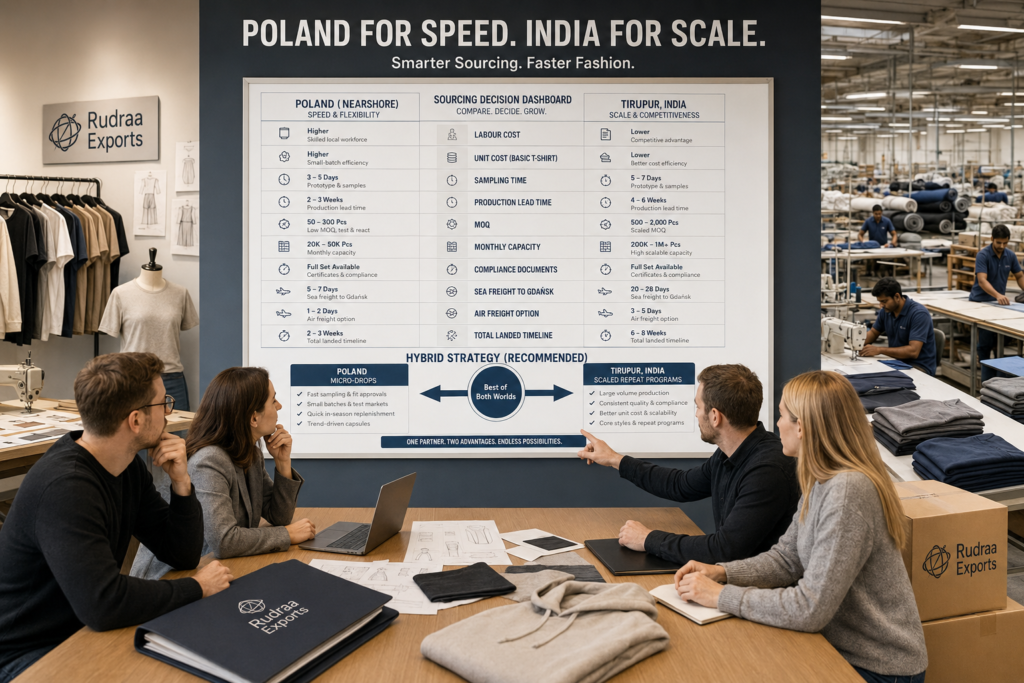
Polish fashion brands have two strong sourcing options.
They can manufacture locally in Poland or nearby EU countries for speed, low MOQs and easier control.
Or they can source from India, especially Tirupur, for lower unit costs, scalable knitwear capacity and export-ready production systems.
The right choice is not simply “nearshore is premium” or “India is cheap.”
The right choice depends on:
- Product category
- Target margin
- MOQ
- Speed requirement
- Sampling complexity
- Lead time
- Shipping risk
- Compliance expectations
- Reorder strategy
- Long-term scale
For many brands, the smartest answer is not one country.
It is a hybrid sourcing model.
Use Poland for fast samples, micro-drops and urgent replenishment. Use Tirupur, India for scaled repeat programs, knitwear basics, hoodies, joggers and predictable seasonal production.
At Rudraa Exports, we support international apparel brands with factory-direct knitwear manufacturing from Tirupur, including sampling, fabric sourcing, production planning, quality control, export packing and scalable repeat-order support.
Quick Answer
Poland is usually better for fast development, low MOQs, short lead times and in-season replenishment. India, especially Tirupur, is usually better for cost-effective knitwear manufacturing, larger quantities, repeat programs and scalable production. Polish brands should choose Poland for speed-sensitive micro-runs and choose India for planned, volume-driven products where lower unit cost and production capacity matter more than rapid local turnaround.
Planning a knitwear program for Europe? Contact Rudraa Exports to discuss Tirupur production, MOQ, sampling and export timelines.
India vs Poland Garment Manufacturing: Quick Comparison
| Criteria | Poland / EU Local Manufacturing | Tirupur, India Manufacturing |
|---|---|---|
| Best strength | Speed and proximity | Cost and scale |
| Sampling speed | Faster | Moderate |
| Bulk production | Faster for small runs | Better for planned volume |
| MOQ | Lower | Higher for best pricing |
| Unit cost | Higher | Lower for many knitwear items |
| Freight | Road freight within Europe | Sea or air freight required |
| Inventory risk | Lower for micro-runs | Lower per-unit cost at scale |
| Fit development | Easier in-person | Strong with clear tech packs |
| Scalability | Depends on factory size | Strong for knitwear programs |
| Best for | Drops, tests, urgent replenishment | Core products and repeat orders |
The uploaded source compares Poland/EU local production with Tirupur, India across labour cost, unit pricing, sampling, production lead time, shipping, MOQ, capacity and compliance readiness.
Why Polish Brands Compare India and Poland
Polish fashion and apparel brands often need to balance two priorities:
- Speed and control
- Margin and scale
Local production makes it easier to visit factories, approve samples quickly and respond to changing demand.
India gives access to a large textile ecosystem, especially in knitwear, where products like T-shirts, hoodies, joggers, polos and leggings can be produced at scale.
The sourcing question becomes:
Do you need fast flexibility, or do you need scalable cost efficiency?
Cost Comparison: Poland vs India
Labour is one of the biggest drivers of garment cost.
Poland has higher European labour costs and overhead structures, while India offers lower production labour costs and a specialised knitwear ecosystem.
The uploaded guide explains that the labour cost differential is a primary reason for the garment manufacturing cost gap between Poland and India, especially for labour-intensive styles.
Cost Factors to Compare
| Cost Factor | Poland | India |
|---|---|---|
| Labour cost | Higher | Lower |
| Small-batch overhead | Lower risk but higher per unit | Higher setup sensitivity |
| Fabric options | Local or EU-accessible | Strong knitwear ecosystem |
| Freight | Lower within Europe | International freight required |
| Duty and clearance | Simpler within EU | Import handling needed |
| Rework risk | Easier to correct locally | Must be controlled before shipment |
| Scale cost | Can rise quickly | More competitive at volume |
Important Cost Rule
Do not compare only:
Polish ex-factory price vs Indian FOB price
Compare:
Final landed cost per garment at your warehouse
Landed Cost Should Include
- Factory cost
- Sampling
- Fabric
- Trims
- Printing or embroidery
- Packaging
- Quality inspection
- Freight
- Duty where applicable
- Import VAT treatment
- Customs clearance
- Local delivery
- Defect or rework risk
When India Wins on Cost
India is usually stronger when:
- Products are knitwear-heavy
- Quantity is large enough
- Styles are repeatable
- Fabric is available
- Colours are consolidated
- Tech packs are clear
- Sea freight can be planned
When Poland Wins on Total Cost
Poland may win when:
- Quantities are very small
- Demand is uncertain
- Speed reduces inventory risk
- Frequent changes are expected
- Local correction avoids remakes
- In-season replenishment protects full-price sales
Quality Comparison: Geography Is Not the Main Factor
Quality does not automatically come from a country.
It comes from process discipline.
Both Poland and India can produce good garments.
Both can also produce poor results if the process is weak.
Quality Depends On
- Tech pack clarity
- Fabric specification
- Pattern control
- Sample approval
- Size-set validation
- Inline inspection
- AQL inspection
- Measurement tolerance
- Trims and labels
- Packing standards
The uploaded source explains that quality outcomes are less about geography and more about tech packs, inline inspections, fabric testing and workmanship standards.
Poland Quality Advantage
Poland can offer:
- Faster feedback loops
- Easier factory visits
- Faster fit corrections
- Better proximity for complex development
- Easier small-batch supervision
Tirupur Quality Advantage
Tirupur can offer:
- Knitwear specialisation
- Established cotton and fleece supply chains
- Large export-production experience
- Scalable sewing and finishing capacity
- Stronger repeat-program economics
Buyer Rule
Whether you source in Poland or India, always define:
- Fabric
- GSM
- Measurements
- Tolerances
- Shrinkage limits
- Print or embroidery standard
- Label placement
- Packing method
- QC inspection level
Lead Time Comparison
Lead time is one of the biggest differences between Poland and India.
Poland Lead-Time Advantage
Poland is usually better when speed matters.
It can support:
- Faster sampling
- Faster fit revisions
- Faster local trucking
- Shorter replenishment cycles
- Faster reaction to trends
The uploaded guide states that Poland/EU manufacturing can be more suitable for brands needing fast sampling, rapid iteration and short replenishment cycles.
India Lead-Time Reality
India requires a longer calendar because buyers must include:
- Sampling time
- Fabric sourcing
- Lab dips
- Bulk production
- Inspection
- Export packing
- Sea freight
- Customs
- Final delivery
The uploaded source notes that Tirupur production can be workable for seasonal development when tech packs and approvals are locked early.
Practical Timeline Comparison
| Stage | Poland / EU | Tirupur, India |
|---|---|---|
| Sampling | Faster | Moderate |
| Fit correction | Faster due to proximity | Requires clear remote approval |
| Bulk production | Faster for small runs | Planned production window needed |
| Freight | Days by road | Weeks by sea |
| Best use | In-season decisions | Planned seasonal or repeat programs |
Shipping and Freight Risk
Shipping is a major part of the India vs Poland decision.
Poland to Poland / EU
Freight is usually simpler because goods move by local or EU road transport.
Benefits include:
- Shorter transit
- Easier tracking
- Lower customs complexity within EU
- Faster warehouse delivery
- Better emergency replenishment
India to Poland
India-to-Poland shipments require:
- Export packing
- Sea or air booking
- Port handling
- International transit
- Customs clearance
- Inland delivery
The uploaded guide discusses Chennai-to-Gdańsk sea freight and notes that disruptions can increase landed timelines.
Freight Strategy
Use:
- Air freight for samples, urgent launches or limited top-up stock
- Sea freight for planned bulk orders and repeat programs
- Hybrid freight when part of the shipment is urgent and the rest can move by sea
Shipping Rule
If your business model requires delivery to warehouse in under six weeks, India sea freight may not be the right tool.
MOQ Comparison
MOQ means Minimum Order Quantity.
This is where Poland and India often serve different business models.
Poland MOQ Strength
Poland may be better for:
- Small drops
- Low-volume collections
- Many colours
- Small batch testing
- Early product-market fit
- Frequent replenishment
India MOQ Strength
India may be better for:
- Repeat programs
- Larger production runs
- Consolidated colours
- Core basics
- Uniform-like products
- Seasonal pre-planned quantities
The uploaded guide explains that nearshoring can support lower MOQs and faster replenishment, while Tirupur becomes more cost-effective at higher MOQs due to fabric, dye lot and line-planning efficiency.
MOQ Planning Table
| Brand Situation | Better Direction |
|---|---|
| 300 pieces per colour | Poland likely easier |
| 100–200 units micro-drop | Poland or nearby EU |
| 500+ units core T-shirt | India becomes attractive |
| 1,000+ units hoodie program | India strong fit |
| Many experimental colours | Poland easier |
| Repeat basics in fewer colours | India strong fit |
Capacity and Scaling
Poland can work well for small to mid-sized runs depending on the factory.
But brands planning thousands of units per month may need a more scalable production base.
Tirupur is built for knitwear volume.
Scaling Products Suitable for Tirupur
- Basic T-shirts
- Oversized T-shirts
- Polo shirts
- Hoodies
- Sweatshirts
- Joggers
- Leggings
- Kidswear
- Babywear
- Uniforms
- Private-label knitwear
The uploaded source states that Tirupur is a scaling engine for knitwear programs once demand is proven.
When Capacity Matters
Capacity becomes important when:
- You are launching in multiple markets
- Reorders are frequent
- Wholesale buyers require supply reliability
- SKU count is increasing
- You need consistent repeat blocks
- Monthly volume is growing
Compliance and Traceability
EU-facing brands need strong compliance records regardless of production country.
Compliance Areas to Check
- Fibre composition
- Labelling requirements
- Restricted substances
- OEKO-TEX where applicable
- GOTS where applicable
- ISO systems where relevant
- Social compliance
- Product testing
- Material traceability
- Production records
The uploaded guide says buyers should request certificate copies, product scope, site coverage, validity dates and test plans rather than assuming compliance.
Compliance Checklist
| Document | What to Verify |
|---|---|
| Certificate | Is it current? |
| Scope | Does it cover the product? |
| Facility | Does it match the production site? |
| Material | Does it match the ordered fabric? |
| Test report | Is it relevant to the product? |
| Traceability record | Can material lots be linked to production? |
Important Rule
A certificate is not enough.
You still need:
- Correct product specification
- Buyer-approved materials
- Inspection plan
- Accurate labelling
- Shipment documents
- Retained records
Best Fit for Poland / EU Manufacturing
Choose Poland or nearby EU manufacturing when:
- You need fast sampling
- You need low MOQs
- You run frequent drops
- You are testing product-market fit
- You need in-person development
- You need fast replenishment
- You are producing complex experimental products
- You need shorter warehouse lead times
- You want to reduce inventory risk
Example
A Warsaw streetwear label running monthly drops may prefer Poland for small quantities because speed and flexibility matter more than the lowest unit cost.
The uploaded source says Poland/EU local manufacturing is a strong fit for drops, fast trend turns, frequent replenishment and complex development requiring constant iteration.
Best Fit for Tirupur, India
Choose Tirupur, India when:
- You need lower unit cost
- You produce knitwear
- You sell core repeat products
- You can plan earlier
- You can meet practical MOQs
- You need scalable capacity
- You want strong fabric options
- You can use sea freight
- You have clear tech packs
- You want repeat-order consistency
Example
A Polish brand with a proven 240 GSM T-shirt selling every month may move that product to Tirupur for better margin and scalable repeat supply.
The uploaded guide states that Tirupur is best suited for cost-sensitive basics, predictable demand, scaling beyond local capacity and planned seasonal calendars.
Fit-Not: When India Is the Wrong Tool
India may not be the right choice when:
- You need stock in under six weeks by sea
- You are still changing the product every week
- You need under 300 pieces per colour
- You have many untested colours
- Your tech pack is incomplete
- You cannot approve samples quickly
- You cannot manage international logistics
- Your order is too complex for the volume
The uploaded source clearly notes that India is not suitable for sub-six-week warehouse turnaround, vague approvals or true micro-MOQ programs.
Recommended Hybrid Strategy
For many Polish fashion brands, the best model is hybrid.
Use Poland For
- First prototypes
- Urgent samples
- Micro drops
- Fast trend tests
- In-season replenishment
- Complex fit experiments
- Small colour runs
Use Tirupur For
- Proven styles
- Core T-shirts
- Hoodies
- Joggers
- Leggings
- Polo shirts
- Repeat basics
- Wholesale orders
- Seasonal bulk production
The uploaded guide concludes that sourcing teams should not only choose a country, but should choose a supply model. In many cases, that model is Poland for rapid development and India for scaled repeat programs.
Migration Plan: Moving Production from Poland to Tirupur
Step 1: Choose One Hero Style
Do not move the whole collection first.
Start with one proven product.
Good pilot options:
- Core T-shirt
- Hoodie
- Jogger
- Legging
- Polo shirt
Step 2: Build a Cost Comparison
Compare:
- Poland unit cost
- India FOB cost
- Freight
- Duty
- VAT or import handling
- Quality inspection
- Local delivery
- Inventory risk
- Reorder timing
Step 3: Prepare a No-Guess Tech Pack
Include:
- Technical sketch
- Fabric
- GSM
- Measurements
- Tolerances
- Construction
- Artwork
- Labels
- Packaging
- Testing expectations
Step 4: Run a Pilot Quote
Ask for two quantity tiers.
Example:
- 500 pieces
- 1,000 pieces
This shows how unit cost changes with scale.
The uploaded guide recommends requesting a pilot quote for one hero style with two quantity tiers to validate whether India is commercially attractive.
Step 5: Build a Real Calendar
Include:
- Sample date
- Fit approval date
- PP sample date
- Bulk start date
- Ex-factory date
- Inspection date
- Freight booking date
- Estimated warehouse date
Step 6: Check Compliance
Ask for:
- Certificate copies
- Scope and validity
- Test plan
- Material traceability
- Restricted substances approach
- Labelling support
Step 7: Place a Controlled Pilot Order
Keep the first Indian order simple:
- One style
- One or two colours
- Proven fabric
- Clear size curve
- Standard trims
- Sea freight timeline
Step 8: Scale After the Pilot
After the pilot, review:
- Fit accuracy
- Fabric quality
- Production timeline
- Inspection result
- Freight performance
- Landed cost
- Customer feedback
India vs Poland Sourcing Decision Checklist
| # | Decision Question |
|---|---|
| 1 | Is the style proven? |
| 2 | Is demand predictable? |
| 3 | Is MOQ realistic? |
| 4 | Is the tech pack complete? |
| 5 | Is fabric finalised? |
| 6 | Is lead time flexible? |
| 7 | Can sea freight be planned? |
| 8 | Is unit cost a major constraint? |
| 9 | Is speed more important than margin? |
| 10 | Do you need frequent micro-runs? |
| 11 | Is in-person fitting required? |
| 12 | Is compliance documentation needed? |
| 13 | Is the product knitwear-heavy? |
| 14 | Can colours be consolidated? |
| 15 | Can a pilot order be tested first? |
| 16 | Is inventory risk acceptable? |
| 17 | Is the supplier’s capacity enough? |
| 18 | Are shipping disruptions planned for? |
| 19 | Does landed cost still work? |
| 20 | Is a hybrid model better? |
How Rudraa Exports Supports Polish and EU Brands
Rudraa Exports supports brands looking to source scalable knitwear from Tirupur, India.
Production Support
- Product brief review
- Tech-pack review
- Fabric and GSM planning
- Pattern and fit support
- Sample development
- PP sample approval
- Size-set coordination
- Print and embroidery support
- Lab dip coordination
- Inline QC
- AQL inspection support
- Export packing
- Documentation coordination
- Repeat-order planning
Products Supported
- T-shirts
- Oversized T-shirts
- Polo shirts
- Hoodies
- Sweatshirts
- Joggers
- Leggings
- Activewear
- Kidswear
- Babywear
- Nightwear
- Corporate apparel
- School uniforms
- Private-label knitwear
Why Rudraa Can Fit Scaled Knitwear Programs
Rudraa is especially relevant when brands need:
- Repeatable knitwear quality
- Factory-direct communication
- Scalable production planning
- Export-ready packing
- Clear sample timelines
- Clear bulk production calendar
- Quality-control checkpoints
- Long-term repeat production
Ready to compare Poland vs Tirupur for your next production program? Speak with Rudraa Exports and share your tech pack, quantity, target price, deadline and destination.
FAQ: India vs Poland Garment Manufacturing
1. Is India cheaper than Poland for garment manufacturing?
India is often cheaper for knitwear at scale because of lower labour costs and strong textile manufacturing ecosystems, especially in Tirupur.
2. Is Poland better for small clothing runs?
Yes. Poland or nearby EU manufacturing is often better for low-MOQ drops, fast samples and urgent replenishment.
3. Which country is better for T-shirts?
For small experimental T-shirt drops, Poland may be better. For larger repeat T-shirt programs, Tirupur, India can offer stronger cost and scale.
4. Which country is better for hoodies?
Poland is useful for small tests and fast revisions. Tirupur can be better for planned hoodie production at larger quantities.
5. How long does production take in India?
Indian production timelines depend on fabric, sampling, approval speed and factory capacity. Planned knitwear programs usually need a longer calendar than local EU production.
6. How long does shipping from India to Poland take?
Sea freight can take several weeks and may vary by route and disruption. Air freight is faster but more expensive.
7. Is quality better in Poland or India?
Quality depends on process, not only location. Tech packs, sampling, fabric control and inspections decide the result.
8. What MOQ is best for India?
India is usually better when quantities are high enough to support fabric, dyeing, cutting and line efficiency. Many brands pilot with 500 or 1,000 units for core products.
9. Can I use both Poland and India?
Yes. A hybrid model can use Poland for fast development and India for scaled repeat programs.
10. What should I test before moving to India?
Test one hero style, confirm landed cost, approve samples, check quality, review timeline and compare customer feedback.
11. Can Rudraa Exports support EU brands?
Yes. Rudraa supports international and EU-facing buyers with knitwear manufacturing, sampling, QC, export packing and repeat production planning.
12. What should I send Rudraa Exports?
Send your tech pack, reference sample details, fabric, GSM, quantity, colours, size range, compliance needs, target price and destination country.
Conclusion
India vs Poland garment manufacturing is not a simple choice between cheap and premium.
It is a sourcing strategy decision.
Poland is strong for speed, small batches, fast replenishment and constant development.
Tirupur, India is strong for cost-effective knitwear, scalable production, repeat programs and planned seasonal orders.
For many Polish and EU brands, the best answer is hybrid.
Keep fast-moving tests and micro-drops nearshore. Move proven, repeatable knitwear products to Tirupur when volume, margin and calendar make sense.
Rudraa Exports helps brands build scalable knitwear programs from India with factory-direct communication, sample development, fabric planning, quality control, export packing and repeat-order support.
Visit rudraaexports.com or contact the Rudraa Exports team to compare India vs Poland sourcing for your next garment production run.
Related reading
The True Landed Cost of Sourcing T-Shirts from India: Tirupur to Rotterdam and Hamburg Guide
EU Sustainability Compliance for Garments Made in India: Practical Guide for European Apparel Brands
EU ESPR Unsold Goods Ban: Compliance Guide for Indian Apparel Exporters