
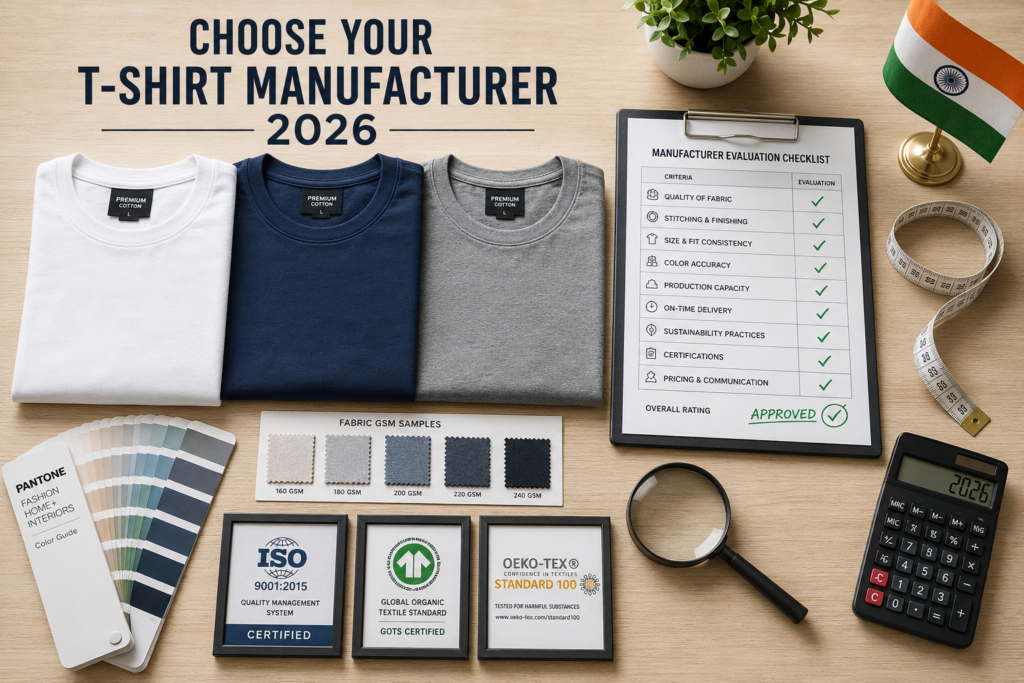
Selecting the right OEM or private-label partner for men’s round-neck T-shirts in 2026 requires evidence, not promises. The wrong manufacturer choice can cost your brand weeks of delays, quality disputes, compliance failures, and lost margin. The right partner becomes a multi-year competitive advantage.
This complete 2026 framework shows you exactly what to measure, how to verify supplier claims, and which proof points reduce commercial and execution risk — whether you’re sourcing 1,000 pieces for a brand launch or 100,000 pieces for a retail program.
At the end, you’ll see how Rudraa Exports — a factory-direct Tirupur, India manufacturer — fits this evaluation framework for international buyers in 2026.
Quick Answer: How Do I Choose the Best Men’s Round-Neck T-Shirt Manufacturer in 2026?
To choose the best men’s round-neck T-shirt manufacturer in 2026, follow a 12-point proof-led evaluation framework: verify MOQ flexibility, request pricing at multiple volume tiers (300/500/1k/3k/10k pieces), confirm ISO 9001 quality systems, check environmental certifications (ISO 14001, GOTS, OEKO-TEX), validate social compliance audits (WRAP, SA8000, BSCI, SMETA), assess production capacity and vertical integration, lock written lead times, evaluate fabric options and GSM range, confirm in-house vs subcontracted printing, verify shipping experience to your target markets, test communication discipline, and require full traceability documentation. Always verify certificate validity through official databases, run a paid pilot sample, and place a controlled pilot purchase order before scaling.
Why Choosing the Right T-Shirt Manufacturer Matters in 2026
The global apparel industry in 2026 operates under increasingly demanding conditions:
- EU CSRD (Corporate Sustainability Reporting Directive) requires supply chain transparency
- US state-level regulations (California, New York) demand traceability
- Modern Slavery Acts (UK, Australia) require labor compliance documentation
- REACH and chemical safety regulations apply across multiple markets
- Faster trend cycles demand quicker sample-to-bulk timelines
- China-plus-one strategies drive diversification to India and Bangladesh
For men’s round-neck T-shirts — the most foundational product in any apparel brand’s lineup — manufacturer selection determines whether your business scales smoothly or stalls under execution risk.
The 12-Point Proof-Led Manufacturer Evaluation Framework
1. MOQ Plus Size and Color Ratio Flexibility
What matters: Can the factory produce 1,000 pieces split across 4 colors? What’s the sampling MOQ? Do reorder minimums drop after the first purchase order?
How to verify in 2026:
- Request a written MOQ policy on the quotation and tech-pack acknowledgement
- Ask for sampling MOQ separately from production MOQ
- Confirm whether MOQ applies per style, per color, or per total order
- Vertically integrated suppliers may accept mixed programs but expect volume commitments over time
Tirupur benchmark: Best-in-class manufacturers like Rudraa Exports accept MOQs starting from ~300 pieces per style for basic programs, with practical export production typically running 300 pieces per color.
2. Unit Economics at Multiple Volume Tiers
What matters: Your true landed cost — not just FOB. Request pricing at 3–5 volume tiers to understand cost behavior at scale.
Standard volume tiers to request:
| Tier | Quantity | Purpose |
|---|---|---|
| Tier 1 | 300 pieces per style-color | Pilot / test launch |
| Tier 2 | 300 pieces per style-color | Small program |
| Tier 3 | 300 pieces per style-color | Standard program |
| Tier 4 | 300 pieces per style-color | Mid-scale program |
| Tier 5 | 10,000+ pieces per style-color | Bulk program |
Include in every quote:
- Fabric composition (combed cotton, CVC, organic cotton, etc.)
- GSM (160, 180, 200, 220+)
- Yarn type and count
- Dyeing method (reactive, pigment, garment-dye)
- Finishing (enzyme wash, silicone, compacting)
- Print method (screen, DTG, sublimation)
- Trims (labels, hangtags, polybag)
- Testing and inspection surcharges
- Incoterm (FOB, CIF, DDP) and what’s included
Verification standard: Use globally recognized Incoterms 2020 definitions to standardize comparison across quotes.
3. Quality Systems and Product Safety
What matters: Repeatability at scale across hundreds of POs.
Key quality certifications and capabilities:
- ISO 9001:2015 — Quality management systems
- In-house testing labs — Shrinkage, GSM, colorfastness, pilling
- Restricted substances compliance — Azo dyes, formaldehyde, AZO amines
- Inline and end-line QC — Documented inspection at every stage
- AQL 2.5 standard — For major defects on export apparel
- Shade band management — Bundling tickets and dye lot control
How to verify in 2026:
- Request certificate copies and verify scope on the issuing body’s site
- Ask for the manufacturer’s documented AQL inspection plan
- Request sample inline inspection reports and CAPA closure documentation
- Verify whether testing is in-house or outsourced
4. Sustainability and Environmental Controls
What matters: Brand risk reduction plus 2026 regulatory readiness.
Environmental certifications to require:
- ISO 14001 — Environmental management systems
- GOTS (Global Organic Textile Standard) — Organic textile chain-of-custody
- OEKO-TEX Standard 100 — Chemical safety of finished textiles
- GRS (Global Recycled Standard) — Recycled content verification
- Zero Liquid Discharge (ZLD) — Wastewater recycling proof
- SBTi alignment — Science Based Targets for emissions
Tirupur cluster sustainability advantage: Tirupur operates the world’s first 100% ZLD textile cluster with approximately 130 million liters per day of water recycling capacity and ~2,250 MW of renewable energy infrastructure — a structural advantage every Tirupur manufacturer including Rudraa Exports benefits from.
How to verify:
- Ask for published sustainability targets
- Request ETP/ZLD compliance documentation
- Verify SBTi progress reports if claimed
- Cross-check renewable energy percentage claims
5. Social Compliance and Labor Standards
What matters: Retailer readiness and 2026 regulatory compliance (Modern Slavery Acts, EU forced labor regulations).
Social compliance certifications to require:
- WRAP (Worldwide Responsible Accredited Production)
- SA8000 — Social accountability standards
- BSCI (now amfori BSCI) — European social compliance
- SMETA (Sedex Members Ethical Trade Audit) — 2-pillar or 4-pillar
- Disney FAMA — For Disney licensee programs
- GOTS social criteria — Embedded in GOTS certification
How to verify in 2026:
- Request latest audit report cover pages with grade, date, and site identifier
- Cross-check facility identifiers in SEDEX or amfori databases where accessible
- Confirm worker grievance mechanisms and wage payment documentation
- Verify subcontracting policy in writing
6. Production Capacity and Vertical Integration
What matters: Delivery reliability and ability to scale with your business.
Capacity verification questions:
- Monthly garment capacity for your specific SMV
- Number of dedicated lines
- Backup capacity for peak season
- Specialization in knitwear vs woven (knits matter for round-neck tees)
Vertical integration steps to confirm in-house:
- Knitting (single jersey, interlock, rib)
- Dyeing and finishing
- Printing (screen, sublimation, digital)
- Embroidery
- Cutting and stitching
- Packing and shipping
2026 capacity benchmarks for context:
| Manufacturer Type | Typical Monthly Capacity |
|---|---|
| Mega-vendor (Eastman, KPR) | 8–14 million pieces |
| Mid-scale leaders | 1–3 million pieces |
| Mid-market (e.g., Rudraa Exports) | 72,000+ pieces |
| Small specialist | 20,000–100,000 pieces |
The right capacity isn’t the largest — it’s the one matched to your program size with surge flexibility.
7. Lead Times and Quick-Response Capability
What matters: Speed to market for trend-driven brands and seasonal launches.
Lead-time components to confirm separately:
| Stage | Typical Duration |
|---|---|
| Proto sample | 7–10 days |
| Salesman/fit sample | 7–10 days |
| Size set | 5–7 days |
| Pre-production (PP) sample | 10–14 days |
| Lab dips and shade approval | 5–10 days |
| Print strike-off approval | 5–7 days |
| Bulk production (basics) | 30–45 days |
| Bulk production (complex) | 45–60 days |
Critical distinction: Separate “greige fabric knitting required” vs “fabric ready stock” scenarios. Ready stock can cut 15–20 days off total timeline.
How to verify:
- Request a critical path / Time-and-Action (TNA) template for your specific program
- Test responsiveness during sampling — track days to confirm BOM, pattern questions, and artwork queries
8. Fabric Options and Hand-Feel
What matters: Customer-facing product quality — feel, drape, shrinkage, pilling resistance, durability.
Standard men’s round-neck T-shirt fabric menu to request:
- Cotton variants: Combed, compact, carded, ring-spun
- Organic cotton: GOTS-certified
- Cotton blends: Cotton/elastane (5–10%), CVC (cotton-viscose), polycotton
- Recycled blends: Cotton/rPET, organic cotton/rPET
- GSM range: 160 (lightweight), 180 (standard), 200 (mid-weight), 220+ (heavyweight)
- Knit structures: Single jersey, interlock, rib (1×1, 2×2)
- Finishes: Enzyme wash, silicone wash, compacting, anti-pilling, bio-wash, peach finish
How to verify:
- Request fabric spec sheets and test reports (shrinkage, spirality, pilling, GSM)
- Ask for physical fabric swatches in your target GSM
- Request bulk fabric samples before approving PP
9. Printing and Embellishment Capabilities
What matters: Design feasibility, cost drivers, and quality consistency.
Printing methods to evaluate:
- Screen printing: Plastisol, water-based, discharge, puff
- Embroidery: Computerized flat, 3D puff, sequin, applique
- DTG (Direct-to-Garment): For complex multi-color graphics
- Sublimation: For polyester or poly-blend tees only
- DTF (Direct-to-Film) / Heat transfer: Flexible for small runs
- All-over print (AOP): Sublimated or reactive
Key questions for 2026:
- Maximum color count for screen printing
- Placement limits (chest, back, sleeve, side seam)
- Wash durability standards
- Color matching capability (Pantone reference)
- In-house vs subcontracted — subcontracting adds lead time and quality variability
10. Shipping Logistics to Target Markets
What matters: Service level and predictability for door-to-door delivery.
Logistics verification questions:
- Typical export ports used (Tuticorin, Chennai, Cochin for India)
- Consolidation capability for partial container loads (LCL)
- Carton optimization and master carton dimensions
- Documentation accuracy and accuracy track record
- Experience shipping to your target regions (EU, US, Australia, Middle East)
- Region-specific compliance paperwork:
- EU: REACH compliance, fiber content labeling
- US: CPSIA testing, FTC labeling
- Australia: Country of Origin labeling
- Middle East: GCC conformity, SASO documentation
How to verify:
- Confirm Incoterms contractually
- Test with a small initial shipment to assess document accuracy
11. Communication Practices
What matters: Hidden execution risk and relationship quality.
Communication factors to evaluate:
- Assigned merchandiser or account manager (named individual)
- Response SLA (e.g., 24-hour response for queries)
- Escalation path for urgent issues
- English proficiency at merchandising level
- Time-zone coverage for your hours
- Weekly WIP (Work-in-Progress) reporting format
- PLM (Product Lifecycle Management) tool usage
- Standardized tech-pack signoff process
How to verify:
- Test responsiveness during sampling phase
- Track days to confirm BOM, pattern questions, and artwork queries
- Request sample WIP report format from past programs
- Ask for QA report templates
12. Traceability Documentation
What matters: Increasingly mandatory for premium, sustainable, and EU-bound programs in 2026.
Traceability components to require:
- Fiber to yarn — Cotton origin documentation
- Yarn to fabric — Knitting lot tracking
- Fabric to dye house — Dye lot and shade documentation
- Cut and sew lot — Production lot mapping
- Carton mapping — Packing list linking cartons to production lots
- Transaction Certificates (TCs) — For organic and recycled claims
How to verify:
- Request a traceability map for a past order
- Ask for a sample documentation pack from a recent shipment (redacted)
- Confirm QR-code traceability options if you plan consumer-facing sustainability storytelling
Step-by-Step Manufacturer Vetting Process for 2026
Step 1: Define Your Non-Negotiables (One Page)
Document on a single page:
- Product specifications (fabric, GSM, print method, packaging)
- Commercial terms (initial order range, reorder expectation, target ex-factory date)
- Compliance requirements (certifications, target markets)
- Budget parameters (target FOB range)
Step 2: Build an RFI and Scorecard
Send to every shortlisted manufacturer:
- MOQ rules
- Price tiers (300/500/1k/3k/10k) under a named Incoterm
- Capacity and lead times with TNA template
- Fabric menu and test standards
- Printing methods (in-house vs subcontract)
- Certifications (PDFs + certificate numbers + scope sites)
- Traceability pack (sample documentation bundle, redacted)
Step 3: Certificate and Claims Verification (Before Sampling)
- Request latest certificate PDFs
- Verify certificates match the legal entity and site address
- For OEKO-TEX, validate through the official label check
- For GOTS, require both scope certificate AND transaction certificate process
- The scope certificate alone is not sufficient to make product claims
Step 4: Sampling Phase Discipline
Request from finalists:
- Proto sample — Fit and construction validation
- Fabric swatches — Shade bands and hand-feel options
- Print tests — Strike-off and wash test
- Measurement and shrinkage report
Score on speed, clarity of clarifying questions, pattern accuracy, and consistency between spec and delivered sample.
Step 5: Pilot Purchase Order (The Stress Test)
Run a controlled first PO:
- One fabric
- 1–2 colors
- One embellishment method
- Inspection gates (inline + final + lab testing)
- Weekly WIP reporting (cut date, sewing start, finishing, packing, ex-factory readiness)
Step 6: Logistics and Landed-Cost Validation
- Lock Incoterms in the PO
- Confirm who pays what (inland freight, documentation, terminal handling)
- Request carton dimensions and weights early for freight estimation
- Confirm export documentation process
Step 7: Traceability Implementation (For Sustainability Marketing)
Minimum viable traceability pack per PO:
- Yarn and fiber declarations
- Fabric knitting and dyeing lots
- Cut and sew lot
- Packing list mapping cartons to production lots
- Optional QR-based traceability for consumer storytelling
Step 8: Contracting Essentials
Include in every PO:
- Golden sample retention and tolerance limits
- Shade band acceptance rules and re-dye responsibility
- Defect definitions and chargeback policy
- IP and artwork confidentiality
- Late delivery remedies
- Subcontracting disclosure clause (must notify and seek approval)
Comparison: Mega-Vendor vs Mid-Scale vs Boutique Manufacturer
| Factor | Mega-Vendor (8M+ pcs/month) | Mid-Scale (50k–300k pcs/month) | Boutique (under 50k pcs/month) |
|---|---|---|---|
| Best for | Major retail programs | Mid-tier brands, DTC growth | Niche, premium, slow fashion |
| MOQ | Often 1,000+ pieces | 100–500 pieces | 50–200 pieces |
| Cost transparency | Often opaque | Transparent (factory-direct) | Transparent |
| Lead time flexibility | Fixed slots | More flexible | Most flexible |
| Certification depth | Full stack | Major certs verified | Variable |
| Communication | Account-managed | Direct merchandiser | Direct owner contact |
| Best fit example | Eastman Exports, KPR Mill | Rudraa Exports | Specialist Tirupur shops |
For most international brands launching or scaling men’s round-neck T-shirt programs in 2026, mid-scale factory-direct manufacturers like Rudraa Exports offer the optimal balance of capacity, cost transparency, and operational flexibility.
Frequently Asked Questions
What is the minimum order quantity for men’s round-neck T-shirts in 2026?
MOQs vary by manufacturer scale. Factory-direct partners like Rudraa Exports accept ~300 pieces per style for basic programs, while mega-vendors typically require 1,000+ pieces. Custom-dyed organic cotton programs require 300–500+ pieces per color.
How much does a men’s cotton round-neck T-shirt cost FOB from India in 2026?
Basic 180 GSM combed cotton round-neck T-shirts from Tirupur, India typically range from ₹120 to ₹250 per piece (~US$1.50–US$3.00) depending on fabric quality, GSM, print method, trims, and order volume. Organic GOTS-certified versions carry a 15–30% premium.
Which certifications should I require from a T-shirt manufacturer in 2026?
Essential certifications include ISO 9001:2015 (quality), ISO 14001 (environmental), OEKO-TEX Standard 100 (chemical safety), GOTS (for organic), GRS (for recycled), WRAP/SA8000/BSCI (social compliance), and SMETA audit participation. Always verify scope and validity through official databases.
How long does T-shirt production take from purchase order to delivery in 2026?
Standard production lead time is 50–90 days from confirmed PO to FOB-ready goods. Add ocean transit (18–35 days depending on destination) for total door-to-door of 80–140 days. Build a 10–20% buffer given global shipping schedule reliability.
What’s the difference between FOB, CIF, and DDP pricing?
FOB (Free On Board) means the manufacturer delivers to the port; buyer handles freight. CIF (Cost, Insurance, Freight) means the manufacturer arranges shipping to your port. DDP (Delivered Duty Paid) means the manufacturer handles all costs including import duties. FOB is most common for India exports in 2026.
Should I work with a mega-vendor or mid-scale manufacturer for my first T-shirt order?
For first orders under 5,000 pieces, mid-scale factory-direct manufacturers like Rudraa Exports typically offer better attention, flexibility, and cost transparency. Mega-vendors may de-prioritize small orders behind their major retail accounts.
How do I verify if a T-shirt manufacturer’s certifications are real?
Request the certificate PDF with certificate number, validity date, facility address, and scope. Cross-check through the official issuing body’s online database (GOTS, OEKO-TEX, SEDEX, amfori BSCI all maintain public verification portals).
What is AQL 2.5 in T-shirt quality inspection?
AQL (Acceptable Quality Limit) 2.5 means the inspection sample passes if major defects fall below the threshold defined by AQL 2.5 statistical standards. It’s the standard for major defects in export apparel programs in 2026.
Can Tirupur T-shirt manufacturers provide private label and custom branding?
Yes — private label is a core strength of Tirupur manufacturers. Services include custom fabric sourcing, brand-specific dyeing, custom prints and embroidery, branded woven labels, custom hangtags, and tailored packaging. Rudraa Exports provides complete private-label services.
Why are international brands shifting T-shirt sourcing from China to India in 2026?
China-plus-one diversification reduces concentration risk. India offers cost-competitive pricing (25–40% below mainstream Chinese rates for basics), lower MOQs (300 pcs vs 500+ in China), expanding FTA network (UK, UAE, Australia, EFTA), English-language workforce, and mature export ecosystem.
What payment terms are standard for first-time T-shirt orders in 2026?
Standard first-order terms are 30% advance with PO + 70% balance against shipping documents (or Letter of Credit for larger orders). After 2–3 successful shipments, negotiate 20/80 or extended terms.
Which port should I ship from for India-made T-shirts?
Tuticorin (VOC Port) is closest to Tirupur with strong dwell-time performance. Chennai Port handles larger vessels for major routes. Cochin Port offers flexibility for West Coast US and Middle East destinations.
Why Rudraa Exports Fits This 2026 Manufacturer Selection Framework
Rudraa Exports operates as a factory-direct Tirupur, India manufacturer built specifically for the proof-led evaluation framework outlined above:
- Flexible MOQ structure starting from ~300 pieces per style
- Transparent multi-tier pricing with detailed line-item costing (fabric, CMT, trims, finishing)
- ISO 9001:2015 certified quality management systems
- Alignment with international sustainability standards — GOTS, OEKO-TEX Standard 100, SMETA, BSCI
- Access to Tirupur’s full ecosystem — knitting, dyeing, printing, embroidery, finishing
- 72,000+ units per month capacity sized for serious programs without mega-vendor rigidity
- AQL 2.5-disciplined quality control with documented inline and final inspections
- Multi-port shipping flexibility through Tuticorin, Chennai, and Cochin
- Mature export documentation for EU, US, Australia, and Middle East buyers
- FTA-eligible documentation for India’s UK, UAE, Australia, and EFTA trade agreements
- Up to 40% cost savings through factory-direct structure versus trading-company sourcing
- Direct English-language communication with named merchandiser accountability
Rudraa Exports is particularly well-suited for DTC fashion brands, private-label retailers, corporate uniform programs, and compliance-focused importers sourcing men’s round-neck T-shirts in 2026.
Conclusion: Make Your Manufacturer Selection Decision Based on Evidence
Choosing the right men’s round-neck T-shirt manufacturer in 2026 is fundamentally a risk-management decision — capacity must match your calendar, compliance must satisfy your brand’s audits, and quality systems must be repeatable across hundreds of POs.
Use the 12-point evaluation framework, request the same RFI and scorecard from every candidate, verify certificates through official databases, run paid sampling with 2–3 finalists, and place a controlled pilot PO before scaling. Keep a second-source supplier warm for risk diversification.
For international buyers seeking a factory-direct Tirupur partner with transparent pricing, mid-scale capacity, and full compliance alignment, Rudraa Exports offers a strong shortlist option in 2026.
Ready to start your T-shirt manufacturer evaluation?
Related guides: our T-shirt quality comparison guide, the complete custom T-shirt manufacturing guide, and the best garment manufacturers in Tirupur.
Visit rudraaexports.com to share your tech pack, target MOQ, and destination market — and receive a transparent factory-direct quote built for serious international buyers in 2026.