
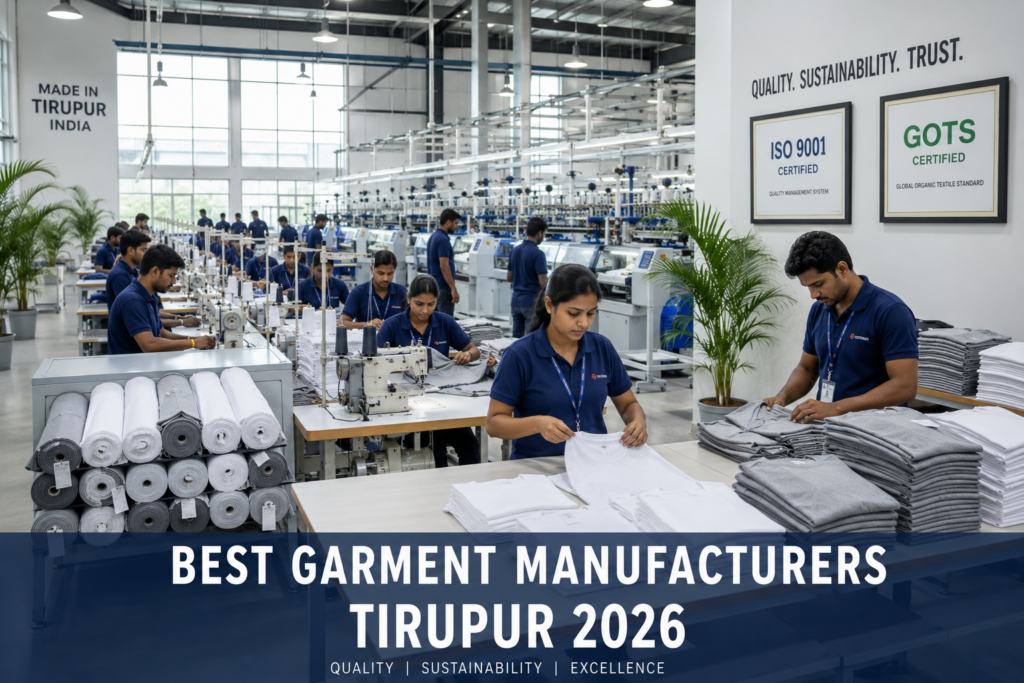
If you’re sourcing cotton T-shirts, polos, hoodies, sweatshirts, or knitwear for an international brand in 2026, Tirupur, India is the most concentrated knitwear manufacturing ecosystem in the world. The Tamil Nadu cluster handles approximately 90% of India’s cotton knitwear exports and contributes around 55.6% of India’s total knitted garment exports — making it the leading sourcing destination for global apparel buyers executing China-plus-one diversification strategies.
But finding the best garment manufacturers in Tirupur is not just about Googling supplier lists. With approximately 20,000 production units in the cluster, many “manufacturers” are actually traders, coordinators, or assemblers who outsource critical steps. The difference between selecting the right and wrong partner can mean weeks of delays, quality disputes, and lost margin.
This complete 2026 guide shows you exactly how to identify the best Tirupur garment manufacturers — including pricing benchmarks, certifications to require, MOQ ranges, lead times, evaluation checklists, and why Rudraa Exports is built specifically as a factory-direct partner for international buyers.
Quick Answer: How Do I Find the Best Garment Manufacturer in Tirupur in 2026?
The best garment manufacturers in Tirupur, India in 2026 share seven characteristics: (1) factory-direct operations with no agent or trader markups, (2) valid international certifications including ISO 9001:2015, GOTS, WRAP, OEKO-TEX, and SA8000, (3) flexible MOQs starting at 300 pieces per design, (4) competitive FOB pricing of ₹120–₹250 per cotton T-shirt, (5) vertical access to Tirupur’s full knit ecosystem (spinning, knitting, dyeing, printing, finishing), (6) AQL 2.5-disciplined quality control with documented inline and final inspection, and (7) mature export documentation for EU, US, Australia, and Middle East buyers. Rudraa Exports operates with all seven characteristics, making it a leading choice for international buyers in 2026.
Why Tirupur Is the World’s Top Garment Manufacturing Hub in 2026
Tirupur’s manufacturing scale and ecosystem depth set it apart from every other Asian garment hub:
- Approximately 90% of India’s cotton knitwear exports originate from Tirupur
- ₹40,000+ crore (US$4.69 billion) in knitwear exports in FY 2024-25
- ~20,000 production units across the value chain
- 600,000+ skilled workers specializing in knitwear
- 100% Zero Liquid Discharge (ZLD) — world’s first textile cluster at this scale
- 130 million liters per day of water recycling capacity
- ~2,250 MW renewable energy infrastructure (wind and solar)
- FOB pricing of ₹120–₹250 per cotton T-shirt depending on specifications
The cluster’s strength is not just sewing capacity — it’s the integrated value chain where knitting, dyeing, printing, embroidery, garmenting, and packing all happen within a short radius, compressing lead times and reducing handoff risks.
What Makes a Garment Manufacturer “The Best” in Tirupur?
International buyers evaluating Tirupur manufacturers in 2026 should look for these seven qualifying characteristics:
1. Factory-Direct Operations (No Agent or Trader Markups)
The most important distinction is whether you’re working with an actual factory or a middleman. Trading companies typically add 15–40% markup to factory prices, while agents add 3–7% commission. A factory-direct manufacturer like Rudraa Exports gives you transparent line-item pricing and direct accountability.
How to verify: Ask to visit the production floor, request photos of the factory with date stamps, ask for the legal entity registration documents, and run a traceability drill on a past purchase order.
2. Valid International Certifications
Top Tirupur manufacturers maintain certifications relevant to global export compliance:
- ISO 9001:2015 — Quality management systems
- GOTS (Global Organic Textile Standard) — Organic cotton certification
- WRAP (Worldwide Responsible Accredited Production) — Ethical labor
- SA8000 — Social accountability standards
- OEKO-TEX Standard 100 — Chemical safety of finished textiles
- Sedex / SMETA — Audit data sharing across buyers
- GRS (Global Recycled Standard) — Recycled content verification
Verification rules in 2026:
- Match certificate name and address to the legal contracting entity
- Check scope — a dyeing certificate does not cover a sewing unit
- Confirm validity dates and ensure no suspended status
- Request the most recent audit report with CAPA closure evidence
3. Flexible MOQ Structure
The best Tirupur manufacturers accommodate both startup and bulk buyers:
| Order Type | Typical MOQ in 2026 |
|---|---|
| Basic cotton tees (pilot run) | 300 pieces per style |
| Standard export production | 300 pieces per style |
| Custom-dyed fabric programs | 300 pieces per color |
| Organic GOTS-certified programs | 500+ pieces per style |
Practical MOQ reduction strategies:
- Consolidate to 2–3 core colors for first orders
- Use stock-supported fabric platforms
- Reduce print complexity in initial runs
- Phase volumes from pilot → repeat
4. Competitive and Transparent FOB Pricing
Tirupur FOB pricing for cotton knitwear in 2026:
- Basic cotton T-shirts: ₹120–₹250 per piece (approximately US$1.50–US$3.00)
- Polo shirts: ₹180–₹350 per piece
- Hoodies and sweatshirts: ₹650–₹1,200 per piece
- Organic cotton premium: 15–30% above standard cotton equivalents
Sample cost breakdown for a ₹180 FOB cotton T-shirt (180 GSM):
| Cost Component | Amount (₹) |
|---|---|
| Fabric (yarn + knitting + dyeing) | 95 |
| CMT + finishing | 45 |
| 12 | |
| Trims and packing | 15 |
| Testing, overhead, margin | 13 |
| Total FOB | 180 |
A transparent factory-direct manufacturer will provide this kind of line-item breakdown when requested.
5. Vertical Access to Tirupur’s Full Knit Ecosystem
The best Tirupur manufacturers leverage the cluster’s specialization rather than trying to do everything in-house. A typical end-to-end production flow includes:
Yarn supply → Knitting (10,000+ units) → Dyeing (729 ZLD-compliant units) → Printing (screen, digital, sublimation) → Embroidery → Cutting → Stitching → Finishing → Quality control → Packing → Export documentation
Red flag warning: If a factory claims to do every step in-house but cannot show specific machines or named partner units for each stage, you may be dealing with a coordinator rather than a real manufacturer.
6. AQL 2.5-Disciplined Quality Control
Export-ready Tirupur factories operate AQL 2.5 for major defects — the international standard for apparel quality inspection. Look for:
- Inline inspection at every production stage
- Midline inspection after washing and finishing
- Final inspection before packing
- Documented defect taxonomy (critical, major, minor)
- Independent authority for QC to stop a production line
7. Mature Export Documentation and Logistics
The best Tirupur manufacturers understand international shipping discipline:
- FOB Incoterm is most common for India exports
- Multi-port flexibility: Tuticorin (VOC Port), Chennai, Cochin
- Pre-alert documentation 72 hours before vessel departure
- Standardized export packaging and carton marking
- FTA-eligible Certificate of Origin documentation
Tirupur Manufacturer Comparison: What to Look For
| Evaluation Factor | Top-Tier Manufacturer | Mid-Tier Factory | Trader/Coordinator |
|---|---|---|---|
| Operational model | Factory-direct | Factory + minor subcontract | Outsources everything |
| Certifications | Full stack (ISO, GOTS, WRAP, OEKO-TEX) | Selective | Self-claimed, often unverified |
| MOQ flexibility | 100–500+ pieces | 300–500 pieces | Highly variable |
| FOB transparency | Line-item breakdown provided | Limited | Single price quote |
| QC discipline | AQL 2.5, inline + final | Final inspection only | None documented |
| Traceability | Yarn-to-shipment | Partial | Cannot demonstrate |
| Export documentation | Mature, FTA-eligible | Standard | Often delayed |
| Best fit for | International brands, regulated markets | Mid-volume programs | High-risk for first-time buyers |
How to Shortlist the Best Garment Manufacturers in Tirupur (2026 Process)
Step 1: Define Your Sourcing Brief
Before contacting any manufacturer, lock specifications across four dimensions:
Product definition — Fabric type, GSM, knit structure, dyeing method, print specifications Quality performance — AQL standard, measurement tolerances, color fastness Compliance requirements — Required certifications, audit standards, restricted substance lists Commercial terms — Target MOQ, Incoterm preference, payment terms, delivery timeline
Step 2: Identify Factory-Direct Candidates
Use proof-based channels rather than random online listings:
- Tiruppur Exporters’ Association (TEA) member directory
- Apparel Export Promotion Council (AEPC) market focus reports
- Referrals from buyers with comparable product complexity and order sizes
- LinkedIn outreach to factory leadership (not sales agents)
Target a shortlist of 6–10 verified manufacturers before deeper evaluation.
Step 3: Run a Structured Factory Evaluation
For each shortlisted manufacturer, request:
- Factory profile with machine count, line count, and monthly output capacity
- Two recent customer references in your destination market
- Certification copies with scope, validity dates, and recent audit summaries
- Last 12 months of on-time delivery percentage, rejection rate, and rework rate
- Sample production turnaround time for your specific product category
Step 4: Send a Detailed RFQ
A complete RFQ generates accurate quotes faster:
- Complete tech pack with measurements, BOM, construction details, artwork
- Fabric specifications (fiber composition, GSM, knit structure, finishing)
- Colorways and size ratio breakdown
- Quantity breaks (e.g., 300 / 600 / 1,200 pieces)
- Required quality standards (AQL level, colorfastness, shrinkage)
- Incoterm preference and destination port
- Required delivery date with realistic flexibility
Step 5: Gate the Sampling Process
Use a 5-stage gated sampling approach to reduce bulk risk:
- Proto sample — Construction and overall look validation
- Fit sample — Pattern corrections and ergonomic adjustments
- Size set — Graded sizing check across all sizes
- PP (Pre-Production) sample — Made from bulk fabric and bulk trims
- Golden sample — Signed standard physically attached to the PO
Step 6: Plan Realistic Timelines
First-order timelines in Tirupur typically follow this structure:
| Stage | Duration |
|---|---|
| Sampling and approvals | 30–45 days |
| Bulk production (basics) | 30–45 days |
| Bulk production (complex) | 45–60 days |
| Sea transit Tuticorin → Rotterdam | 21–46 days |
| Sea transit Tuticorin → New York | 28–55 days |
| Air freight Chennai → EU/US hubs | 5–10 days |
Total first-order PO to delivery: 80–145 days depending on destination
Step 7: Negotiate Terms and Sign Documentation
Recommended first-order structure:
- 30% advance with purchase order confirmation
- 70% balance against shipping documents (or Letter of Credit for larger orders)
- PO references tech pack, golden sample, and AQL standards as binding documents
- Clear rework and claim mechanisms for defects beyond tolerance
12-Point Best Manufacturer Evaluation Checklist
Use this checklist to score every shortlisted Tirupur manufacturer:
✅ 1. Product category fit — Proven experience in your specific product type
✅ 2. Capacity evidence — Machine count, lines, monthly output, dedicated capacity
✅ 3. MOQ clarity — Documented MOQ per style and color with drivers
✅ 4. Lead time map — Written calendar from PO to ex-factory
✅ 5. Quality system — SOPs for inline, midline, final inspection; AQL 2.5 target
✅ 6. Testing readiness — Lab access, CAPA process, failure handling
✅ 7. Certification validity — ISO 9001, GOTS, SA8000, WRAP, OEKO-TEX, Sedex
✅ 8. Traceability — End-to-end PO tracing in 24 hours
✅ 9. Subcontracting controls — Written policy, disclosure, approval requirements
✅ 10. Sustainability infrastructure — ZLD-compliant dyeing access, renewable energy
✅ 11. Commercial transparency — Open costing, clear payment terms, FOB clarity
✅ 12. Logistics maturity — Multi-port flexibility, FTA documentation, pre-alerts
India’s Trade Policy Advantages for 2026 Buyers
When evaluating the best Tirupur manufacturers, consider India’s expanding trade policy environment in 2026:
- RoSCTL scheme (Rebate of State and Central Taxes and Levies) extended through 2026, offsetting embedded taxes on exports
- India-UAE CEPA — Preferential tariff access to GCC markets
- India-UK FTA — Preferential treatment for UK buyers
- India-Australia ECTA — Tariff advantages for Australian importers
- India-EFTA TEPA — Coverage for Switzerland, Norway, Iceland, Liechtenstein
- Active EU FTA negotiations — Potentially major duty changes for European buyers
- PLI scheme for textiles — Government incentives supporting scale and competitiveness
A top Tirupur manufacturer should help you leverage these tariff advantages through proper Certificate of Origin documentation.
Frequently Asked Questions
Who are the best garment manufacturers in Tirupur in 2026?
The best garment manufacturers in Tirupur in 2026 are factory-direct operators with valid international certifications (ISO 9001:2015, GOTS, WRAP, OEKO-TEX), flexible MOQs starting at 300 pieces, transparent FOB pricing, AQL 2.5 quality discipline, and mature export documentation. Rudraa Exports operates with all of these characteristics, making it a leading choice for international buyers.
What is the FOB price of a cotton T-shirt from Tirupur in 2026?
Basic cotton T-shirt FOB pricing from Tirupur ranges from ₹120 to ₹250 per piece (approximately US$1.50 to US$3.00) depending on fabric GSM, yarn quality, trims complexity, print method, and order volume. Premium specifications and organic cotton carry higher pricing.
What is the minimum order quantity for T-shirts from Tirupur garment manufacturers? Tirupur MOQs typically start at 300 pieces per style for simple pilot programs and 300 pieces per style for standard export production. Custom-dyed programs and organic cotton certifications require higher MOQs (500–1,000+ pieces).
How long does it take to produce and ship T-shirts from Tirupur to Europe or the US?
Total door-to-door time is typically 80–145 days, combining sampling (30–45 days), production (30–60 days), and ocean transit (21–55 days depending on destination). Build a 10–20% buffer given global shipping schedule reliability around 50–55%.
Which certifications should I require from a Tirupur garment manufacturer in 2026?
Required certifications include ISO 9001:2015 (quality management), OEKO-TEX Standard 100 (chemical safety), GOTS (organic textiles if applicable), WRAP or BSCI (ethical labor), Sedex/SMETA (audit sharing), and GRS (recycled content). Verify all through official issuing body databases.
How do I tell if a Tirupur supplier is a real factory or a trader?
Request a video walkthrough of the production floor, ask to see specific machines, request photos of certifications displayed on-site, run a traceability drill on a past PO, and ask for the legal entity registration documents. Traders typically cannot demonstrate physical production capability.
What’s the difference between a factory-direct manufacturer and an agent in Tirupur?
A factory-direct manufacturer owns and operates production with transparent line-item pricing. An agent acts as a middleman charging 3–7% commission, while a trading company adds 15–40% markup. Factory-direct partnerships like Rudraa Exports give you cost transparency, accountability, and quality control.
Which port should I ship from when sourcing from Tirupur?
Tuticorin (VOC Port) is closest to Tirupur with reported strong dwell-time performance. Chennai Port handles larger vessels for major global routes. Cochin Port offers flexibility for West Coast US and Middle East destinations.
What payment terms are standard for first-time orders from Tirupur?
Standard first-order terms are 30% advance + 70% before shipment (or against documents). After 2–3 successful shipments, negotiate 20/80 or Letter of Credit arrangements for larger programs.
Can Tirupur manufacturers handle private label and custom branding?
Yes — private label manufacturing is a core strength of Tirupur factories. Services typically include custom fabric sourcing, brand-specific dyeing, custom prints and embroidery, branded woven labels, custom hangtags, and tailored packaging. Rudraa Exports provides full private-label services for international brands.
What products can Tirupur manufacturers make besides T-shirts?
Tirupur specializes in cotton knitwear including T-shirts, polo shirts, hoodies, sweatshirts, loungewear, sleepwear, kidswear, innerwear, athleisure, lightweight knit jackets, dresses, and tank tops. The cluster handles both basic and complex value-added knitwear programs.
How does Tirupur compare to manufacturing in China for cotton T-shirts in 2026?
Tirupur is more cost-competitive than mainstream China for cotton knitwear basics, with FOB pricing roughly 25–40% lower for matched specifications. MOQs are dramatically lower (300 pieces in Tirupur vs 500–1,000+ in mainstream China), and India’s expanding FTA network adds tariff advantages in covered markets.
Why Rudraa Exports Is Among the Best Garment Manufacturers in Tirupur in 2026
Rudraa Exports operates as a factory-direct garment manufacturer in Tirupur specifically built for international buyers. Our advantages align with every characteristic of the best manufacturers in 2026:
- Factory-direct operations — No agent layers, no hidden subcontractors, no trader markups
- Transparent line-item costing with full visibility into fabric, CMT, finishing, and overhead
- Flexible MOQ structure accommodating both emerging brands and established retailers
- AQL 2.5-disciplined quality control with documented inline, midline, and final inspections
- Vertical access to Tirupur’s complete knit ecosystem (spinning, knitting, dyeing, printing, embroidery, finishing)
- ZLD-aligned wet processing for sustainability-focused buyers
- Multi-port shipping flexibility through Tuticorin, Chennai, and Cochin
- Mature export documentation for US, EU, Australia, and Middle East markets
- FTA-eligible certification of origin for buyers in India’s expanding trade agreement markets
- Transparent English-language communication across all time zones
Rudraa Exports is particularly well-suited for fashion startups testing first runs, established brands diversifying away from China, private-label retailers, corporate uniform programs, and importers serving regulated markets in Europe, North America, Australia, and the Middle East.
Conclusion: Choose Tirupur Manufacturers Based on Evidence, Not Promises
The best garment manufacturers in Tirupur, India in 2026 are not the ones with the slickest websites or the lowest headline FOB quotes. They are the ones with factory-direct operations, valid certifications, flexible MOQs, transparent pricing, disciplined quality control, and mature export documentation.
With Tirupur producing approximately 90% of India’s cotton knitwear exports, generating ₹40,000+ crore in annual export value, and operating the world’s first 100% ZLD textile cluster at scale, the case for sourcing from Tirupur in 2026 has never been stronger. Combined with India’s expanding FTA network providing tariff advantages in the UK, Australia, UAE, and EFTA markets, Tirupur offers structural advantages that mainstream Chinese hubs cannot match for cotton knitwear.
Ready to start with one of the best garment manufacturers in Tirupur?
Related guides: the top 10 garment exporters in Tirupur, the certifications buyers should verify, and how Rudraa Exports compares to other suppliers.
Visit rudraaexports.com to share your tech pack, target MOQ, and destination market — and receive a transparent factory-direct quote built for international buyers in 2026.