
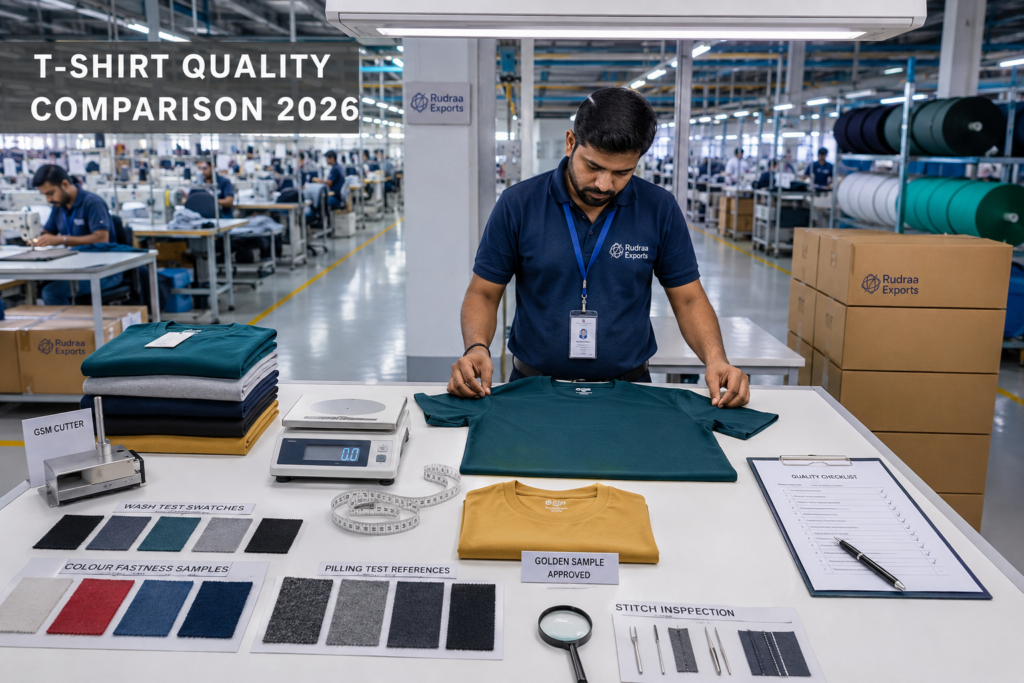
A proper T-shirt quality comparison in 2026 cannot be based on brand name, product photos, or “premium cotton” claims. Buyers need to compare measurable proof: GSM, fabric composition, stitching construction, shrinkage data, colour-fastness, pilling resistance, seam strength, certifications, warranty terms, defect signals, return policies, and traceability documents.
The uploaded research compared brands and suppliers such as Patagonia, UNIQLO, Everlane, AS Colour, Hanes, Gildan, Fruit of the Loom, Sunspel, Nike, adidas, and Rudraa Exports across fabric quality, construction details, testing evidence, certifications, warranty signals, customer reviews, and traceability. The strongest lesson is simple: most brands do not publicly disclose full technical manufacturing data such as SPI, seam tensile strength, AATCC colour-fastness results, or ISO-based shrinkage reports. That means buyers should not depend only on brand reputation. They must request proof.
At Rudraa Exports, the right buyer-facing positioning should be honest: factory-direct Tirupur T-shirt manufacturing must be supported by clear test reports, inspection systems, and documentation. If Rudraa wants to compete with established global T-shirt suppliers, the opportunity is not to make vague “highest quality” claims. The opportunity is to prove quality through GSM consistency, AQL 2.5 inspections, shrinkage testing, colour-fastness reports, seam checks, compliance documents, and transparent sourcing records.
Quick Answer
The best way to compare T-shirt quality in 2026 is to check objective manufacturing evidence, not marketing claims. Buyers should compare GSM, fiber composition, stitch construction, shrinkage results, colour-fastness, pilling resistance, seam strength, certifications such as OEKO-TEX, GOTS, ISO 9001, BSCI, WRAP, SMETA, and warranty or defect-rate signals. Patagonia, UNIQLO, and Everlane show stronger public quality evidence in the uploaded benchmark, while Rudraa Exports should be evaluated as a factory-direct manufacturing option where buyers must request lab reports, inspection records, and traceability proof before bulk sourcing.
Want to verify T-shirt quality before placing a bulk order? Contact Rudraa Exports to share your tech pack, GSM target, test requirements, and destination market.
Why T-Shirt Quality Comparison Is Harder Than Buyers Think
Most buyers compare T-shirts by touching the fabric or checking the brand name. That is not enough.
A 200 GSM T-shirt can still shrink badly. A soft cotton T-shirt can still have weak seams. A premium-looking garment can still fail colour-fastness. A branded supplier can still avoid publishing technical data. A low-cost factory can produce good quality if the buyer defines specifications clearly and verifies production properly.
The uploaded benchmark shows a serious industry problem: many well-known brands disclose fabric weight and basic construction, but do not publish complete lab data for seam tensile strength, stitching density, shrinkage, colour-fastness, or pilling.
That means buyers need to create their own quality comparison framework.
T-Shirt Quality Scorecard for Buyers
Use this scorecard before selecting a T-shirt supplier.
| Quality Factor | What to Check | Why It Matters |
|---|---|---|
| Fabric composition | 100% cotton, Supima, organic cotton, recycled blend, CVC | Affects softness, durability, shrinkage, and price |
| GSM | 150, 160, 180, 190, 200, 210+ GSM | Indicates fabric weight, not full quality |
| Stitching | Double-needle hem, shoulder tape, side seams, SPI | Affects seam durability and shape retention |
| Shrinkage | ISO 6330 / wash test data | Prevents size complaints after washing |
| Colour-fastness | AATCC 61 / ISO 105 | Prevents fading and dye bleeding |
| Pilling | ISO 12945 / Martindale | Important for long-term wear |
| Seam strength | ISO 13935-2 | Confirms stitching durability |
| Certifications | OEKO-TEX, GOTS, ISO 9001, WRAP, BSCI, SMETA | Supports chemical, quality, and compliance claims |
| Warranty / returns | Return rate, seam warranty, repair policy | Useful real-world quality signal |
| Traceability | Factory, lot, batch, transaction certificates | Helps verify material and production source |
The brutal truth: if a supplier cannot provide at least some of this evidence for bulk sourcing, you are not comparing quality. You are guessing.
What the Uploaded Benchmark Shows About Global T-Shirt Brands
The research compared multiple global and supplier brands. The top finding is not that one brand is perfect. The top finding is that public technical proof is incomplete across almost the entire market.
Evidence-Weighted Brand Comparison
| Brand / Supplier | Strong Public Quality Signals | Main Evidence Gap |
|---|---|---|
| Patagonia | 190 GSM recycled blend, Fair Trade Certified sewing, B Corp, repair/replace policy, low return-rate signal | No public seam strength or colour-fastness data |
| UNIQLO | Supima cotton, quantified shrinkage evidence, quality governance | No public SPI or seam tensile data |
| Everlane | 210 GSM organic cotton, 365-day seam warranty, GOTS claim | No third-party shrinkage or seam test data |
| AS Colour | 180 GSM combed cotton, shoulder tape, double-needle construction, BSCI | No public lab durability metrics |
| Hanes | 206 GSM Beefy-T, double-needle construction, OEKO-TEX, 90-day refund | No public SPI or seam tensile data |
| Gildan | 180 GSM Heavy Cotton, taped neck/shoulders, double-needle hems, OEKO-TEX | No public third-party shrinkage or colour-fastness results |
| Fruit of the Loom | 150 GSM, OEKO-TEX signal, broad availability | Limited technical test evidence |
| Sunspel | Premium Supima positioning, factory information | Limited public technical data |
| Nike | Supplier map, warranty/returns, global quality systems | Limited SKU-level T-shirt QA metrics |
| adidas | bluesign system partner signal, global quality programs | Limited garment-level QA data |
| Rudraa Exports | Factory/exporter positioning, 200 GSM listing in source | Public gaps in lab reports, reviews, traceability, and published test data in the uploaded benchmark |
This table should guide how Rudraa talks about quality. Do not claim “better than Patagonia” or “highest quality” without proof. That is weak marketing and easy to attack. Instead, Rudraa should position itself as a factory-direct manufacturer that can build buyer-specified quality and provide verification documents during sourcing.
GSM Comparison: Why Fabric Weight Alone Is Not Enough
GSM stands for grams per square meter. It tells you how heavy the fabric is. Many buyers treat GSM as quality, but that is incomplete.
A 200 GSM T-shirt is usually heavier than a 160 GSM T-shirt, but heavier does not automatically mean better. The yarn quality, knitting, compacting, dyeing, finishing, shrinkage control, stitching, and measurement consistency matter just as much.
GSM Reference Table
| GSM Range | Common Use | Buyer Interpretation |
|---|---|---|
| 140–160 GSM | Lightweight fashion / summer tees | Breathable but may feel thin |
| 160–180 GSM | Standard retail T-shirts | Balanced weight and comfort |
| 180–200 GSM | Premium midweight tees | Better structure and durability |
| 200–220 GSM | Heavyweight / premium blanks | Stronger feel, higher cost |
| 220+ GSM | Oversized / streetwear / luxury blanks | Heavy drape, not always suitable for all climates |
The uploaded benchmark lists examples such as Patagonia around 190 GSM, UNIQLO around 160 GSM, Everlane around 210 GSM, AS Colour around 180 GSM, Hanes around 206 GSM, Gildan around 180 GSM, Fruit of the Loom around 150 GSM, and a Rudraa-related listing at 200 GSM.
For buyers, the correct question is not “What GSM is best?” The correct question is:
What GSM is best for my customer, climate, price point, wash requirement, and brand positioning?
Stitching and Construction: The Missing Data Problem
Stitching quality is one of the biggest gaps in public T-shirt quality data.
Many brands mention:
- Taped shoulders
- Double-needle hems
- Side seams
- Ribbed collar
- Reinforced neckline
These are useful, but they are not complete technical proof.
Buyers should ask for:
| Construction Detail | Why It Matters |
|---|---|
| SPI — stitches per inch | Higher/lower SPI affects seam strength and flexibility |
| Seam tensile strength | Confirms how much force seams can handle |
| Shoulder tape quality | Helps prevent neckline and shoulder distortion |
| Neck rib recovery | Affects collar shape after washing |
| Hem construction | Prevents twisting and seam failure |
| Side seam alignment | Reduces garment twisting |
| Measurement tolerance | Keeps fit consistent across sizes |
The uploaded research says most brands do not publish SPI or seam tensile strength results. That is a major gap.
For private-label buyers, this is where factory partnership matters. A manufacturer like Rudraa should be asked to produce stitching specifications, sealed samples, TOP samples, and inspection reports instead of relying only on product descriptions.
Shrinkage and Colour-Fastness: The Real Quality Test
Customers judge T-shirt quality after washing, not when the garment is new.
A T-shirt that looks perfect on arrival can still become a bad product if it shrinks, twists, fades, bleeds colour, or pills after washing.
Important test standards include:
| Test | Common Standard | What It Checks |
|---|---|---|
| Dimensional change / shrinkage | ISO 6330 / ISO 5077 | Size change after washing |
| Colour-fastness to washing | AATCC 61 / ISO 105 | Dye loss and staining |
| Colour-fastness to rubbing | ISO 105-X12 | Dry and wet rubbing resistance |
| Pilling resistance | ISO 12945 | Surface fuzz and pills |
| Fabric mass | ISO 3801 / ASTM D3776 | GSM accuracy |
| Seam strength | ISO 13935-2 | Stitching strength |
The uploaded benchmark highlights that quantified shrinkage and colour-fastness results are rarely published. UNIQLO had one of the better public shrinkage signals through an independent review, while many others lacked public lab data.
For OEM buyers, this means you should not wait for customer complaints. Add test requirements before production.
Certifications: Useful, But Not a Substitute for Testing
Certifications help, but they do not replace product testing.
For example:
- OEKO-TEX supports product chemical safety.
- GOTS supports organic textile claims and chain-of-custody.
- ISO 9001 supports quality management systems.
- BSCI, WRAP, SMETA, and SA8000 support social compliance.
- bluesign supports chemical and environmental management in textile supply chains.
But none of these automatically prove your exact T-shirt will not shrink, fade, twist, or fail at the seam.
Certification vs Product Quality Table
| Certification / Standard | Helps Prove | Does Not Automatically Prove |
|---|---|---|
| ISO 9001 | Quality management system | Specific T-shirt wash performance |
| OEKO-TEX STANDARD 100 | Harmful substance control | Stitching strength or fit consistency |
| GOTS | Organic chain-of-custody | Premium stitching or low shrinkage |
| WRAP / BSCI / SMETA | Social compliance | Fabric durability |
| bluesign | Chemical/environmental input controls | Finished garment measurements |
| AQL inspection | Shipment-level defect control | Long-term wash durability |
Buyers need both: certifications plus product-specific testing.
How Rudraa Exports Should Compete on T-Shirt Quality
The uploaded comparison is blunt: Rudraa had a 200 GSM listing, but the provided benchmark did not show public lab reports, defect rates, aggregated reviews, traceability systems, or full public certification proof within that specific dataset.
This is not something to hide. It is something to fix.
Rudraa can compete better by making quality proof easier for buyers to verify.
Rudraa’s Best Quality Positioning
Rudraa should not say:
“We are better than Patagonia, UNIQLO, Hanes, or Gildan.”
That is not supported.
Rudraa should say:
“We manufacture buyer-specified T-shirts from Tirupur with factory-direct control, AQL-based inspection, fabric and construction customization, and documentation support for international buyers.”
That is believable, useful, and commercially stronger.
What Buyers Should Request from Rudraa or Any OEM T-Shirt Factory
If you are sourcing from Rudraa or any Tirupur factory, request this before bulk approval.
| Requirement | What to Ask For |
|---|---|
| Fabric proof | GSM report, composition, yarn type, mill source |
| Shrinkage proof | ISO 6330 / wash test report |
| Colour proof | AATCC 61 / ISO colour-fastness reports |
| Pilling proof | ISO 12945 or equivalent |
| Stitching proof | SPI, seam type, seam strength where available |
| Inspection proof | Inline, end-line, final inspection reports |
| AQL proof | AQL 2.5 or buyer-defined standard |
| Compliance proof | ISO, OEKO-TEX, GOTS, BSCI, SMETA, WRAP where relevant |
| Traceability proof | Batch IDs, fabric lot, TC documents for organic/recycled |
| Golden sample | Signed and sealed PP sample |
This is how Rudraa can win serious buyers: not by making bigger claims, but by making verification easier.
Quality Decision Framework for Buyers
Use this framework to select the right supplier.
✅ If you need the strongest public brand-level accountability, Patagonia has the strongest evidence in the uploaded benchmark.
✅ If you need shrinkage evidence, UNIQLO had one of the clearest public quantified signals.
✅ If you need seam warranty confidence, Everlane’s 365-day seam warranty is a strong buyer-facing signal.
✅ If you need standardized blank T-shirts, Hanes and Gildan have strong availability and construction references.
✅ If you need factory-direct OEM production, Rudraa Exports should be evaluated through test reports, samples, inspections, and documentation, not brand reputation alone.
Why Rudraa Exports
Rudraa Exports is best positioned for buyers who want to create their own T-shirt quality specification instead of buying existing blank T-shirts from mass-market brands.
Manufacturing Capabilities
- Factory-direct Tirupur T-shirt and knitwear manufacturing
- 72,000+ units per month production capacity
- Custom men’s round-neck T-shirts, polos, uniforms, activewear, and private-label knitwear
- Fabric sourcing, sampling, cutting, stitching, finishing, packing, and export documentation support
- MOQs starting from around 300 pieces per style, depending on product and customization
Quality and Compliance
- ISO 9001:2015 certified manufacturing approach
- AQL 2.5 inspection standards
- Ability to manufacture to buyer-defined GSM, fabric, construction, measurement, and packaging requirements
- Support for quality testing such as GSM, shrinkage, colour-fastness, pilling, and seam checks where required
- Certification-aligned sourcing support for OEKO-TEX, GOTS, GRS, BSCI, SMETA, WRAP, and related buyer requirements where applicable
International Buyer Advantages
- Factory-direct pricing without trading-company markups
- Up to 40% cost-saving positioning compared with indirect sourcing models
- English-language communication for global buyers
- Export support for EU, USA, Australia, and Middle East markets
- Multi-port shipping through Tuticorin VOC, Chennai, and Cochin
- FTA-eligible documentation support for relevant destination markets
Ready to build a T-shirt quality spec instead of guessing from product photos? Speak with Rudraa Exports for a factory-direct discussion based on GSM, fit, fabric, testing, and export requirements.
FAQ: T-Shirt Quality Comparison
1. What is the best way to compare T-shirt quality?
The best way is to compare GSM, fabric composition, stitching construction, shrinkage, colour-fastness, pilling resistance, seam strength, certifications, return policies, and traceability documents. Do not rely only on brand name or fabric feel.
2. Is higher GSM always better for T-shirts?
No. Higher GSM means heavier fabric, but not automatically better quality. A 200 GSM T-shirt can still shrink or fade if fabric processing and testing are weak. Choose GSM based on product use, climate, brand positioning, and wash expectations.
3. What GSM is best for premium T-shirts?
Premium T-shirts commonly use 180–220 GSM depending on style. Around 180–200 GSM works well for structured everyday T-shirts, while 200–220+ GSM is better for heavyweight or oversized styles.
4. Which brand had the strongest quality evidence in the uploaded benchmark?
Patagonia had one of the strongest public quality cases because of its accountability programs, Fair Trade Certified sewing, B Corp status, repair/replace policy, and published low return-rate signal. UNIQLO also had useful quantified shrinkage evidence.
5. What is more important: OEKO-TEX or ISO 9001?
They prove different things. OEKO-TEX focuses on harmful substance testing for textile products, while ISO 9001 focuses on quality management systems. A strong supplier may need both, plus product-specific test reports.
6. How can I check if a T-shirt will shrink?
Ask for shrinkage test reports based on ISO 6330 or similar washing standards. Also test pre-production samples before bulk approval and define acceptable shrinkage limits in the tech pack.
7. What stitching details should I check in a T-shirt?
Check shoulder tape, side seams, double-needle hems, neck rib recovery, stitch type, SPI, seam strength, and measurement tolerance. Public brands often do not disclose all this, so OEM buyers should request it directly from the factory.
8. What tests should I request for private-label T-shirts?
Request GSM, fiber composition, shrinkage, colour-fastness to washing, colour-fastness to rubbing, pilling resistance, seam strength, and print wash durability. Add chemical testing if required by your destination market or retailer.
9. Can Rudraa Exports compete with global T-shirt brands?
Rudraa should not be compared like a retail brand unless it publishes the same level of evidence. Its stronger role is as a factory-direct OEM manufacturer that can produce buyer-defined quality with samples, inspections, test reports, and export documentation.
10. Why do many brands not publish SPI or seam strength?
Most consumer-facing brands publish only basic product information because technical lab data is not usually demanded by retail customers. B2B buyers should request this data privately before placing bulk orders.
11. What does AQL 2.5 mean in T-shirt inspection?
AQL 2.5 is a commonly used acceptable quality level for major defects in apparel inspection. It helps buyers decide whether a shipment passes or fails based on a statistical sample instead of subjective judgment.
12. What should I ask a factory before placing a bulk T-shirt order?
Ask for a tech-pack review, fabric details, GSM proof, sample stages, testing plan, AQL inspection method, certifications, production timeline, packaging details, export documents, and defect remedy terms.
Conclusion
T-shirt quality comparison in 2026 must be evidence-based. GSM, cotton type, and brand reputation are useful, but they are not enough. Serious buyers should compare shrinkage, colour-fastness, pilling, seam strength, stitching construction, certifications, return signals, traceability, and inspection records before choosing a supplier.
Related guides: the certifications worth verifying, how to choose a T-shirt manufacturer, and our complete guide to custom T-shirt manufacturing.
Visit rudraaexports.com or contact our team directly to share your tech pack, target GSM, quality standards, test requirements, and destination market — and receive a factory-direct T-shirt manufacturing quote built for serious international buyers in 2026.
Related reading
India vs China T-Shirt Manufacturing in 2026: Which Is Better for Your Brand?
GSM Fraud in Indian Garment Factories: 3 Factory Practices Every Brand Must Verify