
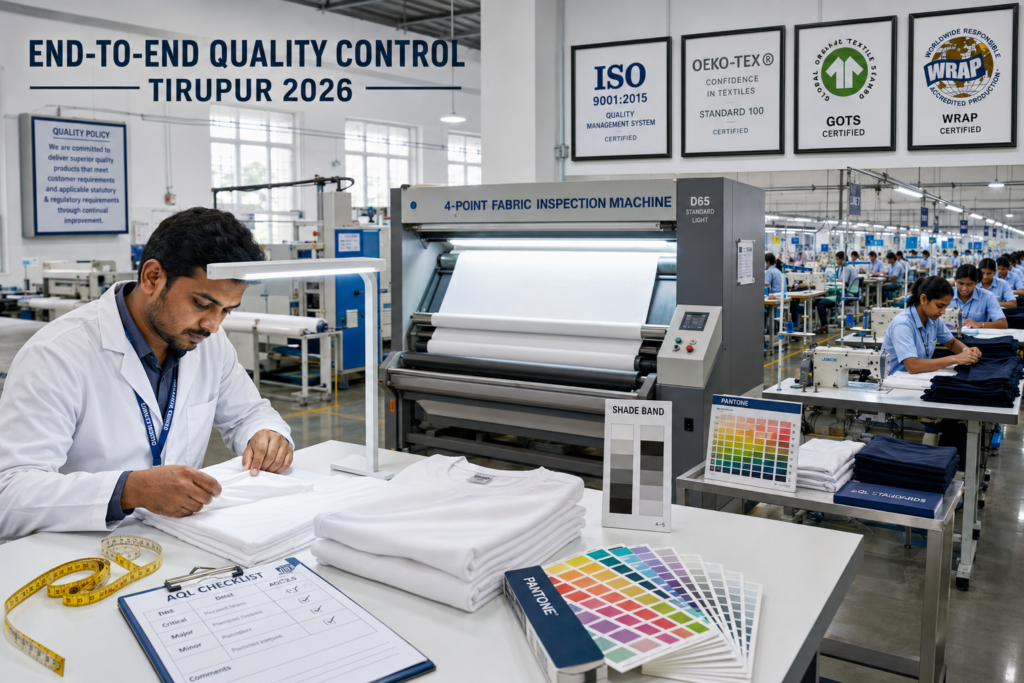
In 2026, international apparel buyers no longer ask “Will my T-shirts arrive on time?” — they ask “Can I trust every roll of fabric, every stitch, every shade, and every carton?” The difference between a reliable Tirupur exporter and a risky one comes down to one thing: the quality control system behind every shipment.
Factory-direct exporters in Tirupur, India — including Rudraa Exports and similar vertically organized knitwear manufacturers — operate layered quality systems built on incoming material qualification, tight in-process controls, lab verification, AQL-based final inspection, and traceability that links every fabric roll to the carton your customer opens.
This complete 2026 guide explains exactly how end-to-end quality control works in ISO-certified Tirupur T-shirt exporters: the procedures, checkpoints, certifications, technologies, and verification standards international buyers should demand.
Quick Answer: How Does Quality Control Work in Tirupur T-Shirt Manufacturing in 2026?
End-to-end quality control in ISO-certified Tirupur T-shirt exporters in 2026 follows five integrated stages: (1) incoming inspection of fabric (4-Point System, shade grouping, ISO 105 colorfastness, dimensional stability testing) and trims; (2) in-process controls during cutting, sewing (traffic-light system, inline audits every 30 minutes), printing/embroidery, and finishing; (3) lab testing for colorfastness, shrinkage, pilling, strength, and chemical compliance (REACH, RSL); (4) final AQL inspection using ANSI/ASQ Z1.4 or ISO 2859-1 sampling with AQL 1.0 for critical, 2.5 for major, 4.0 for minor defects; and (5) digital traceability linking fabric rolls to shade groups, bundle tickets, sewing lines, finishing batches, and shipment cartons through barcode/QR-based MES and ERP systems. The entire framework operates within an ISO 9001:2015 Quality Management System with buyer-specific layered standards (H&M RQS, WRAP social compliance, OEKO-TEX chemical safety).
Why End-to-End Quality Control Matters in 2026
The cost of quality failure in 2026 is higher than ever:
- EU regulations (CSRD, EU Strategy for Sustainable Textiles) demand documented quality processes
- US retailer chargebacks for AQL failures can exceed 5–10% of order value
- Consumer return rates above 3% destroy DTC brand margins
- Social media amplification turns isolated defects into brand-wide PR problems
- Modern Slavery Acts (UK, Australia) require documented compliance
For Tirupur exporters serving international buyers, quality control isn’t a cost center — it’s the foundation of long-term customer relationships and brand reputation.
Stage 1: Incoming Fabric and Trim Inspection (Raw-Material Gatekeeping)
The first quality gate happens before a single garment is cut. Failures caught here cost the least to fix.
Fabric Roll Receipt and Quarantine
ISO 9001-compliant garment QMS requires controlled receiving with documented identification and status control:
- Accepted — Approved for production
- On-hold — Pending test results
- Rejected — Returned to supplier
Fabric is held in physical quarantine zones until roll inspection and key tests clear.
Shade Continuity and Bulk Shade Grouping
Every roll is inspected under standardized light sources — commonly D65 (daylight) and TL84 (store lighting) — and grouped into shade lots so each order is cut from color-consistent rolls.
Why this matters: Without shade grouping, you get “panel shading” — where the front and back of one T-shirt appear visibly different colors after washing. This is a classic chargeback trigger.
Advanced practice: Spectrophotometer readings build electronic shade libraries for precise color matching across orders.
4-Point Fabric Inspection System
The international standard for incoming fabric inspection. Every roll is visually inspected on a fabric inspection machine, and defects are scored using the 4-Point System:
| Defect Length | Points |
|---|---|
| Up to 3 inches | 1 point |
| 3 to 6 inches | 2 points |
| 6 to 9 inches | 3 points |
| Over 9 inches | 4 points |
| Holes (any size) | 4 points |
Rolls exceeding allowed points per 100 square yards are rejected or downgraded. Buyer manuals like the H&M Fabric Inspection Guideline define acceptance thresholds.
Incoming Fabric Performance Tests
Top Tirupur exporters run a “fabric approval test pack” before bulk cutting:
- Dimensional stability (shrinkage) — AATCC 135 or ISO 6330 methods
- Spirality and skew — Critical for tubular knits to prevent side-seam twist
- Fabric weight (GSM) — Verified against tech pack specification
- Bursting strength — For knit fabric durability
- Pilling resistance — Martindale method
- Colorfastness — ISO 105 series (washing, rubbing, perspiration, light)
Trim and Accessory Incoming Control
Trim inspection covers:
- Color match to approved standards (woven labels, hangtags, neck tapes)
- Functional tests — Button/snap attachment strength, zipper function, drawcord pull strength
- Safety control — Metal detection readiness, needle risk management
- Chemical compliance — RSL conformance for trims with dyes or coatings
Stage 2: In-Process Controls During Production
In-process controls prevent defects from compounding across the order.
Cutting Stage Controls
Cutting is the highest-risk stage because errors replicate across the entire lot.
Key cutting controls:
- Marker and lay verification — Correct size ratio, placement, fabric face direction, nap direction
- Ply count checks — End-of-lay audits prevent over-cutting or short-cutting
- Bundle ticketing — Cut parts traced through sewing lines via barcode tickets
- Shade group enforcement — Prevents mixing dye lots within a single lay
Quality intent: Prevent mis-cuts, size set errors, and ply shading — all expensive to rework after sewing.
Sewing Inline Quality Controls
Modern Tirupur exporters use inline patrol audits every 30 minutes to catch defects at the source rather than at end-line.
The Traffic Light System is a recognized best practice:
| Status | Meaning | Action |
|---|---|---|
| 🟢 Green | Defect levels within acceptable range | Continue production |
| 🟡 Yellow | Defect levels rising | Investigate, adjust, monitor |
| 🔴 Red | Defect levels exceed threshold | Stop line, root cause, fix |
This shifts quality control from “inspection as sorting” to “inspection as process control” — catching needle damage, tension imbalance, skipped stitches, and operator issues before they affect 100 pieces.
Printing and Embroidery Controls
Printing adds specific quality risks:
- Off-placement
- Color mismatch
- Cracking after wash
- Bleeding into adjacent fabric
- Handfeel changes
Standard controls:
- Pre-production strike-off approval (signed by buyer)
- On-line checks for placement and shade
- Cure temperature and time logs for plastisol/water-based prints
- Wash test on first off before line approval
Finishing Stage Controls
The last stage before packing:
- 100% visual inspection for stains, dirt, loose threads, seam appearance
- Measurement checks against approved spec (within tolerance bands)
- Metal detection for needle contamination risk (mandatory for many EU/US retailers)
- Tag and label verification — Country of origin, fiber content, care instructions
Stage 3: Laboratory and Field Testing
Lab testing verifies performance attributes that visual inspection cannot detect.
Colorfastness Testing (ISO 105 Series)
The most standardized area in textile QA:
| Test Type | ISO Method | What It Tests |
|---|---|---|
| Washing colorfastness | ISO 105-C06 | Color retention after laundering |
| Rubbing/crocking | ISO 105-X12 | Color transfer (wet and dry) |
| Perspiration | ISO 105-E04 | Color retention to sweat |
| Light fastness | ISO 105-B02 | UV exposure resistance |
| Water | ISO 105-E01 | Color retention to water immersion |
Dimensional Stability and Appearance Retention
- Shrinkage testing — AATCC 135 / ISO 6330 wash methods
- Spirality testing — Especially critical for jersey knits
- Skewness — Pattern alignment after wash
- Appearance retention — After 5–10 home wash cycles
Durability Testing
- Pilling resistance — Martindale method (ISO 12945-2)
- Bursting strength — For knit T-shirts (ISO 13938)
- Seam strength — Critical seam performance
- Tensile strength — Yarn and fabric integrity
Chemical Compliance Testing (RSL/MRSL)
In 2026, chemical compliance is non-negotiable:
- REACH (EU) — Registration, Evaluation, Authorisation of Chemicals
- CPSIA (US) — Lead, phthalates, small parts testing
- Brand RSLs — Restricted Substance Lists (varies by retailer)
- ZDHC MRSL — Zero Discharge of Hazardous Chemicals
- California Prop 65 — Toxic substance warnings
Common chemical tests:
- Azo dyes (forbidden in EU)
- Formaldehyde
- Heavy metals (lead, cadmium, nickel)
- Phthalates (in prints)
- pH levels
- AZO amines
Internal Wear and Wash Trials
Top Tirupur exporters run internal wear trials to detect:
- Spirality after 3–5 wash cycles
- Torque in side seams
- Print cracking or peeling
- Handfeel changes
- Pilling progression
Stage 4: Final AQL Inspection (Statistical Acceptance at Shipment Gate)
The last quality gate before goods leave the factory.
Sampling Standard: ANSI/ASQ Z1.4 or ISO 2859-1
International apparel uses statistical sampling rather than 100% inspection (which is cost-prohibitive at export volumes).
Typical AQL setup for export apparel in 2026:
| Defect Class | Examples | Typical AQL |
|---|---|---|
| Critical | Safety hazards (broken needle, sharp object), legal labeling failures | 0 or 1.0 |
| Major | Saleability defects (visible stains, broken seams, measurement out of tolerance) | 2.5 |
| Minor | Small appearance issues (loose threads, slight color variation) | 4.0 |
Standard inspection parameters:
- General Inspection Level II
- Normal inspection with switching rules
- Single sampling plan
What’s Checked in Final AQL Inspection
- Visual defects — Stains, holes, print issues, sewing faults
- Measurement checks — Against approved size chart with tolerance
- Labeling and packing — Size labels, care labels, country of origin, carton marks
- Metal detection pass confirmation — For retailers requiring needle policy
- Assortment accuracy — Size ratio matches PO requirement
- Carton condition — No damage, correct master carton dimensions
Failure Handling and Escalation
When a lot fails AQL:
- Quarantine the lot immediately
- 100% re-screen or rework depending on defect type
- Root cause analysis (5-Why, fishbone diagram)
- Corrective Action (CAPA) documented per ISO 9001 requirements
- Verify effectiveness in subsequent lots
- Apply switching rules — Normal → Tightened inspection until quality recovers
Stage 5: Digital Traceability (Roll to Carton)
In 2026, traceability is mandatory for EU CSRD compliance, sustainability claims, and rapid problem resolution.
What “Good Traceability” Looks Like
A complete traceability chain links:
Fabric roll ID → Shade group → 4-Point inspection result → Lay/marker ID → Bundle ticket ID → Sewing line + operator + timestamp + inline QC result → Finishing batch → Metal detection pass → Packing list → Carton ID → Shipment documents
Technologies Enabling Traceability
Barcode and QR Code MES Systems:
- Raw material identification at receiving
- Inventory tracking through production stages
- Real-time monitoring of WIP (Work-in-Progress)
- Final packaging with carton-level barcode
ERP and Shop-Floor Digitization:
- Integration of inventory, material tracking, and barcode systems
- Real-time visibility for both factory and buyer
Digital QC Platforms:
- Mobile inspection workflows
- Real-time reporting to buyer dashboards
- Centralized defect data and trend analytics
- Significant time savings vs paper-based QC
Chain-of-Custody Standards
- ISO 22095:2020 — Umbrella chain-of-custody standard
- GS1 Digital Link — Turns barcodes into web-addressable product information
- GOTS Transaction Certificates (TCs) — Per-shipment organic verification
- Blockchain-enabled traceability — Increasingly used for recycled and organic claims
Example: Major brands like H&M have expanded blockchain-enabled traceability partnerships to scale recycled material verification across supply chains.
International Quality Standards and Certifications That Matter in 2026
ISO 9001:2015 (Quality Management Systems)
The foundation framework for Tirupur exporters. ISO 9001 requires:
- Defined processes and responsibilities
- Documented information control
- Internal audits and management review
- Control of nonconforming outputs
- Corrective action processes
- Risk-based thinking embedded into operations
Buyer-Specific Quality Standards
Major retailers layer their own standards on top of ISO 9001:
- H&M RQS (Requirements for Quality System) — Supplier quality system expectations
- H&M Fabric Inspection Guideline — Operational fabric inspection direction
- Inditex (Zara) Quality Standards — Trend-driven quality control discipline
- Walmart QC Standards — Large-volume retailer quality framework
- Marks & Spencer Quality Manual — UK retailer quality requirements
Social Compliance Standards
While not strictly “quality” standards, these affect quality through factory governance:
- WRAP (Worldwide Responsible Accredited Production) — Tirupur Exporters Association (TEA) is a formal WRAP partner
- SA8000 — Social Accountability International standard
- BSCI / amfori BSCI — European social compliance program
- SMETA / SEDEX — Audit data sharing platform
Environmental and Material Standards
- ISO 14001 — Environmental management systems
- GOTS (Global Organic Textile Standard) — Organic certification with chain-of-custody
- OEKO-TEX Standard 100 — Chemical safety of finished textiles
- GRS (Global Recycled Standard) — Recycled content verification
How Tirupur Exporters Identify and Remediate Common Defects
Defect Classification System
Defects are typically categorized by source:
- Fabric defects — Yarn breaks, knitting flaws, dyeing issues
- Cutting defects — Wrong pattern, mis-cuts, ply shading
- Sewing defects — Skipped stitches, puckering, broken seams
- Print/embroidery defects — Off-placement, color mismatch, cracking
- Finishing defects — Stains, miss-pressing, packaging errors
- Safety/chemical defects — Metal contamination, RSL failures
Common Defect → Standard Remediation
| Defect Type | Root Cause | Remediation |
|---|---|---|
| Skipped stitches / seam opening | Needle damage, tension imbalance | Needle change policy, tension reset, operator retraining |
| Puckering | Differential feed/tension issues | Adjust SPI, fabric relaxation control |
| Panel shading | Mixed dye lots in single lay | Enforce shade grouping at fabric stage |
| Measurement failure | Cutting tolerance, pattern issue | Tighten cutting tolerance, in-line measurement gates |
| Stains/soiling | Handling/housekeeping | Improve flow control, packing discipline |
| Color migration | Dye/fabric chemistry | Re-evaluate fabric and dye source |
CAPA (Corrective and Preventive Action)
ISO 9001 requires structured CAPA:
- Detect — Identify the defect through inspection
- Contain — Quarantine affected lot
- Investigate — Root cause analysis (5-Why, fishbone)
- Correct — Implement immediate fix
- Prevent — Update SOPs, retrain operators, modify process
- Verify — Confirm effectiveness in subsequent lots
Cost and Efficiency Advantages of Factory-Direct Quality Control
Why Factory-Direct Beats Agent-Led Quality Systems
A factory-direct exporter like Rudraa Exports delivers measurable quality advantages:
1. Fewer handoffs = less rework Agent-led chains with multiple subcontractors create communication gaps that lead to specification drift and quality variation.
2. Faster corrective action loops When QC, production, and maintenance sit under one management system, the traffic-light stop-and-fix approach works in hours, not days.
3. Better traceability IDs and inspections are captured at the source — not reconstructed through layers of intermediaries.
4. Direct accountability Single-point ownership means problems get solved, not shifted between parties.
5. Cost transparency Factory-direct pricing eliminates 15–40% trading markups, freeing budget for better quality infrastructure.
Digital QC Efficiency Gains
Digitized inspection platforms deliver:
- Real-time visibility vs paper-based delays
- Significant time savings in inspection workflows
- Trend analytics that prevent recurring defects
- Centralized buyer reporting for transparent communication
Tirupur Cluster Advantage
Tirupur is recognized as a “Town of Export Excellence” with structurally export-grade systems and compliance expectations. The cluster’s:
- ~20,000 production units
- 600,000+ skilled workers
- 100% ZLD water recycling infrastructure
- ~2,250 MW renewable energy capacity
- Mature WRAP and SMETA partner ecosystem
…all contribute to a quality environment that scales with global buyer demands in 2026.
Frequently Asked Questions
What is AQL 2.5 in T-shirt quality inspection?
AQL (Acceptable Quality Limit) 2.5 means the lot passes if major defects in the inspection sample fall below the threshold defined by AQL 2.5 statistical standards (ANSI/ASQ Z1.4 or ISO 2859-1). It’s the standard for major defects in export apparel programs in 2026.
What is the 4-Point fabric inspection system?
The 4-Point System assigns 1–4 points to each defect based on length: up to 3 inches = 1 point, 3–6 inches = 2 points, 6–9 inches = 3 points, over 9 inches or any hole = 4 points. Rolls exceeding allowed points per 100 square yards are rejected or downgraded.
Which ISO standard covers colorfastness testing for T-shirts? The ISO 105 series covers colorfastness testing including ISO 105-C06 (washing), ISO 105-X12 (rubbing/crocking), ISO 105-E04 (perspiration), ISO 105-B02 (light), and ISO 105-E01 (water).
What is the traffic light system in garment manufacturing?
The traffic light system is an inline quality control method where defect levels trigger green (normal), yellow (investigate), or red (stop the line) status. It shifts quality control from end-line sorting to real-time process control.
Which certifications should I require from a Tirupur T-shirt exporter in 2026?
Required certifications include ISO 9001:2015 (quality management), ISO 14001 (environmental), OEKO-TEX Standard 100 (chemical safety), GOTS (organic textiles), GRS (recycled materials), WRAP/SA8000/BSCI (social compliance), and SMETA audit participation. Verify all certificates through official issuing body databases.
How does traceability work in modern Tirupur garment factories?
Modern traceability links fabric roll IDs through shade groups, inspection results, lay/marker IDs, bundle tickets, sewing line data, finishing batches, metal detection status, packing lists, and carton IDs. This is implemented through barcode/QR-based MES and ERP systems with optional blockchain layers.
What is the difference between inline and final inspection?
Inline inspection happens during production (often every 30 minutes) to catch defects at the source. Final inspection happens after packing using AQL statistical sampling to verify the finished lot meets acceptance criteria. Best practice uses both, not either/or.
Why is shade grouping important in T-shirt production?
Shade grouping prevents “panel shading” — where the front and back of a single T-shirt appear different colors after washing. Every fabric roll is inspected under standardized D65 and TL84 lighting and grouped into shade lots so each garment is cut from color-consistent rolls.
What chemical compliance tests are required for EU and US T-shirt imports in 2026?
Required tests typically include azo dyes (banned in EU), formaldehyde, heavy metals (lead, cadmium, nickel), phthalates (in prints), pH levels, and brand-specific RSL conformance. EU exports must meet REACH; US children’s apparel requires CPSIA compliance.
How is corrective action (CAPA) handled in ISO-certified factories? ISO 9001:2015 requires structured CAPA: detect → contain → root cause analysis (5-Why, fishbone) → corrective action → preventive action → effectiveness verification. Documentation is auditable and recurring defects must show measurable reduction.
Can buyers receive real-time quality reports from Tirupur factories?
Yes — modern digital QC platforms provide mobile inspection workflows, real-time reporting, and centralized defect data accessible by both factory and buyer. Cloud-based architecture supports scalable QC data management.
Why is factory-direct better than agent-led sourcing for quality control?
Factory-direct quality is better because it eliminates handoff gaps that cause specification drift, accelerates corrective action loops, provides traceability at source rather than reconstructed through layers, ensures single-point accountability, and frees budget through cost transparency (no 15–40% trading markups) that can be reinvested in quality infrastructure.
Why Rudraa Exports Delivers ISO-Certified End-to-End Quality Control in 2026
Rudraa Exports operates as a factory-direct Tirupur T-shirt exporter with quality control systems built specifically for international buyers in 2026:
- ISO 9001:2015 certified quality management system
- Layered quality framework — Incoming inspection, in-process controls, lab testing, AQL final inspection, traceability
- 4-Point fabric inspection with shade grouping under D65/TL84 lighting
- Inline quality audits with traffic-light system discipline
- AQL 2.5 standard for major defects on export programs
- ISO 105 colorfastness testing and dimensional stability verification
- Chemical compliance alignment with REACH, CPSIA, and brand RSLs
- Digital traceability linking rolls to shipment cartons
- WRAP, SMETA, BSCI social compliance alignment
- GOTS and OEKO-TEX chemical and organic certifications
- Single-point accountability through factory-direct model
- Up to 40% cost savings vs trading-company sourcing
- Multi-port shipping through Tuticorin, Chennai, and Cochin
- Mature export documentation for EU, US, Australia, and Middle East markets
Rudraa Exports’ quality framework is particularly well-suited for DTC fashion brands, private-label retailers, compliance-focused EU importers, regulated US programs, and corporate uniform buyers sourcing men’s and women’s cotton T-shirts in 2026.
Conclusion: Trust Is Built on Documented Quality, Not Promises
End-to-end quality control in 2026 is no longer optional for serious international apparel buyers — it’s the baseline for staying in business. ISO-certified Tirupur exporters like Rudraa Exports deliver this through layered systems that catch defects at every stage: incoming fabric inspection, in-process controls, lab testing, AQL final inspection, and digital traceability from roll to carton.
The 5-stage framework — combined with international certifications (ISO 9001, ISO 14001, OEKO-TEX, GOTS, GRS, WRAP, SMETA), buyer-specific quality manuals, and digital QC technologies — gives international buyers the auditable evidence they need to make sustainable sourcing decisions and pass regulatory scrutiny in EU, US, Australia, and Middle East markets.
Quality control is only as strong as the workflow around it. See how testing fits into our complete design-to-delivery manufacturing process, from tech pack to pre-shipment inspection.
Ready to experience ISO-certified end-to-end quality control in your next T-shirt order? Visit rudraaexports.com to share your tech pack, quality requirements, and destination market — and receive a transparent factory-direct quote built for serious international buyers in 2026.
Related reading
How to Choose Quality Labels for Your Apparel: Avoiding Common Pitfalls in 2026
Tirupur Garment Certifications Guide for Buyers in 2026
How to Avoid Apparel Production Nightmares: A Startup Guide for 2026