
If you’re sourcing knit T-shirts, polos, sweatshirts, or lightweight knitwear for a private label, Tirupur (Tamil Nadu) gives you something no other manufacturing hub in the world can match: an end-to-end ecosystem where yarn becomes a finished, packed garment within one city — no multi-country coordination, no fragmented suppliers, no broken accountability chains.
Tirupur is India’s “Knitwear Capital.” The cluster handles roughly 90% of India’s knitwear exports, with export value rising from ₹30,690 crore in FY 2022–23 to ₹39,618 crore in FY 2024–25. Industry reports cite the broader Tirupur export ecosystem at ₹44,747 crore in FY 2024–25.
For first-time international buyers, the upside is speed and flexibility: you can prototype quickly, place repeatable programs, and scale once you have a reliable partner. The risk is also real: the same density that makes Tirupur fast can make it confusing. Many “manufacturers” are actually assemblers who outsource critical steps, and quality systems vary widely between suppliers.
This guide walks you step by step from factory discovery to your first shipment — covering RFQs, MOQs, sampling, negotiation, AQL quality control, timelines, logistics, payment terms, communication, and the most common pitfalls. It also shows why a factory-direct, ISO-certified model like Rudraa Exports eliminates the biggest risks new importers face.
Quick Answer: How Do You Source T-Shirts from Tirupur, India?
To source T-shirts and knitwear from Tirupur successfully, follow this 12-step process: (1) define a complete product brief and tech pack, (2) shortlist factory-direct manufacturers (not agents), (3) run a structured factory evaluation, (4) send a detailed RFQ with quantity breaks, (5) negotiate MOQs (typically ~300 pieces per style for basics), (6) approve samples through a 5-stage gated process, (7) negotiate price drivers, (8) set AQL-based QC protocols, (9) build realistic 60–90 day timelines, (10) lock payment terms with milestones, (11) choose FOB or CIF Incoterms, and (12) maintain weekly written communication. Partnering with a factory-direct, ISO-certified manufacturer like Rudraa Exports consolidates accountability under one compliant system and eliminates the agent-related risks most first-time buyers face.
Why Tirupur Is the Best Place to Source Knitwear in 2026
Three structural advantages make Tirupur uniquely suited for international knitwear sourcing:
1. Vertical integration in one location. Knitting, dyeing, processing, printing, cutting, sewing, finishing, and packing capacity is concentrated within a short radius. You don’t coordinate across multiple cities or countries.
2. Export-first ecosystem. Tirupur has supplied global brands for decades. Export documentation, compliance frameworks, and English-language communication are mature.
3. Scale and flexibility coexist. Around 20,000 units across the knitwear value chain means you can find both small-batch specialists and bulk producers — and your supplier can grow with you.
The flip side: you have to vet carefully. The next sections show exactly how.
The 12-Step Tirupur Sourcing Framework
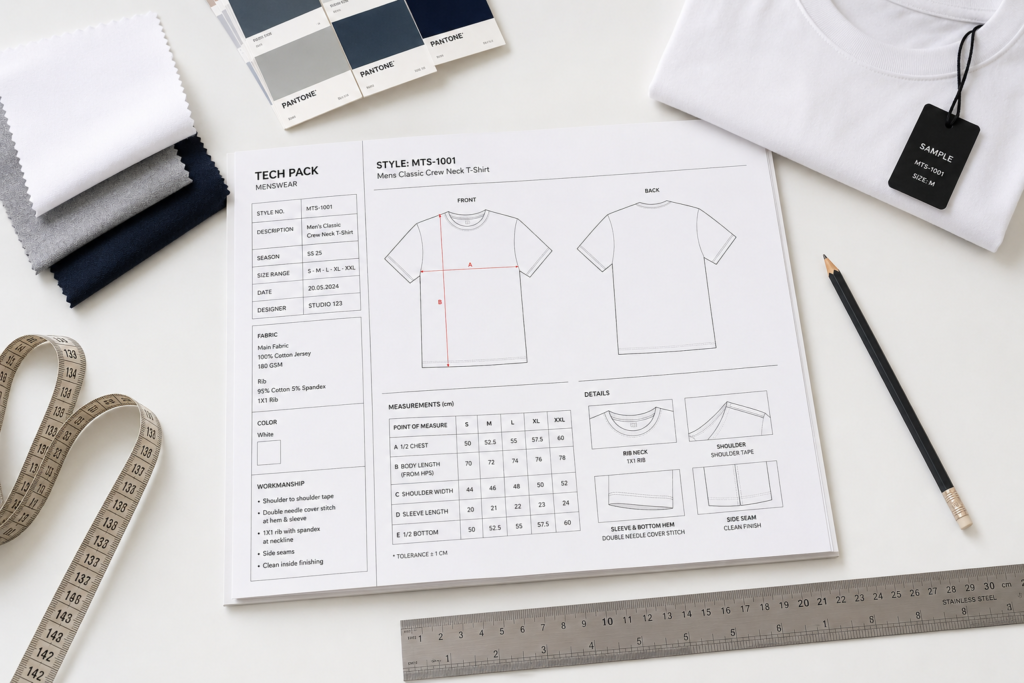
Step 1: Define Your Product Brief Before Contacting Any Factory
Start with a sourcing-ready brief. This single discipline prevents inaccurate quotes and weeks of back-and-forth confusion.
For T-shirts and knitwear, specify:
- Fabric type: Combed cotton, CVC (cotton-viscose), cotton-elastane, organic cotton, recycled blends
- GSM (Grams per Square Meter): 140–160 (lightweight), 180–200 (standard), 220–280 (heavyweight)
- Knit structure: Single jersey, rib, interlock, pique, fleece
- Dyeing: Reactive dyes, pigment dyeing, garment dyeing
- Print type: Screen, puff, discharge, DTG, digital, sublimation
- Embroidery: Computerized, hand, applique
- Measurements: Complete size chart with tolerances
- Packaging: Polybag, hangtag, woven label, master carton
Actionable outputs from your brief:
- A short line plan (3–8 styles for first order)
- A target ex-factory cost per style
- A critical path with required ship date plus buffer
- A compliance list (ISO 9001, SA8000, OEKO-TEX, GOTS for organic)
Real-world examples:
- A US streetwear label targeting 220 GSM oversized tees specifies double-needle hems and silicone wash to prevent hand-feel surprises
- A golf brand defines pilling resistance expectations upfront for polo piqué
- A basics brand documents acceptable tolerances: chest ±1 cm, length ±1.5 cm
Step 2: Find Reliable Tirupur Manufacturers (and Separate Factories from Traders)
The hardest part of Tirupur sourcing isn’t finding names — there are thousands of suppliers. The real work is separating actual factories from coordinators who outsource everything.
Where to find suppliers:
- Export promotion bodies (TEA — Tiruppur Exporters’ Association)
- Trade fair directories (India International Garment Fair)
- Direct outreach via verified business directories
- Referrals from existing international buyers
Practical vetting signals:
- Ask directly: “Are you factory-direct, or do you outsource sewing and printing?”
- Request certification copies (ISO 9001, SA8000, GOTS, OEKO-TEX)
- Ask for recent export references by market (EU, US, Middle East, Australia)
- Prefer suppliers with in-house QA teams and documented checkpoints
Real examples of vetting outcomes:
- A first-time Australian buyer shortlists 12 suppliers from directories — only 4 can show consistent factory audit documentation
- A buyer discovers a “factory” cannot share knitting and dyeing process details — turns out to be a trader; they move on
- A sourcing manager prioritizes a unit with Zero Liquid Discharge (ZLD) processing for sustainability requirements
Why Rudraa Exports passes the vetting test: Factory-direct operations, no agent layers, ISO-certified quality management, documented QC checkpoints, and verifiable export references across EU, US, Australia, and Middle East markets.
Step 3: Run a Structured Factory Evaluation (Remote First, Then On-Site)
Before spending money on sampling, run a standardized supplier evaluation across four dimensions:
Capability assessment
- Knit types handled in-house
- Print and embroidery techniques
- Washing and finishing capacity
- Packing and shipping operations
Capacity realism
- Which production lines are genuinely dedicated to your order?
- What gets subcontracted, and to whom?
- Peak season surge capability
Quality system maturity
- AQL inspection usage
- Inline inspection frequency and format
- Final audit documentation
- Defect taxonomy and tolerance levels
Compliance discipline
- Labor practice audits
- Safety standards
- Restricted substance lists
- Material traceability documentation
If you cannot visit in person, commission a paid third-party audit. If you can visit Tirupur, do a complete process walk: fabric warehouse → cutting → sewing → finishing → packing.
Mini case example: A small EU brand orders samples from two suppliers. Supplier A sends good samples but refuses to share the production line plan or QC checkpoints. Supplier B shares an AQL plan, inline inspection format, and offers a pre-production meeting. The brand picks Supplier B — bulk closely matches the golden sample, reducing rework and avoiding emergency airfreight.
Step 4: Send an RFQ That Gets Accurate Pricing Fast
Factories quote fastest when your RFQ is complete. A vague request gets a vague price that later excludes critical line items.
Include in every RFQ:
- Complete tech pack (measurements, BOM, construction, artwork placements)
- Fabric details (fiber composition, GSM, knit structure, finishing requirements)
- Colorways and size ratio breakdown
- Quantity breaks (e.g., 300 / 600 / 300 pieces per style)
- Required quality standards (AQL level, colorfastness, shrinkage limits)
- Incoterm preference (FOB or CIF) and destination port
- Required delivery date with realistic flexibility
Real RFQ outcomes:
- A buyer asks only for “quote 180 GSM tee” — receives a low number that later excludes print, packing, and testing
- Another buyer requests three quantity tiers and specifies water-based screen printing — receives a usable quote within 48 hours
- A Middle East buyer includes bilingual labeling requirements upfront — avoids costly reprinting later
Step 5: Understand Typical Tirupur MOQs (and How to Reduce Them)
MOQs in Tirupur vary based on fabric availability, color count, and process complexity:
- Basic cotton T-shirts: Commonly ~300 pieces per style as a starting point
- Custom programs: Hundreds to thousands of pieces, especially when fabric requires dedicated knitting or dyeing runs
- Organic cotton: Typically carries a 15–30% premium due to material costs and certification overhead
How to reduce MOQ pain without damaging quality:
- Consolidate colors — limit your first drop to 2–3 core shades
- Use stock-supported fabrics — if your partner offers them, you avoid custom dyeing minimums
- Reduce print complexity — fewer prints and placements first, expand in repeat orders
- Negotiate size splits — a 600-piece order can split across 3 sizes if it keeps one color
Real MOQ examples:
- A startup splits a 600-piece order across 3 sizes but keeps one color to stay MOQ-compliant
- A brand wants 6 colors; the factory proposes 2 colors in run one and 4 colors in run two to optimize dye lots
- A buyer switches from custom neck tape to a standard option for first run, dramatically reducing trim MOQs
Step 6: Sampling — Manage It Like a Gated Process
Sampling is where first-time buyers lose weeks of timeline. Use a 5-stage gated approach:
- Proto sample — Construction and overall look validation
- Fit sample — Pattern corrections and ergonomic adjustments
- Size set — Graded sizing check across all sizes
- Pre-production (PP) sample — Made from bulk fabric and bulk trims
- Golden sample — Signed standard physically attached to the PO for QC reference
Sample fees may be charged but are sometimes credited against bulk order value. Confirm this in writing during RFQ.
Sampling lessons from real buyers:
- A US brand approves fit, but bulk shrinks differently because the PP sample wasn’t made from bulk fabric — lesson: insist PP comes from actual bulk fabric and finish
- An EU buyer signs the golden sample and attaches it to the purchase order; final inspection uses it as the physical benchmark
- A brand adds a size set stage after first-run sleeve opening complaints — reduces returns dramatically
Step 7: Negotiate Pricing by Cost Drivers, Not Just the Final Number
Tirupur T-shirt FOB pricing typically falls in the $1.50–$4.00 per piece range, depending on fabric, printing, order size, and customization. India remains competitive versus China and close to Bangladesh on basics.
Use these negotiation levers without breaking feasibility:
- Fabric choice — Combed vs carded yarn, compact vs open-end, blend ratios
- GSM and finish — Enzyme wash, silicone finish, peach finish add cost
- Print method complexity — Color count, screen setup charges, ink type
- Packaging — Single polybag vs belly band vs branded box
- Payment terms — Risk-sharing can reduce price
- Volume commitment — Annual forecast can unlock better margins
Real negotiation examples:
- A buyer removes individual hangtags for first shipment and applies them domestically — saves significant packing labor cost
- A brand changes a 4-color chest print to 2-color — reduces screen setup cost
- A retailer agrees to a 60/40 style split that matches factory marker efficiency — receives a better cut-make rate
Step 8: Set QC Protocols — AQL, Tolerances, and Inline Checkpoints
Don’t hope for quality. Design it into the process.
International best practice uses AQL-based inspection — typically AQL 2.5 for major defects on apparel. Tirupur factories serving export markets are accustomed to this standard.
Build a 3-point QC plan:
Inline inspection (during production):
- Stitching quality
- Measurement accuracy
- Print placement
- Shade continuity within bundles
Midline inspection (after washing/finishing):
- Wash quality results
- Pilling resistance checks
- Color shade verification
Final inspection (before packing):
- Packing standards
- Carton markings
- Assortment accuracy
- Needle policy compliance
Real QC wins:
- A brand adds a “shade band” rule: body panels must be cut from the same dye lot; QC checks bundling tickets
- A buyer requests a shrinkage test report on bulk fabric before cutting — prevents short body lengths
- A first-time importer books a third-party final inspection and catches a wrong carton size, avoiding freight re-pricing
Step 9: Build Realistic Timelines (and Know What Slows Tirupur Programs)
Lead times depend on fabric availability, dyeing capacity, print complexity, and approval cycles. Tirupur’s integrated supply chain helps, but first orders almost always take longer due to sampling cycles.
Lock these approvals early to reduce timeline risk:
- Fabric and color approvals (lab dips) — start before bulk dyeing
- Artwork approvals and print strike-offs
- Trim orders (labels, zippers, drawcords)
- Production slot booking with confirmed PO and advance payment
Typical first-order timeline (Tirupur):
- Sampling and approvals: 30–45 days
- Production: 40–60 days
- Total PO to FOB: 60–90 days for first order
- Repeat orders: 30–45 days once relationship is established
Real timeline mistakes:
- A brand misses ship date because neck labels arrive late — fix: approve label artwork at the RFQ stage
- A brand builds a 10–14 day buffer around Indian holidays and avoids last-minute dispatch issues
- A buyer agrees to ship in two partial lots to hit launch date while finishing remaining sizes
Step 10: Choose Payment Terms That Match Your Risk Profile
Common international trade practice for new relationships uses an advance plus balance structure, or documentary instruments like Letter of Credit (LC).
Recommended first-order payment structure:
- Proforma invoice and purchase order referencing the tech pack and golden sample
- Advance payment (typically 30%) to start procurement
- Balance against inspection pass and shipping documents (typically 70%)
Risk reducers to negotiate:
- Use staged payments tied to milestones: PP sample approval, fabric in-house, final inspection passed
- Clarify who pays bank charges and the currency conversion basis
- Include rework or claim mechanisms for defects beyond AQL tolerance
- Reference tech pack and golden sample in the PO as binding standards
Real payment lessons:
- A new buyer pays 100% upfront and struggles to enforce deadlines — switches to milestone-based terms for the second order
- Another buyer uses an LC for the first shipment, then moves to TT payment once performance is proven
- A buyer insists the PO includes AQL standards and testing requirements — avoids “not agreed” disputes later
Step 11: Pick the Right Incoterm for Your First Shipment
For first-time importers, keep Incoterms simple:
FOB (Free On Board)
- Factory delivers to port and clears export
- You control freight and import
- Better cost control if you have a freight forwarder
CIF (Cost, Insurance, Freight)
- Supplier arranges freight to your port
- You handle only import clearance
- Simpler for first-time buyers without forwarder relationships
Routing reality from Tirupur:
- Tirupur is inland in Tamil Nadu — shipments move by truck to Tuticorin (closest), Chennai, or Cochin port
- Sea freight to EU and US: multi-week transit windows
- Air freight: faster but significantly more expensive
Real Incoterm decisions:
- A US buyer ships FOB and uses their forwarder to consolidate with another supplier — reduces per-carton cost
- A Middle East buyer uses CIF for first order, then switches to FOB after learning customs procedures
- A brand avoids demurrage by insisting on pre-alert documents (invoice, packing list, BL draft) 72 hours before vessel departure
Step 12: Master Communication and Avoid the 5 Most Common Pitfalls
Tirupur suppliers understand export business, but first-time buyers still stumble on preventable mistakes.
Communication best practices:
- Confirm everything in writing — measurements, tolerances, test standards, ship marks
- Use visual references — annotated photos, placement guides, approved fabric swatches
- Set a weekly cadence — Work-in-Progress (WIP) report with risk flags
- Use single-point-of-contact discipline — avoid messaging different team members with different instructions
The 5 most common pitfalls and how to fix them:
| Pitfall | Fix |
|---|---|
| Vague tech packs | Add measurement chart and construction callouts |
| Too many colors/prints in first order | Simplify to meet MOQs and stabilize quality |
| Skipping the PP sample | Insist PP sample comes from bulk fabric and bulk trims |
| No formal QC gate | Define AQL standard and inspection timing before cutting |
| Unclear responsibility for delays/defects | Write accountability terms into PO and proforma |
Real pitfall examples:
- A buyer specifies “soft hand feel” without defining the finish — receives inconsistent results. Fix: request a wash recipe and reference sample
- A brand approves digital artwork but skips strike-off approval — print color shifts. Fix: approve strike-off under agreed lighting conditions
- A buyer changes specs mid-production — costs spike. Fix: freeze specifications at PP stage unless you accept formal variation charges
First-Order Readiness Checklist
Copy this into a spreadsheet or sourcing SOP. Check every box before placing your first Tirupur PO.
✅ Tech pack completed (measurement chart, BOM, construction, artwork placements)
✅ Target FOB or CIF price and quantity breaks defined (e.g., 300 / 600 / 1,200)
✅ MOQ validated per style and color (basics often start at ~300 pieces/style)
✅ Fabric specs locked (fiber, GSM, knit structure, finishing requirements)
✅ Compliance needs listed (ISO 9001, SA8000, GOTS, OEKO-TEX as applicable)
✅ Sampling plan agreed (proto → fit → size set → PP → golden sample)
✅ Lab dips and shade approvals completed (or scheduled before bulk dyeing)
✅ QC plan documented (tolerances, defect rules, inspection timing — inline/mid/final)
✅ Packaging and labeling confirmed (folding, polybag, carton marks, barcodes)
✅ Contract documents aligned (PO references tech pack, golden sample, and AQL standards)
✅ Payment terms agreed (advance, milestones, balance against documents and inspection)
✅ Logistics plan set (Incoterm, freight forwarder, ship window, document timeline)
Frequently Asked Questions
What is the minimum order quantity for T-shirts in Tirupur?
Tirupur MOQs for basic cotton T-shirts typically start at ~300 pieces per style at the standard manufacturer level. Custom programs requiring dedicated dyeing or knitting runs may have higher minimums (500–1,000+ pieces). Organic cotton carries a 15–30% premium and may require larger minimums. Established direct-factory partners like Rudraa Exports work with buyers to consolidate colors and styles, reducing effective MOQ exposure.
How much do T-shirts cost to manufacture in Tirupur?
Tirupur FOB pricing for cotton T-shirts typically ranges from $1.50 to $4.00 per piece depending on fabric type, GSM, print method, trim complexity, and order volume. Standard 180–200 GSM cotton crewnecks with basic printing usually fall in the $2.00–$2.80 range.
How long does the first T-shirt order take from Tirupur?
First orders typically take 60–90 days from confirmed PO to FOB-ready goods due to sampling cycles (30–45 days) plus production (40–60 days). Repeat orders run in 30–45 days once the relationship is established and fabric specs are locked.
What’s the difference between a factory-direct supplier and a trader in Tirupur?
A factory-direct supplier owns the production process — knitting, dyeing, cutting, stitching, and finishing happen under their accountability. A trader takes your order, marks it up, and outsources production to factories you never directly access. Factory-direct partners offer cost transparency, faster issue resolution, and stronger quality control. Rudraa Exports operates on a factory-direct model with no agent layers.
Which certifications should I require from a Tirupur knitwear manufacturer?
Standard certifications include ISO 9001 (quality management), SA8000 or WRAP (social compliance), OEKO-TEX Standard 100 (chemical safety), and GOTS (organic textiles if applicable). Always verify certificates through each issuing body’s official online database — not from supplier-published claims alone.
What is AQL in garment inspection?
AQL (Acceptable Quality Limit) is the international standard for statistical sampling inspection. AQL 2.5 for major defects is standard for export apparel — meaning a defined sample size is inspected, and the lot passes only if defects fall below the allowed threshold. Always specify AQL standards in your PO before production begins.
What’s the best payment term for first-time Tirupur orders?
For first orders, use a 30% advance and 70% against shipping documents structure, or a Letter of Credit (LC) for added security. As the relationship matures, you can negotiate Telegraphic Transfer (TT) terms with milestone payments tied to PP sample approval, fabric in-house confirmation, and final inspection pass.
Should I choose FOB or CIF for my first Tirupur shipment?
CIF is simpler for first-time buyers without freight forwarder relationships — the supplier handles ocean freight to your port. FOB gives you more control and is more cost-effective once you have a forwarder. Most established buyers transition to FOB after their first 2–3 successful shipments.
What’s the best port to ship from Tirupur?
Tuticorin (VOC Port) is the closest port to Tirupur and has reported strong export dwell-time performance. Chennai Port handles larger vessels for major global routes. Cochin Port provides flexibility for West Coast US and Middle East destinations.
How do I avoid quality issues with Tirupur manufacturers?
Define quality into the process from day one: (1) complete tech pack with measurement tolerances, (2) approved PP sample from bulk fabric, (3) signed golden sample attached to the PO, (4) documented AQL standards in writing, (5) inline plus midline plus final inspections, and (6) clear defect tolerance and rework mechanisms in the PO.
Can Tirupur manufacturers handle private label and custom branding?
Yes — private label is a core strength of Tirupur. Custom branding services include brand-specific dyeing, custom prints and embroidery, branded woven labels, custom hangtags, neck taping, and tailored packaging. Rudraa Exports provides complete private-label manufacturing for international brands.
What sustainability features should I look for in a Tirupur manufacturer?
Look for Zero Liquid Discharge (ZLD) dyeing infrastructure, water recycling systems, GOTS certification for organic production, OEKO-TEX Standard 100 for chemical safety, and SBTi-aligned climate reporting. Tirupur pioneered ZLD at scale in apparel and remains a global leader in textile sustainability infrastructure.
Why Rudraa Exports for Your First Tirupur Sourcing Partnership
If you’re sourcing from Tirupur for the first time, the fastest path to a stable supply chain is choosing a partner that owns the process end-to-end — not just takes an order and outsources critical steps.
Rudraa Exports operates on a factory-direct, ISO-certified model built specifically for international buyers who need:
- Predictable quality through documented QC checkpoints (inline, midline, final inspection)
- Single-point accountability with no agent layers, no hidden subcontractors
- Transparent communication in English across all time zones
- Mature export documentation for EU, US, Australia, and Middle East markets
- Multi-port shipping flexibility through Tuticorin, Chennai, and Cochin
- Vertical access to knitting, dyeing, printing, embroidery, and finishing specialists across Tirupur’s cluster
- FTA-eligible certification for buyers in India’s expanding free trade agreement markets
Rudraa Exports works particularly well for first-time international importers, fashion startups launching private-label brands, established retailers diversifying away from China, and importers serving regulated markets in Europe and North America.
Next Steps: Start Your Tirupur Sourcing Journey
The fastest way to launch a stable Tirupur sourcing program is to follow three steps:
1. Share your tech pack (or even a draft) and your target quantities with Rudraa Exports
2. Request a sampling roadmap (proto → fit → PP → golden sample) and a written QC plan from day one
3. Use a cost-saving calculator to compare scenarios — fabric options, print methods, packaging choices, MOQ splits — and identify where you can reduce cost without sacrificing quality
When you’re ready to start, begin with one “hero” style, keep the first purchase order simple, and build repeatability before scaling. That’s how every successful Tirupur sourcing program scales — from a controlled first shipment into a long-term factory partnership.
Related guides: why Tirupur is India’s knitwear capital, the best garment manufacturers in Tirupur, and the direct-vs-agent sourcing cost breakdown.
Ready to request your first quote? Visit rudraaexports.com, share your tech pack, target MOQ, and destination market — and receive a transparent factory-direct quote built for international buyers.